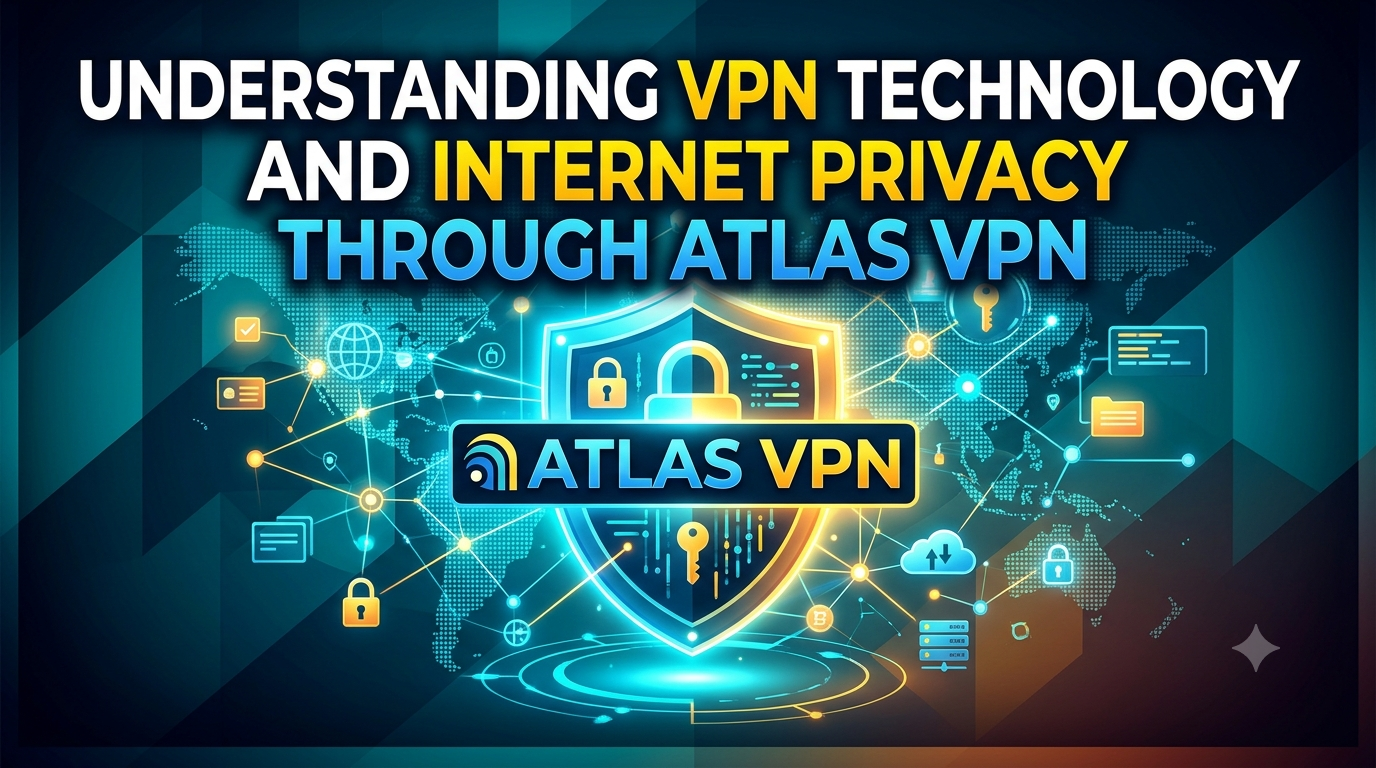
Discover everything about Atlas VPN, including how its VPN technology worked, its key privacy features, encryption, IP masking, and internet security benefits. Learn why Atlas VPN discontinued its service in April 2024, what happened to its users, and which alternatives are worth exploring in 2026. This guide helps you understand VPN technology, protect your online privacy, and choose the right VPN solution for safer browsing.
Table of Contents
- Introduction to VPN Technology
- What Is a Virtual Private Network?
- How Atlas VPN Worked
- Why Internet Privacy Matters
- Key Features and Benefits of Atlas VPN
- Understanding VPN Security and Its Limitations
- Atlas VPN Shutdown and Its Impact on Users
- Alternatives to Atlas VPN
- How to Choose the Right VPN
- Best Practices for Online Privacy
- Conclusion
- Frequently Asked Questions (FAQs)
Introduction to VPN Technology
The internet has become an essential part of everyday life, helping people communicate, work remotely, shop online, manage finances, and access entertainment from almost anywhere. However, every online activity creates opportunities for different parties to collect information about browsing habits, approximate locations, device details, and digital preferences. This is where Virtual Private Network (VPN) technology becomes useful. A VPN creates an encrypted connection between a user’s device and a VPN server, helping protect data in transit and making the user’s public IP address appear to be that of the VPN server. Atlas VPN was one service that helped introduce these privacy benefits to everyday internet users through an accessible application. Understanding its technology offers a useful way to explore how VPNs work, what they can protect, and where their limitations begin.
A VPN should not be viewed as an invisible shield that makes every online activity completely private.Rather, consider it as one crucial layer of digital security, like locking your home door while keeping an eye on the windows and who you welcome inside. It can limit the exposure of your actual IP address to websites and lower some of the risks associated with unprotected networks, but it cannot automatically prevent phishing, malware downloads, or tracking through logged-in accounts, or every form of online surveillance. Learning how Atlas VPN approached these challenges provides a practical starting point for understanding modern internet privacy. It also helps users make better decisions when choosing a VPN service today.
What Is a Virtual Private Network?
A Virtual Private Network, commonly known as a VPN, establishes an encrypted tunnel between your device and a VPN server. When you connect to the internet through that tunnel, your traffic is routed through the VPN provider’s infrastructure before reaching its destination. This changes how websites and some network observers see your connection, because websites generally see the VPN server’s public IP address rather than your original public IP address. Encryption also helps prevent people sharing an unsecured network from easily reading the contents of protected traffic. These functions make VPN technology useful for people who travel, work remotely, use public Wi-Fi, or want to reduce the amount of information exposed directly through their internet connection.
To understand the process, imagine sending an important letter inside a locked box through a delivery service. The delivery service carries the box to its destination, while the lock makes it harder for someone handling the package to read the contents. A VPN works in a comparable way by encrypting supported traffic between your device and the VPN server. However, the VPN provider becomes an important part of the trust relationship because it handles your traffic as it exits the encrypted tunnel. HTTPS encryption continues to protect the connection between your browser and websites, so the VPN does not replace the security already provided by properly configured websites. Rather, it creates an additional layer between your device and the internet-connected network.
How Atlas VPN Worked
Atlas VPN was developed as a consumer VPN service designed to make internet privacy accessible to ordinary users. Its applications allowed users to connect to VPN servers, route supported internet traffic through those servers, and change the public IP address presented to online services. The general objective was straightforward: make it easier for users to protect their internet connections without requiring advanced networking knowledge. Like other consumer VPN providers, the service combined a user-facing application with VPN server infrastructure and connection protocols to establish encrypted network tunnels. Its approach illustrates how a complicated networking technology can be packaged into a simple interface with a connect button, server choices, and settings for additional protection.
The program created a VPN session and sent qualified network traffic through the chosen server when a user connected using Atlas VPN. The VPN protocol handled the encryption and communication required to maintain that connection, while the remote server forwarded traffic to its destination. Websites receiving the traffic could generally identify the VPN server’s public IP address instead of the user’s original public IP address. This could help reduce exposure of the user’s direct network address and improve protection on networks where other people might otherwise observe unencrypted traffic. Nevertheless, the actual protection depended on factors such as the selected protocol, the security of the device, whether the VPN connection remained active, and the privacy practices of the provider. A VPN is only one component of a broader security strategy, and its benefits depend on how the technology is implemented and used.
Encryption, IP Masking, and Secure Connections
Encryption is one of the central technologies behind a VPN. It transforms readable information into a protected form that cannot easily be understood without the appropriate cryptographic keys. When supported traffic travels through a properly configured VPN tunnel, someone monitoring the local network generally cannot read the contents of that traffic simply by observing the connection. IP masking provides a separate benefit: websites typically see the VPN server’s address as the source of the connection rather than the user’s original public IP address. These features address different privacy concerns, which is why understanding both is essential when evaluating a VPN service.
Secure connections also depend on the protocol used to create the tunnel. VPN protocols define how devices establish sessions, authenticate endpoints, exchange keys, and protect data in transit. A well-designed protocol can provide strong security without making everyday browsing unnecessarily complicated. Users should also understand that encryption does not prevent every form of information collection. A website can still associate activity with an account when the user signs in, and cookies or browser fingerprinting may help services recognize a device across sessions. Consequently, the most effective approach combines VPN protection with secure websites, updated software, careful account management, and sensible privacy settings.
Why Internet Privacy Matters
Internet privacy has become increasingly important because personal information can reveal far more about a person than they might realize. Browsing activity, search queries, location signals, shopping preferences, and account interactions can collectively create a detailed picture of someone’s interests and habits. Advertisers may use tracking technologies to personalize advertisements, websites may collect analytics data, and cybercriminals may attempt to steal credentials through fraudulent pages or malicious software. Although some data collection supports legitimate services, users deserve to understand what information is being collected and how it may be used. A VPN can help reduce certain types of network-level exposure, but privacy also requires awareness of the websites and applications people trust with their information.
Consider a situation in which you connect your laptop to public Wi-Fi at an airport or café. You may be sharing the network with dozens of unfamiliar devices, and you cannot always verify how securely the network is managed. HTTPS protects the contents of connections to properly secured websites, but a VPN can add another encrypted layer between your device and the VPN server. This can be particularly useful when you want to reduce the amount of traffic information visible to the local network operator. However, it does not make an unsafe website trustworthy or prevent you from entering a password into a convincing phishing page. Combining a reputable VPN with multifactor authentication, updated software, and careful browsing habits provides a more realistic and effective approach to online safety.
Privacy also matters when people work remotely or manage sensitive professional information. Employees may access company dashboards, cloud applications, email platforms, and shared documents while travelling or working outside the office. A properly configured VPN can help secure network traffic, although workplace VPNs and consumer VPNs serve different purposes and should not be confused. Organizations may require employees to use company-approved VPNs that connect to internal systems under specific access controls. Individual users, meanwhile, should choose a service based on their own security needs and should never assume that a VPN alone guarantees compliance with workplace security policies or legal requirements.
Key Features and Benefits of Atlas VPN

Atlas VPN offered several features intended to make digital privacy easier to understand and use. Its service combined standard VPN functionality with additional tools designed to address common online risks. Historical descriptions of the product mention features such as SafeBrowse, data-breach monitoring, and SafeSwap, alongside encrypted connections and IP-address masking. These tools addressed different concerns: VPN tunnelling helped protect supported network traffic, browsing protection aimed to reduce exposure to certain suspicious websites or tracking elements, and breach monitoring helped users identify whether an email address appeared in known data leaks. Their practical value depended on the particular feature, application version, and subscription plan available at the time.
It is important to distinguish these historical features from services that are currently available. Atlas VPN permanently discontinued its service on April 24, 2024, and new subscriptions can no longer be purchased. Its official announcement explained that paid subscribers were transitioned to its sister service, NordVPN, for the remainder of their eligible subscription periods, subject to the applicable migration arrangements. Free Atlas VPN accounts were terminated when the service closed. These details are confirmed in the provider’s official closure announcement and support information.
Understanding the Main Features
| Feature | Purpose | Important limitation |
| VPN encryption | Protects supported traffic between the device and VPN server | Does not automatically encrypt every connection end to end |
| IP masking | Replaces the user’s direct public IP address with the VPN server’s address for external websites | Does not guarantee complete anonymity |
| SafeBrowse | Historically offered browsing protection against certain suspicious websites and unwanted elements | Cannot replace antivirus software or careful browsing |
| Data-breach monitoring | Helped users check whether email addresses appeared in known data breaches | Cannot prevent breaches or guarantee that all leaks will be detected |
| SafeSwap | Historically, supported servers have provided IP-address exposure changes. | Does not prevent account-based tracking or all forms of identification |
The table describes the general purpose of Atlas VPN’s historical features, not a currently operational Atlas VPN product. A former user’s experience may also have varied depending on the device, settings, and subscription tier. Anyone researching a modern VPN should verify its current feature documentation rather than assume that an older review accurately describes today’s services.
How SafeSwap and Browsing Protection Fit Into Privacy
SafeSwap was designed to provide a changing public IP address through supported VPN infrastructure, helping make IP-based tracking more difficult in certain circumstances. This can be useful because websites and online services sometimes use IP addresses as one signal when assessing traffic or associating activity with a location. However, an IP address is only one part of a person’s digital identity. Cookies, browser fingerprints, signed-in accounts, and other identifiers may still connect multiple browsing sessions to the same user. Changing an IP address therefore improves one aspect of privacy without erasing every digital footprint.
Browsing protection addresses another part of the problem by attempting to block access to certain harmful domains or unwanted web elements. Such features can be helpful when users encounter deceptive websites, intrusive advertisements, or known malicious destinations. Yet no filtering system can reliably identify every new threat, and malicious content can sometimes appear on otherwise legitimate websites. Users should still install security updates, maintain suitable endpoint protection, and avoid downloading unfamiliar files. The broader lesson is that VPN features work best as complementary tools rather than substitutes for sound security practices.
Understanding VPN Security and Its Limitations
A VPN’s value depends on more than its marketing claims. Users should examine the provider’s encryption standards, supported protocols, privacy policy, independent security assessments, and record of maintaining its infrastructure. A clear no-logs policy is particularly relevant because the VPN provider sits between the user’s device and the wider internet. However, the phrase “no logs” can cover different categories of information, and the exact policy matters more than the label itself. A trustworthy evaluation should determine what information a provider collects, why it collects it, how long it retains it, and whether independent evidence supports its claims.
Another important consideration is the possibility of a VPN connection dropping unexpectedly. If an application does not have an effective kill switch, traffic may resume through the ordinary internet connection when the encrypted tunnel disconnects. DNS leaks or configuration mistakes can also expose some information outside the intended tunnel. Reputable providers offer protections designed to reduce these risks, but users should understand how the settings work and test their configuration where appropriate. Keeping the application updated and enabling available leak-prevention features can help, although results vary by operating system and network setup.
Speed and reliability also matter. Because VPN traffic travels through an additional server and encryption process, a connection can sometimes become slower or less responsive. The impact depends on server distance, congestion, routing, internet speed, protocol implementation, and the performance of the user’s device. A nearby server may offer better latency than a distant one, while a busy server can perform poorly even when it is geographically close. Choosing a VPN therefore involves balancing privacy, performance, usability, and cost rather than assuming that the service with the largest list of features is automatically the best.
Finally, users should recognize the limits of anonymity. A VPN does not erase browsing history stored on a device, stop a social network from recognizing an account after login, or guarantee protection against malware installed on a computer. It also cannot prevent a website from collecting information that a user voluntarily provides. For people facing serious threats, such as targeted surveillance or sophisticated cyberattacks, a consumer VPN may be insufficient on its own. Understanding these limitations makes it easier to use VPN technology responsibly and avoid a false sense of security.
Atlas VPN Shutdown and Its Impact on Users
Atlas VPN’s closure is an essential part of any current article about the service. On April 24, 2024, the company discontinued its VPN operations, explaining that rising costs, increasing technological demands, and competition in the VPN market made continuing the service unsustainable. The company arranged a transition to NordVPN for eligible paid subscribers, while free accounts were terminated. According to its official announcement, the information transferred for the subscription migration was limited to what was needed to establish the replacement service, including the user’s registered email address and remaining subscription duration.
For former premium users, the practical next step is to check the email address associated with their old account and look for official migration instructions. The company’s support guidance states that eligible subscribers could use NordVPN’s premium features without additional cost until their remaining Atlas VPN subscription period expired. The precise options depended on how and when the subscription had been purchased, so users with billing or migration questions should consult official support documentation rather than rely on old online tutorials. Those who subscribed through an app store should also review their purchase history and the relevant store’s account information if they have questions about refunds or subscription status.
For former free users, there is no active Atlas VPN service to reconnect to. Old instructions describing how to install the app, select a free server, or activate a new Atlas VPN account should therefore be treated as historical material. Users looking for a replacement should select a currently operating VPN provider and download its software from an official website or authorized app store. They should also remove outdated applications that no longer receive security updates, especially if they have reason to believe the software is unsupported. This is not simply a matter of convenience: security tools are most useful when their developers continue to maintain and update them.
The closure also demonstrates a broader lesson about digital services. A product can have useful features and a loyal user base while still becoming commercially unsustainable. Before choosing a VPN, consider the provider’s long-term support, ownership structure, update history, independent security assessments, and the practical options available if the service closes. These factors may not seem as exciting as speed tests or streaming performance, but they directly affect how dependable a privacy tool will be over time.
Alternatives to Atlas VPN
Since Atlas VPN is no longer operational, users need to compare currently available services rather than look for a new Atlas VPN subscription. Several established VPN providers offer encrypted connections, IP masking, and additional security features, but their pricing, server coverage, privacy policies, and capabilities differ. The right choice depends on whether your primary concern is public Wi-Fi security, everyday browsing, remote work, streaming, or more advanced privacy requirements. Before paying for a subscription, review the provider’s current terms and confirm that its applications support your devices. It is also wise to check independent reviews and security assessments instead of relying exclusively on promotional claims.
The following providers are examples to research, not a ranking or a claim that any one service is best for every user.
A relevant option for former Atlas VPN premium users because NordVPN was the designated migration destination for eligible subscribers. It offers VPN connections alongside additional security features, with availability depending on the plan and platform. Review its current official website for supported features and subscription details.
Worth researching if you want a privacy-focused provider with a free plan available under its current terms. Compare the free and paid plans carefully, including server access, performance, device support, and the provider’s privacy documentation.
An option to investigate if minimizing account-identifying information is a priority. Review its account model, payment options, supported protocols, and current privacy documentation to decide whether its approach suits your needs.
Another provider to compare if you want VPN protection across several personal devices. Examine its current simultaneous-connection policy, additional security tools, renewal pricing, and supported operating systems before subscribing.
Comparing VPN Providers
| Comparison factor | What to look for |
| Privacy policy | Clear explanations of collected data and retention practices |
| Encryption and protocols | Modern, well-maintained security protocols |
| Independent audits | Recent assessments with a clearly defined scope |
| Kill switch and leak protection | Controls that help prevent accidental traffic exposure |
| Server network | Locations that suit your actual needs |
| Price and renewal | Total cost, renewal rates, refund terms, and plan restrictions |
| Customer support | Clear troubleshooting guidance and a reliable support channel |
| Long-term reliability | Regular updates, transparent ownership, and an established support process |
No single comparison factor tells the whole story. A large server network does not automatically prove strong privacy, and a low subscription price does not necessarily mean poor security. Similarly, an independent audit is useful evidence but does not guarantee that a provider will never experience a security incident. Compare the available evidence as a whole and choose a service whose policies and capabilities match your requirements.
Read More:-
How Does Strikingly Simplify the Website Building Process?
Building Your Dream Website with Site123
Boost Your E-commerce Strategy with YITH Plugins
Maximize Your Customer Engagement with LiveAgent’s Features
Why STRIPO is Essential for Digital Product Marketersa
How to Choose the Right VPN
Choosing a VPN becomes easier when you start with your actual privacy concerns rather than a long list of advertised features. If you mainly connect to public Wi-Fi while travelling, you may prioritize reliable encryption, a kill switch, and stable mobile applications. If you work remotely, you should confirm whether your employer requires a specific corporate VPN instead of installing a consumer service. If you frequently use international websites, server availability and connection performance may be more important. Identifying your needs first helps you avoid paying for features that sound impressive but provide little practical benefit in your situation.
Next, examine the provider’s privacy policy and security documentation. Look for specific information about connection logs, browsing activity, diagnostic information, account details, payment records, and data-sharing practices. In order to manage subscriptions or stop misuse, a provider could require some account details, but this does not imply that browsing histories are automatically recorded. The key is understanding exactly what is collected and how it is handled. Independent assessments can help validate particular claims, especially when the report identifies what was tested and when the assessment occurred.
You should also test the service before committing to a long subscription whenever a suitable trial or refund period is available. Check connection stability, loading times, video-call performance, and whether essential features work on your devices. Test for DNS or IP leaks using reputable testing tools, and verify that the kill switch behaves as expected if your connection drops. Avoid assuming that one successful test proves permanent protection, because results can change after application updates, network changes, or configuration adjustments. A practical evaluation gives you a better understanding of how the VPN performs in your everyday environment.
Finally, consider the provider’s business stability and support arrangements. Atlas VPN’s closure illustrates why a service’s future matters as much as its current features. Read the subscription terms, understand how automatic renewal works, and check whether the company communicates clearly about changes to its service. Keep a copy of important purchase information and know how to cancel or request support. A good VPN should not only protect your traffic today; it should also provide clear information and a sensible process when circumstances change.
Best Practices for Online Privacy
Even a high-quality VPN cannot protect every part of your digital life. Effective privacy requires several complementary habits, including keeping your devices updated, using strong passwords, enabling multifactor authentication, and reviewing application permissions. You should also be selective about the information you share on websites and social media. Personal details such as birthdays, phone numbers, workplace information, and travel plans can be combined to build a profile or support social-engineering attempts. Reducing unnecessary exposure makes it harder for strangers and malicious actors to exploit information about you.
Browser settings deserve attention, too. Review cookie permissions, block unnecessary third-party tracking where practical, and consider using separate browser profiles for work and personal activities. Be cautious when installing extensions because an extension may have permission to access sensitive browsing information. Download applications from official sources, remove software you no longer use, and avoid granting administrator permissions without a good reason. These simple steps help reduce the amount of information available to tracking systems and limit the damage that a compromised application could cause.
When using a VPN, develop the habit of checking that the connection is active before carrying out tasks where additional network privacy matters. Enable the kill switch if the application provides one, keep the software updated, and choose a suitable protocol using the provider’s recommended settings. Remember that a VPN provider can still see certain connection information and that websites may identify you through your account or browser. For particularly sensitive activities, think carefully about the full threat model: who might access your information, what information they could obtain, and what controls would realistically reduce the risk.
It is equally important to understand local laws and the rules governing the services you use. A VPN does not make illegal activity lawful, and it does not guarantee that you can access every website or streaming catalogue. Some websites restrict VPN connections, while organizations may prohibit unapproved VPNs on managed devices. Using privacy technology responsibly means understanding both its technical capabilities and the obligations that apply to your situation. With sensible habits and the right tools, you can reduce avoidable exposure without expecting a single application to solve every online security problem.


Conclusion
Understanding VPN technology through the example of Atlas VPN provides valuable lessons about encryption, IP masking, network security, and digital privacy. The service helped make VPN technology accessible to everyday users, but it permanently closed on April 24, 2024, so it is no longer an option for new subscriptions. Eligible former premium subscribers were transitioned to NordVPN for the remainder of their qualifying subscription periods under the provider’s migration arrangements. Anyone searching for Atlas VPN today should be aware of this closure and compare currently supported alternatives instead of relying on outdated installation instructions.
The wider lesson is that internet privacy depends on informed decisions, not just a VPN connection. A VPN can protect supported traffic between your device and its server, reduce direct IP-address exposure, and improve privacy on networks you do not control. However, it cannot guarantee anonymity, eliminate all tracking, or prevent every cyberattack. Strong passwords, multifactor authentication, updated devices, safe browsing habits, and a transparent VPN provider all contribute to a stronger privacy strategy. By understanding what VPNs can and cannot do, you can make more confident decisions about protecting your personal information in an increasingly connected world.
Frequently Asked Questions (FAQs)
Q. What was Atlas VPN used for?
A. Atlas VPN was a consumer VPN service used to encrypt supported internet traffic between a user’s device and a VPN server, mask the user’s public IP address from destination websites, and provide additional browsing-security features. It was designed to make VPN protection accessible through straightforward applications. The service permanently closed in April 2024.
Q. Is Atlas VPN still available in 2026?
A. No. Atlas VPN discontinued its service on April 24, 2024. New subscriptions are no longer available, and former free accounts were terminated. Users looking for a VPN should choose a currently supported provider and download its application from an official source.
Q. Did Atlas VPN transfer its users to NordVPN?
A. Eligible paid Atlas VPN subscribers were transitioned to NordVPN for the remainder of their existing subscription periods, according to the official migration announcement. Free users were not transferred in the same way. Individual users should consult the official Atlas VPN closure guidance for details about their circumstances.
Q. Can a VPN make me completely anonymous online?
A. No. A VPN can mask your direct public IP address from destination websites and encrypt supported traffic between your device and the VPN server. However, websites can still identify you through account logins, cookies, browser fingerprinting, and information you provide. A VPN is a privacy tool, not a guarantee of complete anonymity.
Q. What should I look for in an Atlas VPN alternative?
A. Look for a transparent privacy policy, strong encryption, modern VPN protocols, kill-switch functionality, leak protection, independent security assessments, and reliable applications for your devices. Compare server availability, performance, subscription costs, and renewal terms as well. The best provider is the one whose verified features and privacy practices match your needs.