Discover how TIDIO helps businesses improve website engagement and customer support through live chat, AI-powered chatbots, automated responses, and real-time customer communication. Learn how TIDIO enables businesses to answer customer queries faster, generate quality leads, improve customer satisfaction, and increase website conversions. Explore TIDIO’s key features, benefits, pricing, and best practices to create a seamless customer experience and build long-term customer relationships.
Table of Contents
- Understanding TIDIO and Its Role in Customer Experience
- Key TIDIO Features for Better Customer Communication
- How TIDIO Improves Website Engagement
- Using TIDIO to Strengthen Customer Support
- TIDIO for Lead Generation and Sales Conversion
- Integrating TIDIO With Business Tools
- TIDIO Pricing, Benefits, and Limitations
- Best Practices for Implementing TIDIO
- Measuring Website Engagement and Support Performance
- Conclusion
- Frequently Asked Questions (FAQs)
Understanding TIDIO and Its Role in Customer Experience
What Is TIDIO?
TIDIO is a customer service and engagement platform designed to help businesses communicate with website visitors, manage customer conversations, and automate common support tasks. Its capabilities include live chat, automated conversation flows, and Lyro, its AI customer service agent. Businesses can use these tools together to provide assistance, capture leads, and help customers find information without navigating complicated support systems. According to TIDIO’s official product information, the platform also offers help desk capabilities and integrations with popular business tools.
Think of TIDIO as a digital reception desk for your website. A physical store has employees who welcome visitors, answer questions, and recommend suitable products. An online business needs a similar experience, even though its customers may be browsing from different cities or countries. With TIDIO, visitors can start conversations directly from a website, while support teams can respond through a centralized inbox. AI-powered assistance can handle suitable routine questions, leaving human agents more time for complicated problems. The goal is not simply to add a chat bubble to a webpage; it is to make the entire customer journey easier, faster, and more helpful.
Why Website Engagement Matters
Website engagement describes how visitors interact with your website, including the pages they explore, the products they view, the questions they ask, and the actions they take. Strong engagement can indicate that visitors find your content useful and your website easy to navigate. However, a high number of page views does not automatically mean that customers are satisfied or likely to purchase. Businesses need to understand what visitors want and identify the obstacles preventing them from taking the next step.
Consider an online clothing store where visitors regularly open a product page but leave before completing their purchases. The reason might be uncertainty about sizing, delivery charges, return policies, or product availability. Without a way to ask questions conveniently, these potential customers may simply abandon their shopping journeys. TIDIO can provide a direct communication channel where shoppers can request clarification before making a decision. By responding to genuine concerns, businesses can make the experience more convenient and discover recurring problems that deserve attention on their website.
Key TIDIO Features for Better Customer Communication
Live Chat and Real-Time Assistance
Live chat allows website visitors to communicate with support representatives without leaving the page they are viewing. This feature is particularly useful when customers need quick answers about products, services, account issues, or purchasing decisions. Rather than searching for an email address or waiting for a telephone connection, visitors can explain their questions in a chat window. Support representatives can respond, share relevant information, and transfer conversations to colleagues when another team member is better equipped to help. TIDIO’s conversation tools also support conversation history, internal notes, and reassignment between agents.
For example, imagine a visitor comparing two subscription plans on a software company’s website. The visitor may want to know whether a particular plan includes team collaboration or advanced reporting. A support agent can explain the difference and direct the visitor toward the most suitable option. This interaction makes the experience feel more personal while helping the customer make an informed decision. However, live chat is most effective when businesses establish realistic response times, provide accurate information, and ensure that someone is available when the chat is advertised as live. A chat window that promises immediate help but receives no response can damage trust instead of improving engagement.
AI-Powered Chatbots and Automation
One of TIDIO’s key capabilities is the combination of automated Flows and its Lyro AI agent. Flows allow businesses to create predefined conversational paths for tasks such as collecting contact details, guiding visitors, and responding to specific situations. Lyro uses a different approach by answering customer questions using the support information made available to it. These tools can reduce the amount of repetitive work handled manually, although their suitability depends on the complexity of the question and the quality of the information provided.
Suppose an online store receives dozens of daily questions about delivery times, return policies, and payment options. Instead of requiring a representative to answer every basic question individually, the business can configure automated support for common requests. A customer asking about the return window could receive an answer based on the store’s approved policy. If the customer then reports a damaged product or a complicated refund issue, the conversation can be directed to a human representative according to the configured workflow. This balance is important because automation should make customer service more convenient, not prevent customers from reaching a person when they need one.
Visitor Tracking and Customer Insights
Understanding visitor behavior is another important part of website engagement. TIDIO provides visitor information and viewed-page history that can help support agents understand what a customer was browsing before starting a conversation. For example, an agent may see that a visitor has recently viewed a pricing page or a particular product page. This context can help the agent ask more relevant questions and avoid making the customer repeat information unnecessarily. The available information depends on the setup, the platform’s settings, and the data collected.
Visitor insights become particularly useful when businesses look for patterns rather than focusing on individual interactions alone. If many visitors ask about the same product specification, the website may need a clearer product description. If customers frequently request clarification about shipping, delivery information may be difficult to find. If visitors repeatedly contact support during checkout, the business should investigate whether the checkout process is confusing. Teams can use these information to prioritize modifications that answer real customer demands, reduce friction, and enhance website content. Businesses should also handle visitor data responsibly, provide appropriate privacy disclosures, and collect only information that is necessary for legitimate purposes.
How TIDIO Improves Website Engagement
Reducing Customer Waiting Time
Waiting can create frustration, especially when a customer is close to making a purchase or trying to resolve an urgent issue. TIDIO can help reduce unnecessary waiting by allowing customers to start conversations through live chat or receive automated answers to supported questions. When properly configured, AI assistance can remain available outside normal business hours, while human agents handle issues that require judgment, investigation, or personal attention. The result is a more flexible support experience that does not depend entirely on the availability of a large customer service team.
Imagine a small business that sells home appliances online. A visitor wants to confirm whether a particular appliance includes a warranty before placing an order late in the evening. If the answer is available in the business’s approved support content, an AI agent may provide the relevant information immediately. If the visitor instead reports a technical fault with an existing appliance, the system may need to collect basic details and create a support request for the appropriate team. This approach helps customers make progress even when a complete resolution is not immediately possible. Businesses should measure actual response and resolution times rather than assuming that installing a chatbot automatically makes service faster.
Personalizing Website Conversations
Personalization means adapting communication to the visitor’s needs, preferences, or current situation. A customer exploring a product page may need different information from someone checking an order status or reading a cancellation policy. TIDIO can support more relevant conversations through contextual chat prompts, visitor information, and automated flows designed for particular pages or customer situations.
For example, a visitor browsing a pricing page might see an invitation to ask about plan features, while someone reading a shipping policy could be offered help understanding delivery options. These prompts work best when they are relevant and unobtrusive. Repeated pop-ups, aggressive sales messages, and intrusive questions can interrupt the browsing experience and encourage visitors to leave. A useful rule is to offer assistance at moments when it solves a likely problem. Personalization should make customers feel understood, not monitored, and any use of behavioral data should respect applicable privacy requirements and customer preferences.
Using TIDIO to Strengthen Customer Support
Managing Customer Questions Efficiently
As a business grows, customer inquiries often arrive through several channels, including website chat, email, and social messaging. Handling these conversations through disconnected systems can make it difficult to track issues, maintain context, and ensure that every customer receives a response. TIDIO’s centralized conversation tools help participating teams manage supported communication channels from one place. Features such as conversation assignment, internal notes, and ticket management can help staff organize requests and coordinate their work.
Consider a company receiving requests about billing, product defects, account access, and delivery problems. Different levels of knowledge may be needed for each category. By establishing clear ownership rules, the company can direct billing questions to the appropriate team and technical problems to trained support specialists. Internal notes can preserve useful context when another representative takes over a conversation. This structure reduces the risk of duplicated effort and makes it easier to follow a problem through to resolution. However, a well-thought-out support procedure cannot be replaced by software alone.Before expecting a consolidated inbox to boost performance, businesses must define roles, escalation protocols, service expectations, and quality standards.
Delivering Consistent Support Across the Customer Journey
Customers interact with a business at different stages, from discovering a product to purchasing it and requesting assistance afterward. Good customer support should remain consistent throughout this journey. A prospective buyer may need help comparing products, while an existing customer may need assistance with account access, delivery, returns, or troubleshooting. TIDIO can support these different situations through live conversations, predefined flows, AI responses, and human escalation.
Consistency depends on the quality of the information provided to both automated systems and support representatives. If a chatbot gives one return policy and a human agent gives another, customers may lose confidence in the business. Companies should therefore maintain a reliable knowledge base, review automated answers, and update information whenever prices, policies, or product details change. They should also establish clear rules for transferring conversations when the AI cannot answer confidently. A smooth handoff should preserve relevant context so the customer does not need to explain the same issue repeatedly. When businesses treat support as a continuous relationship rather than a series of isolated conversations, they can build greater confidence and encourage customers to return.
TIDIO for Lead Generation and Sales Conversion
Website engagement is not limited to customer service. It can also help businesses identify potential customers and guide them toward relevant products or services. A visitor who is interested in a product but uncertain about its suitability may be willing to share a few details in a chat conversation. With an appropriately designed flow, a business can collect contact information, ask qualifying questions, and direct the visitor toward a suitable resource or sales representative. TIDIO’s published capabilities include lead collection and automated flows designed for customer engagement and sales support.
For instance, a digital marketing agency might use a website chat flow to ask visitors about their business type, marketing goals, and approximate project requirements. Based on the answers, the agency could recommend a relevant service page or offer the option of speaking with its sales team. This approach can help sales representatives spend more time with prospects whose needs match the company’s services. However, lead generation should focus on relevance rather than collecting as much information as possible. Visitors are more likely to trust a business when questions are reasonable, the value of sharing details is clear, and contact information is handled transparently.
TIDIO can also help businesses address shopping concerns before a visitor abandons a purchase. A timely message about product information or delivery terms may help a customer make a decision. Yet businesses should avoid assuming that every abandoned cart can be recovered through chat or that every interaction will lead to a sale. Product quality, price, website performance, customer trust, and competitor offerings remain important factors. The most effective strategy combines helpful conversations with a reliable overall shopping experience.
Integrating TIDIO With Business Tools
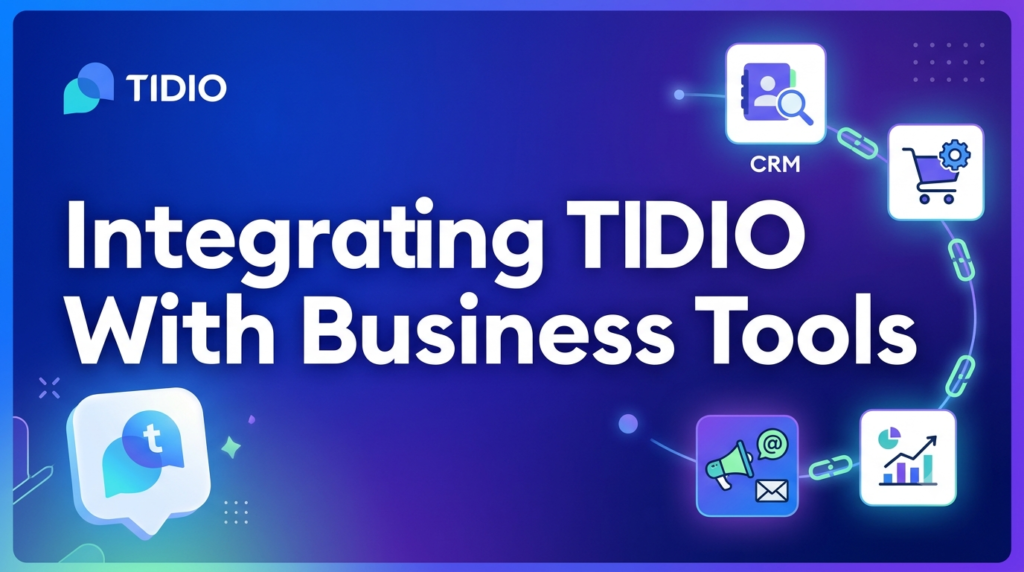
A customer support platform becomes more useful when it works alongside the tools a business already uses. Online stores, content management systems, email platforms, and customer databases often hold information that helps teams answer questions and manage customer relationships. TIDIO supports integrations with platforms such as Shopify and WordPress, along with other supported services. The exact features available depend on the integration, subscription, and configuration.
For an ecommerce business, integrating TIDIO with a compatible online store can make customer conversations more relevant to the shopping experience. A business might use its setup to help customers find products, address common purchasing questions, or support particular order-related workflows. A WordPress website, meanwhile, can use TIDIO’s chat functionality to provide assistance to readers, service prospects, and existing customers. Integrations can reduce the need to switch between disconnected tools, but they should be selected according to specific business requirements rather than simply because they are available.
Before implementing an integration, businesses should identify which information needs to be shared and what the integration will accomplish. They should test common customer journeys, verify that the correct information appears, and check what happens when an external service is unavailable. If customer records or order information are involved, appropriate access controls and privacy safeguards are essential. It is also wise to document the setup so the team can maintain it when website features or business processes change.
TIDIO Pricing, Benefits, and Limitations
Choosing the right TIDIO plan requires understanding both the subscription price and the usage limits associated with the features a business needs. TIDIO offers free and paid options, while its pricing structure distinguishes between customer conversations, AI conversations, and visitors reached by automated Flows. These usage categories matter because a business may need substantial live-chat capacity but relatively little AI automation, or the opposite. Current plan details should be checked on the official TIDIO pricing page.
The following table summarizes the main options displayed on TIDIO’s pricing page at the time of research. Prices can change, and annual-billing prices are not the same as monthly-billing prices.
| Plan | Displayed price | Best suited for |
| Free | $0/month | Exploring basic chat and engagement features |
| Starter | $24.17/month with annual billing | Small teams beginning to centralize support |
| Growth | Starts at $49.17/month with annual billing | Businesses needing more advanced analytics and team workflows |
| Plus | Starts at $300/month, plus usage charges | Organizations needing advanced management and additional support capabilities |
| Premium | Custom pricing | Businesses seeking larger-scale AI deployment and tailored services |
Source: TIDIO official pricing page. Prices are shown in USD and are subject to change; verify the latest terms before purchasing.
One important advantage of TIDIO is that businesses can start with a relatively simple setup and expand as their needs grow. Live chat can provide direct access to customers, while automation can help handle recurring questions. Centralized conversations can also improve visibility into customer concerns and make it easier for teams to coordinate their work. For a small business with limited support staff, these capabilities may help create a more professional online experience without immediately building a large customer service department.
However, TIDIO also has limitations. Some advanced capabilities require paid plans or additional usage purchases, and businesses with high conversation volumes should carefully calculate the expected monthly cost. AI responses may be incomplete or unsuitable if the supporting information is outdated, unclear, or missing. Automated systems also require testing and maintenance, while complex or sensitive customer issues still need appropriate human attention. Businesses should evaluate these trade-offs using real support data rather than assuming that automation will automatically reduce expenses or improve satisfaction.
Read More:-
How Does Strikingly Simplify the Website Building Process?
Building Your Dream Website with Site123
Boost Your E-commerce Strategy with YITH Plugins
Maximize Your Customer Engagement with LiveAgent’s Features
Why STRIPO is Essential for Digital Product Marketersa
Best Practices for Implementing TIDIO
Successful implementation begins with a clear understanding of the problems the business wants to solve. Instead of activating every available feature at once, start by identifying the most common customer questions and the points where visitors struggle. Review support emails, chat transcripts, product feedback, and website analytics to find repeated issues. These findings can guide decisions about which conversations should be handled through live chat, which can be automated, and which should go directly to a specialist. A focused implementation makes it easier to evaluate results and improve the setup over time.
Next, prepare accurate information for automated responses. This may include product descriptions, shipping policies, return conditions, account guidance, service details, and frequently asked questions. Organize the content so that answers are easy to understand and do not contradict one another. Configure the AI agent to use approved information and establish clear escalation rules for requests it cannot handle. Test the system with ordinary questions, unusual wording, incomplete requests, and questions outside the business’s area of expertise. A reliable support experience depends on knowing when the system should answer and when it should ask a human for help.
The chat widget should also fit the website’s design and customer expectations. Use clear introductory messages, accessible colors, readable text, and a placement that does not cover important content. Set realistic expectations about agent availability and response times. If human support is not available around the clock, explain when a customer can expect a reply and offer an appropriate alternative, such as leaving a message. Avoid sending repeated promotional messages or demanding unnecessary personal information before helping a visitor.
Finally, train the support team to use the platform consistently. Representatives should understand how to assign conversations, record useful notes, escalate difficult requests, and communicate in the company’s preferred tone. Regularly review unresolved conversations and customer feedback to identify areas where the system needs improvement. TIDIO should support a customer-first process, not become another layer of technology that customers must navigate before receiving help.
Measuring Website Engagement and Support Performance
How can a business tell whether TIDIO is actually improving website engagement? The answer lies in choosing relevant metrics and comparing results over time. Installing a chat widget is an implementation milestone, not proof of success. Businesses should establish a baseline before making significant changes and then monitor how visitors and support teams respond after implementation.
Useful metrics include the following:
- First response time: How long customers wait before receiving their first meaningful reply.
- Resolution rate: The percentage of support conversations resolved successfully, including the share handled by AI where that measurement is available.
- Customer satisfaction (CSAT): How customers rate their support experience after an interaction.
- Chat engagement rate: The proportion of relevant website visitors who start or participate in a chat.
- Lead conversion rate: The percentage of eligible visitors who become qualified leads after engaging with the business.
- Sales conversion rate: The percentage of visitors who complete a purchase, measured alongside other factors that influence buying decisions.
- Escalation rate: How frequently automated conversations need to be transferred to a human representative.
These measurements should be interpreted together. For example, a chatbot may handle many conversations but still perform poorly if customers repeatedly request human assistance or leave without receiving useful answers. A low escalation rate is not necessarily positive either, because customers may be struggling to reach a representative. Likewise, a higher conversion rate after introducing chat does not prove that chat alone caused the improvement. Changes in pricing, advertising, website design, and seasonal demand may also affect results.
Businesses can obtain better insights by comparing similar periods, examining different website pages, and reviewing a sample of conversation transcripts. A controlled test can help determine whether a particular chat invitation performs better than another. Support managers can also categorize unresolved questions to identify missing documentation or confusing website content. The objective is to turn conversation data into practical improvements rather than simply collecting reports.
Most importantly, performance should include the customer’s perspective. A fast response is valuable only when it is accurate and helpful. A successful AI resolution should mean that the customer’s issue was genuinely addressed, not merely that the conversation ended. Combining quantitative metrics with customer feedback gives businesses a more realistic understanding of whether TIDIO is making the experience better.



Conclusion
Improving website engagement and customer support through TIDIO is about creating a more convenient, responsive, and customer-focused online experience. With live chat, automated Flows, AI-powered assistance through Lyro, and centralized conversation management, businesses can help visitors find information, address common concerns, and connect with the right support representative. These capabilities can be valuable for ecommerce stores, service providers, SaaS companies, and small businesses that want to improve how they communicate with customers.
However, the real value of TIDIO depends on how effectively a business implements it. Accurate support content, thoughtful automation, clear escalation procedures, and well-trained agents are essential for delivering reliable service. Companies should also monitor customer satisfaction, response times, conversion rates, and resolution quality to understand which improvements are working. Instead of treating TIDIO as a standalone solution, businesses should integrate it into a broader customer experience strategy that prioritizes trust, accessibility, and useful communication.
Ultimately, customers remember how a business makes them feel when they need help. By combining the efficiency of AI with the judgment and empathy of human representatives, TIDIO can help businesses build stronger relationships, reduce unnecessary friction, and create better opportunities for long-term customer loyalty.
Frequently Asked Questions (FAQs)
Q. What is TIDIO used for?
A. TIDIO is used for website live chat, customer support, AI-powered responses, conversation automation, and lead generation. Businesses can use it to answer questions, guide visitors, and organize customer conversations through supported communication channels.
Q. Can TIDIO improve website conversion rates?
A. TIDIO can help address questions that prevent visitors from purchasing or submitting inquiries. Relevant assistance, timely responses, and useful automated conversations may support higher conversion rates, but results depend on the website, products, audience, and quality of implementation.
Q. Does TIDIO offer AI-powered customer support?
A. Yes. TIDIO offers Lyro, an AI customer service agent, alongside Flows, which enable businesses to create predefined automated conversation paths. These tools can handle suitable routine requests and support escalation to human agents when necessary.
Q. Is TIDIO suitable for small businesses?
A. Yes. TIDIO offers a free plan and paid options for businesses with different requirements. Small businesses can begin with basic live chat and explore additional automation as their support volume grows. They should check current conversation limits, AI usage allowances, and pricing before choosing a plan.
Q. How can businesses measure the success of TIDIO?
A. Businesses can monitor first response time, resolution rate, customer satisfaction, chat engagement, qualified leads, and sales conversions. Reviewing conversation transcripts and customer feedback also helps identify unanswered questions and opportunities to improve the website experience.