
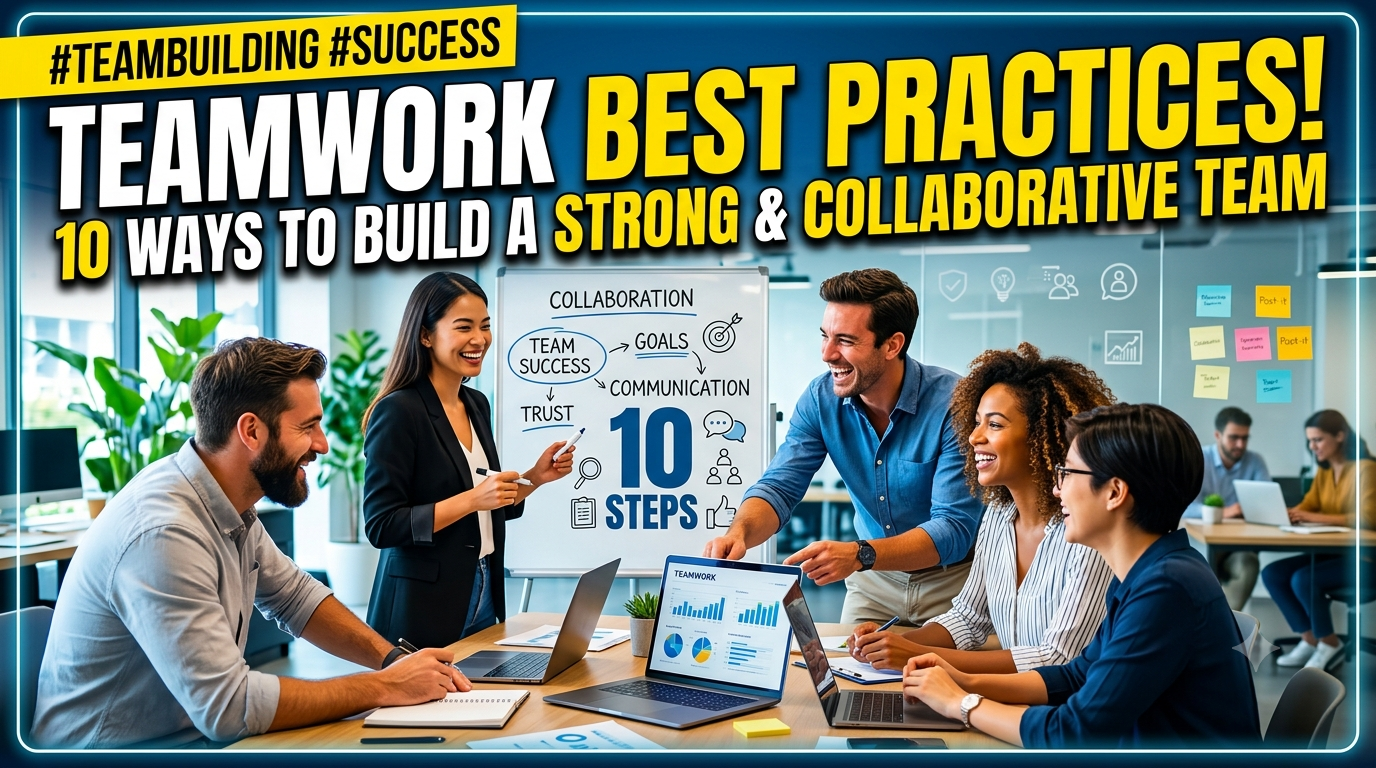
Teamwork is the key to building productive, innovative, and successful organizations. Discover 10 proven teamwork best practices that improve communication, strengthen collaboration, boost employee engagement, and help teams achieve shared goals more efficiently in today’s modern workplace.
Table of Contents
- Why Teamwork Matters More Than Ever
- 10 Best Practices for Building a Collaborative Team
- 1. Establish a Shared Vision and Goals
- 2. Encourage Open and Honest Communication
- 3. Define Clear Roles and Responsibilities
- 4. Build Trust Through Transparency
- 5. Celebrate Individual Strengths
- 6. Promote Accountability
- 7. Embrace Diversity and Inclusion
- 8. Use the Right Collaboration Tools
- 9. Invest in Continuous Learning
- 10. Recognize and Reward Team Success
- Teamwork Best Practices Comparison Table
- Measuring Team Collaboration Success
- Mistakes That Can Destroy Teamwork
- Conclusion
- Frequently Asked Questions
Why Teamwork Matters More Than Ever

Successful organizations aren’t built by talented individuals working alone—they’re built by teams that communicate, collaborate, and solve problems together. Whether you’re managing a startup, leading a remote workforce, or working in a traditional office, teamwork remains the foundation of productivity and innovation. Today’s workplace has become increasingly digital, with employees collaborating across different locations, time zones, and cultures. As a result, organizations that intentionally build collaborative environments consistently outperform those that rely solely on individual performance.
Recent workplace research highlights the growing importance of collaboration. According to workplace collaboration studies, office employees spend roughly 42% of their working time collaborating with colleagues, while 75% of leaders whose teams use AI believe collaboration has improved through better workflows and communication. These findings demonstrate that teamwork is evolving alongside technology rather than being replaced by it.
As leadership expert Simon Sinek famously said, “It is better to have a great team than a team of greats.” This quote perfectly captures today’s workplace reality. Organizations no longer win because they hire the smartest individuals—they succeed because they create environments where talented people amplify each other’s strengths. Building that kind of culture requires intentional habits, consistent leadership, and proven teamwork practices.
The Business Impact of Strong Collaboration
When collaboration becomes part of an organization’s culture, every department benefits. Projects move faster because communication barriers disappear. Employees become more engaged because they understand how their work contributes to larger goals. Customers receive better service because departments coordinate effectively instead of operating in silos.
Research consistently shows that collaborative workplaces experience higher employee satisfaction, improved innovation, and better problem-solving. Teams that openly exchange ideas are more likely to discover creative solutions than individuals working independently. This collaborative mindset also reduces costly misunderstandings and prevents duplicated work.
Perhaps the biggest advantage is adaptability. Modern businesses constantly face changing customer expectations, emerging technologies, and evolving market conditions. A collaborative team responds quickly because information flows naturally between members. Instead of waiting for instructions, employees proactively share knowledge, support one another, and solve problems together.
10 Best Practices for Building a Collaborative Team
1. Establish a Shared Vision and Goals
Every successful team begins with a clear destination. People naturally work harder when they understand not only what they’re doing but also why they’re doing it. Leaders should communicate organizational objectives in simple language and connect every project to larger business goals.
Shared goals eliminate confusion and align everyone’s priorities. Imagine a rowing team where each member rows in a different direction. Even with incredible strength, the boat barely moves. Teams operate the same way. Without shared objectives, energy becomes scattered instead of focused.
Effective leaders regularly revisit team goals rather than discussing them only during annual planning sessions. Weekly meetings, quarterly reviews, and project kickoffs provide opportunities to reinforce priorities. Employees should always understand how their daily work contributes to long-term success.
2. Encourage Open and Honest Communication
Communication is the heartbeat of teamwork. Even highly skilled professionals struggle when information isn’t shared openly. Teams perform best when members feel comfortable asking questions, providing feedback, and expressing concerns without fear of criticism.
Transparent communication reduces misunderstandings before they become major problems. Leaders can encourage openness by actively listening, inviting participation from quieter team members, and responding respectfully to differing opinions. Constructive disagreement often leads to stronger ideas because it challenges assumptions and encourages critical thinking.
Modern collaboration tools also play an important role. Instant messaging platforms, video conferencing, shared documents, and project management software help distributed teams stay connected. Technology should simplify communication rather than overwhelm employees with unnecessary notifications.
3. Define Clear Roles and Responsibilities
Nothing creates workplace frustration faster than unclear expectations. When employees aren’t sure who owns specific tasks, projects become delayed, responsibilities overlap, and accountability disappears.
Every team member should understand their responsibilities while also recognizing how their role supports colleagues. Clear role definitions reduce confusion without limiting collaboration. Employees can confidently make decisions because they know where their authority begins and ends.
Role clarity becomes especially valuable during complex projects involving multiple departments. Marketing, sales, product development, and customer support must coordinate seamlessly, and that coordination depends on everyone understanding their unique contribution.
4. Build Trust Through Transparency
Trust isn’t created during motivational speeches—it’s built through everyday actions. Teams develop trust when leaders communicate honestly, admit mistakes, and consistently follow through on commitments.
Transparency encourages employees to share challenges before they become crises. Instead of hiding mistakes, trusted teams discuss problems openly and focus on finding solutions. This creates a learning culture where continuous improvement replaces blame.
Patrick Lencioni summarizes this idea perfectly: “Great teams do not hold back with one another. They admit their mistakes, weaknesses, and concerns without fear of reprisal.”
5. Celebrate Individual Strengths
Every employee brings unique experiences, skills, and perspectives to the workplace. Strong teams recognize these differences as competitive advantages rather than obstacles.
Leaders should identify each employee’s strengths and create opportunities for them to excel. Someone with excellent analytical skills may thrive during data analysis, while another employee shines during client presentations. Assigning responsibilities based on strengths increases both confidence and productivity.
Recognition also matters. Publicly acknowledging individual contributions reinforces positive behavior while motivating others. Employees who feel valued naturally become more engaged and willing to support teammates.
6. Promote Accountability
Accountability isn’t about punishment—it’s about ownership. Collaborative teams understand that everyone contributes to shared success, making personal responsibility essential.
Clear expectations, measurable objectives, and regular progress reviews help maintain accountability without creating unnecessary pressure. Leaders should provide support when challenges arise while still expecting team members to fulfill their commitments.
Healthy accountability builds trust because employees know colleagues will deliver quality work on time. That reliability strengthens collaboration across departments and reduces project delays.
7. Embrace Diversity and Inclusion
Diverse teams consistently generate more innovative solutions because they combine different viewpoints, experiences, and problem-solving approaches. Inclusion ensures every voice is heard, regardless of job title, background, or experience level.
Creating an inclusive culture requires more than hiring diverse talent. Leaders should actively encourage participation, respect different perspectives, and eliminate behaviors that discourage collaboration.
When employees feel respected and included, they contribute ideas more confidently. Those ideas often become breakthrough innovations that homogeneous teams might overlook.
8. Use the Right Collaboration Tools
Technology has transformed teamwork. Cloud-based platforms enable employees to collaborate in real time regardless of location. Project management software improves visibility, while shared document systems reduce version confusion.
Choosing the right tools depends on team size, workflow complexity, and organizational needs. Simplicity often beats complexity. Employees should spend more time collaborating than learning complicated software.
| Practice | Primary Benefit | Expected Outcome |
| Shared Goals | Better alignment | Higher productivity |
| Open Communication | Faster problem-solving | Improved trust |
| Defined Roles | Reduced confusion | Greater accountability |
| Collaboration Tools | Better coordination | Faster project delivery |
| Recognition | Higher motivation | Improved retention |
9. Invest in Continuous Learning
Great teams never stop learning. Markets evolve, technologies change, and customer expectations continue shifting. Organizations that prioritize learning remain competitive because employees continuously develop new skills.
Training programs, mentorship, workshops, certifications, and knowledge-sharing sessions all strengthen collaboration. Learning together also creates stronger interpersonal relationships, making teamwork more natural.
Leaders should encourage curiosity by celebrating experimentation rather than expecting perfection. Mistakes often become valuable learning opportunities when teams analyze them constructively.
10. Recognize and Reward Team Success
Recognition reinforces the behaviors organizations want to encourage. While individual achievements deserve celebration, recognizing collective success strengthens collaboration even more.
Rewards don’t always require financial incentives. Public appreciation, career opportunities, flexible work arrangements, or additional professional development can all motivate teams effectively.
As Henry Ford famously stated, “If everyone is moving forward together, then success takes care of itself.”
Teamwork Best Practices Comparison Table
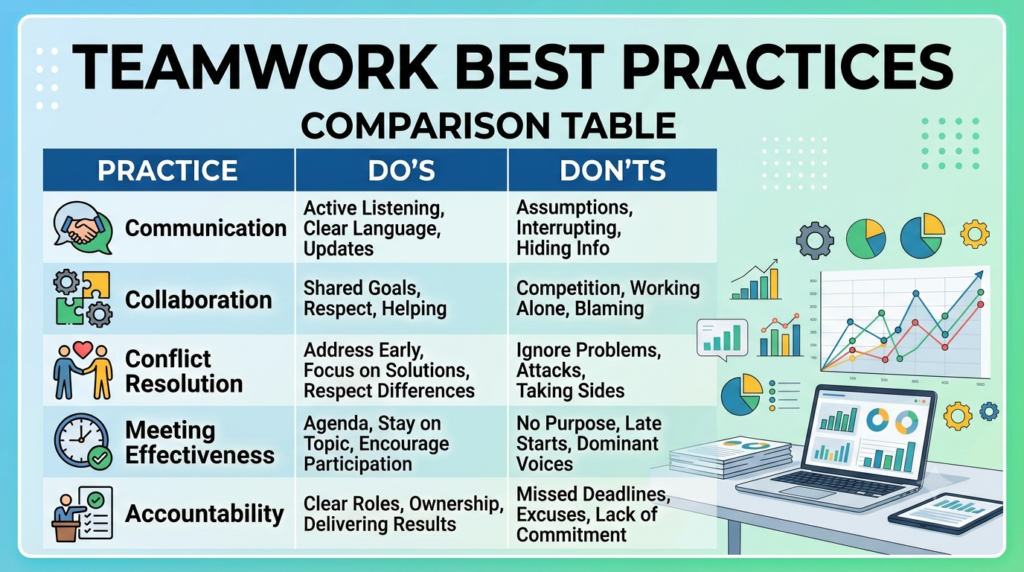
| Best Practice | Difficulty | Business Impact |
| Shared Vision | Low | High |
| Communication | Medium | Very High |
| Clear Roles | Low | High |
| Transparency | Medium | Very High |
| Strength Recognition | Low | High |
| Accountability | Medium | High |
| Diversity & Inclusion | Medium | Very High |
| Collaboration Tools | Medium | High |
| Continuous Learning | Medium | High |
| Recognition Programs | Low | High |
Read More:-
Parcel ABC UK Shipping Guide: Features, Pricing, and Benefits Explained
Why Fun-sport-vision.com DE Is Gaining Popularity in Germany
Mashvisor (US): Complete Review for Real Estate Investors in 2026
What Is Scandic SE? A Complete Beginner’s Guide
Simpel NL Explained: Everything You Need to Know
Measuring Team Collaboration Success
Building collaboration is only the beginning. Organizations also need measurable indicators to determine whether teamwork initiatives are producing meaningful results.
Useful performance indicators include employee engagement scores, project completion rates, customer satisfaction, employee retention, innovation metrics, and cross-functional project success. Regular surveys provide valuable insight into communication quality, trust levels, and overall team morale.
Managers should combine quantitative metrics with qualitative feedback. Numbers reveal trends, while conversations explain the reasons behind those trends. Together, they provide a complete picture of team performance.
Key Metrics Every Team Should Track
Some of the most valuable collaboration metrics include:
- Employee engagement scores
- Project completion rate
- Customer satisfaction (CSAT)
- Net Promoter Score (NPS)
- Employee retention
- Internal communication response time
- Cross-functional project success
- Innovation submissions
- Knowledge-sharing participation
- Meeting effectiveness ratings
Reviewing these indicators quarterly helps leaders identify strengths, address weaknesses, and continuously improve teamwork practices.
Mistakes That Can Destroy Teamwork
Even talented teams can struggle when poor habits become normalized. Lack of communication, unclear expectations, micromanagement, favoritism, and unresolved conflicts gradually erode trust. Employees become disengaged when they feel their opinions don’t matter or when recognition is distributed unfairly.
Another common mistake is prioritizing individual performance at the expense of collaboration. Healthy competition can motivate employees, but excessive competition discourages knowledge sharing and creates unnecessary tension. Leaders should reward collaborative behavior alongside individual achievement.
Ignoring employee feedback is equally damaging. Teams evolve continuously, and successful leaders adapt by listening carefully to their people. Small improvements made consistently often produce greater long-term results than dramatic organizational changes.




Conclusion
Strong teamwork doesn’t happen by accident. It grows through intentional leadership, clear communication, mutual trust, shared goals, and continuous learning. Organizations that invest in collaboration create workplaces where employees feel engaged, respected, and motivated to achieve collective success.
The 10 teamwork best practices discussed in this guide provide a practical roadmap for building stronger, more connected teams. Whether your organization is fully remote, hybrid, or office-based, these principles remain timeless. When people trust one another, communicate openly, and work toward a common purpose, extraordinary results become possible.
Frequently Asked Questions
Q. What are the most important teamwork best practices?
A. The most important practices include clear communication, shared goals, accountability, trust, recognition, defined roles, and continuous learning.
Q. Why is teamwork important in the workplace?
A. Teamwork improves productivity, encourages innovation, strengthens employee engagement, enhances customer satisfaction, and helps organizations solve complex problems more efficiently.
Q. How can leaders improve team collaboration?
A. Leaders can improve collaboration by setting clear expectations, encouraging open communication, recognizing achievements, providing collaboration tools, and building trust through transparency.
Q. What are the biggest barriers to teamwork?
A. Poor communication, unclear responsibilities, lack of trust, workplace conflict, micromanagement, and insufficient recognition are among the biggest barriers.
Q. Which collaboration tools are most commonly used by teams?
A. Popular collaboration tools include project management platforms, cloud document sharing, instant messaging applications, video conferencing software, and shared knowledge bases.