Ryte is a comprehensive SEO and website optimization platform that helps businesses improve their online visibility through technical SEO audits, content optimization, website quality monitoring, and performance analysis. Whether you’re a blogger, digital marketer, agency, or enterprise, Ryte offers valuable tools to identify SEO issues, enhance user experience, and optimize your website for better search engine rankings. While Ryte remains a trusted choice for technical website management, many users also compare it with leading SEO platforms to find the best solution based on features, pricing, AI capabilities, and overall performance in 2026.
Why Businesses Are Looking for Ryte Alternatives

The SEO industry has become far more competitive than it was just a few years ago. Google’s ranking systems now evaluate websites using hundreds of signals that extend well beyond technical optimization. Businesses need insights into user intent, semantic search, AI-generated search results, topical authority, backlink quality, page experience, and competitor performance. While Ryte remains a capable platform for website quality management and technical SEO, many organizations feel that they need additional capabilities that fit today’s rapidly evolving search ecosystem.
One of the biggest reasons companies are switching is the growing demand for all-in-one SEO platforms. Instead of juggling separate tools for keyword research, backlink monitoring, content optimization, rank tracking, and competitor analysis, businesses increasingly prefer a unified solution. Modern SEO teams also expect AI-powered recommendations that can identify content gaps, suggest keyword opportunities, detect technical issues automatically, and prioritize tasks based on potential traffic impact. Platforms such as Semrush and Ahrefs have invested heavily in these capabilities, making them attractive alternatives for organizations looking to streamline their workflows.
Another important consideration is reporting and collaboration. Digital marketing agencies often manage dozens—or even hundreds—of client websites simultaneously. They require customizable dashboards, white-label reports, scheduled audits, API access, and collaborative project management features. While Ryte performs well for website optimization, agencies frequently seek tools that simplify multi-client management and provide more comprehensive analytics across technical SEO, backlinks, content performance, and keyword rankings. As SEO becomes increasingly data-driven, having everything available within a single dashboard saves valuable time and improves decision-making.
Budget also plays a significant role. Some businesses discover that they are paying for features they rarely use, while others outgrow Ryte’s available functionality and require enterprise-level capabilities. Small businesses, freelancers, and startups may prioritize affordable pricing with solid keyword research and rank tracking, whereas large enterprises often need scalable crawling, advanced integrations, AI-assisted content recommendations, and detailed technical reporting. The availability of specialized alternatives means organizations can now select a platform that aligns more closely with their goals, budget, and level of SEO expertise.
Common Limitations of Ryte
Although Ryte continues to be a respected SEO platform, users commonly mention several areas where competing solutions offer a broader experience. One limitation is the relatively smaller keyword research database compared with industry leaders like Semrush and Ahrefs. Keyword discovery has become increasingly important as businesses compete for highly specific search queries, voice search, and AI-generated search experiences. Comprehensive keyword databases help marketers uncover long-tail opportunities, estimate search intent, and identify emerging trends before competitors do.
Backlink analysis is another area where some users look elsewhere. Link building remains one of Google’s strongest ranking signals, making accurate backlink monitoring essential for SEO success. Tools with larger backlink indexes provide deeper insights into referring domains, toxic links, lost backlinks, anchor text distribution, and competitor link-building strategies. Businesses focused on aggressive organic growth often prefer platforms that specialize in backlink intelligence while still offering robust technical SEO capabilities.
Another consideration involves AI-powered workflows. The rise of artificial intelligence has transformed how marketers create, optimize, and maintain content. Many competing SEO platforms now include AI writing assistants, automated content briefs, SERP intent analysis, topic clustering, and predictive optimization suggestions. These features reduce manual work and help teams publish optimized content much faster. As AI continues reshaping digital marketing, businesses increasingly value platforms that integrate these intelligent capabilities directly into their SEO workflows rather than requiring additional third-party tools.
Finally, enterprise users often seek greater flexibility when integrating SEO data with other marketing systems. Large organizations frequently connect SEO platforms with analytics tools, CRM software, business intelligence dashboards, and internal reporting systems. While Ryte supports many integrations, some competitors provide more extensive APIs, automation options, and customizable reporting features that better support enterprise-scale operations.
What Modern SEO Teams Need in 2026
SEO in 2026 is no longer just about ranking for keywords—it is about building digital authority across multiple search experiences. Modern SEO teams need tools capable of monitoring traditional Google rankings alongside visibility in AI-generated search summaries, conversational search engines, and answer engines. This shift requires platforms that can measure brand mentions, entity recognition, structured data performance, and topical authority rather than focusing solely on keyword positions.
Automation has also become essential. Marketing teams manage thousands of pages across websites, making manual audits impractical. Today’s leading SEO platforms automatically detect crawl issues, identify duplicate content, monitor Core Web Vitals, flag indexing problems, and prioritize recommendations based on business impact. Instead of presenting long lists of technical errors, the best tools help users understand which improvements will generate the greatest SEO returns.
Collaboration features have become equally valuable. SEO professionals now work closely with content writers, developers, UX designers, marketing managers, and executives. The ability to assign tasks, share reports, monitor project progress, and create customized dashboards improves productivity across departments. Cloud-based collaboration has become particularly important for distributed teams managing multiple brands or international websites.
Finally, scalability separates average SEO software from exceptional platforms. Businesses want solutions that can grow with them—from managing a small business website to overseeing enterprise websites containing millions of pages. Flexible pricing, powerful crawlers, AI-assisted optimization, customizable reporting, and reliable customer support are now considered standard expectations rather than premium extras. These evolving requirements explain why many businesses are actively evaluating the best Ryte alternatives available in 2026.
Key Features to Look for in an SEO Platform
Selecting the right SEO platform isn’t simply about replacing Ryte with another tool. The ideal solution should fit your business goals, team size, technical expertise, and long-term SEO strategy. In 2026, search optimization extends beyond ranking for keywords—it includes optimizing for AI-powered search experiences, improving website performance, strengthening topical authority, and delivering an outstanding user experience. The best SEO platforms combine technical analysis, competitive intelligence, content optimization, and reporting into a single ecosystem that helps businesses make smarter marketing decisions.
When comparing Ryte alternatives, avoid focusing solely on price. A less expensive platform may lack essential features that save countless hours every month, while a premium solution might generate significantly higher ROI through improved rankings and traffic growth. The most valuable SEO software helps teams identify high-impact opportunities, automate repetitive tasks, and prioritize improvements based on measurable business outcomes. Whether you’re an independent blogger, an eCommerce store owner, or an enterprise marketing manager, understanding the core capabilities of an SEO platform ensures you invest in software that continues delivering value as your website grows.
Technical SEO Audits
Technical SEO remains the backbone of organic search success. Even the highest-quality content can struggle to rank if search engines encounter crawling, indexing, or performance issues. Modern SEO platforms perform comprehensive website crawls that identify broken links, redirect chains, duplicate pages, orphan pages, missing metadata, canonicalization problems, XML sitemap errors, structured data issues, and Core Web Vitals performance metrics. These insights allow businesses to resolve technical obstacles before they negatively affect rankings.
Advanced auditing tools also prioritize issues by severity rather than simply listing every detected problem. This prioritization helps SEO teams focus on fixes that produce the greatest impact first. Enterprise websites containing thousands—or even millions—of pages particularly benefit from scalable crawlers capable of monitoring changes continuously. Scheduled audits ensure new issues are detected quickly, preventing small technical problems from becoming major ranking challenges.
Another valuable capability is integration with platforms such as Google Search Console and Google Analytics. Combining crawl data with real user metrics provides a clearer understanding of how technical issues influence traffic, impressions, and conversions. Some modern SEO tools even use AI to explain technical recommendations in plain language, making them easier for developers, marketers, and business stakeholders to understand and implement.
Keyword Research & Competitor Analysis
Keyword research has evolved far beyond identifying high-volume search terms. In 2026, marketers focus on search intent, semantic relevance, topical clusters, and AI-driven search behavior. The best Ryte alternatives provide massive keyword databases, accurate search volume estimates, keyword difficulty scores, click potential metrics, seasonal trends, and SERP analysis. These insights enable businesses to target opportunities that align closely with user intent instead of chasing highly competitive keywords with limited conversion potential.
Competitor analysis is equally critical. Understanding why competing websites rank higher often reveals valuable optimization opportunities. Leading SEO platforms analyze competitors’ top-performing pages, keyword rankings, backlink profiles, content strategies, featured snippets, and traffic trends. This intelligence helps marketers uncover keyword gaps, identify successful content formats, and build stronger SEO campaigns based on proven market data rather than guesswork.
Modern competitor analysis tools also monitor changes over time. Businesses can receive alerts when competitors gain backlinks, publish new content, or experience significant ranking improvements. This continuous monitoring enables SEO teams to react quickly and refine their own strategies before losing market share. Combined with keyword clustering and content gap analysis, competitor research becomes one of the most powerful features available in today’s SEO software.
AI-Powered SEO Features
Artificial intelligence has become one of the defining characteristics of leading SEO platforms. Instead of merely reporting data, AI-powered tools actively recommend actions that improve search visibility. Content optimization assistants analyze top-ranking pages, identify missing topics, suggest semantic keywords, improve readability, and generate content briefs tailored to specific search intent. These capabilities significantly reduce research time while helping writers create more comprehensive, search-friendly articles.
AI also enhances predictive analysis. Some platforms estimate the potential traffic gains associated with specific optimizations, forecast keyword growth, and recommend content updates before rankings decline. Rather than relying solely on historical performance, AI models help marketers anticipate future opportunities and adapt proactively to search engine algorithm changes. This forward-looking approach provides businesses with a competitive advantage in increasingly dynamic search environments.
Another emerging trend is AI visibility monitoring. Businesses need to know how often their brands show up in AI-generated responses as generative AI platforms and search engines offer direct answers rather than conventional search results. Several leading SEO tools now include features that track AI citations, monitor entity recognition, and measure visibility across conversational search experiences. These innovations reflect the future of SEO, where success depends not only on ranking first in search results but also on becoming a trusted source for AI-generated answers.
Best Ryte Alternatives Compared
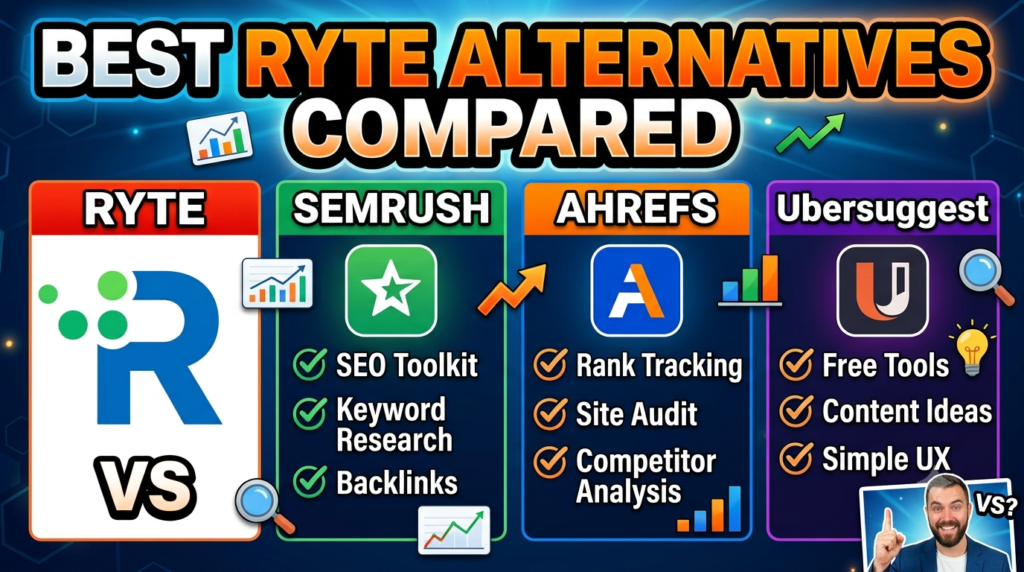
Choosing the right alternative depends on your objectives, budget, and workflow. Some tools excel in technical SEO, while others dominate backlink research, AI content optimization, or enterprise reporting. Below are the strongest Ryte alternatives available in 2026, each offering unique strengths for different types of users.
Semrush
Semrush continues to be one of the most comprehensive SEO platforms on the market. It combines keyword research, backlink analysis, technical SEO audits, competitor intelligence, PPC research, social media management, content marketing, and AI-powered optimization tools within a single interface. This broad functionality makes it particularly attractive for businesses seeking an all-in-one digital marketing solution instead of maintaining multiple subscriptions.
One of Semrush’s biggest strengths is its enormous keyword database, covering millions of search queries across numerous countries. Its Keyword Magic Tool helps marketers discover long-tail opportunities, analyze keyword intent, estimate ranking difficulty, and organize keywords into topical clusters. Combined with Position Tracking and Organic Research reports, users can monitor their search visibility while identifying new opportunities for traffic growth.
The platform also excels in competitor analysis. Businesses can compare domains, evaluate backlink profiles, monitor advertising strategies, identify top-performing content, and analyze market share with remarkable accuracy. AI-powered writing assistants simplify content creation by recommending semantic keywords, readability improvements, and structural enhancements that align with current ranking factors.
Semrush is particularly well-suited for agencies, enterprise businesses, content marketers, and growing companies that require a comprehensive SEO ecosystem. Although its pricing may exceed that of some smaller competitors, the breadth of features often eliminates the need for additional SEO software, making it an excellent long-term investment for organizations focused on sustained organic growth.
Ahrefs
Ahrefs has earned a reputation as one of the most trusted SEO tools for backlink analysis and competitor research. Over the years, it has evolved into a complete SEO platform that serves bloggers, affiliate marketers, agencies, SaaS companies, and enterprise organizations alike. While Ryte primarily focuses on technical website optimization, Ahrefs provides a broader view of your entire SEO ecosystem by combining technical audits with keyword research, content exploration, rank tracking, and one of the industry’s largest backlink databases.
The standout feature of Ahrefs is undoubtedly its backlink intelligence. Users can analyze referring domains, monitor newly acquired and lost backlinks, review anchor text distribution, and uncover link-building opportunities with exceptional detail. This level of insight helps businesses strengthen their domain authority while understanding exactly why competitors rank above them. Link analysis remains one of Google’s strongest ranking signals, making Ahrefs an invaluable resource for long-term SEO growth.
Keyword research is another area where Ahrefs performs exceptionally well. Its Keyword Explorer provides search volume, keyword difficulty, clicks per search, traffic potential, parent topics, and search intent analysis across multiple search engines. Instead of focusing solely on keyword volume, Ahrefs encourages marketers to target topics capable of generating sustained organic traffic. Topical authority, which has grown in significance in Google’s current ranking methods, is supported by this strategy.
The Content Explorer tool deserves special recognition because it helps marketers discover high-performing content across the web. Users can identify trending topics, analyze competitor articles, find broken link opportunities, and uncover pages attracting significant backlinks. Combined with detailed Site Audit reports and rank tracking, Ahrefs offers an impressive all-in-one SEO experience for professionals who prioritize data accuracy and competitive intelligence.
Screaming Frog SEO Spider
Unlike cloud-based SEO platforms, Screaming Frog SEO Spider is a desktop application specifically designed for technical SEO professionals. Although its interface appears simpler than many modern SaaS platforms, it remains one of the most powerful website crawlers available in 2026. Developers, SEO consultants, and enterprise organizations frequently rely on Screaming Frog for in-depth technical analysis that uncovers issues many other platforms overlook.
The software crawls websites in a manner similar to search engine bots, collecting detailed information about URLs, redirects, duplicate pages, missing metadata, canonical tags, hreflang implementation, structured data, broken links, and page response codes. For large websites containing tens of thousands of pages, this level of detail proves invaluable when diagnosing complex technical problems that impact search visibility.
One of Screaming Frog’s greatest strengths is its flexibility. Users can integrate it with Google Search Console, Google Analytics, PageSpeed Insights, and other APIs to combine crawl data with real performance metrics. Advanced users can also create custom extraction rules, automate crawls, generate XML sitemaps, and export highly detailed reports for developers and stakeholders.
Although Screaming Frog lacks extensive keyword research and backlink databases, it excels in technical SEO. Many agencies pair it with platforms like Semrush or Ahrefs to create a complete SEO toolkit. For professionals responsible for maintaining technically healthy websites, few alternatives match the crawling accuracy and customization capabilities offered by Screaming Frog.
Sitebulb
Sitebulb has become one of the fastest-growing technical SEO platforms because it transforms complex audit data into easy-to-understand visual reports. Unlike many crawlers that overwhelm users with spreadsheets and raw data, Sitebulb emphasizes actionable insights through interactive diagrams, visual crawl maps, priority scores, and clear recommendations. This user-friendly approach makes technical SEO more accessible to marketers who may not have a development background.
The platform performs comprehensive website audits covering crawlability, indexability, internal linking, duplicate content, page speed, structured data, JavaScript rendering, mobile optimization, and Core Web Vitals. Instead of simply identifying issues, Sitebulb explains why each problem matters and how resolving it could improve organic performance. These educational insights help businesses implement fixes with greater confidence.
Another advantage is Sitebulb’s reporting system. Agencies appreciate its visually appealing reports because they simplify client communication. Technical findings are organized into clear categories with screenshots, graphs, and prioritized recommendations that stakeholders can easily understand. This reduces the time required to explain technical concepts during client meetings or internal presentations.
Enterprise users also benefit from Sitebulb’s cloud capabilities, scheduled crawls, collaboration tools, and scalability. While it may not replace comprehensive keyword research platforms, Sitebulb stands out as one of the strongest Ryte alternatives for organizations focused primarily on technical website health and ongoing optimization.
SE Ranking
SE Ranking has gained significant popularity by offering a well-balanced combination of affordability and functionality. It provides many of the features found in premium enterprise SEO platforms while maintaining pricing that appeals to freelancers, startups, small businesses, and growing digital agencies. For organizations seeking a cost-effective Ryte alternative, SE Ranking delivers excellent overall value.
The platform includes keyword research, rank tracking, competitor analysis, website audits, backlink monitoring, on-page SEO analysis, local SEO tools, and white-label reporting. Its intuitive interface makes navigation straightforward even for users with limited SEO experience. Beginners appreciate the guided recommendations, while experienced professionals benefit from detailed reporting and customizable dashboards.
Rank tracking is particularly impressive. Users can monitor keyword performance across multiple search engines, devices, and geographic locations while receiving automated updates and historical trend analysis. Local businesses benefit from accurate local search monitoring, helping them evaluate visibility within specific cities and regions. Combined with competitor comparisons, this enables businesses to measure SEO progress against their market rivals.
SE Ranking also continues expanding its AI-powered capabilities. While increasing campaign efficiency, content suggestions, keyword clustering, automated audits, and optimization recommendations minimize human labor. SE Ranking continues to be one of the greatest Ryte substitutes for companies looking for enterprise-level capabilities without enterprise-level prices, given its affordable pricing and extensive feature set.
Moz Pro
Moz Pro remains one of the most recognizable names in the SEO industry. Although newer competitors have introduced more advanced AI capabilities, Moz continues attracting loyal users thanks to its clean interface, educational resources, and trusted proprietary metrics such as Domain Authority (DA) and Page Authority (PA). These metrics have become industry standards for evaluating website strength and comparing backlink profiles.
Moz Pro offers a comprehensive suite of SEO tools that includes keyword research, rank tracking, site audits, backlink analysis, page optimization recommendations, and competitor research. Its Keyword Explorer helps marketers identify opportunities by analyzing search volume, keyword difficulty, organic click-through potential, and search intent. Rather than overwhelming users with excessive data, Moz presents information in a way that supports faster decision-making.
Technical SEO auditing is another strength. The platform identifies crawl issues, duplicate content, redirect errors, missing metadata, and indexing problems while providing actionable recommendations for improvement. Its Page Optimization feature evaluates individual pages against target keywords and suggests enhancements based on current ranking factors, making it particularly useful for content marketers and in-house SEO teams.
Moz also excels as an educational platform. Extensive learning resources, webinars, documentation, and community support make it an ideal choice for beginners entering the SEO industry. While larger enterprises may require more advanced competitive intelligence, Moz Pro remains a dependable solution for small businesses and marketers seeking reliable SEO fundamentals in an intuitive package.
Surfer SEO
Surfer SEO has become one of the leading AI-powered content optimization platforms available in 2026. Unlike traditional SEO tools that primarily focus on technical audits or backlink analysis, Surfer SEO specializes in helping writers create content that aligns closely with search intent and the characteristics of top-ranking pages. For businesses publishing blogs, landing pages, and long-form guides, this content-first approach makes Surfer one of the strongest Ryte alternatives.
The platform analyzes the highest-ranking pages for a target keyword and generates real-time recommendations covering keyword usage, content length, headings, semantic terms, readability, internal links, and topical coverage. As writers create or edit content, Surfer continuously updates an optimization score that reflects how closely the article matches current search engine expectations. This immediate feedback dramatically reduces guesswork and improves the chances of ranking competitively.
One of Surfer SEO’s biggest advantages is its integration with AI writing workflows. Marketers can generate content briefs, identify content gaps, cluster related keywords, and refresh older articles without performing hours of manual research. The platform also includes audit features that compare existing pages against competitors and highlight opportunities for improvement. This is especially valuable for websites with large content libraries that require ongoing optimization to maintain rankings.
Although Surfer SEO is not intended to replace comprehensive SEO suites like Semrush or Ahrefs, it complements them exceptionally well. Businesses that already have reliable keyword research and technical SEO tools often adopt Surfer specifically to strengthen content quality, improve topical authority, and accelerate publishing workflows. For content-heavy websites, it delivers measurable value by helping teams create search-optimized articles more efficiently.
Comparison Table
The following table summarizes how the leading Ryte alternatives compare across the features that matter most to SEO professionals in 2026.
| Tool | Best For | Technical SEO | Keyword Research | Backlink Analysis | AI Features | Ease of Use |
| Semrush | All-in-one SEO & Digital Marketing | ⭐⭐⭐⭐⭐ | ⭐⭐⭐⭐⭐ | ⭐⭐⭐⭐⭐ | ⭐⭐⭐⭐⭐ | ⭐⭐⭐⭐☆ |
| Ahrefs | Backlinks & Competitor Research | ⭐⭐⭐⭐☆ | ⭐⭐⭐⭐⭐ | ⭐⭐⭐⭐⭐ | ⭐⭐⭐⭐☆ | ⭐⭐⭐⭐☆ |
| Screaming Frog | Technical Website Audits | ⭐⭐⭐⭐⭐ | ⭐⭐☆☆☆ | ⭐☆☆☆☆ | ⭐☆☆☆☆ | ⭐⭐⭐☆☆ |
| Sitebulb | Visual Technical SEO Audits | ⭐⭐⭐⭐⭐ | ⭐⭐☆☆☆ | ⭐☆☆☆☆ | ⭐⭐⭐☆☆ | ⭐⭐⭐⭐⭐ |
| SE Ranking | Small Businesses & Agencies | ⭐⭐⭐⭐☆ | ⭐⭐⭐⭐☆ | ⭐⭐⭐⭐☆ | ⭐⭐⭐⭐☆ | ⭐⭐⭐⭐⭐ |
| Moz Pro | Beginners & SMBs | ⭐⭐⭐⭐☆ | ⭐⭐⭐⭐☆ | ⭐⭐⭐⭐☆ | ⭐⭐⭐☆☆ | ⭐⭐⭐⭐⭐ |
| Surfer SEO | Content Optimization | ⭐⭐☆☆☆ | ⭐⭐⭐⭐☆ | ⭐☆☆☆☆ | ⭐⭐⭐⭐⭐ | ⭐⭐⭐⭐⭐ |
The comparison clearly demonstrates that no single SEO platform dominates every category. Instead, each solution specializes in different aspects of search optimization. Businesses should evaluate their priorities carefully before making a final decision.
Which Ryte Alternative Is Right for You?
Choosing the best Ryte alternative ultimately depends on your objectives rather than simply selecting the platform with the longest feature list. A freelancer managing a few websites has very different requirements from an international eCommerce company overseeing millions of indexed pages. Understanding your workflow, budget, and growth plans will help you identify the platform that delivers the greatest return on investment.
Many organizations make the mistake of paying for enterprise-level capabilities they rarely use. Others choose inexpensive software only to discover that they need additional subscriptions for backlink analysis, content optimization, or rank tracking. Evaluating your long-term SEO strategy before investing in software can save both time and money while improving overall productivity.
Best for Beginners
If you’re new to SEO, ease of use should be your highest priority. Learning technical SEO, keyword research, and content optimization simultaneously can feel overwhelming. Moz Pro and SE Ranking offer intuitive interfaces, educational resources, guided recommendations, and straightforward reporting that help beginners understand SEO fundamentals without excessive complexity.
These platforms provide enough functionality to manage website audits, keyword tracking, backlink monitoring, and content optimization while remaining approachable for users with limited technical knowledge. Their learning resources also make it easier to develop SEO skills as your website grows.
Read More:-
Parcel ABC UK Shipping Guide: Features, Pricing, and Benefits Explained
Why Fun-sport-vision.com DE Is Gaining Popularity in Germany
Mashvisor (US): Complete Review for Real Estate Investors in 2026
What Is Scandic SE? A Complete Beginner’s Guide
Simpel NL Explained: Everything You Need to Know
Best for Agencies
Digital marketing agencies require scalability, collaboration, automation, and client reporting. Managing multiple projects efficiently becomes essential when serving dozens of clients simultaneously. Semrush stands out because it combines technical SEO, keyword research, backlink analysis, competitor intelligence, PPC research, social media tools, and customizable reporting within one ecosystem.
SE Ranking is another strong choice for agencies seeking a more budget-friendly solution. Its white-label reports, automated ranking updates, team collaboration features, and client management tools make it particularly attractive for smaller agencies looking to scale their operations without significantly increasing software costs.
Best for Enterprise SEO
Large organizations often manage complex websites containing hundreds of thousands—or even millions—of pages. Enterprise SEO requires scalable crawlers, API integrations, advanced reporting, role-based permissions, scheduled audits, and sophisticated analytics. For these organizations, technical precision and automation become more valuable than simple keyword tracking.
A combination of Semrush, Screaming Frog, and Sitebulb often delivers the strongest enterprise solution. Semrush provides market intelligence and competitor insights, while Screaming Frog and Sitebulb handle deep technical analysis. Together, these platforms support enterprise teams responsible for maintaining large-scale websites while continuously improving organic search performance.



Final Verdict
The SEO software market in 2026 offers far more choices than ever before, making it easier for businesses to find a platform tailored to their specific needs. While Ryte remains a capable solution for technical website optimization and quality management, many organizations now require broader functionality that includes AI-powered content optimization, advanced keyword research, comprehensive backlink analysis, competitor intelligence, and enterprise reporting.
For businesses seeking an all-in-one SEO ecosystem, Semrush remains the strongest overall Ryte alternative due to its extensive feature set, AI capabilities, and integrated digital marketing tools. Ahrefs continues leading in backlink intelligence and competitor analysis, making it ideal for aggressive organic growth strategies. Technical SEO specialists will appreciate the unmatched crawling capabilities of Screaming Frog and the visually intuitive reporting offered by Sitebulb. Smaller businesses looking for exceptional value should strongly consider SE Ranking, while Moz Pro provides an excellent starting point for beginners. Content-focused teams can dramatically improve publishing efficiency with Surfer SEO, especially when paired with a comprehensive SEO suite.
Rather than asking which tool is objectively “best,” businesses should identify which platform aligns most closely with their goals, workflows, and budget. Investing in the right SEO software today can improve search visibility, strengthen digital authority, and create sustainable organic growth for years to come.
FAQs
Q. What is the best alternative to Ryte in 2026?
A. For most businesses, Semrush is considered the best overall Ryte alternative because it combines technical SEO, keyword research, backlink analysis, competitor intelligence, AI-powered content tools, and comprehensive reporting within a single platform.
Q. Which Ryte alternative is best for technical SEO?
A. Screaming Frog SEO Spider and Sitebulb are widely regarded as the top choices for technical SEO audits. They provide in-depth crawling capabilities, detailed issue detection, and actionable recommendations for improving website health.
Q. Is Ahrefs better than Ryte?
A. If backlink analysis, competitor research, and keyword discovery are your primary priorities, Ahrefs offers broader functionality than Ryte. However, businesses focused mainly on website quality management may still find Ryte suitable for their needs.
Q. Which SEO platform is best for small businesses?
A. SE Ranking is one of the best options for small businesses because it offers a strong balance of affordability, ease of use, keyword tracking, website auditing, and backlink monitoring without requiring a large monthly investment.
Q. Can I use multiple SEO tools together?
A. Yes. Many SEO professionals combine platforms to leverage their individual strengths. For example, businesses often use Semrush or Ahrefs for keyword research and competitor analysis, Screaming Frog for technical audits, and Surfer SEO for AI-powered content optimization.