
LiveChat is a powerful customer communication platform that helps businesses deliver instant support, engage website visitors in real time, and increase sales through personalized conversations. With features like AI-powered chatbots, proactive messaging, CRM integrations, visitor tracking, and detailed analytics, LiveChat enables companies to resolve customer queries faster while improving satisfaction and conversion rates. Whether you run an eCommerce store, SaaS business, or service-based company, LiveChat streamlines customer interactions, builds trust, reduces cart abandonment, and creates a seamless support experience that drives long-term business growth.
What Is LiveChat and Why Businesses Use It
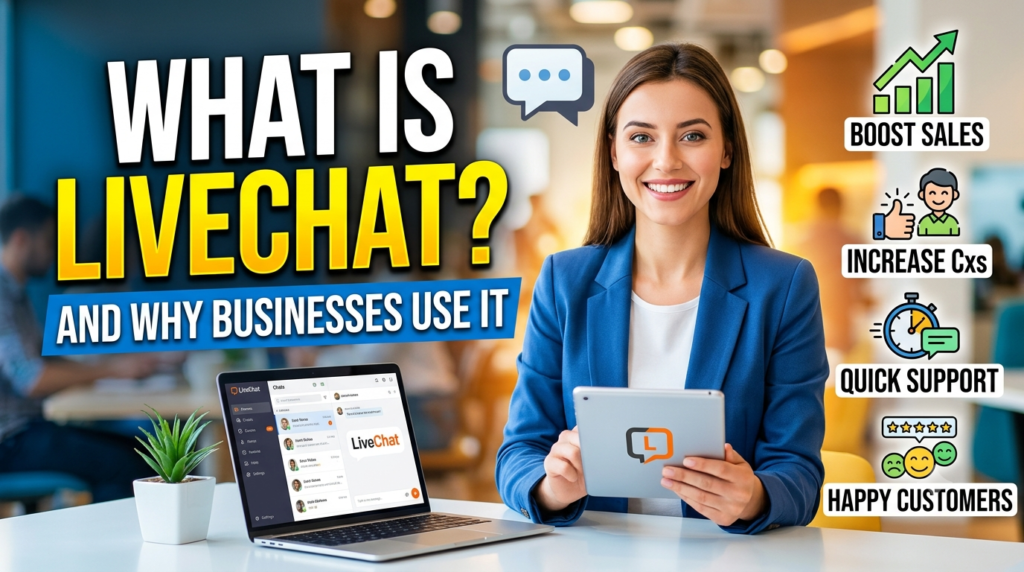
LiveChat is a cloud-based customer communication platform that allows businesses to interact with website visitors in real time. Instead of forcing customers to fill out lengthy contact forms or wait for email replies, LiveChat opens an instant communication channel where questions can be answered immediately. That speed alone can dramatically improve customer confidence because people naturally trust businesses that respond quickly. Whether someone needs help choosing a product, understanding a pricing plan, or troubleshooting an issue, a live conversation removes uncertainty and keeps the buying journey moving forward.
Today’s version of LiveChat goes far beyond basic text messaging. The platform includes AI-powered chat assistance, intelligent routing, chat history, automation, reporting dashboards, proactive chat invitations, ticket management, and integrations with hundreds of business applications. Businesses can monitor visitor behavior, identify returning customers, and provide personalized assistance based on browsing activity. These capabilities help companies reduce response times while increasing both efficiency and customer satisfaction. LiveChat also supports omnichannel communication, allowing businesses to manage conversations from websites, mobile apps, and social platforms within one centralized dashboard.
Key Features of LiveChat
Some of the most valuable features include:
| Feature | Business Benefit |
| Real-time messaging | Instant customer assistance |
| AI-powered responses | Faster replies and reduced workload |
| Visitor tracking | Personalized conversations |
| File sharing | Easier issue resolution |
| Chat transcripts | Better customer history |
| Analytics dashboard | Measure performance |
| CRM integrations | Unified customer data |
| Mobile apps | Support customers anywhere |
One of the biggest strengths of LiveChat is its balance between automation and human interaction. AI handles repetitive questions, while human agents focus on complex conversations that require empathy, expertise, or sales skills. This combination enables businesses to scale customer support without sacrificing service quality. According to customer reviews and platform documentation, organizations appreciate LiveChat for its ease of use, extensive integrations, and AI features that improve both productivity and customer engagement.
Benefits of Using LiveChat for Customer Support
Customer support has evolved from being a cost center into a competitive advantage. Businesses that deliver faster, friendlier, and more personalized service often retain customers longer and generate more repeat purchases. LiveChat contributes directly to these outcomes by reducing waiting times and enabling meaningful real-time conversations. Instead of customers becoming frustrated while waiting for email responses, they receive immediate assistance that keeps them engaged throughout their buying journey. Faster communication also reduces the likelihood of abandoned shopping carts, unresolved complaints, and negative reviews.
Another major advantage is improved agent productivity. LiveChat allows support representatives to handle multiple conversations simultaneously while AI automates repetitive tasks such as answering FAQs, providing order status updates, or routing inquiries to the appropriate department. Businesses can therefore serve more customers without proportionally increasing staffing costs. Industry research also shows that AI-powered customer support can significantly reduce response times and lower operational expenses when implemented effectively.
From the customer’s perspective, the experience feels far more personal than waiting for email replies or navigating lengthy phone menus. Agents can greet returning visitors by name, review previous conversations, and recommend solutions tailored to each individual’s needs. This personalized experience strengthens trust, encourages loyalty, and often results in higher customer lifetime value. Over time, businesses that consistently deliver excellent live support build stronger relationships with their audience, leading to higher retention rates and increased referrals.
How LiveChat Helps Increase Sales
Many businesses initially invest in LiveChat to improve customer support, only to discover that it also becomes one of their highest-performing sales channels. Think about your own shopping habits. Have you ever visited an online store, hesitated because of a question about pricing, shipping, or product compatibility, and then left without buying? That hesitation is exactly where LiveChat creates value. Instead of allowing uncertainty to drive potential customers away, businesses can start a conversation at the perfect moment and guide visitors toward a purchase. Research consistently shows that customers are more likely to complete a purchase when they receive immediate assistance, especially during high-intent moments such as checkout or product comparison.
LiveChat allows sales representatives to identify visitors who have spent significant time browsing important pages, added items to their shopping cart, or repeatedly viewed pricing information. These behaviors often indicate purchase intent. Rather than waiting for customers to ask for help, businesses can send friendly proactive messages like, “Hi! Can I assist you in selecting the best plan?” or “Need help finding the perfect product?” This simple interaction often removes doubts that prevent customers from making a decision. The result is higher conversion rates, larger average order values, and fewer abandoned carts.
Another major sales advantage comes from personalized recommendations. By viewing customer history, browsing activity, and previous conversations, support agents can recommend products that genuinely match customer needs instead of making generic suggestions. For example, if someone is purchasing a laptop, the agent can recommend compatible accessories, extended warranties, or software subscriptions. These upselling and cross-selling opportunities feel helpful rather than pushy because they solve real customer problems. Over time, this personalized approach increases customer trust while boosting revenue without increasing advertising costs.
Proactive Customer Engagement
Proactive chat is one of LiveChat’s most valuable sales features because it starts conversations before customers decide to leave the website. Businesses can configure automated triggers based on visitor behavior, including time spent on a page, scrolling activity, cart value, referral source, or geographic location. Instead of displaying the same message to every visitor, companies can create personalized greetings for different audiences. Someone browsing pricing pages might receive information about discounts, while another visitor reading documentation could receive technical assistance.
Successful proactive engagement focuses on helping rather than selling. Visitors appreciate businesses that offer timely assistance without interrupting their browsing experience. Friendly, conversational messages encourage customers to ask questions they might otherwise leave unanswered. Even if a sale doesn’t happen immediately, the positive interaction builds confidence and increases the likelihood of future purchases.
Personalized Product Recommendations
Modern consumers expect personalized shopping experiences similar to those offered by major eCommerce platforms. LiveChat makes personalization possible by giving agents access to customer information during conversations. Representatives can quickly understand previous purchases, browsing history, support tickets, and customer preferences before making recommendations.
This creates a more natural conversation where recommendations are relevant instead of random. Customers feel understood, making them more likely to trust the business and accept suggested products or services. Personalized support also reduces return rates because customers receive guidance before making purchasing decisions.
Setting Up LiveChat for Your Business

Implementing LiveChat is surprisingly straightforward, even for businesses with limited technical experience. Most organizations can install the platform within minutes by adding a small JavaScript snippet to their website or using plugins available for popular content management systems such as WordPress, Shopify, Wix, Squarespace, Magento, and BigCommerce. Once installed, the chat widget immediately becomes available to website visitors, allowing businesses to begin conversations in real time.
The first step involves creating your LiveChat account and selecting a pricing plan that matches your business size and expected conversation volume. After registration, administrators can customize the appearance of the chat widget by changing colors, logos, welcome messages, language settings, and operating hours.These modifications guarantee that the chat window complements the business’s branding and produces a unified user experience throughout the website.
Businesses should also configure departments and agent roles before launching LiveChat. Customer inquiries can automatically be routed to sales, technical support, billing, or customer service teams based on visitor selections or AI analysis. This intelligent routing reduces transfer times and ensures customers speak with the most qualified representative from the beginning of the conversation.
Creating Your Account
Getting started with LiveChat involves a few simple steps:
- Create your LiveChat account.
- Install the chat widget on your website.
- Customize branding and greetings.
- Add support agents.
- Configure departments.
- Set business hours.
- Test the chat experience before launch.
Although the setup process is simple, businesses should spend time optimizing workflows rather than using default settings. Customized greetings, quick responses, AI automation, and proper routing significantly improve both customer satisfaction and operational efficiency.
Customizing the Chat Widget
Your chat widget serves as the digital front desk for your business, making first impressions incredibly important. A professionally branded widget builds trust and encourages visitors to initiate conversations. Businesses should customize colors, fonts, logos, welcome messages, and chat buttons so they match the overall website design.
Another useful customization involves setting proactive greetings for different pages. Visitors browsing pricing pages may receive sales assistance, while customers visiting help documentation might automatically receive technical support offers. Personalized greetings create a smoother customer journey and increase engagement rates.
Integrating with CRM and E-commerce Platforms
One of LiveChat’s greatest strengths is its integration ecosystem. Businesses can connect the platform with CRM systems, email marketing software, help desks, analytics platforms, and eCommerce stores to create a unified customer experience.
| Integration | Benefit |
| Shopify | View customer orders during chat |
| HubSpot | Sync customer information automatically |
| Salesforce | Access CRM data instantly |
| WordPress | Quick installation using plugins |
| Google Analytics | Track chat conversions |
| Zapier | Connect hundreds of additional apps |
These integrations eliminate manual work by automatically sharing customer information across systems. Agents gain instant access to order history, purchase behavior, support records, and marketing interactions, allowing them to provide more informed assistance without asking customers to repeat information.
Read More:-
Parcel ABC UK Shipping Guide: Features, Pricing, and Benefits Explained
Why Fun-sport-vision.com DE Is Gaining Popularity in Germany
Mashvisor (US): Complete Review for Real Estate Investors in 2026
What Is Scandic SE? A Complete Beginner’s Guide
Simpel NL Explained: Everything You Need to Know
Best Practices for LiveChat Success

Simply installing LiveChat on your website is not enough to achieve meaningful results. The businesses that generate the greatest return on investment treat live chat as an essential part of their customer experience strategy rather than just another communication channel. Every conversation should be fast, helpful, and personalized. Customers expect accurate answers within seconds, so businesses should establish response-time goals, maintain consistent service quality, and continuously improve agent performance through regular training. Even experienced support representatives benefit from coaching sessions that focus on communication skills, product knowledge, and problem-solving techniques.
Consistency is equally important. Customers should receive the same high-quality experience regardless of which agent responds to their message. Creating standardized responses for common questions helps maintain professionalism while reducing response time. At the same time, agents should avoid sounding robotic. Personalized greetings, empathy, and conversational language make interactions feel genuine and build stronger customer relationships. Customers are much more likely to stick with a firm and refer others to it when they feel understood rather than processed.
Businesses should also encourage collaboration between support, sales, and marketing teams. LiveChat conversations reveal valuable insights into customer concerns, frequently asked questions, and purchasing behavior. Marketing teams can use this information to improve website content, while product teams can identify recurring issues that require improvements. This continuous feedback loop transforms LiveChat from a support tool into a valuable source of business intelligence.
Train Your Support Team
A knowledgeable support team is the foundation of successful live chat. Training should cover:
- Product and service knowledge
- Effective communication skills
- Handling difficult customers professionally
- Upselling and cross-selling techniques
- Using canned responses appropriately
- Escalation procedures
- Privacy and security best practices
Well-trained agents can confidently solve problems while identifying opportunities to increase customer satisfaction and sales.
Use AI Chatbots Wisely
Artificial Intelligence has become an important part of modern customer support, but it should complement—not replace—human agents. AI chatbots excel at answering frequently asked questions, collecting customer information, scheduling appointments, checking order status, and routing conversations to the correct department. These automated interactions reduce waiting times while allowing human representatives to focus on complex issues that require empathy or technical expertise.
The most successful businesses create a seamless handoff between AI and human agents. Customers should never feel trapped in endless automated conversations. When the chatbot cannot confidently resolve an issue, the conversation should immediately transfer to a live representative along with the complete chat history. This ensures customers do not have to repeat themselves and creates a smoother support experience.
Analyze Reports and Metrics
Continuous improvement depends on measuring performance. LiveChat provides detailed reports that help businesses understand customer behavior, agent productivity, and sales performance.
Key metrics include:
| Metric | Why It Matters |
| First Response Time | Measures speed of support |
| Average Resolution Time | Indicates efficiency |
| Customer Satisfaction (CSAT) | Evaluates service quality |
| Chat Volume | Tracks demand |
| Conversion Rate | Measures sales impact |
| Missed Chats | Identifies staffing issues |
| Agent Performance | Supports coaching and training |
Regularly reviewing these metrics allows businesses to identify trends, optimize staffing, improve workflows, and enhance the overall customer experience.
Common Mistakes to Avoid
Even with a powerful platform like LiveChat, certain mistakes can limit its effectiveness. One of the most common is responding too slowly. Customers choose live chat because they expect immediate assistance. Delayed responses can frustrate visitors and cause them to leave the website before making a purchase. Businesses should monitor staffing levels and use AI automation during peak hours to maintain fast response times.
Another frequent mistake is relying too heavily on scripted responses. While canned replies improve efficiency, overusing them can make conversations feel impersonal. Customers appreciate authentic interactions where agents acknowledge their specific concerns instead of providing generic answers. Personalization should always remain a priority.
Ignoring analytics is another missed opportunity. Many businesses install LiveChat but rarely review performance reports. Without analyzing customer feedback, chat transcripts, and conversion metrics, it becomes difficult to identify areas for improvement. Regular performance reviews ensure that LiveChat continues delivering value as customer expectations evolve.
Finally, failing to integrate LiveChat with existing business systems can create unnecessary inefficiencies. CRM, eCommerce, and marketing integrations provide valuable customer context that helps agents deliver faster, more personalized support.



Conclusion
LiveChat has evolved into far more than a simple messaging tool. It combines real-time communication, AI automation, customer insights, and sales enablement into one powerful platform that helps businesses build stronger relationships with their customers. Whether your goal is reducing response times, improving customer satisfaction, increasing conversions, or generating repeat business, LiveChat provides the tools needed to achieve measurable results.
Success, however, depends on more than simply adding a chat widget to your website. Businesses should invest in agent training, personalize customer interactions, leverage AI responsibly, integrate LiveChat with existing systems, and continuously monitor performance metrics. When these best practices are followed consistently, LiveChat becomes an important driver of both customer loyalty and business growth.
As digital customer expectations continue to rise, companies that prioritize fast, personalized, and convenient communication will be better positioned to stand out from competitors. Implementing LiveChat strategically today can create lasting improvements in customer support while contributing directly to higher sales and long-term success.
Frequently Asked Questions (FAQs)
Q. Is LiveChat suitable for small businesses?
A. Yes. LiveChat offers scalable plans that work well for startups, small businesses, and large enterprises. Small businesses especially benefit from faster customer support and increased sales conversions.
Q. Can LiveChat integrate with Shopify and WordPress?
A. Absolutely. LiveChat integrates with popular platforms such as Shopify, WordPress, HubSpot, Salesforce, Magento, BigCommerce, and many other business applications.
Q. Does LiveChat support AI chatbots?
A. Yes. LiveChat includes AI-powered automation that can answer common questions, qualify leads, route conversations, and transfer complex issues to human agents.
Q. How does LiveChat help increase sales?
A. LiveChat improves conversions by engaging visitors in real time, answering pre-purchase questions, recommending relevant products, reducing cart abandonment, and providing personalized customer assistance throughout the buying journey.
Q. What metrics should businesses monitor in LiveChat?
A. Businesses should regularly track First Response Time, Average Resolution Time, Customer Satisfaction (CSAT), Conversion Rate, Chat Volume, Missed Chats, and Agent Performance to measure success and identify opportunities for improvement.