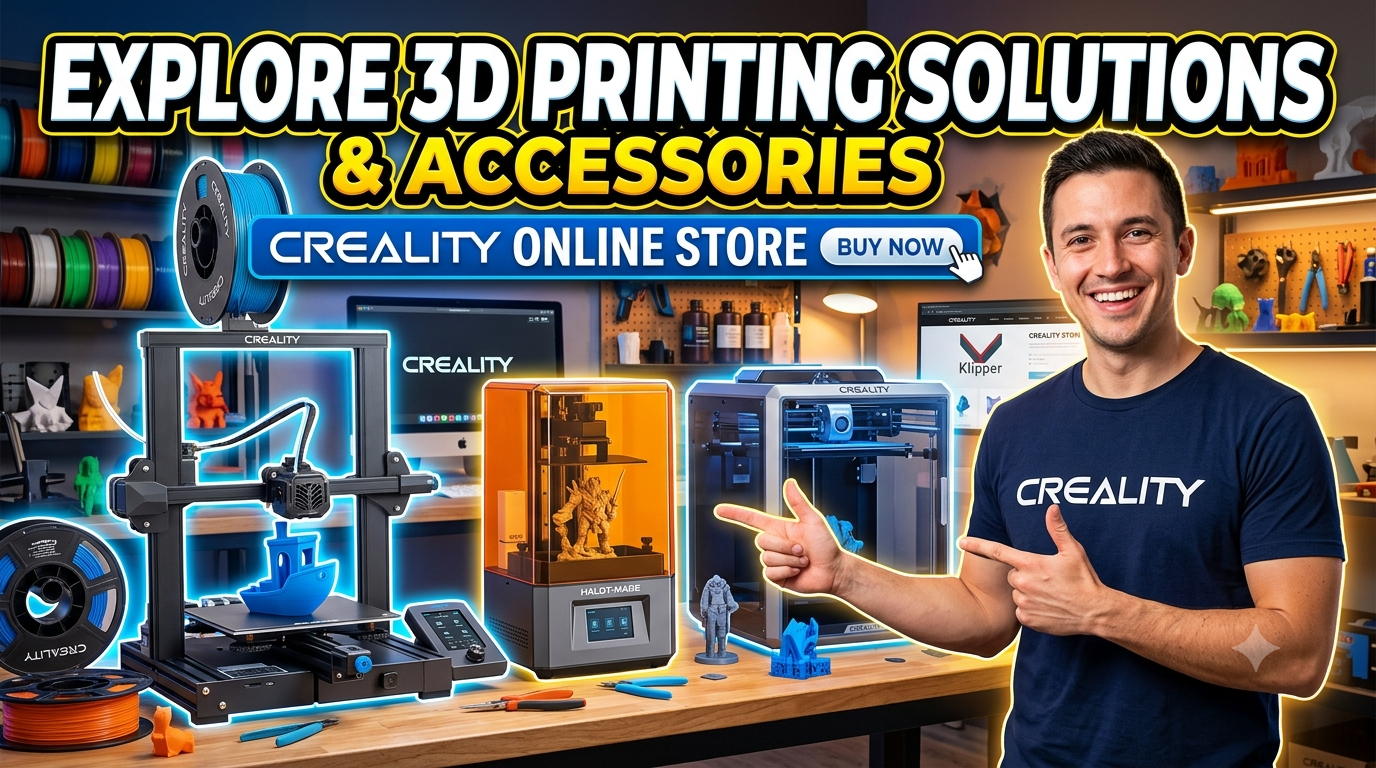
CrealityOnlineStore is a convenient destination for exploring innovative 3D printing solutions, including advanced 3D printers, high-quality filaments, resin printers, replacement parts, and essential accessories. Whether you are a beginner, hobbyist, designer, or professional maker, CrealityOnlineStore offers a wide range of products designed to make 3D printing more efficient, reliable, and creative. Discover the latest printing technologies, upgrade your setup with compatible accessories, and find the tools and materials you need to bring your ideas to life.
Table of Contents
- Why CrealityOnlineStore Stands Out for 3D Printing
- Exploring Creality 3D Printers
- Creality Filaments and Printing Materials
- Essential 3D Printer Accessories
- Upgrading Your 3D Printing Setup
- How to Choose the Right Creality Products
- Benefits of Shopping Through the Creality Store
- Building a Smarter 3D Printing Workflow
- Conclusion
- FAQs
Why CrealityOnlineStore Stands Out for 3D Printing
A Complete 3D Printing Ecosystem
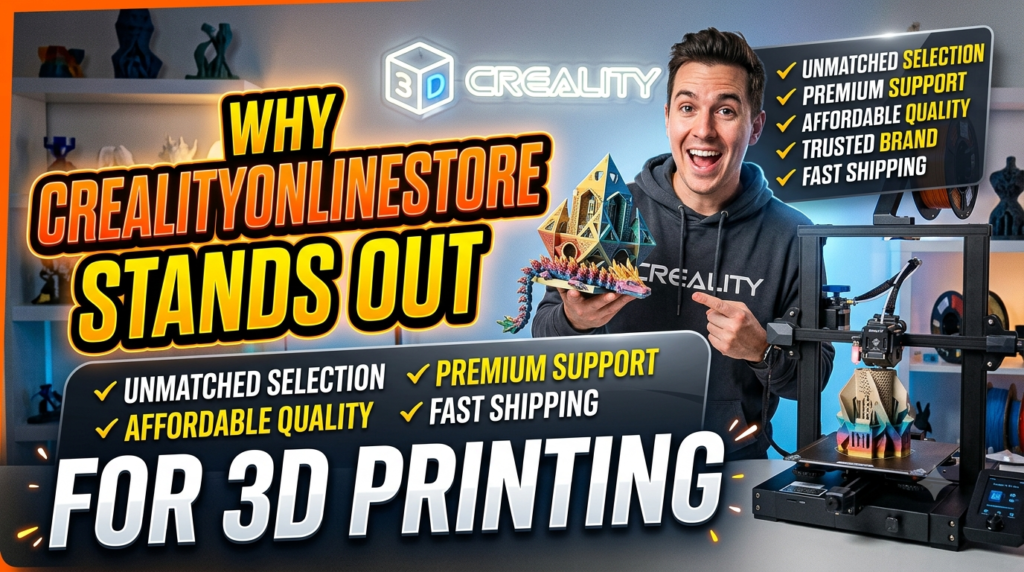
One of the biggest advantages of shopping within a dedicated 3D printing ecosystem is convenience. Imagine buying a car and then having to search several unrelated stores whenever you need tires, filters, tools, or replacement components. That experience can become frustrating quickly. A similar problem can happen with 3D printers when users purchase machines from one source, filament from another, accessories from a third, and replacement components from somewhere else without knowing whether everything is compatible.
The official Creality Store attempts to simplify this process by organizing printers, materials, accessories, and related equipment in one place. Its current store structure includes categories for flagship printers, DIY printers, multicolor machines, laser engravers, scanners, resin printers, materials, and accessories. This organization can be particularly useful for people who want to build a setup gradually rather than purchase every component at once.
The accessory section is especially important because it covers practical components such as nozzles, hotends, build plates, belts, printer tool kits, heating blocks, extruder kits, and other replacement or upgrade parts. The store currently lists more than 200 accessory products, illustrating how extensive the supporting ecosystem can become around a modern 3D printer.
Products for Beginners and Experienced Makers
Not everyone approaches 3D printing with the same expectations. A beginner may prioritize simple calibration, straightforward assembly, reasonable pricing, and ease of use. An experienced maker may care more about printing speed, advanced materials, automation, larger build volumes, multicolor capabilities, or the ability to customize a machine.
Creality’s current range addresses several of these different needs. Its official store currently highlights products such as the K2 Plus Combo, K2/K2 Combo, SPARKX i7 series, K2 Pro/Combo, K2 SE, and Ender-3 V4 Combo. The wider Creality product catalog also includes the K3, K2 family, Ender-3 V3 SE, Ender-3 V3 KE, Ender-5 Max, Ender-3 V4, and resin systems such as the HALOT range.
This variety matters because choosing a printer is less about finding the machine with the biggest specification sheet and more about matching the hardware to the work you actually want to do. A student printing small models has very different requirements from a designer producing functional prototypes every day. The right machine is the one that fits the workload rather than simply looking impressive on paper.
Exploring Creality 3D Printers
High-Speed FDM 3D Printers
FDM printing remains one of the most accessible forms of 3D printing because it uses thermoplastic filament and can support everything from simple decorative models to functional prototypes. Creality has developed several printer families around this technology, with different combinations of speed, automation, build volume, and material compatibility.
For example, the official specifications for the Ender-3 V3 list a 220 × 220 × 250 mm build volume, maximum printing speed of up to 600 mm/s, Wi-Fi connectivity, automatic leveling, a flexible PEI build plate, and compatibility with materials including PLA, TPU, PETG, ABS, PLA-CF, and PETG-CF. Those specifications make it a useful illustration of how modern desktop printers combine mechanical performance with software-assisted calibration and connectivity.
Speed, however, should never be considered in isolation. A printer that can theoretically reach a very high maximum speed still needs appropriate acceleration, cooling, extrusion performance, and material settings to produce consistently good parts. Think of it like driving a sports car: the top speed tells only part of the story. Stability, control, braking, road conditions, and the driver’s experience all influence the actual journey.
For users exploring Creality printers, this means it is sensible to consider the entire printing workflow instead of focusing on a single specification. Build volume, nozzle temperature, supported materials, automatic calibration, connectivity, enclosure requirements, and maintenance requirements can all influence whether a printer feels right for a particular project.
Resin 3D Printing Solutions
FDM is not the only route available to makers. Resin 3D printing is particularly attractive when highly detailed surfaces and intricate shapes are important. Creality’s current product ecosystem includes resin printer families alongside its FDM lineup, giving users another option for specialized projects.
Resin printing can be appealing for miniature models, detailed prototypes, artistic pieces, jewelry-style designs, and other applications where surface detail is a major priority. At the same time, resin printing involves a different workflow from filament-based printing, including material handling, washing, curing, and appropriate workspace practices. That means choosing between FDM and resin should be based on the desired output rather than simply selecting whichever technology is more popular.
A useful way to think about the difference is this: FDM is often like building an object with a heated strand layer by layer, while resin printing is more like sculpting an object from liquid material using controlled light exposure. Both can produce impressive results, but they solve different problems. The better choice depends on whether your priorities lean toward material variety, functional parts, ease of use, fine detail, surface finish, or production workflow.
Creality Filaments and Printing Materials
PLA, PETG, ABS, and Specialty Filaments
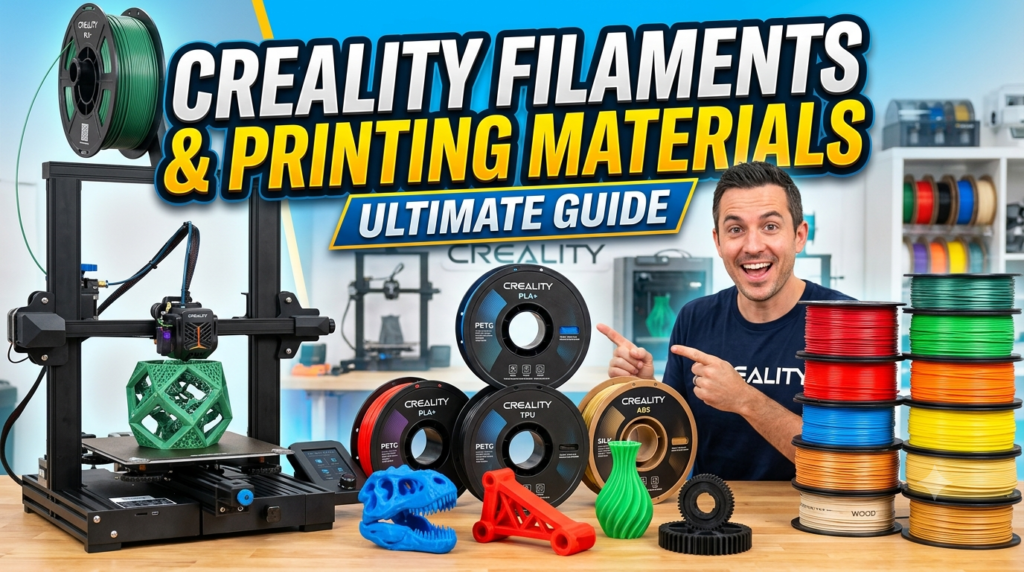
A 3D printer is only as useful as the materials you can successfully print with it. Creality’s current store offers several filament categories, including Hyper PLA, Hyper PETG, Hyper ABS, Hyper PLA CF, Hyper Rainbow PLA, and other materials. This range allows makers to move beyond basic single-material experimentation and explore different combinations of strength, appearance, flexibility, durability, and print behavior.
PLA is often an approachable starting point because it is widely used for models, prototypes, educational projects, decorative objects, and general-purpose printing. PETG can be useful when users want a balance of durability and ease of printing, while ABS can be selected for applications where different mechanical or temperature characteristics are required. Composite materials containing carbon fiber can offer another route for users interested in more specialized applications.
The important lesson is that filament should be selected according to the purpose of the printed object. Printing a decorative figure does not require the same material strategy as producing a functional bracket or prototype.Rather than inquiring, “Which filament is best?” ask, “Which filament is best for this job?” That small change in thinking can lead to better results and fewer wasted prints.
Creality’s official product ecosystem also includes dedicated filament families and material guides, helping users explore different options as their experience develops.
Why Filament Storage Matters
Material management becomes increasingly important as your printing ambitions grow. Filament can be affected by environmental conditions, particularly moisture, and poor storage can contribute to inconsistent printing behavior. This is why accessories such as filament dryers and dry boxes have become increasingly relevant in modern 3D printing setups.
Creality’s store currently offers products such as the Space Pi Dryer and SpacePi X4, while its accessory catalog also includes filament-management products. These systems can help users manage materials more deliberately instead of leaving every spool exposed to the surrounding environment.
This is one of those areas where a relatively simple accessory can have a surprisingly meaningful effect on the overall workflow. Think about filament as an ingredient in a kitchen. Even if you own an excellent oven, ingredients that have been poorly stored can still affect the final meal. In the same way, a capable printer cannot completely compensate for material that has been handled or stored poorly.
Essential 3D Printer Accessories
Nozzles, Hotends, and Extruder Components
Accessories are sometimes treated as optional extras, but anyone who prints regularly quickly discovers that they are part of the core experience. Nozzles wear out, extruder components may need replacement, heating components can require maintenance, and different printing materials may benefit from different hardware configurations.
Creality’s current accessory selection includes nozzle kits, heating block kits, extruder kits, and front covers for several printer families. For example, the official store currently lists a K2 Plus Unicorn Nozzle Kit, K2 Plus Heating Block Kit, and K2 Plus/K2 Pro/K2 Extruder Kit.
Having compatible replacement parts readily available can reduce downtime. Instead of treating a worn component as a reason to stop printing for weeks, a user can replace the relevant part and return to production. This becomes particularly important for people who use their printers frequently for work, prototyping, education, or small-scale manufacturing.
Different nozzles can also influence the balance between detail and productivity. A smaller nozzle can be useful for fine details, while a larger nozzle can help users produce thicker layers and potentially reduce print times for appropriate designs. The right choice depends on the model, material, desired surface quality, and acceptable production time.
Build Plates and Printer Maintenance
The build plate is another component that can dramatically influence the printing experience. If the first layer does not adhere properly, even an otherwise excellent print can fail. Creality’s accessory lineup includes multiple build plates designed for specific printer families, including PEI options.
The official Ender-3 V3 specifications, for example, identify a flexible textured PEI plate as part of the machine’s setup. Creality describes the spring-steel base as allowing users to flex the plate slightly to release completed models. This illustrates how a seemingly simple component can affect both adhesion and model removal.
Maintenance should also be treated as routine rather than something that happens only after a failure. Cleaning the build surface, checking mechanical components, inspecting the nozzle, managing filament, and keeping the printer’s moving parts in good condition can help maintain consistent performance.
A useful maintenance mindset is to think of your printer like a bicycle. You do not wait until the chain completely fails before paying attention to it. Small checks performed regularly are usually easier than major repairs after neglect.
Cameras, Dryers, and Filament Management
Modern 3D printing is becoming more connected and automated, which is reflected in the accessories available through Creality’s ecosystem. The current accessory catalog includes products such as the Nebula Camera, AI Camera for K1/K1 Max, filament dryers, CFS-related components, and other printer-specific upgrades.
A camera can be useful for monitoring prints, particularly when a machine is operating for long periods. Filament-management systems can make material changes and storage more organized. Drying equipment can help users manage moisture-sensitive materials more effectively.
The benefit is not just convenience. Automation can change how much attention a printer requires during a typical job. Instead of repeatedly checking the machine manually, users can increasingly rely on connected systems and carefully configured hardware. That does not eliminate the need for supervision, but it can make the overall process more efficient.
Upgrading Your 3D Printing Setup
Improving Print Quality and Reliability
One of the most satisfying parts of 3D printing is that the journey does not have to end when you purchase a printer. A basic setup can evolve over time. You might begin with standard PLA and simple models, then eventually experiment with different build surfaces, nozzles, materials, drying systems, cameras, and other upgrades.
The official Creality Store specifically positions its accessories around upgrading, repairing, and personalizing printers. Its current accessory collection includes parts for K2 Plus, K2 Pro, K2, K1 Max, K1C, Ender models, and other systems. This printer-specific organization is useful because compatibility matters enormously in 3D printing.
A successful upgrade should solve a real problem. If you frequently experience first-layer issues, a suitable build plate or calibration improvement may be more useful than a cosmetic modification. If you print abrasive composite materials, a suitable wear-resistant nozzle may make more sense. If your filament absorbs moisture, a drying solution may be a more meaningful investment than another spool of material.
The best upgrades are therefore not necessarily the most expensive ones. They are the ones that remove friction from your particular workflow.
Accessories for Greater Automation
Automation is becoming an increasingly important part of desktop manufacturing. Features such as automatic leveling, input shaping, remote connectivity, cameras, filament management, and automated material handling can reduce repetitive tasks.
The Ender-3 V3, for instance, includes one-tap calibration, automatic Z offset and leveling, and an automatic input-shaping test according to Creality’s official specifications. These features demonstrate how modern machines can take over tasks that previously required more manual intervention.
Creality’s current product ecosystem also includes the CFS filament system and related accessories, alongside printer combinations designed around expanded functionality. For makers who want to move toward more automated or multicolor workflows, such systems can become an important part of the setup.
Automation should not be confused with complete independence. A smart printer still benefits from good preparation, correct material settings, clean components, and sensible monitoring. Automation is best viewed as an assistant rather than a replacement for good printing habits.
How to Choose the Right Creality Products
Match the Printer to Your Experience
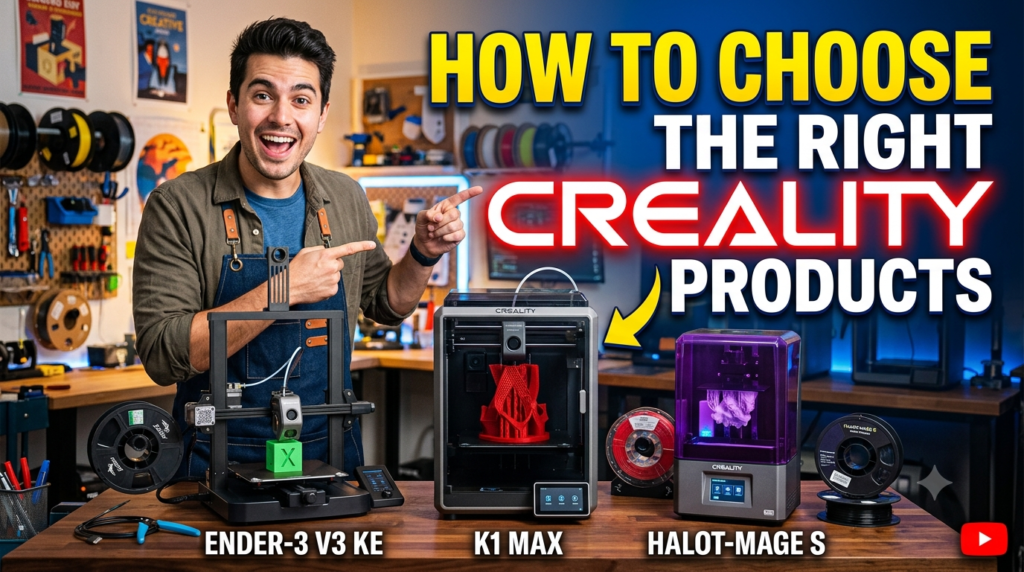
The easiest way to become overwhelmed by 3D printers is to compare specifications without considering your own goals. Instead, start with the project. Are you printing toys and decorative models? Are you making functional parts? Do you need large objects? Do you want multicolor capabilities? Are you planning to use engineering-oriented materials? Are you interested in high-speed production?
Beginners may appreciate machines designed around easier calibration and straightforward operation. Experienced users may want greater flexibility and access to advanced materials or upgrade paths. Businesses may prioritize reliability, productivity, repeatability, and service support.
Creality’s current range spans multiple product categories, from Ender machines to K-series printers and newer SPARKX products, allowing buyers to consider different price and performance levels.
A good purchase is therefore less about chasing the newest model and more about choosing a platform that can grow with you. If you expect your skills and requirements to expand, it can make sense to consider the upgrade ecosystem at the beginning rather than discovering compatibility limitations later.
Consider Materials, Speed, and Build Volume
Three specifications deserve particular attention: material compatibility, printing speed, and build volume. These three factors directly influence what you can produce and how efficiently you can produce it.
Build volume determines the physical size of the objects you can print in one piece. Speed affects how quickly suitable models can be produced, although real-world print time depends on many factors beyond the maximum advertised speed. Material compatibility determines whether your printer can handle the types of filament or resin required for your intended projects.
For example, Creality’s Ender-3 V3 supports a range of materials including PLA, TPU, PETG, ABS, PLA-CF, and PETG-CF, while its specifications list a 220 × 220 × 250 mm build volume and up to 600 mm/s maximum printing speed.
This demonstrates why a specification should always be viewed in context. A high speed may be valuable to a user printing many prototypes, while a large build volume could matter more to someone producing oversized models. Material compatibility may be the deciding factor for another buyer entirely.
Read More:-
How Does Strikingly Simplify the Website Building Process?
Building Your Dream Website with Site123
Boost Your E-commerce Strategy with YITH Plugins
Maximize Your Customer Engagement with LiveAgent’s Features
Why STRIPO is Essential for Digital Product Marketersa
Benefits of Shopping Through the Creality Store
Warranty, Support, and Product Compatibility
Buying from an official manufacturer store can provide advantages beyond the product itself. The current Creality Store advertises a 14-day refund guarantee, a one-year warranty guarantee, secure payments, selected fast and free shipping, early access to new products, and lifetime customer support. Policies can vary by region and product, so buyers should always review the current terms before purchasing.
Support becomes particularly valuable as 3D printing becomes more sophisticated. A new user may need help understanding calibration, while an experienced user might need a compatible replacement component or troubleshooting information. Having access to manufacturer documentation and support resources can make the difference between quickly solving a problem and spending hours searching through unrelated sources.
Compatibility is another major benefit of shopping within the manufacturer’s ecosystem. Creality’s accessory catalog groups products according to printer families, including K2, K1, Ender, and other models. That structure can reduce the risk of purchasing an accessory that does not fit your machine.
Current Deals and Product Availability
Pricing and promotions can change frequently, which is why it is better to check the store directly rather than rely on an old price from a review or article. At the time of research, the official Creality Store was displaying promotional pricing on several printer models, including K2 Plus Combo, K2/K2 Combo, SPARKX i7, K2 Pro/Combo, K2 SE, and Ender-3 V4 Combo.
The store was also displaying a broad selection of filament products, including Hyper PLA, Hyper PETG, Hyper ABS, Hyper Rainbow PLA, and Hyper PLA CF. Accessory promotions were also visible, with the store advertising tiered discounts on qualifying accessory purchases.
Because these offers can change, shoppers should compare the current product page, specifications, availability, shipping information, and warranty terms before making a final purchase. A discounted printer is only a good deal if it meets your actual needs.
Building a Smarter 3D Printing Workflow
The real potential of a Creality setup appears when the individual components begin working together. A printer provides the mechanical foundation, filament provides the raw material, the build plate supports the object, the nozzle controls extrusion, the software converts the design into instructions, and accessories help improve reliability and convenience. When these elements are selected carefully, the entire workflow becomes more predictable.
This is why CrealityOnlineStore can be viewed as more than a place to buy a 3D printer. It is a resource for building and expanding a complete making environment. The current ecosystem spans FDM printers, resin printers, scanners, materials, dryers, cameras, replacement components, and other accessories.
The best setup is not necessarily the one with the largest number of gadgets. It is the setup that removes the obstacles standing between an idea and a finished object. Maybe that means a faster printer. Maybe it means a better build plate. Perhaps it means a filament dryer or a replacement nozzle. Sometimes the most valuable upgrade is simply having the right spare part available when you need it.




Conclusion
Exploring 3D printing solutions and accessories at CrealityOnlineStore reveals how much the technology has evolved. Modern 3D printing is no longer limited to buying a machine, loading filament, and pressing print. Today’s ecosystem includes high-speed printers, resin systems, specialized materials, automatic calibration, connected features, cameras, filament-management solutions, replacement parts, build plates, nozzles, extruders, and other upgrades designed to make printing more capable and convenient.
Creality’s current official store provides access to a wide range of these products, while its broader ecosystem includes printers, scanners, software, materials, and accessories. The Ender-3 V3, for example, demonstrates how even a desktop FDM machine can combine high-speed printing, automatic calibration, Wi-Fi connectivity, flexible PEI printing surfaces, and support for multiple filament types.
For a beginner, the smartest approach is to start with a printer and material combination that matches the projects you actually want to create. For experienced users, the focus can shift toward productivity, specialized materials, automation, and targeted upgrades. Either way, accessories should not be treated as an afterthought. They are part of the broader system that determines how smoothly your printer performs.
Ultimately, the beauty of 3D printing is that your setup can evolve alongside your skills. You can start small, learn the fundamentals, experiment with materials, add useful accessories, and gradually build a workshop tailored to your imagination. With a broad product ecosystem and dedicated support resources, Creality provides makers with multiple paths to turn digital designs into physical creations.
FAQs
Q. What can I buy from the CrealityOnlineStore?
A. The official Creality Store currently offers 3D printers, resin printers, filaments, accessories, scanners, and other maker-related products. Its accessory range includes components such as nozzles, build plates, heating blocks, extruder kits, cameras, and filament-management equipment.
Q. Is Creality suitable for beginners?
A. Yes. Creality offers products across different experience levels, including beginner-oriented machines and more advanced systems. The Ender series and newer SPARKX products are among the options available in the current ecosystem, while features such as automatic leveling and calibration can simplify the learning process on compatible models.
Q. Which accessories are most useful for a 3D printer?
A. Useful accessories depend on your printer and workflow, but common options include spare nozzles, build plates, extruder components, heating components, filament dryers, cameras, and maintenance tools. The Creality Store currently provides accessories organized around several specific printer families.
Q. Why should I consider a filament dryer?
A. Filament can be affected by environmental moisture, and proper material storage can be important for consistent printing. Creality currently offers filament-drying and dry-box products such as the Space Pi Dryer and SpacePi X4, providing dedicated options for users who want more controlled filament storage.
Q. How do I choose the right Creality 3D printer?
A. Start by identifying what you intend to print. Consider your preferred materials, required build volume, desired speed, level of automation, budget, and experience. Comparing these factors against the current Creality lineup is generally more useful than choosing a printer based solely on its maximum speed or newest features.