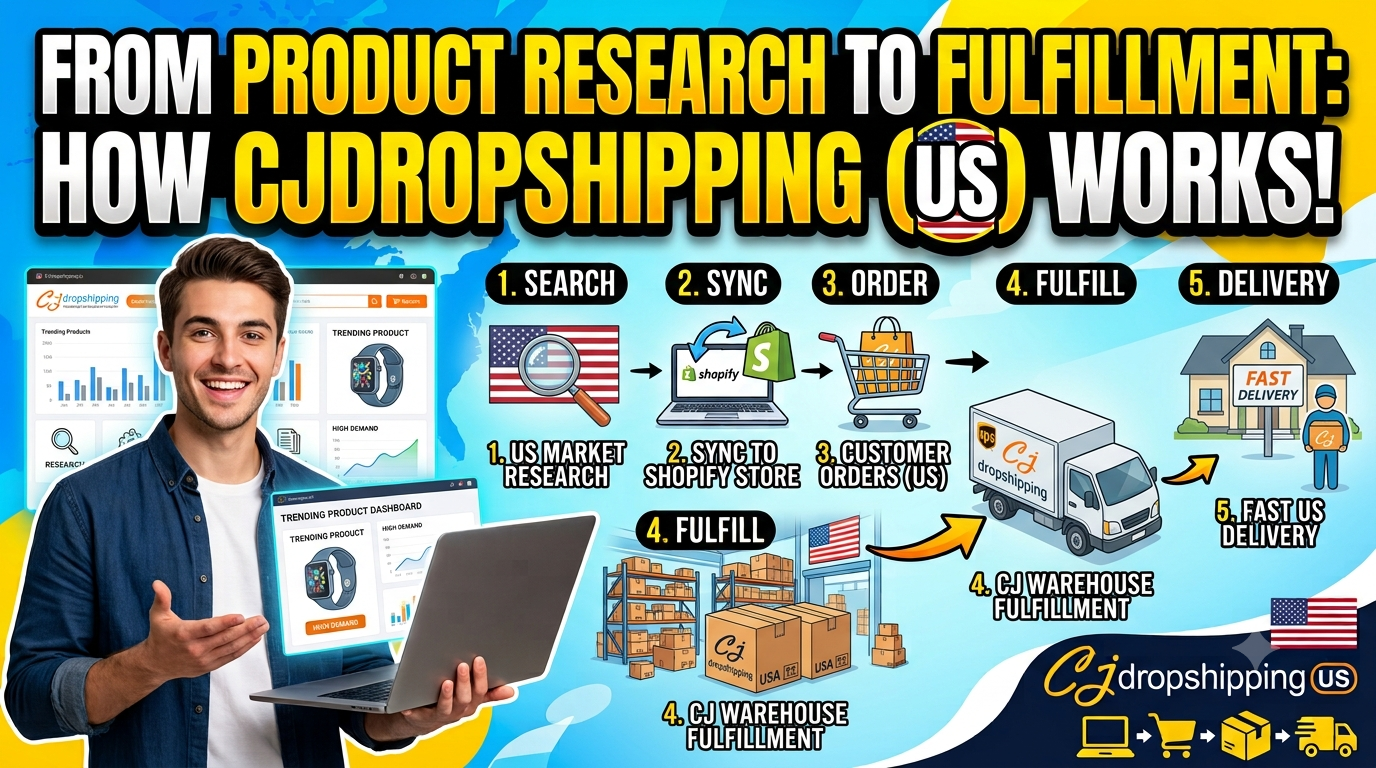
CJdropshipping (US) offers a streamlined solution for ecommerce sellers looking to manage product sourcing, inventory, warehousing, order processing, packaging, and fulfillment. From researching trending products to storing inventory in US warehouses and delivering orders to customers, CJdropshipping (US) helps simplify the dropshipping process while supporting faster and more efficient fulfillment.
Table of Contents
- What Is CJdropshipping?
- How CJdropshipping US Fits Into the Model
- Step 1 — Finding Products to Sell
- Step 2 — Evaluating a Product Before Selling
- Step 3 — Connecting CJdropshipping to Your Store
- Step 4 — Listing and Pricing Products
- Step 5 — Moving Inventory to a US Warehouse
- Step 6 — How Customer Orders Reach CJdropshipping
- Step 7 — Picking, Packing, and Quality Inspection
- Step 8 — Shipping From the US to the Customer
- CJdropshipping US Shipping Times and Costs
- CJdropshipping 3PL Fulfillment for Existing Inventory
- Custom Packaging and Branding Options
- Inventory Management and Stock Planning
- Advantages of Using CJdropshipping in the US
- Potential Challenges and Costs to Consider
- CJdropshipping vs. Traditional Dropshipping Fulfillment
- Who Should Use CJdropshipping US?
- Conclusion
- Frequently Asked Questions
What Is CJdropshipping?
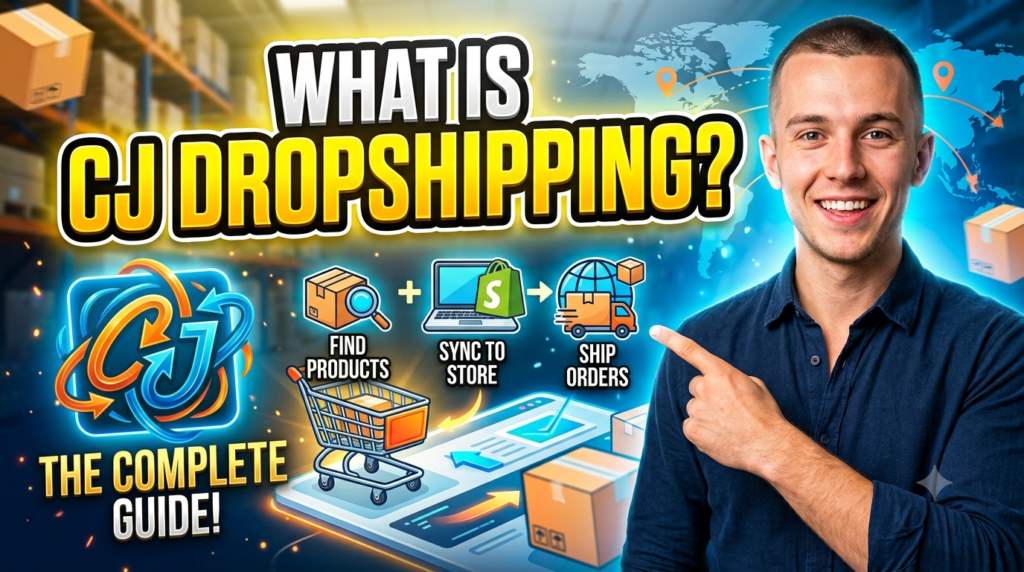
CJdropshipping is an ecommerce sourcing and fulfillment platform that connects online sellers with products, suppliers, warehouses, logistics services, and order-management tools. The basic concept is straightforward: instead of buying a large quantity of merchandise before knowing whether anyone wants it, a seller can identify products through CJ, connect those products to an online store, and have CJ handle much of the operational work when orders arrive. This model can reduce the amount of inventory a new entrepreneur needs to manage directly, although it does not eliminate business expenses or supply-chain risks. CJ also goes beyond conventional dropshipping because its services include private inventory, custom packaging, print-on-demand, sourcing requests, bulk purchasing, and 3PL fulfillment. Its current service information describes an all-in-one model covering storage, inspection, packing, stocktaking, labeling, and shipping. That distinction matters because the platform can serve different stages of an ecommerce business. A beginner may use it to test individual products, while a growing brand may purchase inventory in advance and use CJ primarily as a fulfillment partner. In other words, CJdropshipping is not necessarily tied to one particular business model. It can function as a bridge between product discovery and fulfillment, with the amount of responsibility handled by CJ changing as the merchant grows.
CJdropshipping’s Role in the Dropshipping Supply Chain
Think of an ecommerce business as a relay race. The merchant controls the storefront and customer relationship, while the supplier and fulfillment provider handle several of the physical stages that happen after the customer places an order. CJ’s role can begin before a product is even listed because merchants can search its catalog, submit sourcing requests, or provide product information from other marketplaces. CJ’s current platform specifically supports sourcing requests and lets users search for products through keywords, SKUs, URLs, and even images. Once a suitable item has been identified, the merchant can connect it to an ecommerce store and establish the relationship between the store’s product variants and CJ’s product information. When a customer purchases the item, the order can then be imported or synchronized with CJ, depending on the store integration and workflow. From there, the fulfillment operation may include inventory confirmation, picking, quality inspection, packing, labeling, and carrier handoff. CJ’s warehouse documentation describes a process in which stocked items are picked using a barcode system, checked, packed, weighed, labeled, and moved toward carrier collection. The merchant therefore remains responsible for the commercial side of the business—pricing, advertising, customer acquisition, store management, and customer relationships—while CJ can take responsibility for a significant portion of the physical supply chain.
How CJdropshipping US Fits Into the Model
The US side of CJdropshipping becomes particularly important when an ecommerce seller is targeting American customers. International dropshipping can create a frustrating mismatch between modern ecommerce expectations and long delivery windows. A shopper sees an attractive product online, places an order, and then discovers that the package is traveling across borders for days or weeks. Using inventory that has already reached a US warehouse can change that equation because the final leg can be handled domestically. CJ currently identifies New Jersey and Chino, California, as US warehouse locations and says orders can be allocated to the warehouse closest to the customer’s destination. This does not mean every CJ product is automatically stocked in the United States, nor does it mean every order will have the same delivery time. Inventory availability, product type, shipping method, destination, warehouse location, and carrier performance all matter. CJ itself advises sellers to check SKU inventory, warehouse location, and product availability before placing or synchronizing orders. That is a critical point for merchants who advertise fast shipping. A product page saying “US warehouse” is useful only when the actual variant customers are buying is available in that warehouse.
US Warehouses and Domestic Fulfillment
A US warehouse essentially changes where the fulfillment clock begins. If inventory is already sitting inside the United States, CJ does not need to purchase that unit overseas and transport it across the ocean before sending it to the customer. Instead, the warehouse can process the order locally and hand it to an appropriate domestic carrier. CJ’s help documentation says that when sellers use US warehouse inventory, the company can support domestic shipping and has promoted delivery expectations of roughly 2–4 days for certain stocked products, although merchants should verify the current shipping estimate for each specific SKU and destination rather than treating that figure as a universal guarantee. The advantage is obvious: faster delivery can make an online store feel more credible, reduce the anxiety customers experience after checkout, and potentially improve repeat purchasing. But warehouse placement also introduces a new consideration—inventory commitment. Someone has to buy and move those products into the US before they can be shipped domestically. That means the seller may need to forecast demand and decide whether faster fulfillment is worth the additional inventory exposure. The best approach is usually to treat the US warehouse as a strategic tool rather than assuming every product should be stocked there immediately.
Step 1 — Finding Products to Sell
Product research is where the CJdropshipping workflow begins for many merchants. A seller might already have a winning product idea from social media, an advertising trend, a competitor’s store, or a customer request. Alternatively, the seller may browse CJ’s catalog looking for products that appear promising. CJ’s platform currently supports product discovery through keywords, SKUs, 1688, Taobao, AliExpress URLs, and image-based searches. This flexibility is valuable because product research rarely follows one predictable path. Imagine discovering a short video featuring a clever kitchen gadget but not knowing its name. An image-search capability can help move from inspiration to a potential supplier faster than trying dozens of keyword combinations. A seller can also submit a sourcing request when the exact item is not already available in the desired catalog format. The important thing is to avoid confusing availability with viability. Finding a product is only the first gate. A good product still needs acceptable quality, realistic shipping costs, sufficient margin, reliable inventory, appropriate packaging, and a compelling reason for customers to buy it.
Product Search, Image Search, and Sourcing Requests
CJ’s sourcing system is especially useful when merchants already have a specific product in mind. A sourcing request can effectively turn the platform into a research assistant for locating a product or supplier rather than requiring the seller to search independently across multiple marketplaces. CJ also offers paid sourcing for merchants who need a more tailored sourcing process. This distinction is important because not every product idea can be treated like a simple catalog search. A seller may need a particular material, color, packaging style, variant, or customization. Instead of abandoning the product because it is not immediately visible, the merchant can investigate sourcing options. Still, sourcing should be approached like detective work. Compare the quoted product cost with expected selling prices, check whether the supplier can maintain quality at scale, examine shipping options, and request samples when appropriate. A product that costs very little to source can become expensive once shipping, fulfillment, payment processing, advertising, refunds, returns, and other operating expenses are included. The winning product is not necessarily the cheapest product. It is the product whose total economics make sense after the entire customer journey is considered.
Step 2 — Evaluating a Product Before Selling
Before putting serious advertising money behind a product, testing is one of the smartest steps a merchant can take. CJ supports sample and testing orders so sellers can become familiar with the product and fulfillment process before scaling. A sample gives the merchant an opportunity to inspect the physical item rather than judging everything from product photographs. Is the material acceptable? Does the product look like the listing? Is the packaging damaged or generic? Does the item actually solve the problem it claims to solve? These questions sound basic, but they can separate a sustainable ecommerce business from a refund-heavy one. A merchant should also examine dimensions and weight because those factors can have a major effect on fulfillment economics. A product that looks profitable on a spreadsheet can become unattractive once shipping is calculated based on its actual packed weight or dimensional characteristics. Testing also helps the merchant create better product photography and video content because personally handling the product makes it easier to demonstrate realistic use cases.
Samples, Quality Checks, and Product Validation
Quality control becomes even more important when the merchant never physically handles individual customer orders. CJ describes quality-control procedures that include inspections before inventory is stocked and inspection before orders are dispatched in its 3PL service. CJ also explains that its warehouse fulfillment process includes quality checks, measurement, packing, sorting, weighing, and labeling. That can provide an additional operational layer, but merchants should not treat supplier inspection as a replacement for their own product validation. Your customers judge your brand, not your supplier. If the product has a defect, unclear instructions, weak materials, or disappointing performance, the customer is unlikely to say, “My supplier caused this.” They will simply blame the store that took their money. For that reason, product testing should combine physical inspection, sample ordering, customer-use simulation, competitive research, and financial analysis. It is far easier to reject a poor product before spending hundreds or thousands on advertising than to repair a damaged store reputation afterward.
Step 3 — Connecting CJdropshipping to Your Store
Once a product passes the initial validation stage, the next step is connecting the fulfillment system to the ecommerce storefront. CJ currently advertises integrations with Shopify, eBay, WooCommerce, Etsy, TikTok Shop, Temu, Shoplazza, Nuvemshop, AliExpress, Mercado, Lazada, Shopee, and other platforms. The exact setup depends on the selling channel, but the objective is consistent: create a reliable relationship between the product in the merchant’s store and the corresponding product or SKU in CJ. That connection is what allows the fulfillment system to recognize what needs to be shipped when a customer places an order. Product mapping deserves more attention than it usually receives. A product can have multiple colors, sizes, bundles, or configurations, and a mismatch between store variants and supplier variants can result in the wrong item being shipped. A merchant should therefore check variant mapping before launching paid traffic. Automation is powerful because it reduces repetitive work, but automation only works well when the underlying data is correct. A beautifully automated system with incorrect SKU connections simply makes mistakes faster.
Step 4 — Listing and Pricing Products
Listing a CJ product involves more than copying a supplier description and pressing publish. CJ allows merchants to list products directly to authorized stores, and its FAQ explains that sellers can also edit products before listing and select particular variants. This gives merchants an opportunity to transform supplier information into customer-focused ecommerce content. A strong product page should explain the problem, show the solution, answer common objections, present accurate specifications, and set realistic expectations around shipping. Pricing deserves the same level of care. The selling price needs to account for product cost, shipping, transaction fees, advertising, refunds, discounts, customer service, taxes where applicable, and the merchant’s desired profit. The simple formula of “supplier cost × two” is rarely enough. A store might sell a product for $29.99 and still lose money if customer acquisition costs rise sharply. Conversely, a higher price can be sustainable when the product is well differentiated and the customer experience is strong. The real objective is not simply to maximize markup; it is to build enough contribution margin to support growth.
Step 5 — Moving Inventory to a US Warehouse
For merchants who want domestic US fulfillment, inventory needs to physically reach a US warehouse before it can be shipped from there. CJ supports fulfillment services in which merchants can send their own inventory from a supplier or factory to CJ’s US warehouse, where CJ can store, pack, and deliver those products. CJ’s current fulfillment information states that inventory can be pre-stocked and that its service includes storage, quality inspection, and order fulfillment. It also advertises free storage for the first three months under its 3PL service, while its broader service-fee page provides detailed warehouse and processing charges that can vary by service and location. The inventory-transfer stage is therefore a strategic decision. Sending too little stock can lead to frequent replenishment and stockouts, while sending too much can trap cash in unsold inventory. A merchant should look at sales velocity, seasonal demand, advertising plans, lead times, and safety stock before deciding how much inventory to move. US warehousing can shorten the final-mile journey, but it does not remove the need for sensible inventory forecasting.
Step 6 — How Customer Orders Reach CJdropshipping
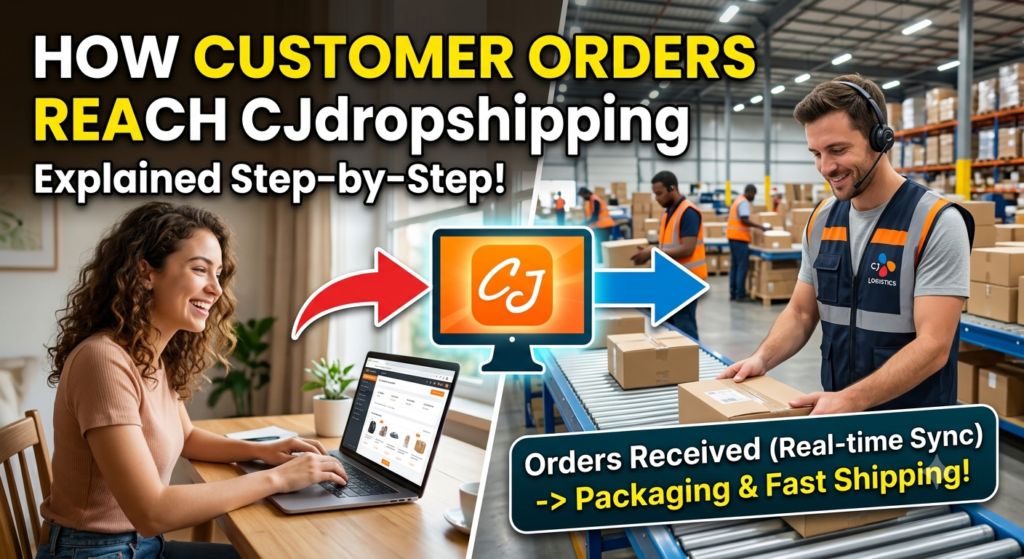
Once a customer places an order, the next question is simple: how does CJ know what to ship? With a connected store, orders can be imported or synchronized into CJ’s order-management workflow. CJ provides tutorials for automatic order creation and supports both automatic and manual order import and fulfillment within its 3PL ecosystem. The order needs to be matched to the correct product, variant, quantity, customer address, and fulfillment warehouse. Payment is another important part of the workflow because the supplier needs authorization or payment before the fulfillment process proceeds. CJ’s supplier agreement describes customer deposits or daily payment options and states that clients are responsible for applicable product, shipping, and other charges. Once the order is ready, the warehouse checks inventory. If the item is available, fulfillment can move into picking and packing. If it is unavailable, the process can instead require purchasing or restocking, which can increase processing time. CJ’s FAQ currently says stocked orders normally have a 2–3 day processing period, while orders requiring product purchasing can normally take 2–5 days, although actual timing can vary.
Step 7 — Picking, Packing, and Quality Inspection
This is where the abstract ecommerce transaction becomes a physical package. CJ’s warehouse documentation describes a fulfillment sequence beginning with stock verification and picking, followed by quality checks, measuring, packing, sorting, weighing, labeling, and movement toward carrier pickup. Barcode-based picking is particularly useful when warehouses process many SKUs because it reduces the risk of confusing visually similar products. Packaging can also vary according to the product. Delicate merchandise may require additional protection, while simpler products may use bags or boxes designed for efficient transportation. CJ says its normal packaging can involve envelope bags with protective air material, while paper boxes or cartons may be used for certain products. This stage is often invisible to customers, but it can have a major effect on customer satisfaction. A fast shipment that arrives damaged is not a successful fulfillment experience. The best ecommerce operation therefore treats packing as part of the product experience rather than an administrative afterthought.
Step 8 — Shipping From the US to the Customer
After the package is prepared and labeled, it enters the final-mile shipping process. When US inventory is used, the package can move through domestic carrier networks rather than beginning its journey in China. CJ says its US warehouses are positioned on the East and West Coasts and that it generally allocates inventory based on destination to help customers receive packages quickly. The practical benefit is that the merchant can market a more competitive delivery experience when the relevant inventory is genuinely available domestically. Still, shipping speed should always be communicated carefully. Estimated delivery is not the same thing as guaranteed delivery, and carrier delays can occur even when the fulfillment provider processes an order correctly. CJ’s FAQ explains that shipping estimates are based on information from local carriers and tracking history. Merchants should therefore use the current shipping calculator and product-level information when setting customer expectations. A realistic delivery promise is better for a brand than an aggressive promise that frequently gets missed.
CJdropshipping US Shipping Times and Costs
Shipping cost is one of the most important variables in the entire dropshipping equation because it directly influences profit margins. CJ publishes shipping information and notes that pricing can change based on route, service, product characteristics, and other variables. Its service-fee page, for example, lists reference transportation rates for shipments moving from China to overseas warehouses, while last-mile shipping charges are handled separately through shipping calculations. This distinction is essential. A seller should not assume that the cost of moving inventory into the United States is the same as the cost of delivering one customer order from a US warehouse. These are separate logistical stages. Merchants should calculate total landed and fulfillment costs rather than looking only at the supplier’s product price. A useful model includes product cost, inbound transportation, warehousing or applicable fees, outbound fulfillment, last-mile shipping, payment fees, advertising costs, refunds, and other operating expenses. Once those numbers are known, the merchant can determine the break-even selling price and realistic profit margin. Shipping is not merely an expense to minimize; it is part of the customer value proposition. Paying slightly more for reliable domestic delivery can sometimes make a product easier to sell.
CJdropshipping 3PL Fulfillment for Existing Inventory
One of the most interesting aspects of CJdropshipping US is that merchants do not necessarily need to buy products from CJ to use its fulfillment infrastructure. CJ’s 3PL service explicitly allows merchants to send inventory from their own supplier or factory to CJ warehouses, after which CJ can store, pack, and deliver orders. This creates a bridge between traditional dropshipping and a more conventional inventory-based ecommerce operation. Imagine a brand that has already found a reliable manufacturer and wants to purchase inventory in bulk for better unit economics. Instead of building its own warehouse operation, it can potentially outsource storage and fulfillment to CJ. The service can therefore become useful as a business scales. CJ states that its 3PL pricing can include shipping, inbound, outbound, and stocking-related costs depending on the fulfillment arrangement. This model also gives merchants more control over their inventory than pure order-by-order sourcing. The trade-off is that the seller now carries inventory risk. If a product does not sell, the merchant still owns those units. That is why 3PL fulfillment often makes more sense after a product has demonstrated demand.
Custom Packaging and Branding Options
Branding is one of the areas where dropshipping businesses can evolve from generic stores into recognizable ecommerce companies. CJ advertises customized packaging and says merchants can add logos, stickers, cards, bags, and other branding elements. Its broader platform also highlights custom packaging, ODM services, and brand internalization as part of its ecommerce offering. Why does this matter? Because a customer may forgive a generic shopping experience when buying a low-cost commodity, but long-term brand value is built through consistency. The package that arrives at someone’s doorstep is part of that consistency. A branded insert, appropriate packaging, or carefully designed label can make the experience feel intentional rather than anonymous. There are practical considerations, however. Customization can involve additional costs, minimum quantities, design requirements, and additional preparation time. Merchants should therefore avoid adding branding simply because it sounds impressive. The better question is whether the branding reinforces the store’s positioning and improves the customer’s perception enough to justify the expense.
Inventory Management and Stock Planning
Inventory management becomes increasingly important once a merchant relies on US fulfillment. Domestic stock can produce faster delivery, but it also creates a physical inventory commitment. CJ’s own documentation emphasizes checking SKU inventory and warehouse availability before placing or synchronizing orders. A merchant should monitor which variants sell quickly, which colors or sizes move slowly, and how long replenishment takes. This is especially important for products with multiple variants because one popular variant can sell out while less popular versions remain untouched. A practical inventory system should track average daily sales, current stock, incoming stock, supplier lead time, and a safety-stock threshold. Seasonal products require even more careful planning because demand can rise rapidly and then disappear just as quickly. The goal is not to maintain the largest possible warehouse balance. The goal is to maintain enough inventory to support sales without turning cash into stagnant stock. In that sense, inventory management is like maintaining water pressure in a pipeline: too little causes interruptions, while too much creates unnecessary pressure on the system.
Advantages of Using CJdropshipping in the US
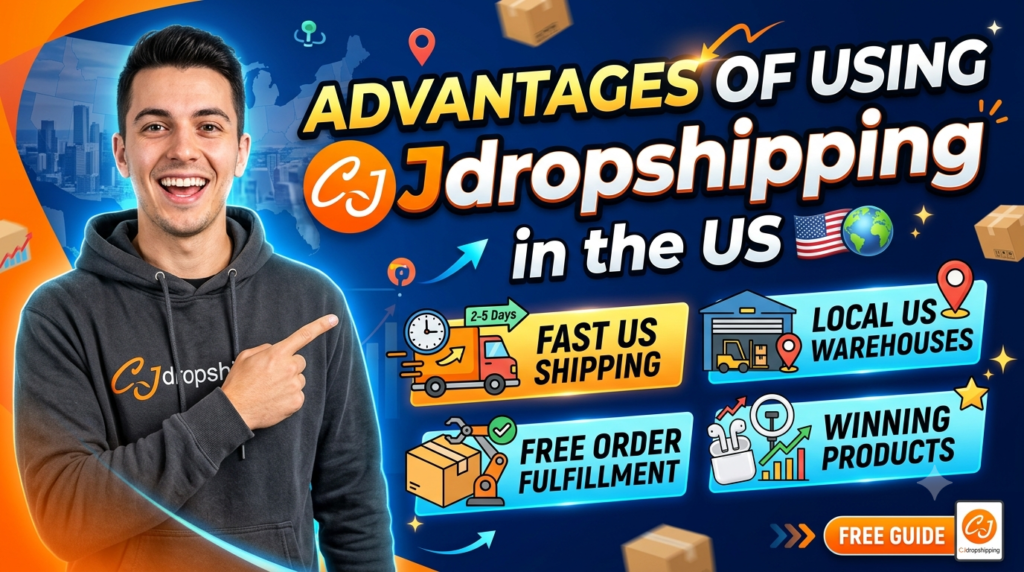
The biggest advantage of CJdropshipping is integration. Instead of managing product discovery, sourcing, inventory, fulfillment, packaging, and shipping as completely separate operations, a merchant can access many of those services through one ecosystem. CJ currently presents sourcing, custom packaging, print-on-demand, bulk purchase, ODM, and 3PL fulfillment as interconnected services. For US sellers, domestic warehouse availability can add another important advantage by shortening the final-mile journey when the appropriate stock is available. The platform also supports a wide range of ecommerce integrations, which can reduce manual order administration. Another advantage is scalability. A seller can start with product research and testing, move toward regular dropshipping, and eventually use private inventory or 3PL fulfillment as order volume increases. This creates a path that does not require rebuilding the entire supply chain every time the business reaches a new stage. The platform is not a magic button, though. Its value depends on product selection, inventory accuracy, shipping choices, store quality, advertising performance, and customer service. CJ can manage physical operations, but it cannot create product-market fit for the merchant.
Potential Challenges and Costs to Consider
No fulfillment platform eliminates the challenges of ecommerce. One potential issue is inventory availability. A product may exist in CJ’s global catalog without being available in the US warehouse in the required variant. Another challenge is the difference between advertised estimates and real-world delivery conditions. Carrier delays, stock shortages, warehouse processing, and incorrect product mappings can all affect the customer experience. Cost complexity can also surprise new merchants because the real fulfillment cost may include several components rather than one simple supplier price. CJ’s published fee information shows separate categories for shipping, inbound fees, labeling, and other services, with charges varying by warehouse and service type. Returns are another area that deserves attention before launch. The merchant should understand the applicable return, refund, damaged-product, and replacement procedures and communicate appropriate policies to customers. CJ’s supplier agreement contains specific return and refund provisions, but merchants should review the current agreement and service terms applicable to their own arrangement rather than assuming every product or account follows identical rules. The lesson is simple: calculate the complete operating model before scaling advertisements.
Read More:-
How Does Strikingly Simplify the Website Building Process?
Building Your Dream Website with Site123
Boost Your E-commerce Strategy with YITH Plugins
Maximize Your Customer Engagement with LiveAgent’s Features
Why STRIPO is Essential for Digital Product Marketersa
CJdropshipping vs. Traditional Dropshipping Fulfillment
Traditional dropshipping often means finding an individual supplier, sending customer orders to that supplier, and relying on the supplier to ship directly to buyers. CJdropshipping expands that concept into a broader supply-chain platform. The comparison becomes clearer when the major functions are placed side by side.
| Feature | Traditional Supplier Model | CJdropshipping US Model |
| Product sourcing | Usually handled separately | Integrated sourcing options |
| Product discovery | Supplier-dependent | Catalog, keyword, URL, and image search |
| US warehousing | Depends on supplier | US warehouse fulfillment available |
| Order fulfillment | Usually supplier-managed | Integrated fulfillment workflow |
| 3PL services | Often separate provider | Available through CJ |
| Custom packaging | Supplier-dependent | Available as a service |
| Store integrations | Varies | Supports multiple ecommerce platforms |
| Inventory model | Usually dropship or wholesale | Dropshipping, private inventory, and 3PL options |
| Quality inspection | Depends on supplier | CJ documents inspection procedures |
| Scalability | Varies significantly | Designed to support multiple fulfillment models |
The key difference is not simply that CJ has warehouses. The bigger difference is that sourcing, fulfillment, inventory, logistics, and ecommerce integrations can operate within one ecosystem. That can reduce operational fragmentation. At the same time, merchants should still compare CJ’s actual product cost, shipping quote, processing time, warehouse availability, and service quality against alternatives for each product. No supplier is automatically the best option for every category. A supplier offering a better unit price may still be worse if its fulfillment is unreliable, while a slightly more expensive supplier may produce better economics through faster shipping and fewer refunds.
Who Should Use CJdropshipping US?
CJdropshipping US can make sense for several types of ecommerce sellers. Beginners may appreciate the ability to explore products, order samples, connect stores, and outsource fulfillment without immediately building a physical warehouse operation. Established sellers can use US inventory to improve delivery performance for products that have already demonstrated demand. Brands with their own manufacturers can potentially use CJ’s 3PL service to outsource warehousing and fulfillment while retaining control over their inventory. The platform can also be attractive to sellers who want to experiment with custom packaging or product sourcing without coordinating every vendor independently. The less obvious question is who should not rely heavily on the model. A merchant selling extremely fragile, highly regulated, highly customized, or unusually complex products may need a specialized fulfillment partner. Similarly, a seller with very high order volume may benefit from comparing CJ with specialized US 3PL companies that offer deeper warehouse automation or negotiated carrier contracts. The right choice depends on economics, product category, order volume, target customers, and the level of operational control the brand requires.




Conclusion
The journey from product research to customer delivery is much larger than the word “dropshipping” makes it sound. CJdropshipping US brings together several parts of that journey: product sourcing, store integration, inventory management, warehousing, quality inspection, packaging, and fulfillment. Its US warehouse model can be particularly useful for merchants targeting American customers because stocked products can be fulfilled domestically rather than beginning every shipment internationally. CJ’s current documentation identifies New Jersey and Chino warehouses and describes processes for product picking, quality inspection, packing, labeling, and carrier handoff. The platform also extends beyond ordinary dropshipping through 3PL fulfillment, allowing merchants to send their own inventory to CJ warehouses for storage and delivery. But the most important lesson is that fulfillment cannot rescue a weak product. Successful sellers still need disciplined product research, realistic pricing, careful testing, accurate product mapping, responsible inventory planning, and strong customer service. Think of CJ as the engine room of the ecommerce operation: it can help keep the machinery moving, but the merchant still has to decide where the ship is going and why customers should want to come aboard.
Frequently Asked Questions
Q. What is CJdropshipping US?
A. CJdropshipping US is the US-focused portion of CJdropshipping’s sourcing, warehousing, and fulfillment ecosystem. It allows merchants to use US warehouse inventory for domestic customer orders when the relevant products and variants are available. CJ currently identifies US warehouse locations including New Jersey and Chino, California.
Q. Does CJdropshipping ship products from the US?
A. Yes, CJ can fulfill eligible inventory from its US warehouses. However, merchants should verify the specific SKU’s warehouse availability before listing it as a US-fulfilled product. CJ specifically recommends checking inventory and warehouse information before placing or synchronizing orders.
Q. Can I send my own products to CJdropshipping?
A. Yes. CJ’s 3PL fulfillment service allows merchants to send products from their own supplier or factory to CJ warehouses, where CJ can store, pack, and ship them to customers.
Q. Does CJdropshipping offer custom packaging?
A. Yes. CJ advertises customized packaging and branding services, including options such as logos, stickers, cards, bags, and other customized elements depending on the service and product.
Q. Is CJdropshipping suitable for beginners?
A. It can be suitable for beginners because it combines product sourcing, store integrations, fulfillment, and other ecommerce services in one platform. However, beginners should still order samples, verify product quality, calculate complete costs, check warehouse availability, and test demand before committing significant advertising or inventory budgets.