
Process Street is a powerful workflow and process management platform that helps businesses automate recurring tasks, streamline operations, and improve team collaboration. With AI-powered workflow creation, customizable templates, approvals, conditional logic, and seamless integrations, Process Street enables organizations to standardize processes while reducing errors and increasing productivity. Whether you’re managing employee onboarding, compliance, project workflows, or daily operations, Process Street provides an intuitive no-code solution to simplify complex business processes and boost operational efficiency.
What Is Process Street?

Process Street is a cloud-based workflow automation and process management platform that enables organizations to build repeatable, standardized workflows using a no-code interface. Originally recognized as a checklist solution, the platform has evolved into a comprehensive compliance operations system powered by artificial intelligence. Today, organizations use it to transform company policies into automated workflows that improve accountability and reduce operational risk.
Unlike traditional task management software that simply assigns to-do items, Process Street focuses on ensuring that every step in a business process is completed correctly and consistently. Teams can design workflows that include required approvals, dynamic due dates, conditional branching, rich forms, and automated notifications. These workflows help eliminate guesswork while creating a transparent record of every completed process.
The platform is particularly valuable for industries with strict compliance requirements, including healthcare, financial services, manufacturing, professional services, and human resources. Since every action is tracked automatically, organizations gain an audit-ready history without additional administrative work. This combination of workflow automation and compliance management has made Process Street a preferred solution for businesses seeking operational excellence.
The Evolution of Workflow Management
Business process management has changed dramatically over the last decade. Organizations once relied heavily on printed SOPs, spreadsheets, email chains, and manual documentation. These approaches often resulted in inconsistent execution because employees interpreted procedures differently or skipped important steps.
Digital transformation introduced project management software, but many tools focused on one-time projects instead of recurring operational processes. Process Street filled this gap by providing structured workflows specifically designed for repeatable business operations. Instead of simply assigning tasks, it ensures each activity follows predefined rules and approval paths.
Recent innovations have taken this concept even further through AI-powered workflow generation. Organizations can now describe a process using natural language, allowing the platform to generate an initial workflow automatically. This significantly reduces implementation time while making workflow automation accessible to non-technical teams.
Why Businesses Choose Process Street
Companies choose Process Street because consistency is essential for sustainable growth. Every recurring task—from onboarding employees to processing invoices—benefits from a standardized procedure that minimizes human error.
The platform improves collaboration by assigning responsibilities clearly, sending automatic reminders, and providing complete visibility into workflow progress. Managers no longer need to chase updates because dashboards display the status of every active process in real time.
Another significant advantage is compliance. Businesses operating in regulated industries require detailed documentation showing that procedures were followed correctly. Process Street automatically records workflow activity, approvals, timestamps, and completed forms, making audits significantly easier while reducing administrative overhead.
Key Features of Process Street
Process Street combines workflow automation with documentation, collaboration, and AI-powered assistance to create a comprehensive business operations platform. Rather than overwhelming users with unnecessary complexity, it focuses on making recurring work predictable, measurable, and efficient.
One of its strongest advantages is the balance between simplicity and power. Small businesses can quickly create basic workflows, while larger enterprises can build sophisticated operational systems involving approvals, integrations, conditional logic, automated reporting, and compliance monitoring. This scalability makes the platform suitable for organizations of virtually every size.
The platform also integrates with thousands of business applications, enabling workflows to communicate with CRMs, communication tools, cloud storage platforms, HR software, and accounting systems. These integrations reduce manual data entry while ensuring information remains synchronized across the business ecosystem.
Workflow Templates
Workflow templates form the foundation of Process Street. Instead of creating every process from scratch, organizations develop reusable templates that can be launched repeatedly whenever needed.
Templates include predefined tasks, instructions, deadlines, form fields, attachments, and assigned responsibilities. Employees simply run a workflow instance and follow each step exactly as designed.
This standardized approach dramatically improves operational consistency. New employees require less training because workflows provide detailed guidance at every stage. Existing employees also benefit because they no longer rely on memory or outdated documentation.
Businesses commonly create templates for employee onboarding, customer onboarding, invoice processing, marketing campaigns, IT support, quality inspections, compliance audits, software deployment, sales pipelines, and customer service operations. Once these templates exist, every execution becomes faster, more reliable, and easier to monitor.
AI-Powered Workflow Creation
One of the biggest advancements in Process Street is its integration of artificial intelligence to simplify workflow creation. Instead of manually building every task, users can describe a business process in plain English, and the AI generates a structured workflow complete with task sequences, descriptions, suggested due dates, and recommended assignments. This dramatically reduces the time required to document complex procedures while making workflow design accessible to non-technical users. According to Process Street, its AI capabilities are designed to help organizations document and automate operational knowledge faster than traditional manual methods.
The AI workflow generator is particularly useful for companies that are just beginning their digital transformation journey. Many organizations already have standard operating procedures (SOPs) stored in Word documents, PDFs, or spreadsheets. Rather than rebuilding these documents from scratch, Process Street can help convert existing documentation into interactive workflows that employees can actually execute. This bridges the gap between static documentation and dynamic process execution.
Another major advantage is continuous improvement. Business processes evolve over time as organizations introduce new products, comply with updated regulations, or improve internal operations. AI makes updating workflows much faster by suggesting edits, identifying redundant steps, and recommending automation opportunities. Instead of spending hours rewriting procedures, managers can refine workflows in minutes while ensuring every team member follows the latest version.
The AI also helps reduce human error during workflow design. By recommending logical task sequences and identifying missing approval stages, Process Street helps organizations build more reliable operational systems. As artificial intelligence continues to evolve, workflow management platforms like Process Street are increasingly becoming intelligent operational assistants rather than simple checklist applications.
Conditional Logic
Not every business process follows the same path. Some tasks are only necessary under specific conditions, while others depend on customer responses, employee roles, or regulatory requirements. Conditional Logic is one of Process Street’s most powerful features because it allows workflows to adapt dynamically based on user input.
Imagine an employee onboarding workflow. A full-time employee may require payroll enrollment, benefits registration, and security training, while a contractor may only need system access and confidentiality agreements. Instead of creating multiple separate workflows, Process Street automatically displays only the relevant tasks depending on previous answers. This creates cleaner workflows while reducing confusion for employees.
Conditional Logic also improves efficiency by eliminating unnecessary work. Employees no longer need to skip irrelevant tasks manually because the workflow intelligently determines which actions should appear next. This reduces errors, shortens completion times, and improves the overall user experience.
From a management perspective, Conditional Logic keeps workflows organized and scalable. Organizations with multiple departments, international offices, or varying compliance requirements can maintain a single master workflow instead of dozens of similar versions. This simplifies maintenance because updates only need to be applied once rather than across multiple templates.
As businesses become more complex, adaptive workflows become increasingly valuable. Conditional Logic transforms Process Street from a static checklist application into a flexible process management platform capable of supporting sophisticated operational requirements.
Forms, Approvals, and Assignments
Process Street goes beyond task management by allowing workflows to capture structured information through customizable forms. Users can add text fields, dropdown menus, dates, file uploads, checkboxes, email fields, and numerical inputs directly into workflows. This transforms ordinary checklists into interactive operational systems that collect valuable business data during execution.
Approval workflows are equally important. Many organizations require management approval before completing sensitive tasks such as financial transactions, hiring decisions, software deployments, or compliance reviews. Process Street enables designated approvers to review submitted information, approve requests, reject them with comments, or request revisions. Every approval is recorded with timestamps, providing complete transparency and accountability.
Task assignments ensure every activity has a clearly defined owner. Managers can assign tasks to individual employees, departments, or dynamic roles that automatically update based on workflow conditions. Automatic notifications and reminders help prevent missed deadlines while keeping projects moving forward without constant manual follow-up.
The combination of forms, approvals, and assignments creates a seamless operational environment where information collection, decision-making, and execution occur within a single platform. Instead of relying on emails, spreadsheets, and disconnected software, businesses gain a centralized workflow system that improves visibility, accountability, and operational efficiency.
Benefits of Using Process Street
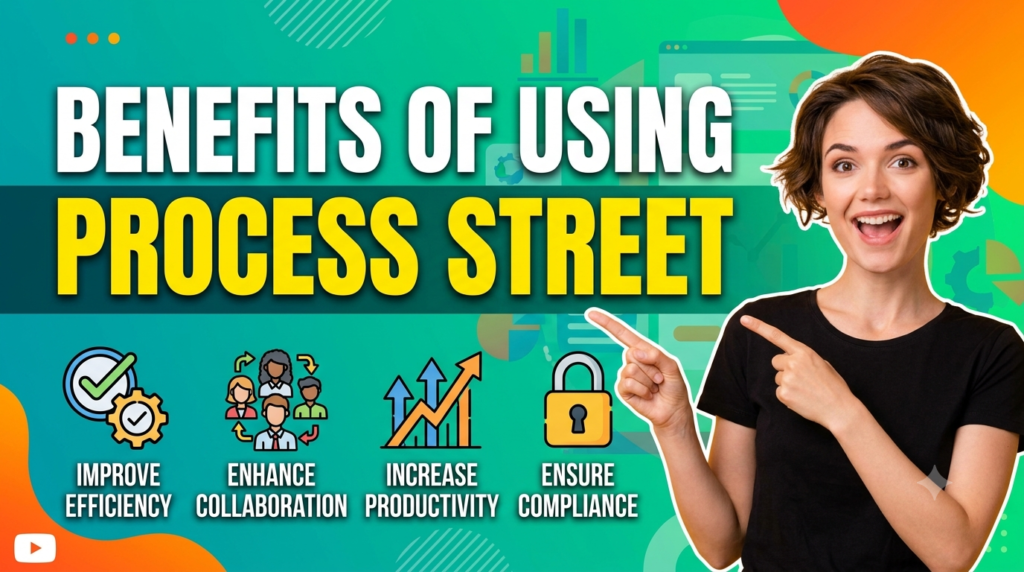
Organizations adopt Process Street because it addresses one of the biggest operational challenges faced by growing businesses: maintaining consistency while scaling operations. Without standardized processes, companies often experience communication breakdowns, inconsistent customer experiences, duplicated work, and compliance risks. Process Street provides a structured framework that helps eliminate these problems through repeatable workflows and intelligent automation.
One of its most significant benefits is operational visibility. Managers can instantly see which workflows are active, who is responsible for each task, what deadlines are approaching, and where bottlenecks exist. Instead of waiting for status meetings or manually requesting updates, leadership gains real-time insights into business operations.
Another major advantage is knowledge retention. Businesses frequently lose valuable expertise when experienced employees leave the organization. Process Street preserves institutional knowledge by documenting every procedure in standardized workflows that can be reused indefinitely. New employees can follow detailed instructions from day one, reducing onboarding time while improving consistency.
The platform also contributes to stronger organizational culture by encouraging accountability. Since responsibilities are clearly assigned and progress is visible to everyone involved, employees understand expectations more clearly. This transparency promotes ownership, collaboration, and continuous improvement across departments.
Increased Productivity
Productivity improvements are among the most compelling reasons organizations invest in workflow automation. Employees spend a surprising amount of time searching for information, requesting approvals, updating spreadsheets, and following up on incomplete tasks. Process Street minimizes these inefficiencies by automating routine administrative work.
Recurring tasks can be launched automatically based on schedules, completed forms, CRM events, or third-party integrations. Employees receive assignments immediately without waiting for manual instructions, while reminders ensure deadlines are not forgotten. This allows teams to focus on high-value work rather than repetitive administrative activities.
Standardized workflows also reduce training requirements. New employees no longer depend entirely on managers for guidance because each workflow provides step-by-step instructions, attached documents, videos, and reference materials. This accelerates onboarding while ensuring consistent execution regardless of experience level.
Automation also reduces costly mistakes. Missed approval steps, forgotten compliance checks, incomplete documentation, and inconsistent procedures often lead to expensive operational problems. By embedding these requirements directly into workflows, Process Street helps organizations prevent errors before they occur. Over time, these productivity improvements translate into significant cost savings and improved customer satisfaction.
Improved Compliance
Compliance is a growing concern across nearly every industry. Organizations must demonstrate that policies, regulations, and internal procedures are consistently followed. Manual documentation often creates gaps that become problematic during audits or regulatory reviews. Process Street addresses this challenge by automatically recording workflow execution, approvals, timestamps, completed forms, and supporting documentation.
For industries such as healthcare, finance, manufacturing, legal services, and human resources, maintaining accurate records is essential. Every completed workflow becomes part of a searchable audit trail, making it easier to prove compliance during inspections or certification processes.
By stopping workers from omitting necessary tasks, Process Street also lowers compliance risks. Required tasks, approval gates, and conditional rules ensure critical activities cannot be overlooked. This proactive approach reduces operational risk while improving confidence in business processes.
Compliance management extends beyond government regulations. Organizations often have internal quality standards, security policies, customer service guidelines, and operational best practices that must be followed consistently. Process Street helps enforce these internal standards just as effectively as external regulatory requirements, creating a culture of accountability and continuous improvement.
Better Team Collaboration
Successful businesses depend on effective collaboration, especially when teams work remotely or across multiple locations. Process Street improves collaboration by providing a centralized workspace where everyone involved in a workflow can view tasks, communicate, share files, and monitor progress in real time.
Instead of relying on lengthy email chains or scattered chat conversations, employees collaborate directly within workflows. Comments, attachments, approvals, and updates remain connected to the relevant task, creating a complete historical record of every process. This reduces confusion while making information easier to locate later.
Managers also benefit from improved visibility into team performance. Dashboards display active workflows, overdue tasks, completion rates, and workload distribution, allowing leaders to identify bottlenecks before they become major issues. This enables proactive resource management and more effective decision-making.
Collaboration becomes even stronger through integrations with communication platforms like Slack, Microsoft Teams, and email notifications. Employees receive updates automatically whenever tasks are assigned, approved, or completed, ensuring everyone stays informed without constantly checking the platform. The result is faster communication, better coordination, and smoother execution of business processes.
How Process Street Works
Process Street is designed to make workflow management intuitive, even for users without technical expertise. The platform follows a simple cycle: create a workflow template, run the workflow whenever needed, assign tasks to the appropriate team members, automate repetitive actions, and monitor progress through real-time dashboards. This straightforward approach allows organizations to replace scattered documents and manual checklists with structured, repeatable processes.
The first step is building a workflow template. Templates can be created from scratch, generated with AI, or imported from existing documentation. Each template contains tasks, instructions, due dates, form fields, approvals, and automation rules. Once a template is finalized, it becomes the standard operating procedure (SOP) for that specific process.
Whenever the process needs to be executed, users simply launch a new workflow run. Every run is independent, meaning businesses can handle hundreds or even thousands of ongoing workflows simultaneously while maintaining complete visibility into each one. Team members receive task notifications, managers monitor progress, and automated actions eliminate repetitive administrative work.
Another advantage is Process Street’s seamless integration with popular business tools such as Slack, Microsoft Teams, Salesforce, HubSpot, Zapier, Google Workspace, Jira, and many others. These integrations allow workflows to exchange data automatically, reducing duplicate data entry and improving operational efficiency. Instead of switching between multiple applications, employees can complete most of their work within a single workflow environment.
Creating Workflows
Creating workflows in Process Street requires no programming knowledge. Users begin by selecting a blank template or using one of the platform’s professionally designed templates for common business processes such as employee onboarding, sales pipelines, content publishing, customer support, IT operations, and compliance audits.
Each workflow consists of individual tasks that can include detailed instructions, multimedia content, links to documentation, forms, file uploads, approval requests, and dynamic due dates. Managers can assign tasks to specific users, departments, or roles, ensuring everyone understands their responsibilities from the beginning.
Conditional Logic makes workflow creation even more flexible. Instead of creating multiple similar templates, organizations can build one intelligent workflow that adapts automatically based on user responses. This keeps documentation organized while reducing maintenance effort.
After publishing a workflow, teams can launch unlimited workflow runs whenever required. Managers retain full control over template updates, ensuring that every future workflow follows the latest business procedures and compliance requirements.
Automating Repetitive Tasks
Automation is one of the biggest reasons businesses adopt Process Street. Manual administrative work consumes valuable employee time and often introduces unnecessary errors. Process Street automates these repetitive activities, allowing teams to focus on strategic work instead of routine administration.
Automation can trigger workflows based on specific events such as a new customer signing up, a support ticket being created, a form submission, or a scheduled calendar event. The platform can automatically assign tasks, send notifications, update CRM records, create calendar events, generate documents, or synchronize information across integrated applications.
For example, when a company hires a new employee, Process Street can automatically launch an onboarding workflow, notify HR, assign IT setup tasks, schedule orientation sessions, and request manager approvals without any manual intervention. Similar automation can be applied to sales follow-ups, invoice approvals, compliance audits, quality inspections, and customer onboarding.
These automated workflows reduce delays, improve consistency, and eliminate repetitive administrative work that often slows business operations. As organizations grow, automation becomes increasingly valuable because it allows teams to scale processes without proportionally increasing administrative overhead.
Tracking Progress
One of Process Street’s strongest capabilities is its real-time reporting and workflow tracking. Managers no longer need to ask employees for status updates because dashboards provide instant visibility into every active workflow.
Users can monitor completed tasks, overdue assignments, approval status, workflow completion percentages, and overall team performance from a centralized dashboard. Filters and reporting tools help managers identify bottlenecks, monitor productivity trends, and measure operational efficiency over time.
Every workflow also maintains a complete activity history. Comments, file uploads, approvals, timestamps, and task completions are recorded automatically, creating a comprehensive audit trail. This historical data is especially valuable during compliance reviews, quality assurance programs, and performance evaluations.
Real-time tracking also improves accountability. Employees know exactly what tasks are assigned to them, managers understand project status instantly, and executives gain visibility into organization-wide operations without requesting manual reports.
Process Street Pricing

Process Street offers multiple pricing plans designed for businesses of different sizes and operational requirements. While pricing may change over time, the platform generally provides customized business plans that scale according to team size, automation needs, compliance features, and enterprise requirements. Organizations interested in advanced capabilities such as AI workflows, enterprise security, API access, and dedicated support can request custom pricing directly from the company.
| Plan | Best For | Key Features |
| Startup/Small Teams | Small businesses | Workflow templates, task management, basic automation |
| Business | Growing organizations | Advanced automation, approvals, integrations, reporting |
| Enterprise | Large companies | Enterprise security, compliance, custom permissions, dedicated support |
Rather than choosing solely based on cost, organizations should evaluate the potential return on investment. Companies often recover their software investment through increased productivity, fewer operational errors, faster onboarding, improved compliance, and reduced manual work. Businesses with complex recurring processes typically see the greatest value from workflow automation.
Is Process Street Worth the Cost?
For organizations managing recurring operational procedures, the answer is generally yes. The platform helps standardize processes, reduce human error, automate repetitive tasks, and improve collaboration across departments. These benefits often outweigh the subscription cost, particularly for growing businesses where operational consistency directly impacts customer satisfaction and profitability.
Companies operating in regulated industries also gain significant value through automated documentation and audit trails. Instead of spending countless hours preparing for compliance reviews, much of the required documentation is generated automatically during workflow execution.
Small businesses may initially use only a portion of the available features, but the platform scales effectively as operational complexity increases. This makes Process Street a long-term investment rather than simply another productivity tool.
Read More:-
How Does Strikingly Simplify the Website Building Process?
Building Your Dream Website with Site123
Boost Your E-commerce Strategy with YITH Plugins
Maximize Your Customer Engagement with LiveAgent’s Features
Why STRIPO is Essential for Digital Product Marketersa
Process Street vs Competitors
Choosing the right workflow management platform depends on your organization’s specific needs. Here’s how Process Street compares with several well-known alternatives.
| Feature | Process Street | Asana | Monday.com | ClickUp |
| Workflow Automation | ✅ Excellent | Good | Excellent | Excellent |
| SOP Management | ✅ Built for SOPs | Limited | Moderate | Moderate |
| AI Workflow Creation | ✅ Yes | Limited | Limited | Partial |
| Conditional Logic | ✅ Advanced | Basic | Good | Good |
| Approval Workflows | ✅ Built-in | Limited | Available | Available |
| Compliance Focus | ✅ Strong | Limited | Moderate | Moderate |
| Ease of Use | Excellent | Excellent | Good | Good |
While project management platforms focus primarily on managing projects and tasks, Process Street specializes in recurring business operations and standardized workflows. Organizations needing strong compliance capabilities, detailed SOP management, and intelligent workflow automation often find Process Street to be a better fit.
Best Use Cases
Process Street supports virtually every department within an organization. Some of the most common use cases include:
- Employee onboarding and offboarding
- Customer onboarding
- Sales pipeline management
- Marketing campaign execution
- IT help desk procedures
- Software deployment checklists
- Internal audits
- ISO compliance
- Financial approval workflows
- Vendor management
- Content publishing workflows
- Quality assurance inspections
- Customer support escalation
- Human resource operations
- Healthcare compliance procedures
Its flexibility allows businesses to standardize almost any recurring process, making operations more efficient and predictable.




Conclusion
Process Street has evolved far beyond a simple checklist application into a comprehensive workflow automation and process management platform. Its combination of AI-powered workflow generation, automation, conditional logic, approvals, integrations, and compliance tracking enables organizations to execute recurring business processes with greater consistency and transparency.
Businesses of every size can benefit from replacing manual procedures with standardized workflows that reduce human error, improve collaboration, and provide complete operational visibility. Whether you’re onboarding employees, managing customer support, conducting audits, or documenting standard operating procedures, Process Street provides the tools needed to streamline operations and support sustainable growth.
As digital transformation continues to reshape modern workplaces, workflow automation is becoming an essential competitive advantage. Organizations that invest in structured process management today will be better equipped to scale efficiently, maintain compliance, and deliver consistently high-quality results in the future.
Frequently Asked Questions
Q. What is Process Street used for?
A. Process Street is used to create, automate, and manage recurring business workflows, standard operating procedures (SOPs), employee onboarding, compliance processes, and operational checklists.
Q. Does Process Street require coding skills?
A. No. Process Street is a no-code platform that allows users to build workflows through an intuitive drag-and-drop interface and AI-assisted workflow generation.
Q. Can Process Street integrate with other software?
A. Yes. Process Street integrates with popular tools including Slack, Microsoft Teams, Zapier, Salesforce, HubSpot, Google Workspace, Jira, and many more.
Q. Is Process Street suitable for small businesses?
A. Absolutely. Small businesses can use Process Street to standardize operations, improve productivity, automate repetitive work, and prepare scalable processes for future growth.
Q. Is Process Street secure?
A. Yes. Process Street provides enterprise-grade security features, role-based permissions, audit logs, and compliance capabilities designed to protect organizational data and support regulatory requirements.