
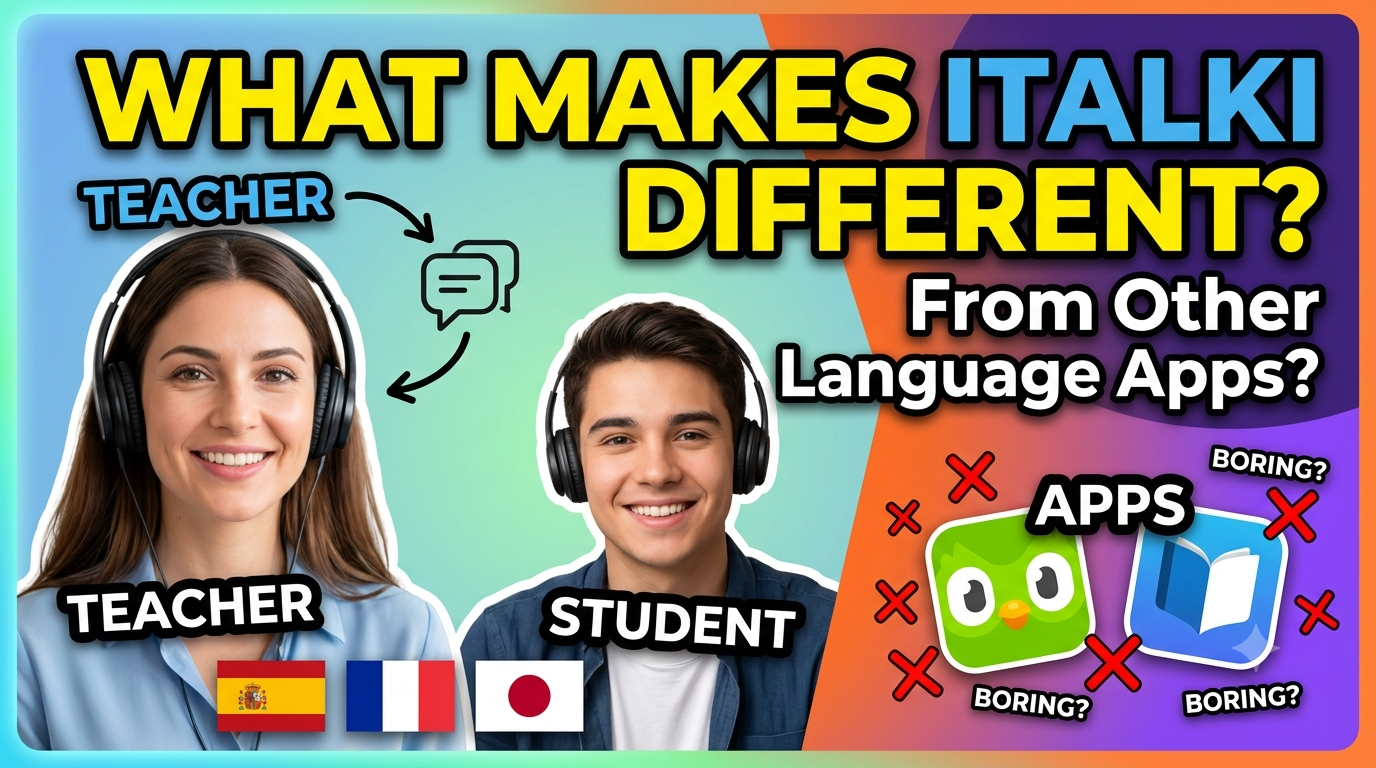
italki is a popular online language learning platform that connects learners with experienced teachers and tutors from around the world. Unlike traditional language apps that mainly rely on automated exercises, italki focuses on personalized, one-on-one lessons tailored to individual goals, skill levels, schedules, and learning preferences. Learners can choose teachers based on their language expertise, teaching style, availability, and specialties, making italki suitable for conversation practice, grammar, pronunciation, business communication, travel, and exam preparation. With flexible lesson options and a global community, italki offers a practical and interactive way to develop real-world language skills while connecting with people from different cultures.
Table of Contents
- Understanding the italki Learning Model
- How italki Compares With App-Based Learning
- The Variety of Teachers on italki
- Flexible Pricing and Pay-As-You-Go Lessons
- Language and Cultural Diversity
- Personalized Learning for Different Goals
- italki Community Features
- italki vs AI-Powered Language Learning
- Who Can Benefit Most From italki?
- Conclusion
- Frequently Asked Questions
Understanding the italki Learning Model
Language learning has changed dramatically over the past decade. Instead of depending only on classrooms, textbooks, and traditional language schools, learners can now choose from apps, video courses, AI tutors, group classes, and one-on-one online teachers. italki takes a noticeably different route because its core experience is built around connecting individual learners with teachers for live language lessons. The platform describes itself as a global language learning marketplace, and its current company information says it connects more than 10 million learners with more than 30,000 teachers across 180 countries. That scale matters, but the more important difference is the philosophy behind it. Rather than asking every learner to follow exactly the same digital curriculum, italki lets the learner choose a teacher, lesson focus, schedule, and learning style. Think of it less like buying a language textbook and more like having access to a huge international directory of personal coaches. That distinction explains why people who have already tried traditional language apps sometimes turn to italki when they want more conversation, accountability, correction, and personalization.
A Marketplace Built Around Real Teachers
The biggest difference between italki and many popular language-learning applications is the role of the teacher. In a conventional language app, the platform generally designs the learning journey and determines what appears next. With italki, the teacher is a central part of the experience. Learners can browse teacher profiles, consider their specialties, accents, interests, availability, and lesson offerings, and then select someone who appears to match their needs. The current Google Play description specifically highlights the ability to find teachers based on interests, specialization, and even accents, while lessons can cover areas such as conversation, business, grammar, creative writing, and exam preparation. This creates a fundamentally different learning relationship. Instead of being one user inside a standardized course, you become an individual student working with another person. If you struggle with pronunciation, the teacher can spend more time there; if grammar is easy for you but speaking feels uncomfortable, the lesson can shift toward conversation. That flexibility makes the marketplace model particularly attractive to learners who dislike rigid courses.
Human Interaction at the Center
There is something difficult to reproduce when language learning becomes entirely automated: genuine human interaction. A language is not simply a collection of vocabulary cards and grammar rules; it is a living communication system shaped by tone, context, culture, humor, hesitation, body language, and social expectations. italki puts real conversations at the heart of the learning process by giving students opportunities to interact directly with teachers. This can be especially valuable for learners who understand written language but become nervous when somebody speaks to them in real time. A teacher can react to what a learner actually says rather than waiting for a predetermined answer. They can ask follow-up questions, notice recurring mistakes, change the pace, and introduce expressions that fit the conversation. That makes a lesson feel less like completing a digital exercise and more like practicing for the situations in which the language will actually be used.
How italki Compares With App-Based Learning
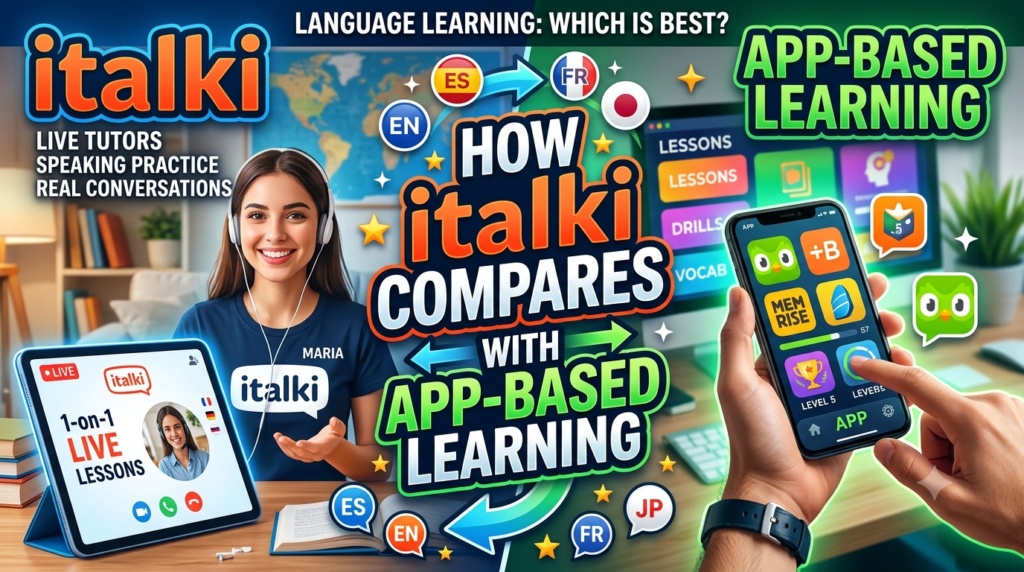
Language-learning apps are excellent at making practice convenient. You can complete a few exercises during a commute, review vocabulary before bed, or spend several minutes practicing grammar without arranging a lesson with another person. That convenience is one reason app-based learning has become so popular. However, convenience and communication ability are not necessarily the same thing. Someone can recognize hundreds of words in an app and still struggle to introduce themselves, explain an opinion, or understand a fast response from a native speaker. italki approaches this gap differently by emphasizing personalized live instruction. Its current app listing says teachers can tailor lessons to a learner’s level and weaknesses, while students can choose courses according to specific priorities. The result is not necessarily a replacement for language apps; in many cases, it can be a complementary experience. An app can help establish vocabulary habits, while a teacher can help turn that vocabulary into usable communication.
Personalized Lessons Instead of Fixed Courses
Imagine two students learning Spanish. One wants Spanish for an upcoming trip to Madrid, while the other wants to prepare for a professional presentation. Giving both learners exactly the same sequence of lessons may be convenient for a software company, but it is not necessarily the most efficient approach for the individuals. With a teacher marketplace, the two students can look for different types of instruction. One could prioritize travel conversations, pronunciation, and everyday phrases, while the other could focus on business vocabulary, formal speaking, presentations, and professional writing. That is one of the defining advantages of italki. The platform’s current listing explicitly mentions personalized classes based on levels from A1 through C2 and learning priorities including conversation, business, grammar, creative writing, and exam preparation. Rather of inquiring, “What lesson does the platform want me to take next?” the learner can ask, “What do I need to improve next?” That small change can make the learning experience feel considerably more personal.
Speaking Practice With Real People
Speaking is often the point where language learning becomes uncomfortable. Reading a sentence silently gives you time to process it, but responding to a person requires listening, thinking, constructing an answer, and speaking almost simultaneously. This is why live practice can be so useful. During an italki lesson, learners are exposed to the unpredictability of actual communication, including different accents, unexpected questions, pauses, corrections, and conversational changes. A teacher can also identify mistakes that may not be obvious to the learner. If someone repeatedly uses the wrong tense, translates expressions directly from their native language, or pronounces a particular sound incorrectly, a teacher can notice the pattern and address it. That kind of immediate human feedback is difficult to recreate through simple flashcards. For learners whose main goal is confidence in conversation, regular live lessons can turn passive knowledge into active language ability.
The Variety of Teachers on italki
Another factor that separates italki from many structured language platforms is the sheer variety of instructors available. The platform’s current company description says it has more than 30,000 teachers from 180 countries, while its app listings emphasize access to native teachers across many languages. This creates an unusual amount of choice. A learner isn’t limited to one teaching personality or one instructional philosophy. You may find a teacher who loves grammar and structured exercises, another who focuses heavily on conversation, and another who specializes in helping professionals prepare for interviews or presentations. You can also search for instructors who fit particular scheduling needs. In practical terms, this means the teacher becomes part of the learning strategy rather than simply being the person delivering a predefined course. The challenge, of course, is that more choice requires more decision-making. Choosing the right teacher may take some experimentation, but that flexibility is also one of the platform’s strongest features.
Professional Teachers and Community Tutors
italki has historically distinguished between Professional Teachers and Community Tutors, giving learners another way to think about their options. Professional teachers generally offer formal teaching expertise, while community tutors can provide conversational practice and language exposure from a less formal tutoring perspective. The distinction can be useful because not every learner needs the same level of structure. Someone preparing for an examination may want a teacher with relevant instructional experience, while someone who simply wants to become more comfortable chatting in another language may prefer a conversational tutor. Older italki teacher materials illustrate this two-tier model and show that pricing has historically varied between professional teachers and community tutors. Current prices can change by teacher, language, and market conditions, so historical figures should not be treated as today’s universal rates. The important point is the choice itself: learners can select the type of support that fits both their goals and their budget.
Choosing Teachers by Goals and Learning Style
Finding a teacher is not simply about finding the cheapest available lesson. The strongest match usually comes from considering what you actually want to accomplish. If your priority is pronunciation, look for someone who emphasizes speaking and correction. If you are preparing for an exam, search for relevant exam experience. If you are learning because you are moving abroad, a teacher who understands everyday communication and cultural context may be more helpful than someone focused exclusively on textbook grammar. The same applies to personality. Some students enjoy teachers who lead the entire lesson, while others prefer relaxed conversations where the teacher corrects mistakes along the way. italki’s marketplace structure makes these preferences part of the selection process. Instead of accepting a single instructor style, learners can compare profiles and gradually discover what works best for them.
Flexible Pricing and Pay-As-You-Go Lessons
Cost is another important distinction. Many digital learning services are designed around subscriptions, where the learner pays regularly for access to a predefined collection of material. italki has traditionally emphasized a pay-per-lesson approach, allowing students to purchase individual lessons, credits, or lesson packages rather than requiring everyone to commit to one fixed learning path. Its current Google Play listing describes the model as paying per class, with options for credits and packages, while noting that educators set their own prices. This structure can make the platform attractive to people who have unpredictable schedules or want to control their spending. If you are traveling for several weeks, working long hours, or studying for another qualification, you may not want another rigid monthly commitment. Being able to book lessons according to your availability gives language learning a more flexible rhythm.
Why Flexible Pricing Matters
The phrase “affordable” means different things to different learners, so the major advantage of italki is not necessarily that every lesson will be inexpensive. Instead, the marketplace gives learners a range of prices because individual teachers set their own rates. A recent independent analysis of more than 22,000 tracked italki tutors found substantial variation across languages, with reported median hourly rates around $20 for several major languages and different middle ranges depending on the language. These figures are useful for illustrating marketplace variation, but they should not be treated as official universal pricing because teacher rates change. The practical benefit is that learners can compare options instead of paying one standardized price. Someone looking for budget conversation practice may select a lower-cost tutor, while someone preparing for an important professional or academic objective may decide that a more specialized teacher is worth paying more for. The choice belongs largely to the learner.
Trial Lessons and Teacher Selection
Teacher fit can make or break a language-learning experience. Even an excellent teacher may not be the right teacher for a particular student’s personality, schedule, goals, or preferred teaching style. That is why trial lessons can be valuable. Instead of making a long-term commitment immediately, learners can use an introductory lesson to evaluate whether the communication style feels comfortable and whether the teacher understands their goals. italki’s current app information also highlights trial opportunities and encourages learners to test the experience before committing more deeply. This is especially important for beginners who may not yet know what kind of instruction they prefer. After a few lessons, a learner can ask a simple question: “Am I becoming more confident and capable?” If the response is negative, the marketplace allows you to look into another teacher instead of believing the platform as a whole is inappropriate.
Language and Cultural Diversity
Language and culture are inseparable. You can memorize a phrase perfectly and still use it awkwardly if you don’t understand when native speakers actually use it. This is where human teachers can add context that a standard lesson may overlook. A teacher can explain why one expression sounds natural while another sounds overly formal, outdated, overly direct, or simply strange in everyday conversation. Because italki connects learners with teachers from many countries, students can encounter regional vocabulary, accents, customs, and conversational habits. The platform says its teacher community spans 180 countries, which gives its marketplace a genuinely international character. For learners interested in more than passing an exam, this cultural exposure can be one of the most rewarding parts of the experience.
Learning Beyond Vocabulary and Grammar
Grammar remains important, but fluency is much bigger than grammar. Consider how a native speaker communicates: they use shortened forms, idioms, humor, gestures, references, informal vocabulary, and different levels of politeness depending on the situation. A teacher can introduce these details naturally during conversation. Someone studying Japanese, for example, may need to understand not only vocabulary but also different levels of politeness. Someone learning English for work may need to know how to disagree professionally without sounding aggressive. Someone learning Spanish for travel may need practical expressions that do not always appear in beginner textbooks. These nuances are where personalized instruction becomes powerful. The learner is not simply collecting language pieces; they are learning how those pieces function in real social situations.
Building Cross-Cultural Connections
There is also a human benefit to the platform. Learning from someone who lives in another country can make the language feel connected to a real person rather than an abstract subject. You may learn about food, holidays, local expressions, workplace habits, entertainment, family traditions, or everyday life while practicing the target language. italki’s stated mission emphasizes building connections with people from other cultures, and that idea is reflected in the platform’s community-oriented positioning. This can increase motivation because the learner begins to associate the language with relationships and experiences. Instead of thinking, “I need to memorize another fifty words,” you may start thinking, “I want to be able to have a better conversation with my teacher.” That emotional connection can make consistent practice easier.
Personalized Learning for Different Goals
One of the strongest reasons to choose italki is that language learners rarely have identical goals. Some people want to travel. Others want to pass an exam, relocate to another country, communicate with a partner, improve their career prospects, or simply enjoy films and books without translation. A platform becomes more useful when it can accommodate these different motivations. italki’s current listings describe lesson options across conversation, business, grammar, creative writing, and exam preparation, among other areas. This means the learning experience can be shaped around an outcome rather than just a language name. Instead of saying, “I am learning French,” you can define a more actionable target such as, “I want to hold a 20-minute conversation in French without switching to English.” That type of goal gives the teacher something concrete to work toward.
Business, Travel, Exams, and Conversation
Different goals demand different teaching methods. A business learner may need formal vocabulary, meeting language, presentation skills, and confidence speaking with colleagues. A traveler may need directions, restaurant conversations, transportation vocabulary, and quick listening comprehension. An exam candidate may need structured preparation, timed practice, writing feedback, and familiarity with the test format. A casual learner may simply want relaxed conversation several times a week. italki’s teacher marketplace can support these different requirements because students can look for teachers whose expertise matches their objectives. The flexibility is particularly useful when goals change. A learner might begin with basic grammar, move into conversation, and later shift toward professional communication. The lesson does not have to remain locked into the same structure forever.
Adapting Lessons to Your Weaknesses
Personalization becomes most valuable when a learner has a specific weakness. Maybe you understand English perfectly when reading but struggle to speak. Perhaps your Spanish vocabulary is strong but your listening comprehension is weak. Maybe you know Japanese grammar but have difficulty forming spontaneous sentences. A teacher can identify these gaps through interaction and modify lessons accordingly. The current italki app description says teachers can build lessons around a student’s level, needs, and weaknesses. That is an important difference from standardized exercises, where every learner may receive the same activity regardless of their individual problem. The goal is not simply to complete another lesson; it is to spend time on the areas most likely to improve actual communication.
italki Community Features
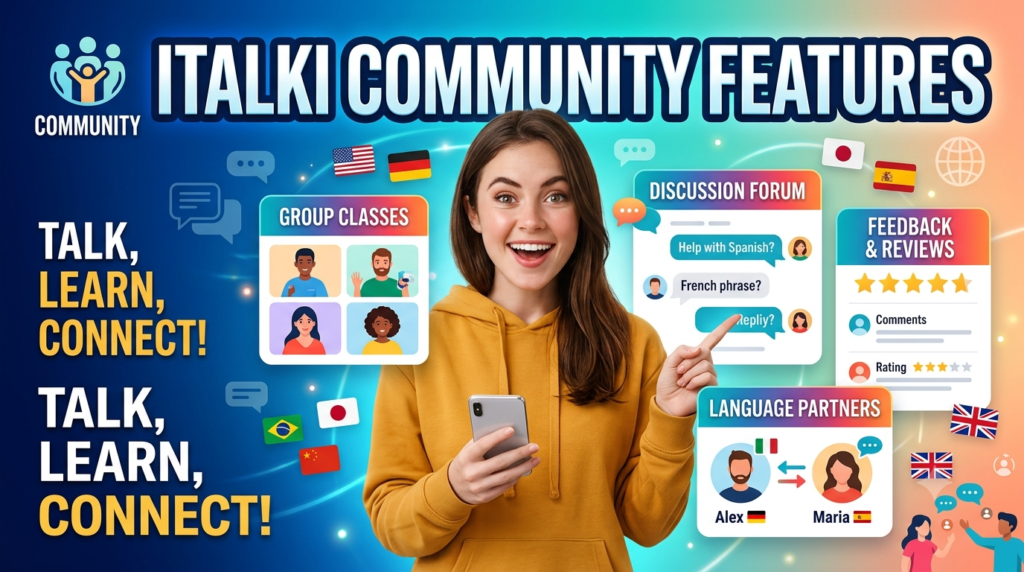
The learning experience on italki does not necessarily end when a paid lesson ends. The platform also promotes a community where learners can ask questions, practice languages, and interact with other students. Google Play describes free community functionality, including opportunities to ask questions and participate in language exchanges. This is an interesting extension of the teacher marketplace because it gives learners another environment for using the language. A student can take a structured lesson with a teacher and then continue practicing through community interactions. That creates a broader learning ecosystem rather than a simple teacher-student transaction. For someone trying to make language practice a regular habit, having multiple ways to interact with the language can be useful.
Learning Outside the Classroom
Think of language learning like fitness. One personal-training session every week can help, but what you do between sessions also matters. The same principle applies to languages. If you speak for an hour with your teacher and then spend six days without using the language, progress may be slower than expected. Community features can provide additional opportunities to read, write, ask questions, and communicate. These activities may be less structured than a formal lesson, but that can actually be useful because real language use is rarely perfectly structured. You have to decide what to say, understand imperfect sentences, and work out meaning from context. These small challenges help turn language knowledge into a habit rather than a once-a-week classroom activity.
Language Exchanges and Peer Practice
Peer interaction can provide a different kind of practice from teacher instruction. A teacher is usually focused on helping you improve, while another learner may simply be interested in communicating. That creates a more relaxed environment where both participants can experiment with the language. italki promotes language exchanges as part of its community experience, giving learners opportunities to communicate with other people studying languages. This can be especially helpful for learners who are nervous about making mistakes. When the goal is mutual practice rather than evaluation, communication can feel less intimidating. The learner starts to understand that making mistakes is not evidence of failure; it is part of the process of becoming comfortable.
italki vs AI-Powered Language Learning
AI has become one of the biggest developments in language education. Modern AI tools can provide instant conversation practice, generate exercises, explain grammar, translate sentences, and simulate different scenarios. That makes AI a powerful supplement for language learners. Yet it also highlights what makes human tutoring on italki different. A teacher does not simply generate another exercise; they build a relationship with the learner and observe how that particular person communicates over time. They can recognize when a learner is hesitant, confused, bored, or ready for a more difficult challenge. They can also introduce personal experiences and cultural context that are difficult to reduce to automated prompts. In 2026, the distinction is becoming less about humans versus technology and more about how both can work together.
Where Human Teachers Still Have an Advantage
AI can simulate conversation extremely well, but human communication contains layers that are difficult to measure. A teacher may notice that you sound too formal in casual conversation, that you avoid certain sentence structures because you are uncertain, or that you understand a concept but lack confidence using it spontaneously. A good teacher can respond to these patterns with encouragement, correction, and strategy. Human teachers can also share personal cultural knowledge and lived experiences. This is especially valuable when the learner’s objective involves social communication rather than simply producing grammatically correct sentences. italki’s marketplace model therefore remains distinctive even as AI tools become better. The platform’s strength is the connection between a learner and a real instructor, while technology can increasingly support that relationship rather than replace it.
Read More:-
How Does Strikingly Simplify the Website Building Process?
Building Your Dream Website with Site123
Boost Your E-commerce Strategy with YITH Plugins
Maximize Your Customer Engagement with LiveAgent’s Features
Why STRIPO is Essential for Digital Product Marketersa
The Role of Technology in the Modern italki Experience
Technology is still an important part of the italki experience. Students use digital profiles, scheduling systems, video communication, lesson tools, messaging, and community functions to connect with teachers and other learners. The company has also indicated that it is continuing to develop AI-powered tools and improve its classroom technology. A 2025 community discussion about planned 2026 updates reported that italki was working on expanded intelligent tools and an improved classroom experience while emphasizing that human connection remained central to its vision. This combination is worth watching because it suggests that the future of language learning may not be a simple choice between AI and human teachers. The strongest platforms may use technology to remove friction while keeping people at the center of meaningful communication.
Who Can Benefit Most From italki?
italki can be particularly valuable for learners who feel that traditional language apps have taken them as far as they can go. If you know vocabulary but cannot speak comfortably, live tutoring addresses that gap directly. If you need a specialized goal such as business communication, exam preparation, travel conversation, or pronunciation practice, you can search for teachers whose experience matches that need. If your schedule changes frequently, pay-per-lesson flexibility can also be appealing. And if cultural understanding matters to you, learning directly from people around the world adds a dimension that purely automated courses cannot easily replicate. At the same time, italki is not necessarily the perfect solution for everyone. Someone who prefers completely self-directed study, does not want live interaction, or simply wants a free daily vocabulary habit may prefer an app-based approach. The real advantage of italki appears when you want language learning to become interactive, personalized, flexible, and human.



Conclusion
What makes italki different from other language learning platforms is not one isolated feature. Its distinction comes from the combination of a teacher marketplace, live one-on-one instruction, flexible pricing, global teacher diversity, personalized lesson goals, and a community that extends learning beyond scheduled classes. Current platform information indicates a network of more than 30,000 teachers across 180 countries and more than 10 million learners, while its app listings emphasize personalized instruction, pay-as-you-go lessons, teacher choice, and community interaction. Rather than treating language learning as a fixed digital course, italki gives learners more control over who teaches them, what they study, and how they practice. That makes the platform especially interesting for people who want to move beyond memorizing vocabulary and start using a language in real conversations. In a world where AI and automated learning are becoming increasingly sophisticated, the human relationship at the center of italki may actually become an even more important differentiator.
Frequently Asked Questions
Q. What is italki mainly used for?
A. italki is primarily used for connecting language learners with online teachers and tutors for personalized lessons. Learners can choose instructors based on language, specialization, teaching style, availability, and other preferences. The platform also provides community-based opportunities for language practice.
Q. Is italki better than language-learning apps?
A. It depends on your learning goal. Apps can be excellent for vocabulary, grammar drills, and convenient independent practice, while italki is particularly strong for live conversation, personalized instruction, and human feedback. Many learners can benefit from combining both approaches instead of treating them as direct substitutes.
Q. How much do italki lessons cost?
A. There is no single universal lesson price because teachers set their own rates. Pricing can vary according to language, teacher experience, specialization, lesson length, and other factors. Current third-party tracking shows significant variation across languages and teachers, so checking individual teacher profiles is the best way to determine current prices.
Q. Can beginners use italki?
A. Yes. Beginners can select teachers who specialize in teaching students at introductory levels. The platform’s current information describes instruction across CEFR levels from A1 through C2, allowing learners to look for lessons appropriate to their current ability.
Q. What is the biggest advantage of italki?
A. The biggest advantage is personalization through real human interaction. Instead of following only a standardized course, learners can choose a teacher and build lessons around their individual goals, weaknesses, interests, schedule, and communication needs. That flexibility makes italki particularly useful for learners who want to turn passive language knowledge into practical speaking ability.