
DiecastModelsWholesale is a convenient destination for diecast car enthusiasts looking to explore a wide selection of collectible vehicles, scales, brands, and styles. Whether you are a beginner building your first collection or an experienced fan searching for detailed models, diecastmodelswholesale offers plenty of options to discover. From classic cars and modern supercars to racing vehicles, trucks, motorcycles, and specialty models, shoppers can compare different designs and manufacturers while considering scale, quality, features, pricing, packaging, and display needs. With smart research and a clear collecting strategy, diecastmodelswholesale can make it easier to find models that match your interests, budget, and growing diecast collection.
Table of Contents
- Why DiecastModelsWholesale Is Worth Exploring
- Know Your Collection Before You Shop
- Understand Diecast Scales Before Buying
- Check the Manufacturer and Model Details
- Examine Materials, Features, and Finish
- Compare Prices Without Chasing the Cheapest Model
- Watch for New Releases and Closeout Opportunities
- Think About Packaging and Condition
- Review Shipping and Return Policies
- Build a Smarter Long-Term Collection
- Conclusion
- FAQs
Why DiecastModelsWholesale Is Worth Exploring
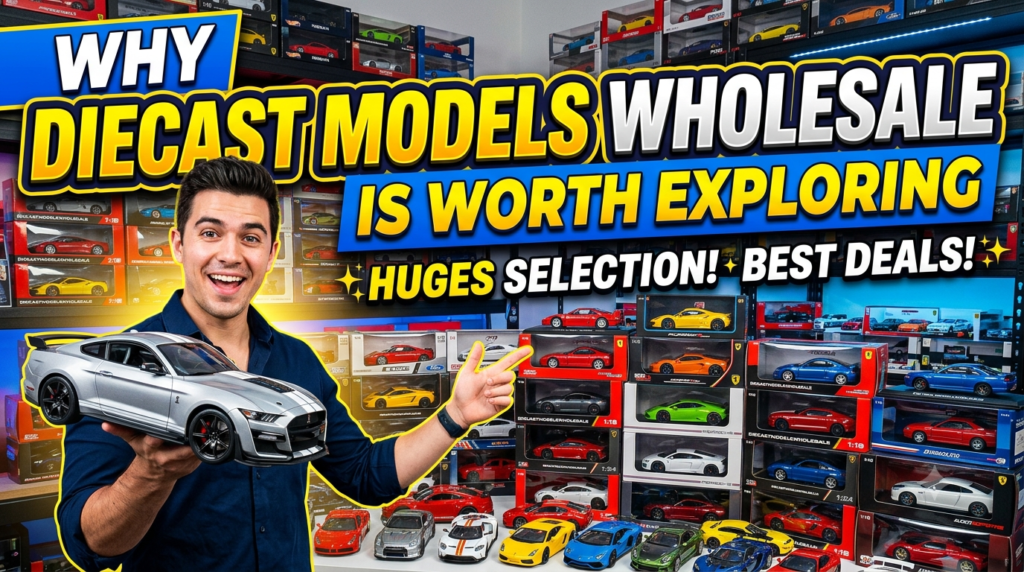
One of the biggest advantages of shopping through a specialist diecast retailer is the ability to browse beyond the handful of models commonly found in general toy or department stores. DiecastModelsWholesale presents an extensive range of categories and brands, including names such as Autoart, Maisto, Greenlight, Motormax, Jada, GeminiJets, Diecast Masters, ERTL/TOMY, and others. Its catalog also covers a remarkably broad range of subjects, from familiar passenger cars to Formula 1 vehicles, construction equipment, aircraft, military models, motorcycles, trucks, movie and television vehicles, and display accessories. For collectors, that variety matters because collecting is rarely a one-size-fits-all hobby. One person may want a garage filled with American classics, another may be fascinated by European supercars, while someone else may build an entire miniature motorsport history.
The retailer also emphasizes competitive pricing, customer service, protective packaging, and a large inventory. According to its company information, it has more than 18 years of experience selling die-cast models online and says that its models are individually protected with bubble wrap and that window boxes receive additional carton protection during shipping. Those details matter because collectors often care about the packaging almost as much as the model itself. A beautiful 1:18 car with a damaged box can mean something very different to a collector who intends to keep everything factory-original. The important lesson, though, is not to assume that every model will be perfect simply because a retailer has a strong packaging process. Treat each purchase as an individual decision, read the listing carefully, understand the return rules, and inspect the model promptly when it arrives.
A Large Selection for Different Collectors
A large selection becomes especially useful when you have already developed a specific collecting direction. Suppose you are building a collection around legendary Ferrari road cars, classic American muscle, modern hypercars, racing icons, or vehicles from a particular film franchise. Instead of settling for the first miniature you see, you can compare multiple interpretations of the same automotive subject. Different manufacturers may offer different scales, finishes, opening features, interior details, wheel designs, and levels of realism. That makes the buying process more like choosing artwork than buying an ordinary toy.
The smartest approach is to establish a personal definition of quality. Do you care primarily about exterior accuracy? Is an opening hood essential because you want to see the engine? Are rubber tires important? Do you need steering wheels that turn with the front wheels? Are you collecting sealed models, or do you prefer opening parts? Do you want every car in the same scale? These questions may sound overly detailed when you are buying your first few models, but they become increasingly important as your collection grows. A collector who decides on standards early can avoid the frustrating experience of owning twenty beautiful models that look inconsistent together because they were purchased without a common strategy.
Understanding the Value of Buying From an Established Retailer
Trust becomes especially important when you are purchasing collectible models online. DiecastModelsWholesale states that it has been selling models since 2005 and highlights customer service, competitive pricing, packaging, and product variety as core parts of its offering. Its published customer testimonials also include buyers who specifically mention fast delivery and protective packaging, although testimonials should naturally be considered customer experiences rather than guarantees of what every future order will be like. Independent review information should also be viewed with context; for example, Trustpilot currently shows a relatively small review base for the retailer, so it should be treated as one signal rather than the entire basis for a purchasing decision.
That distinction is useful for every online collector. Good buying decisions come from multiple signals rather than one glowing review. Look at the product description, scale, manufacturer, photographs, price, shipping terms, return policy, and your own collecting goals. When those pieces fit together, you have a much stronger reason to buy. Think of it as building a small case for every model instead of simply following impulse.
Know Your Collection Before You Shop
The most underrated diecast buying tip is also the simplest: know what you are collecting. Without a clear direction, a large catalog can turn into a temptation machine. One day you buy a classic Porsche because it looks fantastic, the next day a 1:64 American muscle car because it is inexpensive, and then a large 1:18 racing model because you love the driver. None of those purchases is necessarily bad, but if you keep buying this way, your collection can become visually chaotic and difficult to display. A theme doesn’t have to be rigid. You can create a broad theme such as “cars I would love to own in real life,” or a precise theme such as “1:18 endurance racing cars from the 1990s.” The important thing is that your purchases feel connected by a story.
This is also where DiecastModelsWholesale can be particularly useful because its catalog includes a wide variety of vehicle types and brands. Before browsing, write down three things: your preferred subjects, your preferred scale, and your maximum budget for an individual model. That tiny checklist creates a filter between you and impulse buying. You can still make spontaneous purchases, but they become intentional surprises rather than random additions. A collection should feel like a curated garage, not a storage room.
Define Your Collecting Theme
Your theme could be based on a manufacturer, country, decade, vehicle type, motorsport series, movie franchise, body style, or even color. You might collect only classic American cars, only European sports cars, only Formula 1 machines, or only vehicles you remember from childhood. Another interesting strategy is to collect the same vehicle in multiple generations, creating a visual timeline of how a model evolved. A Mustang collection, for example, could become a miniature history lesson covering different eras, body styles, and performance philosophies.
The advantage of a theme is that it makes difficult purchasing decisions easier. When you find two attractive models, the question is no longer simply “Which one looks cooler?” Instead, you can ask, “Which one strengthens the collection I am building?” That change in thinking can dramatically improve your buying discipline. It also makes your display more interesting because every model has a reason for being there.
Set a Realistic Collecting Budget
A budget should not be treated as a restriction on the hobby; it is a tool that keeps the hobby enjoyable. Decide whether you prefer buying several affordable models each month or saving for one premium model every few months. Neither strategy is automatically better. A collector who loves quantity may find enormous satisfaction in building a varied 1:64 collection, while another collector may prefer fewer, larger models with highly detailed interiors and opening components.
Remember that the sticker price is not always the final cost. Shipping, taxes, customs duties for international orders, display cases, shelves, lighting, and maintenance can all affect the real expense. DiecastModelsWholesale’s FAQ states that customers outside the relevant domestic market may be responsible for customs and duties imposed by their country. A sensible budget therefore includes a little breathing room for those additional expenses. The goal is to enjoy your collection without turning every new model into a financial headache.
Understand Diecast Scales Before Buying
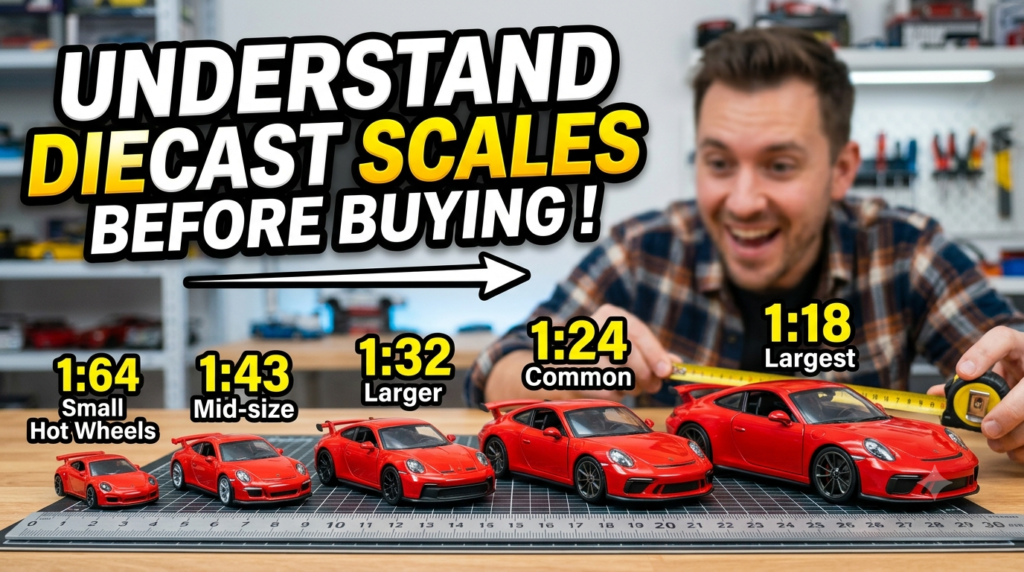
Scale is one of the most important details in diecast collecting because it determines how large the finished model will be and how it will relate to the rest of your collection. A 1:18 model, for example, represents a vehicle at one-eighteenth of its real-world dimensions, while a 1:64 model is considerably smaller. DiecastModelsWholesale explains that typical 1:18 cars are approximately 10–12 inches long, 1:24 models around 7–8 inches, 1:32 models around 4–5 inches, and 1:64 models around 3 inches, although exact dimensions vary by vehicle. This is more than a technical specification. It determines how many cars you can fit on a shelf, how much each model costs, how detailed it can be, and how impressive it looks from across a room.
If you are building your first collection, choose your scale before choosing individual cars whenever possible. Mixing scales can absolutely work, especially when you deliberately use separate display levels, but placing a tiny 1:64 sports car beside a huge 1:18 SUV may make the display feel inconsistent. A consistent scale creates the visual effect of a miniature showroom. It is like arranging books by height: the content may be different, but the organization makes everything feel intentional. Before buying, check the scale in every product listing rather than relying on photographs, because pictures can make models appear larger or smaller than they really are.
Comparing Popular Scales
For many collectors, 1:64 is attractive because the models are compact, relatively easy to display, and allow a large collection without requiring enormous shelf space. The tradeoff is that smaller models generally provide less room for extremely fine interior and engine detailing. A 1:24 model offers a middle ground, giving collectors more physical presence while remaining manageable for many shelves. The 1:18 scale is especially popular among collectors who prioritize visual detail and want each vehicle to become a major display piece.
There is no universally “best” scale. The right choice depends on your priorities. If you want a city-sized collection in a small room, smaller scales make practical sense. If you want every car to feel like a miniature sculpture, larger scales may be more appealing. Before committing to a scale, measure your available display area and imagine not just the cars you own today, but the collection you hope to have two or three years from now.
Matching Scale With Display Space
Display space is often the hidden problem behind successful collecting. A collector may begin with five large models and feel that there is plenty of room, only to discover later that twenty 1:18 cars require a serious shelving system. Larger models need more than shelf length; you also need enough depth, clearance for doors or opening parts, and room to handle them without knocking neighboring models.
For that reason, think about your collection vertically as well as horizontally. Wall-mounted shelves, glass cabinets, acrylic cases, and dedicated display furniture can turn limited floor space into a much more effective showroom. Smaller models can be arranged in rows, while larger models can receive individual display zones. Planning this early helps you avoid the painful decision of selling models simply because your shelves ran out of room.
Check the Manufacturer and Model Details
Not every diecast model is designed for the same audience. Manufacturers can differ considerably in price, construction, accuracy, detailing, moving parts, paint quality, and overall presentation. When you find a car you love, do not stop at the vehicle name. Check the manufacturer, scale, product number, body material, included accessories, opening features, and any information about the interior or exterior finish.
A familiar brand name can provide a useful starting point, but the specific model still matters. Manufacturers produce models at different price points, and a collector may reasonably prefer a simpler model for one vehicle while choosing a premium version for another. The key is to understand what you are paying for. If one model costs substantially more, identify the features that justify the difference. Are the proportions more accurate? Does it have additional opening components? Is the interior more detailed? Does the manufacturer have a reputation for particularly strong representations of that type of vehicle?
Why Brand Reputation Matters
Brand reputation matters because experienced collectors often develop preferences based on repeated exposure to different manufacturers. DiecastModelsWholesale’s catalog includes a broad mix of manufacturers, giving shoppers an opportunity to compare different approaches to miniature vehicles. Instead of automatically choosing the most expensive brand, consider matching the manufacturer to the role the model will play in your collection.
For a casual shelf display, a reasonably priced model with a strong exterior appearance may be exactly what you need. For the centerpiece of a serious collection, you may want to spend more on a model where small details matter. Think of it like photography: you do not need a professional camera to take a beautiful family picture, but a photographer working on a gallery print may care about equipment and technical details that most people never notice. Your collecting style should determine your standards.
Examine Materials, Features, and Finish
The term “diecast” does not mean that every component of a model is metal. DiecastModelsWholesale’s FAQ explains that diecast generally refers to a model with a metal body and notes that a diecast model is not necessarily made entirely of metal. When comparing products, that differentiation is crucial. A model may combine a metal body with plastic components, rubber tires, transparent plastic windows, and other materials. None of that automatically makes it inferior; what matters is how those materials are used and how well the finished model represents the real vehicle.
Look closely at the photographs and specifications. Examine panel lines, headlights, grille design, wheels, badges, interior colors, seats, steering wheel, dashboard, and paint finish. If the model has opening doors, hood, or trunk, consider whether those features add meaningful value for you. Moving parts are fun, but they should not be the only measure of quality. A model with fewer opening components can still be an excellent display piece if its proportions, paint, wheels, and detailing are convincing.
Compare Prices Without Chasing the Cheapest Model
Price comparison is one of the easiest ways to become a smarter collector, but there is a difference between finding value and simply buying the cheapest option. A low price can be attractive, but if the model does not meet your expectations, the money is not really saved. Compare models with similar scale, manufacturer, features, condition, and packaging before deciding which price is better.
Closeout items can sometimes be especially interesting for bargain hunters. DiecastModelsWholesale has a dedicated closeout category, but its FAQ states that closeout items are not eligible for coupons, discounts, or promotions. That means you should calculate the actual final price rather than assuming a coupon will make an already discounted item even cheaper. A smart collector looks at the complete deal.
Another useful habit is to avoid buying simply because something is discounted. Ask yourself whether you would still want the model at full price. If the answer is no, the discount may be creating the desire rather than revealing value. The best bargain is not the model with the biggest percentage reduction; it is the model you genuinely wanted that happens to be available at a favorable price.
Watch for New Releases and Closeout Opportunities
Collectors who check a retailer only when they are ready to buy may miss some of the most interesting opportunities. DiecastModelsWholesale lists new upcoming releases among its catalog areas, making it possible for enthusiasts to keep an eye on future additions rather than discovering them only after availability becomes limited. This can be especially useful for collectors who follow particular manufacturers, vehicle generations, racing subjects, or licensed properties.
At the same time, closeouts can be valuable for collectors who are flexible. A model does not become less interesting because it is being cleared from inventory. In fact, a closeout can be a good opportunity to pick up a vehicle that fits your collection at a lower price. The trick is to know the difference between a genuine collecting opportunity and an impulse purchase created by urgency. Save your wish list, monitor it periodically, and prioritize models that support your overall collection.
Think About Packaging and Condition
Packaging is a serious consideration for many diecast collectors. Some enthusiasts open every model and display the cars individually, while others preserve factory packaging because they value completeness and presentation. Neither approach is wrong. The important thing is to decide what kind of collector you are before buying expensive pieces.
DiecastModelsWholesale says it takes care with protective packaging, including bubble wrap and carton protection around window boxes. Its published return policy also emphasizes keeping the original manufacturer box and shipping carton when dealing with damaged items. That means collectors should resist the temptation to immediately throw away boxes and packing materials after receiving an order. If something is wrong with the model, those materials may be relevant to the return process.
When a shipment arrives, inspect it reasonably soon. Check the model for broken mirrors, loose components, scratches, paint problems, damaged wheels, cracked windows, or other issues. If there is shipping damage, photograph the package and model before discarding anything. A careful inspection process protects both your collection and your ability to address a problem.
Read More:-
How Does Strikingly Simplify the Website Building Process?
Building Your Dream Website with Site123
Boost Your E-commerce Strategy with YITH Plugins
Maximize Your Customer Engagement with LiveAgent’s Features
Why STRIPO is Essential for Digital Product Marketersa
Review Shipping and Return Policies
A great model at a great price can still become a frustrating purchase if you do not understand the shipping and return conditions. DiecastModelsWholesale states that domestic returns are handled through its customer service process and that eligible items generally need to be returned within 30 days, with original manufacturer packaging requirements applying. Its policy also explains specific conditions around damaged, defective, altered, or returned items. Policies can change, so collectors should always read the retailer’s current terms before placing an order.
Shipping timing is another factor. The company’s customer-service information says orders placed before 1 p.m. Pacific Time are scheduled to ship the same day, while delivery estimates depend on the service selected and business-day schedules. If you are buying a model for a birthday, anniversary, event, or other fixed date, leave extra time rather than relying on the fastest possible scenario.
International shoppers should be particularly careful. Customs, duties, forwarding arrangements, and local delivery rules can introduce variables that domestic buyers may not encounter. The retailer’s FAQ specifically notes that international customers may have customs and duties imposed by their respective countries. The smartest approach is to calculate your likely landed cost before deciding that a particular model is a bargain.
Build a Smarter Long-Term Collection
The best diecast collections are rarely built overnight. They grow gradually, with each purchase adding another chapter to the collector’s story. That is why a long-term strategy is more rewarding than constantly chasing whatever happens to be available. Keep a simple record of your models, including manufacturer, scale, vehicle, purchase price, purchase date, and condition. You can also note models you want but have not purchased yet. This prevents duplicate purchases and makes it easier to identify gaps in your collection.
A wish list is particularly useful when shopping a large catalog. Instead of buying immediately, add interesting models to your mental or written shortlist and return to them later. If you still want the model after several days, it has probably survived the impulse test. If you forget about it completely, you may have saved yourself money and shelf space.
Most importantly, allow your collection to reflect your personality. A collection does not need to follow someone else’s definition of serious collecting. Maybe you love obscure station wagons. Maybe you want every movie car from your childhood. Maybe your entire dream is a wall of red Ferraris. That personal connection is what gives diecast collecting its staying power. A miniature car is only a physical object until it represents a memory, an aspiration, a piece of automotive history, or simply a machine you have always admired.



Conclusion
Smart diecast collecting is about making informed choices without removing the fun from the hobby. DiecastModelsWholesale offers a broad marketplace for exploring different vehicles, scales, manufacturers, and categories, and the company says it has been serving online diecast customers since 2005 with a large inventory and protective packaging practices. That variety can be a major advantage, provided you approach it with a clear plan. Know your theme, understand scale, compare manufacturers, examine specifications, consider packaging, calculate the complete cost, and read shipping and return policies before buying.
The most valuable habit is simple: buy for your collection, not just for the moment. A model that perfectly fits your theme, budget, scale, and quality expectations will usually bring more satisfaction than three random purchases made because they happened to be on sale. Treat every model like a small piece of automotive history, and your collection will gradually become more than a group of miniature cars. It will become a visual record of the vehicles, eras, designs, memories, and stories that made you fall in love with the hobby in the first place.
FAQs
Q. Is DiecastModelsWholesale suitable for serious collectors?
A. Yes, its broad catalog can be useful for both casual enthusiasts and serious collectors. The retailer states that it carries more than 10,000 different products and lists numerous manufacturers and vehicle categories. Serious collectors should still evaluate each individual model based on scale, manufacturer, features, condition, and price rather than assuming every listing is aimed at the same level of collector.
Q. What diecast scale should a beginner choose?
A. There is no single best scale for everyone. 1:64 works well when space and quantity are priorities, while 1:24 provides a larger display presence without reaching the footprint of many 1:18 models. A 1:18 model is considerably larger and can showcase more visual detail, but it also requires more display space. DiecastModelsWholesale provides approximate dimensions for several common scales in its FAQ.
Q. Should I keep the original box?
A. If you care about collectible condition, resale potential, or maintaining a factory-original presentation, keeping the original packaging is a smart idea. It is also useful if you ever need to return a damaged or defective model because the retailer’s published return policy requires original manufacturer packaging for relevant returns. Even if you display the model outside the box, storing the packaging safely can preserve flexibility later.
Q. Are closeout diecast models worth buying?
A. They can be, particularly when the model fits your collection and the price represents good value. However, do not buy something simply because it is marked down. DiecastModelsWholesale states that closeout items are not eligible for coupons, discounts, or promotions, so compare the actual price and consider the model’s condition and specifications before purchasing.
Q. What should I check before ordering a diecast car online?
A. Start with the scale, manufacturer, vehicle name, product details, dimensions, features, price, shipping cost, and return policy. If packaging condition matters to you, pay particular attention to how the retailer handles boxes and damaged shipments. For international purchases, also investigate possible customs or duties because those charges may affect your final cost.