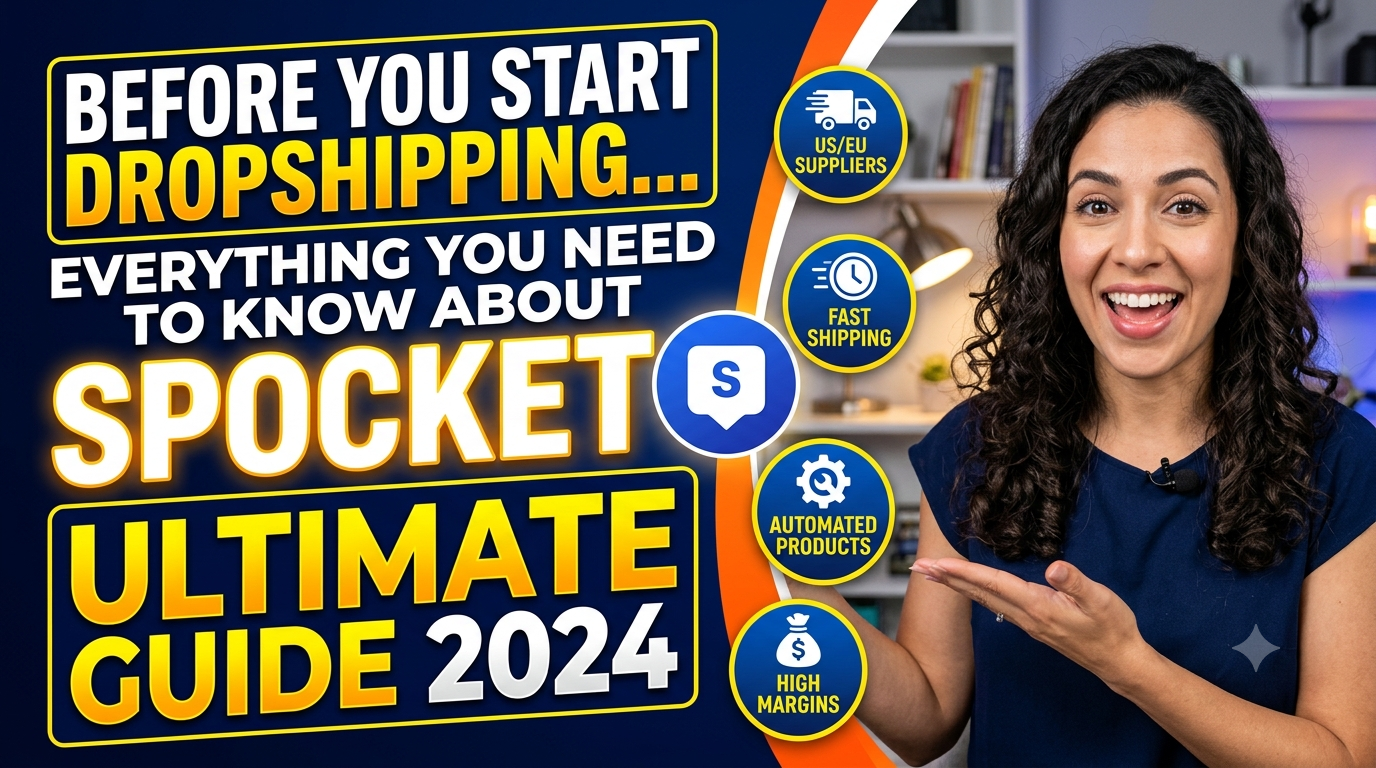
Discover everything you need to know about Spocket before starting your dropshipping business in 2026. Explore Spocket’s features, pricing plans, supplier marketplace, product sourcing, eCommerce integrations, order fulfillment, benefits, and drawbacks. Learn how Spocket works, compare it with other dropshipping platforms, and discover practical tips for finding winning products, managing costs, and building a profitable online store. Whether you’re a beginner or an experienced entrepreneur, this guide will help you decide if Spocket is the right dropshipping platform for your business.
Table of Contents
- What Is Spocket?
- How Does Spocket Work?
- Why Is Spocket Popular Among Dropshippers?
- Key Features of Spocket
- Spocket Pricing Plans
- eCommerce Platforms Supported by Spocket
- Benefits of Using Spocket for Dropshipping
- Disadvantages of Spocket
- How to Start a Dropshipping Business with Spocket
- Tips for Finding Winning Products on Spocket
- Spocket vs. Other Dropshipping Platforms
- Is Spocket Suitable for Beginners?
- How to Calculate Your Dropshipping Profit
- Is Spocket Worth It in 2026?
- Conclusion
- Frequently Asked Questions (FAQs)
What Is Spocket?
A dropshipping network called Spocket links providers of goods in various categories with online retailers. It helps entrepreneurs find products they can sell through their online stores without purchasing or storing inventory in advance. Instead of handling the entire supply chain yourself, you can use Spocket to discover suppliers, import products into your store, and coordinate order fulfillment. The platform is particularly known for its focus on suppliers based in the United States and Europe, although its marketplace also provides access to products from other regions. This makes it an interesting option for sellers who want to offer customers products with potentially shorter delivery times than traditional overseas sourcing.
The basic idea behind Spocket is simple: you concentrate on running your online business, attracting customers, and generating sales, while your suppliers handle product storage and shipping. For example, imagine that you want to establish an online store selling fashion accessories. Instead of purchasing hundreds of handbags and storing them at home, you can explore available products through Spocket, select suitable items, and import them into your eCommerce store. When someone purchases a handbag from your website, you pay the supplier for the product, and the supplier ships it directly to your customer. You earn the difference between your selling price and the total costs involved in fulfilling the order. This business model makes dropshipping attractive to people who want to explore eCommerce without investing heavily in physical inventory.
Spocket is not an online marketplace where customers necessarily purchase products directly from your account. It primarily works as a sourcing and management platform for retailers. You remain responsible for your storefront, marketing strategy, customer communication, pricing decisions, and overall brand experience. The platform provides tools that simplify product discovery and supplier coordination, but it does not automatically guarantee sales or business profitability. That distinction is important because many beginners assume that joining a dropshipping platform is enough to generate passive income. In reality, building a successful store requires research, planning, consistent marketing, and excellent customer service.
How Does Spocket Work?
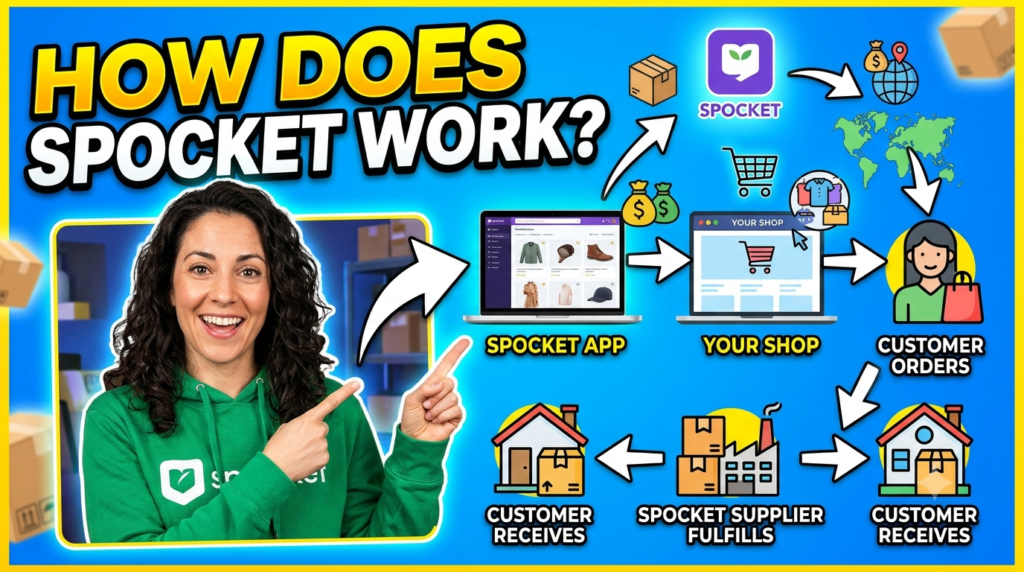
Understanding how Spocket works is one of the first things you should do before starting your dropshipping journey. The platform brings different parts of the dropshipping process together, helping retailers discover products and coordinate their orders without personally managing inventory. After creating an account, you can explore the available product catalog, compare suppliers, examine product details, and select items that match your business niche. Once you find products you want to sell, you can import them into a connected online store. Depending on the integration and settings, product information and order details can be synchronized between your store and Spocket. This reduces the need to manually recreate product listings and process every order from scratch.
Understanding the Dropshipping Process
The dropshipping process through Spocket generally follows a straightforward sequence. First, you create an online store using a supported eCommerce platform and connect it to your Spocket account. Next, you browse the supplier marketplace and select products that suit your target audience. After importing those products, you customize their descriptions, images, prices, and other details before making them available to customers. When a customer places an order and completes payment through your store, you arrange fulfillment through Spocket. You pay the supplier’s product and applicable shipping costs, and the supplier prepares and dispatches the order directly to your customer. Tracking information can then be synchronized with your store, depending on the integration.
Let’s understand this with a simple example. Suppose you list a home decoration product on your website for $40, while the supplier charges you $18 for the product and $5 for shipping. Your initial gross profit is $17. However, you should also account for payment processing charges, advertising expenses, store subscriptions, taxes, and possible refunds before calculating your actual profit. The customer sees your brand and purchases from your store, while the supplier handles the physical product delivery. This arrangement allows you to focus more on marketing and business growth instead of managing a warehouse. Spocket’s official help center explains this retailer-and-supplier relationship as the foundation of its dropshipping model.
Why Is Spocket Popular Among Dropshippers?
One major reason behind Spocket’s popularity is its focus on helping sellers find suppliers closer to their target customers. Traditional dropshipping businesses often source products from overseas manufacturers, which can result in longer delivery times. Customers today expect convenient shopping experiences, accurate tracking, and timely deliveries. If a customer orders something online, waiting several weeks without receiving proper updates can negatively affect their shopping experience. Spocket addresses this concern by providing access to suppliers in locations such as the United States, the United Kingdom, Europe, Canada, and other countries. Sellers can filter sourcing locations to find suppliers that better match their target markets.
Another reason entrepreneurs consider Spocket is its integration with popular eCommerce platforms. Instead of managing every product and order separately, retailers can connect their stores and use available synchronization features to simplify daily operations. This is particularly helpful for small business owners who may not have a dedicated team to handle inventory updates, product uploads, and order management. The platform also offers access to different product categories, including fashion, beauty, electronics, home decoration, accessories, and pet supplies. Having multiple categories available gives entrepreneurs the flexibility to experiment with different business ideas before concentrating on a specific niche. However, a large product catalog does not automatically mean every item is profitable or suitable for your audience.
Spocket also attracts sellers who want to build a recognizable online brand rather than operate a store that looks like a collection of random products. Features such as branded invoicing, supplier communication, and product sourcing can help retailers create a more organized business operation. Its product marketplace and automation tools reduce some of the repetitive work involved in dropshipping. Still, the best reason to consider Spocket is not simply that it offers convenient tools. It is the possibility of combining suitable suppliers, competitive products, reliable delivery, and effective marketing into one business strategy.
Key Features of Spocket
Spocket provides several features designed to simplify the process of managing a dropshipping store. These features cover different business activities, from discovering products and selecting suppliers to importing listings and handling customer orders. Understanding these tools can help you decide whether the platform offers the functionality your business actually needs. Instead of choosing a subscription based only on the number of products available, consider how each feature can support your daily operations and long-term business goals. Some features may be especially valuable when you are starting, while others become more useful as your store grows.
Product Sourcing and Supplier Marketplace
Product sourcing is one of the most important activities in dropshipping, and Spocket provides a marketplace where retailers can explore products from different suppliers. You can search for items according to your preferred category, sourcing location, and business requirements. The available categories include clothing, accessories, home and garden products, beauty items, electronics, toys, pet products, and other merchandise. This variety gives sellers an opportunity to research different niches without contacting every supplier individually. You can compare product information and supplier details before deciding which products deserve a place in your store.
The supplier marketplace can be particularly useful when you want to target customers in specific regions. For example, if your business focuses on American customers, you may prefer products that can be dispatched from US-based suppliers. Similarly, European sellers may want to prioritize suppliers located closer to their customers. This can help reduce delivery times, although actual shipping speed depends on the product, supplier, destination, processing time, and selected shipping service. Always examine the shipping details instead of assuming that every product available on Spocket offers fast delivery.
Automated Order Fulfillment
Managing customer orders manually can become exhausting when your store starts receiving multiple purchases every day. Spocket helps reduce this workload through its order management and synchronization features. Once your store is connected, relevant customer order information can appear in your Spocket dashboard, allowing you to arrange fulfillment through the platform. This reduces repetitive data entry and makes it easier to coordinate orders with suppliers. Available automation depends on your connected store, subscription, and the specific product or supplier workflow.
Imagine receiving 30 orders in a single day. Without an organized system, you would need to identify each product, contact the relevant supplier, share customer information, and manually keep track of shipping updates. Automation can simplify several of these activities and free up time for marketing, customer support, and business development. However, automation does not mean you can ignore your orders completely. You should regularly check payment status, fulfillment progress, inventory availability, and tracking information to make sure customers receive accurate updates.
Product Samples and Quality Checking
One common mistake beginners make is listing products without checking their actual quality. A product may look impressive in photographs but arrive with different colors, poor finishing, incorrect dimensions, or unsuitable packaging. These issues can lead to negative reviews, refunds, and customer complaints. Spocket’s help documentation explains that retailers can order product samples through the dashboard, allowing them to assess products before selling them to customers.
Ordering samples is a practical way to understand what your customers will receive. You can inspect the material, packaging, product dimensions, functionality, and overall appearance. You can also evaluate the supplier’s communication and delivery performance during the sample order. If the product does not meet your expectations, you can avoid promoting it and look for another option. Although samples require an additional investment, this small expense can help prevent larger problems once your store begins receiving regular orders.
Spocket Pricing Plans

Pricing is an important factor to consider before selecting any dropshipping platform. While Spocket helps simplify product sourcing and order management, its subscription charges should be included in your business budget. The platform offers different plans based on the number of products you can import and the additional tools available to your account. As of November 2026, the official pricing information lists several subscription options, with monthly and annual billing arrangements. Prices and features can change, so check the official pricing page before purchasing a subscription.
Here is an overview of the plans and advertised prices:
| Plan | Monthly price | Product allowance |
| Starter | $39.99 | 25 unique products |
| Professional | $59.99 | 250 unique products and 25 premium products |
| Empire | $99.99 | 10,000 unique and premium products |
| Unicorn | $299.99 | 25,000 unique and premium products |
Source: Spocket’s official pricing information, checked November 2026. Annual billing may offer different effective monthly prices.
The Starter plan is designed for sellers who want to begin with a relatively small product selection. It includes access to the product catalog, AliExpress dropshipping, and multiple-store support subject to separate subscription requirements. It may be useful for testing a focused niche, although the limit of 25 unique products can feel restrictive if you want to build a larger catalog. The Professional plan increases the product allowance and adds features such as supplier communication, branded invoicing, premium products, and VIP support. These additions may be helpful when you want to create a more professional customer experience and manage a growing product selection.
The Empire and Unicorn plans are designed for businesses that need significantly higher product limits. They provide more room to expand a catalog and access additional features, including options for marketplace selling and educational resources. However, buying the most expensive plan does not automatically improve your sales. A store with 20 carefully selected products can perform better than one containing thousands of poorly researched listings. Your subscription should match your actual business requirements rather than your expectations about future revenue.
One important detail is that the pricing shown in US dollars may not represent your complete business expense. You should also account for your eCommerce platform subscription, domain registration, payment processing, marketing, currency conversion, taxes, and other operational charges. Spocket advertises 0% transaction fees on its plans, but that does not mean external payment processors or other services will charge nothing. Additionally, make a distinction between a free trial and an ongoing free subscription. The Shopify App Store currently displays a free option with limited functionality alongside paid plans, while Spocket’s website promotes a seven-day trial for its paid subscriptions. Check the exact offer and renewal terms shown during registration.
eCommerce Platforms Supported by Spocket
Choosing a dropshipping supplier platform is only one part of establishing an online business. You also need an eCommerce store where customers can explore products, add items to their shopping carts, and complete purchases. Spocket supports integrations with several popular platforms, making it possible for retailers to connect their product sourcing activities with their preferred storefront.
Some of the platforms and services listed in Spocket’s integration resources include:
- Shopify: Useful for creating and managing an online store with product, checkout, and order management tools.
- WooCommerce: Suitable for businesses that want to build an online store using WordPress.
- BigCommerce: Offers eCommerce functionality for businesses that want a dedicated online selling platform.
- Wix: Provides website-building and online selling capabilities.
- Squarespace: Offers website design and eCommerce features.
- Ecwid: Helps businesses add online shopping functionality to their websites.
- Square: Provides commerce and payment-related services.
- AliExpress: Provides access to products and suppliers for dropshipping workflows.
The precise availability of features varies by integration, so you should check the relevant setup instructions before choosing your store platform.
Shopify is often a convenient starting point because of its dedicated app integration and store management capabilities. WooCommerce may be more attractive if you already operate a WordPress website and want greater control over your website environment. Wix and Squarespace can appeal to entrepreneurs who prioritize website design and straightforward store management. The right choice depends on your technical comfort, budget, business goals, and preferred level of customization.
The important thing is to select your storefront before importing hundreds of products. Establish your store structure, configure payment methods, create essential website pages, and test the checkout experience. A reliable storefront creates a professional first impression and helps customers feel comfortable placing orders.
Benefits of Using Spocket for Dropshipping
Spocket offers several potential benefits for entrepreneurs who want to build an online business without managing physical inventory. One of its most useful advantages is access to suppliers across different geographical locations. This gives retailers an opportunity to choose products based on their target market rather than relying entirely on one sourcing region. If you are selling to customers in the United States or Europe, choosing an appropriate local or regional supplier may help improve delivery expectations. Faster delivery can improve customer satisfaction, encourage repeat purchases, and reduce complaints about delayed orders. However, actual performance should always be checked product by product.
Another advantage is the convenience of product importing and order synchronization. Instead of creating every product listing manually, you can use the available integration tools to transfer product information into your connected store. This can save time, especially when you are testing different product categories. Automated order workflows also help reduce repetitive administrative tasks. For a small business owner handling marketing, customer service, website management, and product research alone, saving time on routine activities can make a meaningful difference.
Spocket also provides access to branded invoicing on eligible plans. Branding matters because customers should remember your business rather than simply the supplier that fulfilled their orders. Consistent branding across your website, invoices, product descriptions, and customer communication can help create a more recognizable shopping experience. The platform also supports communication with suppliers on eligible subscriptions, giving retailers an opportunity to ask questions about products and fulfillment.
Finally, Spocket provides access to a broad range of product categories and integrations. This flexibility allows entrepreneurs to explore different business models, including niche stores and selected print-on-demand products. You can begin with a small collection, evaluate customer interest, and expand once you identify products that perform well. The platform’s usefulness ultimately depends on how effectively you combine its tools with your own research and marketing strategy.
Disadvantages of Spocket
Although Spocket offers useful features, it is not a perfect solution for every dropshipping business. One of the biggest concerns for beginners is the subscription cost. A monthly plan adds to your fixed operating expenses even when your store has not generated any sales. If you are still experimenting with products or have a limited budget, paying for a subscription before validating your business idea may create unnecessary financial pressure. You should calculate how much revenue you need to cover your software, store, marketing, and fulfillment expenses before committing to a paid plan.
Another potential disadvantage is product pricing. Suppliers offering regional fulfillment and other convenient services may have higher product costs than some overseas alternatives. This can reduce your profit margin, particularly when competitors are selling similar products at lower prices. You may need to position your store around product quality, convenience, branding, and customer experience rather than competing only on price. That strategy can work, but it requires effective marketing and a clear understanding of your target customers.
You should also remember that supplier quality and shipping performance can vary. A platform listing does not eliminate the need to investigate individual suppliers. One supplier may provide excellent communication and consistent fulfillment, while another may experience delays or inventory problems. If you rely on a supplier without testing the product, you risk disappointing customers. Ordering samples, checking reviews, and discussing fulfillment expectations can help reduce this risk.
Customer feedback is another important consideration. The Shopify App Store currently displays a rating of 3.6 out of 5 for Spocket, based on 627 reviews at the time of the research. Its review section includes both positive experiences and complaints, including concerns about billing and customer support. These reviews should not be treated as proof that every user will have the same experience, but they are a reminder to examine subscription terms and support policies before joining.
For these reasons, Spocket is best approached as a business tool rather than a guaranteed shortcut to success. Research the costs, understand the limitations, and test the service before making a larger investment.
How to Start a Dropshipping Business with Spocket
Starting a dropshipping business becomes much easier when you follow a structured approach. Rather than creating an account and immediately importing random products, begin by identifying the customers you want to serve. Think about their interests, shopping habits, problems, and purchasing preferences. A clearly defined target audience helps you make better decisions about product selection, pricing, website design, and marketing. Once you understand your potential customers, you can choose a business niche that offers enough demand and room for differentiation.
After choosing your niche, create an account on Spocket and explore the available supplier marketplace. Compare product prices, shipping charges, supplier locations, product descriptions, and fulfillment details. Do not select products only because their images look attractive. Consider whether customers genuinely need them and whether you can market them effectively. Once you have shortlisted suitable products, connect Spocket to your preferred eCommerce platform and import the listings you want to test. Customize the product titles, descriptions, images, and pricing so that your store presents a consistent brand identity.
Choosing Products and Setting Up Your Store
Your online store should look trustworthy and easy to navigate. Create a professional homepage that communicates what your business sells and why customers should consider buying from you. Organize products into useful categories, use clear photographs, and write accurate descriptions that explain product features and benefits. Include important pages such as About Us, Contact Us, Shipping Policy, Return and Refund Policy, Privacy Policy, and Terms and Conditions. These pages help customers understand how your business operates and what they can expect after placing an order.
Next, configure payment methods and shipping settings for your target market. Make sure your product prices include enough room to cover supplier costs, shipping, payment processing, marketing, and other expenses. Test the complete checkout process before launching your store publicly. You should also check how your website appears on mobile devices because many customers browse and purchase products using smartphones.
Once everything is ready, start promoting your store through suitable marketing channels. Social media platforms, search engine optimization, email marketing, influencer collaborations, and paid advertisements can help attract visitors. However, avoid spending a large advertising budget before testing your products and understanding customer behavior. Start with manageable campaigns, examine the results, and improve your strategy using actual performance data.
Tips for Finding Winning Products on Spocket
Finding the right products is one of the biggest challenges in dropshipping. A product that sells well for another retailer may not necessarily perform well in your store. Successful product selection requires a combination of market research, customer understanding, supplier evaluation, and pricing analysis. Begin by looking for products that solve a specific problem or offer a clear benefit. Items that make everyday activities easier, improve convenience, or support a particular hobby may attract customers when presented to the right audience.
Seasonal trends can also create opportunities. For example, home decoration products may attract more interest during holiday periods, while travel accessories may become relevant during vacation seasons. However, seasonal products require careful planning because demand can decline after the event or season ends. A balanced product catalog can include both evergreen items and selected seasonal products. This helps your business avoid relying entirely on short-term trends.
Pay attention to competition before selecting a product. Search for similar items on competing websites and marketplaces to understand their prices, customer reviews, features, and presentation. Look for opportunities to differentiate your offer through better descriptions, product bundles, improved branding, or a more focused target audience. If many stores already sell an identical item, think carefully about why customers would choose your business.
Your product research method should include supplier evaluation. Check delivery estimates, product availability, shipping costs, and communication quality. Order samples whenever possible and evaluate the actual product before investing in advertising. A product with an attractive wholesale price is not necessarily a good business opportunity if shipping is unreliable or quality is inconsistent.
Most importantly, track product performance after launching your store. Examine website traffic, click-through rates, conversion rates, average order value, customer acquisition costs, and refund rates. These metrics help you identify which products deserve more attention and which ones should be replaced. Instead of trying to find a magical winning product, develop a repeatable research and testing process.
Spocket vs. Other Dropshipping Platforms
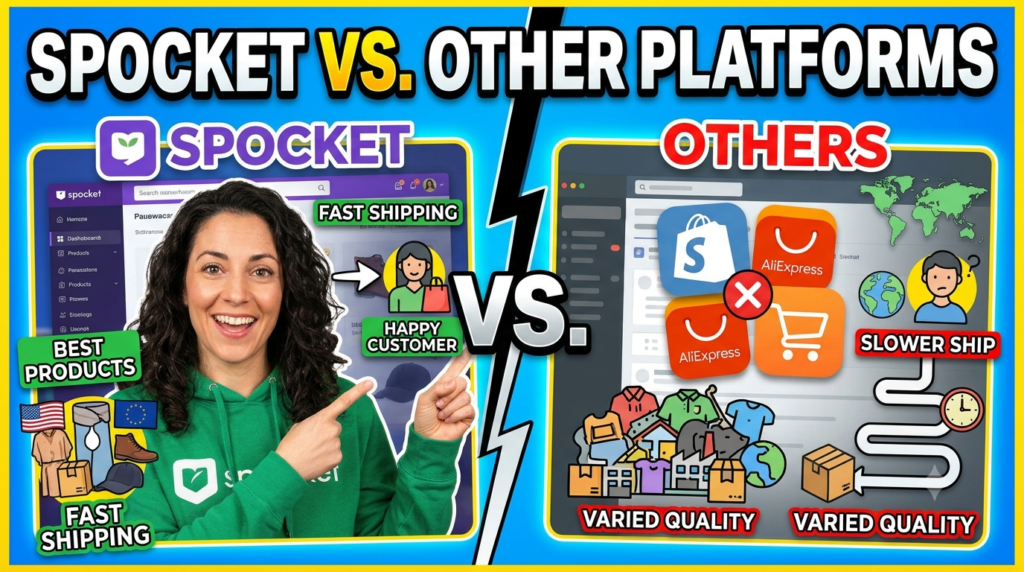
Before selecting Spocket, it is sensible to compare it with other dropshipping platforms. Different services focus on different aspects of the business, including supplier access, automation, product sourcing, customization, and pricing. The best platform depends on the type of store you want to build and the customers you plan to target.
| Platform | Main focus | Suitable for |
| Spocket | US and EU-focused supplier marketplace and integrations | Sellers prioritizing regional sourcing |
| DSers | AliExpress dropshipping and order management | Sellers sourcing products through AliExpress |
| CJdropshipping | Product sourcing, fulfillment, and logistics | Sellers seeking broader sourcing and fulfillment services |
| Zendrop | Dropshipping sourcing and fulfillment tools | Entrepreneurs seeking an integrated workflow |
| Printful | Print-on-demand products | Businesses selling customized merchandise |
| Printify | Print-on-demand supplier network | Sellers comparing custom product providers |
Spocket stands out for its supplier marketplace and focus on regional sourcing. DSers is particularly relevant to retailers who want to work with AliExpress suppliers and manage product orders through a dedicated tool. CJdropshipping offers product sourcing and fulfillment services that may suit sellers who need broader sourcing options. Zendrop provides another option for entrepreneurs looking for an integrated dropshipping workflow. Printful and Printify are different in that their primary focus is print-on-demand merchandise rather than general product sourcing.
There is no universal winner in this comparison. If your business depends on selling products from regional suppliers, Spocket deserves consideration. If your sourcing strategy is heavily based on AliExpress, DSers may be worth evaluating. If your main idea involves customized T-shirts, mugs, or other personalized merchandise, print-on-demand platforms may be a better fit. Compare current pricing, product costs, shipping arrangements, and integration capabilities before making your final choice.
Is Spocket Suitable for Beginners?
Yes, Spocket can be a useful option for beginners who want to explore dropshipping without managing physical inventory. Its product marketplace, store integrations, and order management features can simplify several activities that would otherwise require manual work. New entrepreneurs can browse products, compare suppliers, and experiment with different niches without purchasing large quantities of stock. This makes it easier to understand how online retail works before investing in a traditional inventory-based business. However, beginners should remember that avoiding inventory expenses does not mean starting a dropshipping business is completely free.
One of the biggest challenges for beginners is understanding the difference between revenue and profit. Receiving an order worth $100 does not mean you have earned $100. You still need to pay the supplier, shipping charges, payment processing fees, advertising expenses, and other business costs. If you do not calculate these expenses correctly, your store may generate sales while losing money. Therefore, learning basic financial management is just as important as learning how to use Spocket.
Another important skill is customer communication. Customers expect accurate product descriptions, realistic delivery estimates, and quick responses when something goes wrong. Even though suppliers handle shipping, customers generally hold your store responsible for their shopping experience. You should be prepared to answer questions, resolve complaints, manage returns, and communicate delays professionally. If you are willing to learn these skills and consistently improve your business strategy, Spocket can provide a useful starting point for exploring the dropshipping industry.
Read More:-
How Does Strikingly Simplify the Website Building Process?
Building Your Dream Website with Site123
Boost Your E-commerce Strategy with YITH Plugins
Maximize Your Customer Engagement with LiveAgent’s Features
Why STRIPO is Essential for Digital Product Marketersa
How to Calculate Your Dropshipping Profit
Understanding profit margins is essential before launching your Spocket-powered store. Many beginners focus entirely on the difference between the selling price and supplier price, but this calculation does not represent the actual money they keep. A profitable dropshipping business must account for every expense involved in attracting customers, processing payments, fulfilling orders, and maintaining the website. Without proper calculations, you might spend money promoting a product that generates sales but produces very little profit.
Consider the following example:
| Business expense | Amount |
| Customer selling price | $50 |
| Supplier product cost | $20 |
| Shipping cost | $5 |
| Payment processing estimate | $1.75 |
| Advertising cost per order | $8 |
| Other allocated expenses | $2 |
| Estimated net profit | $13.25 |
In this example, the customer pays $50, while your estimated expenses total $36.75. Your remaining profit is $13.25, representing a margin of 26.5% of revenue. These figures are illustrative rather than actual Spocket charges or guaranteed business results. Your real profit will depend on your supplier, payment provider, advertising performance, taxes, refunds, and other expenses.
You should also calculate your break-even point. This tells you how many orders you need to generate before your business starts covering its expenses. For example, if your monthly fixed expenses are $100 and you earn $10 in contribution profit per order after variable costs, you need 10 orders to cover those fixed expenses. Any additional contribution can help generate operating profit, although other expenses and taxes may still apply.
Keep a spreadsheet to monitor your product costs, selling prices, shipping charges, marketing expenses, and monthly subscriptions. Review these numbers regularly instead of relying on assumptions. When you understand your financial performance, you can make better decisions about increasing product prices, changing suppliers, adjusting advertisements, or discontinuing unprofitable products.
Is Spocket Worth It in 2026?
Spocket can be worth considering in 2026, particularly for entrepreneurs who want to source products from US and European suppliers and manage their online stores through connected eCommerce platforms. Its product discovery tools, supplier marketplace, order synchronization, and available branding features can simplify several parts of the dropshipping process. The platform also supports multiple eCommerce integrations and offers different subscription levels for businesses with different product requirements. These features make it a relevant option for sellers who value convenience and want to organize their sourcing and fulfillment activities.
However, whether it is worth the investment depends on your business model. If you are operating with a very small budget, a monthly subscription may be difficult to justify before you have validated your product idea. If your target customers are located far from your selected suppliers, shipping costs and delivery times may also affect your business performance. You should compare alternative platforms and calculate your potential profit margins before deciding which service to use.
For sellers who prioritize regional suppliers, faster potential delivery, and convenient product importing, Spocket may offer meaningful value. For entrepreneurs who want the lowest possible sourcing costs or depend heavily on a different supplier ecosystem, another platform might be more appropriate. The best decision comes from matching the platform’s actual capabilities with your customers’ needs and your financial goals.
My recommendation is to start with product research, identify a specific niche, examine supplier reliability, and test the platform’s features before committing to a long-term subscription. Do not choose a plan simply because it offers thousands of products. Choose one that supports the business you are actually building.

Conclusion
Starting a dropshipping business can be an exciting opportunity for entrepreneurs who want to enter the eCommerce industry without managing physical inventory. However, building a successful online store requires much more than finding products and uploading them to a website. You need reliable suppliers, competitive pricing, effective marketing, excellent customer service, and a clear understanding of your business expenses.
Spocket brings several useful tools together, including product sourcing, supplier discovery, eCommerce integrations, order management, and branding features. Its focus on US and European suppliers makes it particularly interesting for sellers who want to explore regional sourcing opportunities. At the same time, subscription costs, product pricing, supplier performance, and shipping limitations should be considered before investing.
If you are planning to start dropshipping in 2026, take time to research your niche, compare suppliers, order product samples, and calculate your expected profit margins. Start small, test your ideas, and expand only when you have evidence that your products and marketing strategy are working.
Remember, the success of your dropshipping business will not depend on the platform alone. It will depend on how well you understand your customers, choose your products, manage your expenses, and deliver a shopping experience that encourages people to return.
Frequently Asked Questions (FAQs)
Q. What is Spocket used for in dropshipping?
A. Spocket is used to discover dropshipping products, connect with suppliers, import product listings into online stores, and coordinate order fulfillment. It helps retailers manage important parts of their dropshipping operations without maintaining physical inventory. It also offers integrations with platforms such as Shopify, WooCommerce, Wix, and BigCommerce.
Q. Is Spocket free to use?
A. Spocket offers limited free access through certain channels, while its main paid subscriptions provide additional product allowances and features. Its website advertises a seven-day trial for paid plans. The Shopify App Store also displays a limited free option. Always check the current subscription terms, trial conditions, and renewal charges before signing up.
Q. Can beginners make money using Spocket?
A. Yes, beginners can potentially earn money using Spocket by selecting suitable products, creating an attractive online store, and implementing effective marketing strategies. However, profits are not guaranteed. Success depends on product demand, supplier reliability, pricing, advertising costs, customer satisfaction, and overall business management.
Q. Does Spocket work with Shopify and WooCommerce?
A. Yes. Spocket supports integrations with Shopify and WooCommerce, along with other eCommerce platforms such as Wix, BigCommerce, Squarespace, Square, and Ecwid. These integrations help retailers connect their online stores with the platform’s product sourcing and order management tools.
Q. Is Spocket better than AliExpress for dropshipping?
A. It depends on your business requirements. Spocket focuses on a curated supplier marketplace with strong US and European sourcing options, while AliExpress provides access to a broad international marketplace. Spocket may be attractive if regional suppliers and potentially faster delivery are priorities. AliExpress may offer more sourcing choices and different price points. Compare individual products, suppliers, delivery estimates, and total costs before deciding.