PromoRepublic is a powerful social media management and local marketing platform designed to help businesses simplify content creation, scheduling, publishing, analytics, reviews, and brand management from one centralized workspace. With features such as AI-powered content creation, multi-location management, social media scheduling, approval workflows, digital asset management, and performance insights, PromoRepublic can help brands maintain consistency while giving local teams the flexibility to engage their audiences effectively. Whether you manage a small business, agency, franchise, or growing multi-location brand, PromoRepublic provides practical tools for organizing social media campaigns, improving productivity, and building a stronger online presence.
Table of Contents
- What Is PromoRepublic?
- Why Businesses Choose PromoRepublic
- Getting Started with PromoRepublic
- Building a Social Media Content Strategy
- AI-Powered Content Creation
- Scheduling and Publishing Social Content
- Managing Multiple Social Media Platforms
- Brand Management and Content Governance
- Social Media Collaboration and Approval Workflows
- Analytics and Performance Tracking
- Managing Reviews, Messages and Customer Conversations
- PromoRepublic for Franchises and Multi-Location Brands
- PromoRepublic Pricing and Plans
- Practical Tips for Better Results
- Common Mistakes to Avoid
- PromoRepublic vs. Traditional Social Media Management
- How to Build a Repeatable Workflow
- Is PromoRepublic Right for Your Business?
- Conclusion
- Frequently Asked Questions
What Is PromoRepublic?
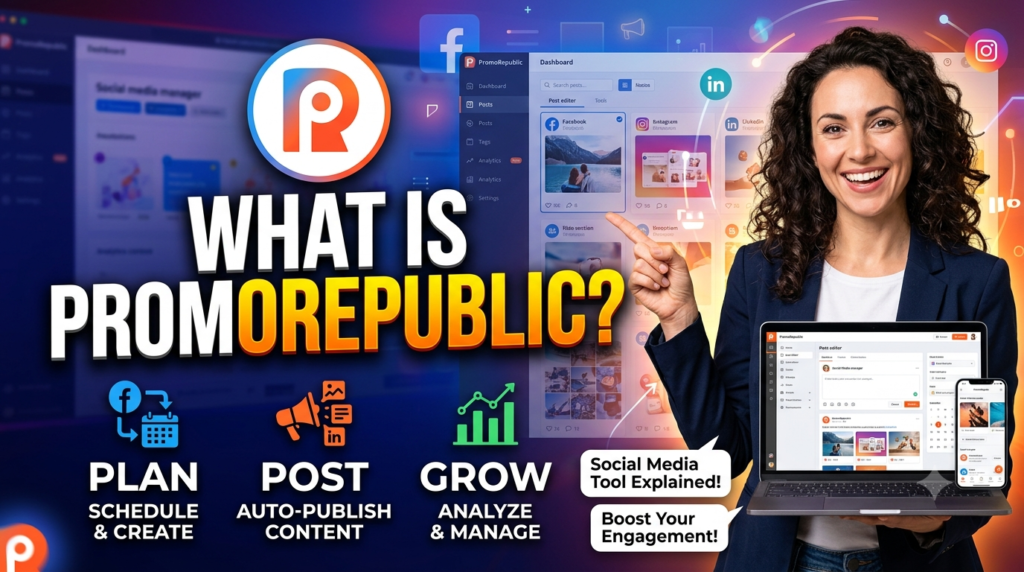
PromoRepublic is a social media and local marketing management platform designed to help organizations manage digital marketing activities from a centralized workspace. While social media publishing remains an important part of the platform, its current product ecosystem extends into listings, reviews, analytics, digital asset management, and AI-powered tools. This broader approach is especially useful for organizations where the same marketing strategy has to be executed across many locations without losing local relevance. Instead of asking individual teams to maintain separate spreadsheets, publishing tools, review dashboards, and reporting systems, businesses can use a connected environment for much of that work. PromoRepublic’s platform currently describes itself as an agentic local marketing platform, with AI Composer for content creation, AI Assistant for insights, and AI Agents designed to execute selected marketing tasks within defined brand rules. That distinction matters because modern social media management is no longer just about posting at the right time. A good system needs to help marketers understand what happened, decide what should happen next, and make execution easier. PromoRepublic is particularly compelling when the problem is scale: dozens or hundreds of pages, multiple regions, different users, and a corporate brand that still wants local teams to sound authentic.
Why Social Media Management Needs a Centralized Platform
Managing social media manually can work for a small business, but manual processes become increasingly fragile as the number of accounts grows. Imagine having twenty locations and asking each manager to create their own posts, remember brand guidelines, schedule content, respond to comments, monitor reviews, and report performance every week. Even if every person is talented, the result can become inconsistent very quickly. One location might publish three times a week while another disappears for a month; one team might use approved imagery while another uses outdated assets; and someone may spend hours building reports that could have been generated from centralized data. A centralized platform addresses these problems by creating one operational layer for planning, publishing, collaboration, governance, and measurement. PromoRepublic supports centralized management of brands, locations, roles, permissions, content approvals, and brand guidelines, which is particularly relevant for distributed marketing teams. Think of it as replacing a pile of individual notebooks with a shared command center. The goal is not simply to make social media easier; it is to make the entire process more predictable. Once the workflow becomes predictable, teams can spend more time thinking creatively about customers and campaigns instead of chasing passwords, spreadsheets, approvals, and missing reports.
Why Businesses Choose PromoRepublic
One of the biggest reasons businesses consider PromoRepublic is the ability to combine multiple marketing functions in a single platform. The current product structure includes social media management, digital asset management, reviews, listings, local SEO capabilities, analytics, and AI tools. This combination can be especially valuable for a company that wants social activity to connect with broader local marketing performance. For example, a local restaurant does not simply need Instagram posts; it also needs accurate business information, positive reviews, discoverability in search, and a way to understand which locations are generating engagement and customer actions. When these activities exist in separate systems, marketers often end up looking at disconnected numbers. PromoRepublic’s approach is designed to bring more of those signals together. The platform also emphasizes brand governance, allowing organizations to establish permissions, approval workflows, content controls, and brand guidelines. That makes it useful for businesses where consistency matters as much as creativity. A franchise headquarters, for example, may want to give local operators enough freedom to speak to their communities while ensuring that logos, messaging, campaigns, and compliance standards remain controlled. The platform therefore works best when it is treated not simply as a scheduling tool but as an operating system for distributed marketing.
Multi-Location and Multi-Brand Management
Multi-location marketing creates a strange contradiction: customers expect local businesses to feel personal, while headquarters needs consistency and control. PromoRepublic is designed around this exact challenge. Its platform supports complex brand hierarchies, location grouping, user permissions, centralized dashboards, and regional or owner-based organization. This means a national marketing team can create a campaign centrally while individual locations can participate without rebuilding everything from scratch. A company with several brands can also organize those brands inside the same broader environment rather than treating each one as an isolated project. The benefit is operational visibility. Headquarters can identify which locations are publishing consistently, which are underperforming, and where additional support may be needed. Local managers, meanwhile, can work with content and tools relevant to their own locations. This structure becomes even more important as an organization grows because the cost of inconsistency grows alongside the number of accounts. If ten locations each make one small mistake, that may be manageable; if five hundred locations do it, the issue becomes strategic. A centralized system creates guardrails without necessarily eliminating local personality. That balance—central control combined with local execution—is one of the strongest reasons to consider PromoRepublic for franchise and multi-location social media management.
Getting Started with PromoRepublic
The first practical step is connecting the social media pages and business profiles you want to manage. PromoRepublic’s current documentation explains that pages can be connected through the Calendar or Location Settings, with location-based management being particularly useful for users handling multiple locations. The connection process depends on the social network and the type of account being connected, so administrators should verify that they have the necessary permissions before starting. For example, Facebook Business Pages require appropriate administrative access, while Instagram Business connections are handled through Facebook authentication. Once accounts are connected, resist the temptation to immediately start publishing. A stronger approach is to first establish your organizational structure, brand guidelines, content categories, approval responsibilities, and reporting goals. Decide who creates content, who reviews it, who approves it, and who is responsible for community management. Then establish a content calendar that reflects business priorities rather than simply filling empty spaces. This preparation may take longer at the beginning, but it pays off later because every new campaign can follow the same framework. The objective is to create a system where someone joining the team can understand the workflow without needing a week-long explanation from another employee.
Connecting Your Social Media Accounts
PromoRepublic currently supports publishing across several major networks, including Facebook, Instagram, X, LinkedIn, Pinterest, TikTok, Google Business Profile, and YouTube, although account requirements and publishing capabilities vary by network. This variety makes it possible to manage a broad social presence from one environment, but marketers should not assume that every platform behaves identically. Instagram, for example, has specific requirements for automated publishing, while Facebook requires suitable administrative permissions for business pages. The smartest approach is to treat each connected network as part of a larger content strategy rather than copying the exact same message everywhere. A LinkedIn audience may respond to an industry insight, while Instagram followers may prefer visual storytelling and TikTok users may respond to short-form video. PromoRepublic gives you the infrastructure to coordinate these channels, but the strategic responsibility still belongs to the marketer. Before connecting dozens of accounts, start with a small group and verify that publishing, analytics, permissions, and notifications work as expected. Then expand systematically. This reduces troubleshooting and helps establish a reliable operating pattern. In a large organization, account connection should also be treated as a governance activity because access permissions determine who can publish, approve, or modify content.
Building a Social Media Content Strategy
A social media management platform is only as effective as the strategy behind it. If the content plan is weak, better scheduling will simply help you publish weak content faster. Start by defining what your social channels are supposed to accomplish. Are you trying to generate leads, increase store visits, build awareness, support customers, strengthen community relationships, recruit employees, or improve retention? Once those goals are clear, create content categories that support them. A useful content mix might include educational posts, promotional campaigns, customer stories, behind-the-scenes content, community highlights, seasonal messaging, product demonstrations, and user-generated content. The exact mix depends on the business, but the principle remains the same: every post should have a reason for existing. PromoRepublic’s calendar and publishing capabilities can then become the execution layer for that strategy. Its posting resources include scheduling, multi-posting, repeating posts, cross-time-zone publishing, approval proposals, and platform-specific workflows. The calendar should therefore be more than a list of scheduled posts. It should represent your marketing rhythm. When someone opens it, they should be able to see whether the brand is balanced, whether important campaigns are properly distributed, and whether local teams are contributing meaningful content.
Creating and Organizing Your Content Calendar
A strong content calendar gives social media managers something incredibly valuable: visibility. Instead of reacting to whatever happens each morning, the team can see upcoming campaigns, seasonal events, promotions, product launches, and local opportunities in one place. PromoRepublic’s publishing system supports scheduling and multi-posting, which can reduce repetitive work when similar content needs to reach multiple pages or locations. The key is to avoid turning the calendar into an automated content factory. A calendar should leave room for real-time moments, customer conversations, unexpected news, and community events. For multi-location brands, a useful model is to divide content into centrally controlled campaigns and locally created posts. Headquarters might provide a national holiday campaign, while each location adds a local customer story or community event. This creates consistency without making every page look identical. You can also use recurring content carefully, especially for evergreen messages that genuinely remain relevant. The objective is not to maximize the number of posts; it is to create a sustainable publishing cadence that audiences recognize and teams can maintain. A well-managed calendar acts like a traffic control system: it prevents campaigns from colliding, keeps important messages moving, and gives everyone visibility into what is happening next.
AI-Powered Content Creation
Artificial intelligence has become one of the most important changes in social media management, but the best use of AI is not simply asking it to write everything. PromoRepublic currently offers AI Composer for generating on-brand social content and personalized review replies, while its AI Assistant can answer questions about live account data and provide recommendations based on the organization’s actual marketing information. This can dramatically reduce the time spent on repetitive tasks. A marketer might use AI to generate several caption concepts, rewrite a message for a different audience, summarize performance trends, or draft a response to a customer review. The human still needs to make the final judgment. Brand voice, accuracy, cultural context, and customer sensitivity cannot simply be delegated without oversight. PromoRepublic’s current AI Assistant workflow is designed around approval: for example, when asked to create a post or review response, it drafts the content and submits it for review rather than automatically publishing or sending it. That is an important distinction for businesses that care about governance. The best workflow is therefore AI for acceleration, humans for judgment. Use technology to remove repetitive work, then use the time you save to improve strategy and creativity.
Using AI Composer and AI Assistant
AI Composer is most useful when you already know what you want to communicate but need help turning the idea into polished social copy. Instead of staring at a blank text box, you can provide the topic, campaign objective, audience, or relevant context and use AI as a starting point. The AI Assistant takes the concept further because it can work with live platform information. PromoRepublic’s current documentation says the assistant can analyze social performance, publishing activity, reviews, Google Business Profile information, local rankings, and inbox conversations, depending on available modules and permissions. That means you can ask questions that are closer to business analysis than simple content generation. For example, a marketing manager might investigate why engagement declined, identify locations that are publishing less frequently, compare performance across periods, or request a summary of network-level activity. The important habit is to ask specific questions. Instead of saying “How are we doing?”, ask which locations experienced the largest engagement change, what content types performed best, or which locations have low publishing activity. The more precise the question, the more actionable the answer tends to become. PromoRepublic’s AI tools should be treated like a highly capable assistant rather than an autopilot button. Give them useful context, inspect the output, and keep humans responsible for decisions that affect customers and the brand.
Scheduling and Publishing Social Content
Scheduling is one of the most obvious benefits of social media management software, but effective scheduling is about more than selecting a date and clicking publish. You need to consider audience behavior, campaign timing, platform differences, location-specific events, and the relationship between organic content and paid campaigns. PromoRepublic supports scheduled publishing and a variety of publishing workflows, including multi-posting and repeating posts. For a business with many locations, these features can significantly reduce repetitive work. Imagine preparing a seasonal campaign once and distributing it to dozens of approved locations rather than asking every manager to manually recreate the post. At the same time, centralized scheduling should not become an excuse for identical feeds. Local audiences still need content that reflects their community. A useful workflow is to schedule foundational brand content centrally and reserve part of the calendar for location-specific storytelling. Before anything goes live, review captions, images, links, targeting, and platform formatting. Scheduling creates efficiency, but a scheduled mistake is still a mistake—it simply arrives at exactly the wrong time. Build approval checks into the workflow, especially for campaigns involving promotions, legal claims, sensitive subjects, or multiple brands.
Managing Multiple Social Media Platforms
Different social networks attract different audiences and encourage different forms of communication, so cross-platform management should never mean blindly copying and pasting. PromoRepublic supports multiple social networks, including Facebook, Instagram, LinkedIn, Pinterest, TikTok, YouTube, X, and Google Business Profile. This broad support allows marketers to coordinate campaigns while adapting individual posts for each channel. A single campaign idea can therefore become a LinkedIn thought-leadership post, an Instagram carousel, a TikTok video, a Facebook community update, and a Google Business Profile message. The central idea stays consistent, but the execution changes. PromoRepublic has also added platform-specific publishing capabilities over time; for example, its August 2026 documentation describes mixed-media Instagram carousels that can combine photos and videos in a single feed post. This illustrates why social media managers should keep checking current platform capabilities instead of assuming every network has the same rules. The strongest cross-platform strategy combines centralized coordination with channel-specific creativity. Use your management platform to organize the workflow, but let each social network maintain its own personality. That approach produces a presence that feels intentional rather than mass-produced.
Facebook, Instagram, LinkedIn, TikTok and Other Channels
The ideal platform mix depends on where your customers actually spend time. Facebook may remain important for community interaction and local businesses, Instagram can support visual storytelling and brand discovery, LinkedIn can help B2B organizations and professional brands, TikTok can provide short-form discovery opportunities, and YouTube can support longer educational or demonstration content. PromoRepublic’s supported network list gives organizations the infrastructure to coordinate these channels from one management environment. However, having access to a platform does not mean you need to use it aggressively. A smaller number of well-managed channels is usually more sustainable than trying to maintain every possible account with weak content. Review your analytics regularly and identify where your audience responds. Then adjust your resources accordingly. For multi-location organizations, the decision can also vary by location. A tourism business in one market might benefit heavily from visual content, while another location could generate stronger results through local community posts. The advantage of centralized management is that you can compare these patterns instead of relying entirely on assumptions. Use the platform data to decide where your attention belongs. Social media management should ultimately answer a business question: where can our limited time and creative resources produce the greatest meaningful impact?
Brand Management and Content Governance
As a company grows, brand consistency becomes increasingly difficult to maintain. Different people naturally use different wording, images, colors, offers, and communication styles. Without governance, a brand can slowly become a collection of disconnected interpretations. PromoRepublic addresses this challenge with brand management features such as brand kits, digital asset management, content approval workflows, permissions, and brand guidelines that can inform AI recommendations. This is particularly important for franchise organizations because local autonomy can create value while also creating risk. A franchisee should be able to talk about a neighborhood event, but they should not accidentally publish outdated corporate branding or an unapproved claim. Establish clear rules about what local teams can change and what requires headquarters approval. Then use the platform to make those rules part of the workflow. Digital asset management can also reduce the problem of people downloading old logos or promotional images from random folders. When the correct assets are easy to find, teams are more likely to use them. Governance should not feel like bureaucracy for its own sake. The best governance system is almost invisible to the user: it makes the correct action easy, the incorrect action difficult, and the approval path obvious.
Social Media Collaboration and Approval Workflows
These days, social media rarely belongs to one individual. Marketing managers, designers, copywriters, franchisees, agency partners, customer service teams, and senior leaders may all touch the same content. Without a structured approval process, collaboration can become a maze of emails, spreadsheets, screenshots, and messages asking, “Has this been approved yet?” PromoRepublic provides content approval workflows and role-based access as part of its platform capabilities. This creates a clearer chain of responsibility. A local manager can propose content, a regional manager can review it, and an authorized person can approve the final version. The exact structure should match your organization, but the principle is universal: everyone should know what they are responsible for. Avoid unnecessary approval layers because excessive bureaucracy can slow campaigns to a crawl. At the same time, do not remove approval from situations where mistakes can create reputational or regulatory problems. A useful approach is to categorize content by risk. Routine evergreen posts may need a lightweight workflow, while sensitive promotions or corporate announcements may require additional review. When teams know the rules, approval becomes faster rather than slower. The goal is not to have more people checking every post; it is to have the right people checking the right posts at the right stage.
Analytics and Performance Tracking

Publishing content without measuring results is like driving while keeping your eyes closed. You may move forward, but you have little idea whether you are heading toward your destination. PromoRepublic includes social media and content performance analytics, location insights, review analytics, and broader reporting capabilities depending on the selected plan and modules. The real value of analytics comes from turning numbers into decisions. Instead of celebrating a high number of likes, ask whether engagement increased because the content was more relevant, whether it generated meaningful actions, or whether the result was isolated to one audience segment. For multi-location organizations, analytics can also reveal operational differences. One location might have excellent engagement because its manager posts consistently, while another may need training or additional content support. PromoRepublic’s current AI Assistant can also interrogate live performance information, allowing users to ask questions about social performance, publishing activity, reviews, rankings, and other available data. This can make reporting more conversational and less dependent on manually navigating multiple dashboards. The best measurement system should therefore answer three questions: What happened? Why did it happen? What should we do next? If your analytics process cannot answer the third question, you are collecting data rather than using it.
Turning Social Data Into Better Decisions
Good reporting is not about producing the largest spreadsheet. It is about finding patterns that can change your next decision. Look for trends across content types, locations, platforms, campaign periods, and audience behavior. If educational content consistently generates meaningful engagement, increase its role in the content strategy. If a particular campaign performs well in one region but poorly in another, investigate the local context rather than simply declaring the campaign successful or unsuccessful. PromoRepublic’s current AI Assistant can help surface these types of insights from live account data, including comparisons between periods and identification of locations that may be underperforming. This can be particularly useful for managers who oversee large networks and cannot manually inspect every location every morning. Still, analytics should lead to experimentation rather than automatic conclusions. A drop in engagement might result from content quality, seasonality, audience changes, platform behavior, or publishing frequency. Treat the data as a clue, not a verdict. The most sophisticated analytics dashboard in the world cannot replace business context. Combine platform data with knowledge of customers, local markets, promotions, and operational changes. That is where numbers become strategy.
Managing Reviews, Messages and Customer Conversations
Social media management increasingly overlaps with customer experience. Customers do not always separate “marketing” from “customer service”; they may leave a complaint under a promotional post, send a direct message asking about opening hours, or publish a review after visiting a location. PromoRepublic brings social inbox and review management into its broader local marketing platform, allowing teams to handle conversations and feedback alongside publishing and analytics. The AI Assistant can also work with inbox conversations and review information when those modules are available. This creates an important opportunity: content and customer feedback can inform each other. If customers repeatedly ask the same question, create content that answers it. If reviews frequently mention a particular strength, showcase it in marketing. If complaints reveal a recurring operational problem, share that insight with the appropriate internal team. Social media management becomes much more valuable when it is connected to the customer journey. The goal is not to respond to every message with a generic template. Customers can recognize robotic communication immediately. Use automation and AI to accelerate routine work, but preserve human judgment for complex, emotional, or sensitive conversations. A fast response is useful; a thoughtful response is better.
PromoRepublic for Franchises and Multi-Location Brands
PromoRepublic is especially relevant to franchises because the platform is designed around the tension between centralized strategy and local execution. Its current pricing structure specifically positions the platform around emerging franchise systems, chains scaling beyond a hundred locations, and enterprise organizations managing multiple brands, regions, and channels. This is a fundamentally different use case from a freelancer scheduling posts for two clients. In a franchise environment, headquarters may need to create campaigns, protect the brand, distribute assets, measure location performance, and encourage local participation. Franchisees need simple tools that help them execute without requiring advanced marketing expertise. PromoRepublic’s platform includes features such as content approvals, brand kits, digital asset management, analytics, leaderboards, benchmarks, adoption tools, and dedicated customer success support depending on plan. Its AI capabilities also extend beyond content generation into insights and automated execution. For a growing franchise network, the biggest benefit may therefore be operational rather than purely creative. The platform can create a shared framework where every location has access to the same strategic foundation while still leaving room for local storytelling. That is the difference between simply managing social media accounts and managing a scalable local marketing program.
PromoRepublic Pricing and Plans
PromoRepublic’s current pricing page presents three primary tiers: Build, Grow, and Enterprise, with the exact capabilities varying by plan and available add-ons. The Build plan is positioned toward emerging franchise systems and smaller chains, while Grow is aimed at franchises and chains scaling to larger numbers of locations, and Enterprise is designed for multi-brand and multi-country organizations requiring deeper control, analytics, integrations, and automation. The plans include different combinations of social publishing, reviews, digital asset management, analytics, listings, AI capabilities, workflows, and support. Because pricing and feature packaging can change, businesses should evaluate the current official pricing page rather than relying on an old third-party article or screenshot. PromoRepublic also currently offers a 14-day free trial that provides access to most platform features, supports up to three social pages, and does not require a credit card at signup according to its help documentation. The best way to evaluate the platform is to test it against your actual workflow. Connect representative accounts, build a small campaign, test approvals, examine analytics, and see whether the platform genuinely reduces administrative work. A lower-priced tool that requires five separate workarounds may cost more in employee time than a platform with broader functionality.
Practical Tips for Better Results

Getting value from PromoRepublic requires more than knowing where the scheduling button is. Start by documenting your workflow before building it inside the platform. Define your audience, content pillars, publishing frequency, approval rules, brand standards, and performance metrics. Then create templates for recurring campaigns so your team does not reinvent the process every month. Use AI for first drafts and analysis, but establish human review for anything customer-facing or strategically sensitive. Make your content calendar flexible enough to respond to local events rather than filling every slot with automated posts. Use analytics to compare locations and content types, but investigate the reasons behind the numbers. Encourage local managers to contribute ideas because local knowledge can make centralized campaigns much more relevant. Finally, review your workflow every few months. A process that works for ten locations may not work for one hundred. PromoRepublic’s platform is built to support growth, but your organizational habits need to evolve alongside the technology. The strongest social media operation is one where the software handles repetitive coordination while the team focuses on creativity, customer understanding, and strategic decisions.
Common Mistakes to Avoid
One of the biggest mistakes is treating PromoRepublic as nothing more than a post scheduler. That approach ignores much of the platform’s broader value, including analytics, reviews, listings, brand governance, digital assets, and AI capabilities. Another common mistake is publishing identical content across every location without considering local audiences. Centralization should create consistency, not monotony. A third mistake is allowing AI-generated content to go live without review. AI can save significant time, but businesses still need to verify facts, tone, offers, names, dates, and customer-sensitive language. Another problem is measuring vanity metrics instead of meaningful outcomes. A post with thousands of impressions is not automatically more valuable than a post that generates qualified leads or store visits. Teams can also create too many approval layers, turning a tool designed for efficiency into another administrative bottleneck. Finally, do not connect every social platform simply because the software supports it. Choose channels based on customer behavior and business objectives. Technology should simplify your strategy, not dictate it.
PromoRepublic vs. Traditional Social Media Management
Traditional social media management often involves a collection of separate tools: one for scheduling, another for graphics, another for reviews, another for analytics, shared folders for assets, spreadsheets for approvals, and messaging apps for communication. That approach can work, but the number of connections between tools creates friction. PromoRepublic’s value proposition is built around bringing more of these activities into one connected local marketing environment. Its platform currently combines social management with listings, reviews, analytics, digital asset management, AI, and broader multi-location governance. The comparison is therefore less about whether one scheduling calendar is prettier than another and more about how much operational complexity your organization can eliminate. If you manage one small account, a lightweight scheduler may be enough. If you manage dozens or hundreds of locations, however, centralized permissions, approval workflows, analytics, and brand controls become much more important. PromoRepublic also emphasizes integrations with systems such as Google, Meta, Yelp, CRM platforms, POS tools, and internal data warehouses for organizations with more advanced requirements. The larger the organization, the more valuable connected data can become because decisions can be based on a broader picture rather than isolated social metrics.
Read More:-
How Does Strikingly Simplify the Website Building Process?
Building Your Dream Website with Site123
Boost Your E-commerce Strategy with YITH Plugins
Maximize Your Customer Engagement with LiveAgent’s Features
Why STRIPO is Essential for Digital Product Marketersa
How to Build a Repeatable Workflow
A repeatable workflow is the secret ingredient behind scalable social media management. Start with strategy, move into content creation, then review, approve, schedule, publish, monitor, analyze, and optimize. Each stage should have a clear owner. For example, headquarters might define campaign themes, content creators might produce drafts, local managers might add location-specific details, and designated approvers might perform final checks. Once the workflow is established, PromoRepublic can provide the infrastructure for scheduling, approvals, brand management, analytics, and AI-assisted execution. The workflow should also include a feedback loop. After publishing, performance data should influence the next round of content. Reviews and customer messages should influence future topics. Local teams should be able to report what customers are asking about. This transforms social media from a one-way publishing operation into a continuous learning system. The best workflows are boring in the best possible way. Everyone knows what happens next, tasks do not disappear into private inboxes, and routine work does not require constant supervision. Once that foundation exists, creative teams can spend more time experimenting because the operational basics are already under control.
Is PromoRepublic Right for Your Business?
PromoRepublic is most compelling for organizations that need more than basic social scheduling. It is particularly well suited to franchises, multi-location businesses, agencies, and brands that need centralized governance combined with local execution. Its current platform combines social media management with reviews, listings, analytics, digital asset management, AI tools, permissions, approvals, and multi-location infrastructure. Smaller businesses can also benefit, particularly if they expect their marketing operations to become more complex over time. However, every organization should evaluate whether the platform’s broader capabilities match its actual needs. If you only publish a few posts each month to one account, a large multi-location marketing platform may offer more functionality than you need. If you manage dozens of pages, multiple stakeholders, customer conversations, and detailed performance reporting, the centralized approach can become far more valuable. The strongest test is practical: connect your accounts, build a campaign, create an approval workflow, analyze the results, and ask your team whether the process is genuinely easier. Technology should reduce friction. If it does, you have found a useful tool; if it adds unnecessary complexity, reconsider the setup or the platform altogether.


Conclusion
Effective social media management is no longer simply about creating attractive posts and publishing them consistently. Businesses need systems that connect content, collaboration, customer conversations, brand governance, analytics, and local marketing performance. PromoRepublic addresses that broader challenge by combining social media management with reviews, listings, analytics, digital asset management, and AI-powered capabilities in a platform designed particularly for multi-location organizations. Its AI Composer can help accelerate content creation, while the AI Assistant can provide answers based on live account data and help teams understand what is happening across their network. The real opportunity, however, is not to automate everything. It is to automate the repetitive parts of marketing so people can concentrate on strategy, creativity, relationships, and better customer experiences. Start with a clear content strategy, organize your accounts, establish governance, build a practical approval workflow, measure meaningful results, and use AI as an assistant rather than a replacement for human judgment. When those pieces work together, PromoRepublic can become more than a scheduling tool—it can become the operational backbone of a scalable social media and local marketing strategy.
Frequently Asked Questions
Q. What is PromoRepublic used for?
A. PromoRepublic is used for social media management and broader local marketing activities. Its current platform includes social publishing, reviews, listings, analytics, digital asset management, AI-powered content tools, and multi-location brand management.
Q. Which social media platforms does PromoRepublic support?
A. PromoRepublic currently supports Facebook, Instagram, X, LinkedIn, Pinterest, TikTok, Google Business Profile, and YouTube, although available publishing features and account requirements differ between networks.
Q. Does PromoRepublic use AI?
A. Yes. PromoRepublic currently offers AI Composer, AI Assistant, and AI Agents. AI Composer supports content creation, while AI Assistant can analyze available live account data and provide insights; AI Agents are designed for more autonomous marketing execution within defined rules.
Q. Is PromoRepublic suitable for franchises?
A. Yes. Franchise and multi-location marketing are central use cases for the platform. Its features include location management, brand governance, content approvals, analytics, permissions, adoption tools, and capabilities designed to help headquarters coordinate local marketing.
Q. Does PromoRepublic offer a free trial?
A. PromoRepublic’s current help documentation states that it offers a 14-day free trial, with up to three social pages and unlimited posts to publish, schedule, and download during the trial. It also states that no credit card is required when starting the trial.