Discover Outschool (US), a flexible online learning platform offering engaging courses for kids, teens, and homeschoolers. Explore interactive classes in math, science, coding, reading, languages, art, and more, designed to match different ages, interests, and learning styles. Whether your child needs academic support, creative enrichment, or opportunities to develop new skills, Outschool (US) provides a wide variety of online learning options to help make education more engaging, convenient, and personalized.
Table of Contents
- What Is Outschool and How Does It Work?
- Why Families Choose Outschool Courses
- Best Outschool Courses for Younger Kids
- Best Outschool Courses for Teens
- Best Outschool Courses for Homeschoolers
- Best STEM Courses on Outschool
- Best Creative and Art Courses
- Best Language-Learning Courses
- How to Choose the Right Outschool Course
- Is Outschool Worth It for US Families?
- Conclusion
- FAQs
What Is Outschool and How Does It Work?
Outschool is an online educational marketplace designed to connect young learners with independent educators offering classes across a remarkably broad selection of subjects. Unlike a conventional online school built around one standardized curriculum, the platform emphasizes choice. Families can search for traditional academic subjects such as mathematics, reading, writing, and science while also exploring specialized topics ranging from coding and app creation to drawing, gaming, languages, and discussion-based learning. Outschool’s February 2026 support information states that the platform serves learners ages 1–18 and has offered more than 100,000 live online classes to over 900,000 learners across 174 countries. Its main marketplace currently advertises more than 140,000 live and self-paced options, illustrating how large and varied the catalog has become.
The platform’s marketplace concept is what attracts US families in particular.Instead of enrolling every child in the same educational pathway, parents can search for classes that address a specific need or interest. Perhaps your eight-year-old needs extra multiplication practice but loves dinosaurs. Maybe your teenager wants to learn Python but has little interest in a traditional computer science textbook. A homeschooling family might need a weekly writing class, while another learner simply wants an interactive drawing club where they can meet children with similar interests. Outschool’s own guidance recommends that parents carefully read class descriptions, use search filters, review preparation requirements, and contact educators with questions before enrolling. This makes thoughtful course selection especially important because the experience can differ considerably from one class and educator to another.
Live, Self-Paced, and 1:1 Learning Options
One of the strongest advantages of Outschool online courses is that learning is not restricted to a single format. The marketplace includes live group experiences as well as self-paced learning, and current category pages also highlight 1:1 tutoring options. Live classes can appeal to children who enjoy talking with teachers, answering questions, participating in activities, and interacting with other learners in real time. Self-paced courses may be more suitable for families that need scheduling freedom or for learners who prefer working independently without having to attend a meeting at a fixed hour. One-on-one tutoring, meanwhile, can be useful when a learner needs more individualized attention or support in a particular subject.
Think of these formats as different vehicles heading toward a similar destination. A live group class is like traveling with a small tour group: everyone moves together and benefits from shared interaction. A self-paced course is closer to having your own map and choosing when to continue the journey. Individual tutoring gives the learner something more like a personal guide. None is automatically superior to the others. While a student who dislikes speaking in groups may find a busy live session distracting, a particularly gregarious child may find asynchronous lessons lonely. Before enrolling, parents should therefore ask a practical question: How does my child learn most comfortably? The answer can quickly eliminate unsuitable options and make the enormous Outschool catalog much easier to navigate.
Why Families Choose Outschool Courses
Families are often attracted to Outschool because it can combine structured education with interest-driven exploration. Traditional education understandably focuses on foundational subjects, but children’s curiosity rarely stays inside neat academic boxes. One child wants to understand black holes; another wants to design a video game; someone else cannot stop drawing dragons. An online marketplace can give families room to follow those interests without abandoning conventional learning. Outschool’s popular-class pages currently span categories including reading and drawing, while dedicated pages showcase subjects such as coding, web games, Spanish, app development, and content creation.
This flexibility can be particularly useful when motivation is the main challenge. Imagine telling a child, “Today you’re going to study logic and computational thinking.” You might receive a blank stare. Tell the same child, “Today you’re going to learn how games are programmed,” and suddenly the laptop is open before you’ve finished speaking. Interest can become a bridge to deeper learning. That does not mean every fun class automatically delivers strong educational value, which is why parents still need to examine course descriptions and educator information carefully. Outschool’s own research for educators has indicated that parents consider factors such as topic, class size, content level, teaching style, and educator personality when deciding whether a class is appropriate. The best course is therefore less about chasing popularity and more about finding the right combination of content, teacher, difficulty, and learner engagement.
Best Outschool Courses for Younger Kids
For younger learners, the strongest Outschool choices tend to be classes that turn foundational skills into active experiences. Children in the early elementary years may struggle to remain engaged when online instruction simply recreates a worksheet on a screen. Interactive storytelling, visual demonstrations, games, movement, drawing, songs, and conversation can make digital learning feel much more natural. Parents searching for the best Outschool courses for kids can start with reading, phonics, beginner mathematics, art, introductory science, creative storytelling, and age-appropriate social clubs. The exact course should depend on developmental readiness rather than simply choosing something because another child of the same age enjoyed it.
Age range also deserves close attention. Outschool’s current listing requirements generally limit live-class age ranges to a five-year span, while broader ranges may be possible for 1:1 and self-paced classes. That structure can help families find groups where learners are reasonably close in developmental stage, although parents should still read each listing rather than relying solely on the displayed age. A six-year-old who reads far above grade level may need something different from another six-year-old who is beginning phonics. The same applies to mathematics, art, and technology. For young children, a successful class should ideally create a sense of “I can do this” while still providing enough challenge to keep curiosity alive.
Reading, Phonics, and Early Literacy
Reading and literacy classes can be particularly valuable when they give children repeated opportunities to practice without making every mistake feel like a test. Younger learners may benefit from courses centered on phonics, letter sounds, sight words, reading fluency, storytelling, or book discussions, depending on their current ability. The key is matching instruction to the child’s actual stage. A beginner who is still decoding simple words needs a very different environment from a confident reader ready to discuss characters and plot. Outschool’s popular categories explicitly include reading among the types of learning families can explore, giving parents a broad starting point for comparison.
Parents should look beyond an attractive class title and examine what learners actually do during each session. Does the teacher model sounds? Will children read aloud? Is participation expected? Are materials required before class? How large is the group? These details can dramatically affect whether a child feels supported or overwhelmed. If your learner is shy about reading in front of others, for example, a small group or individual lesson may be preferable to a highly participatory class. If your child already loves books, a themed reading club could transform literacy practice into a social experience. The ideal early literacy course should make reading feel less like pushing a heavy cart uphill and more like discovering a door the child genuinely wants to open.
Fun Math and Problem-Solving Classes
Mathematics is another area where the right online class can change a learner’s attitude toward a subject. Some children do well with direct explanations and structured practice, while others need visual examples, games, puzzles, and real-world applications before mathematical ideas click. Outschool‘s marketplace includes math-related learning alongside its wider academic and enrichment catalog, and current class listings can be searched and filtered according to family needs. Parents might explore foundational arithmetic, multiplication, fractions, geometry, problem solving, or more advanced topics depending on the learner’s level.
The biggest mistake is assuming that a class labeled for a certain age will automatically match your child’s current knowledge. Mathematics builds like a staircase: when one step is missing, the next one can feel unnecessarily high. Read the prerequisites and learning objectives carefully. If a course teaches fractions but assumes strong multiplication skills, a learner who is still struggling with times tables may become frustrated. Conversely, an advanced student can become bored when the material repeats concepts they have already mastered. For homeschoolers, math classes may provide outside structure and teacher interaction; for traditionally schooled children, they can offer reinforcement or enrichment. Either way, the best Outschool math course is the one positioned at the learner’s “productive challenge” level—not so easy that attention disappears and not so difficult that confidence collapses.
Best Outschool Courses for Teens
Teenagers often need something different from younger learners. They typically want greater independence, deeper subject matter, and a clearer reason for why a skill matters. For that reason, some of the best Outschool courses for teens are those connected to real interests or future possibilities: programming, app development, digital creativity, writing, public speaking, foreign languages, advanced science, and discussion-based subjects. Outschool currently maintains dedicated discovery pages for areas such as coding and web games, app creation, Spanish, and discussion classes, giving teens multiple pathways beyond standard academic tutoring.
Teen course selection should ideally involve the learner rather than being decided entirely by a parent. When teenagers have some ownership over what they study, motivation can improve dramatically. Ask them what they want to build, understand, improve, or explore. A teen who spends hours playing games might be interested in learning the programming principles behind them. Someone who loves debating ideas may enjoy a discussion or public-speaking class. An aspiring writer could benefit from creative writing or essay instruction. The goal does not always have to be immediate career preparation, either. Sometimes a course is valuable because it gives a teenager confidence, introduces a new hobby, or connects them with peers who share an uncommon interest.
Coding, Programming, and Technology
Technology is one of the most compelling categories for teens because it naturally connects abstract concepts with tangible projects. Outschool’s current coding and web-game category promotes learning related to programming and game development, while its app-making category focuses on programming, design, and application creation. Depending on available listings, families may encounter classes covering beginner coding concepts, specific programming languages, web development, game creation, or digital design. Rather than choosing solely based on what sounds most advanced, parents should look for a course aligned with the learner’s existing experience and device setup.
A beginner may gain more from creating a simple interactive project than from jumping directly into complex syntax. Early wins matter. When a learner writes code and immediately sees something move, respond, or appear on screen, programming stops looking like a wall of mysterious symbols. It becomes a tool. More experienced teenagers may benefit from structured projects that require debugging, planning, and persistence. Those skills stretch beyond technology because coding teaches learners to break large problems into smaller pieces—a useful mental habit in almost any field. Before enrolling, check software requirements, hardware expectations, prerequisite knowledge, and whether the course involves third-party tools. A great technology class should challenge the student while leaving enough room for experimentation and creative ownership.
Writing, Communication, and Public Speaking
Strong communication skills remain useful whether a teenager eventually chooses engineering, business, science, design, or another path entirely. Online writing and communication classes can provide structured opportunities to develop arguments, organize ideas, tell stories, participate in discussions, and become more comfortable expressing opinions. Outschool’s discussion-class marketplace, for example, highlights interactive learning centered around conversation on various topics.Families can also look for writing and communication classes that are tailored to a teen’s individual needs on the larger platform.
The right class depends on the problem you are trying to solve. A student struggling with school essays needs something different from an aspiring novelist. A shy teenager who wants to speak confidently may benefit from discussion or presentation practice, while a confident speaker may need help structuring persuasive arguments. Communication is a little like a muscle: understanding the theory helps, but improvement comes through repeated use. Look for courses that give learners meaningful opportunities to produce work, receive feedback, and revise rather than simply listening to lectures. For homeschoolers in particular, interactive communication classes can also provide an external audience beyond parents and siblings, which may make assignments feel more authentic and encourage students to take greater ownership of their work.
Best Outschool Courses for Homeschoolers
The best Outschool courses for homeschoolers are often those that fill a specific gap in the family’s existing learning plan. Homeschooling does not follow one universal model; some families use structured curricula, others prefer project-based learning, and many combine multiple approaches. Outschool itself has described its community as including homeschooling, unschooling, and hybrid-learning families. This flexibility means the platform can function as a supplemental resource rather than requiring families to replace their entire educational approach.
A homeschool family might use Outschool for a subject that a parent does not feel confident teaching, such as advanced mathematics or a foreign language. Another may use live courses to add social interaction to an otherwise independent schedule. Some learners may benefit from semester-style classes; Outschool’s educator guidance defines semester classes as meeting at least weekly for a minimum of eight weeks, with many lasting up to twelve weeks. Others may prefer short enrichment classes that allow children to explore a new topic without a long commitment. The platform is most useful when families first identify what is missing—expert instruction, accountability, peer interaction, enrichment, or scheduling flexibility—and then search for courses designed to meet that particular need.
Core Academic Courses
In subjects like science, math, language arts, reading, writing, and other courses that families wish to include in their homeschool routine, core academic sessions can offer structure. Rather than treating every online course as a complete curriculum replacement, parents should evaluate learning objectives and coverage carefully. Independent teachers design and deliver their own classes through the platform, and Outschool does not require formal teaching credentials for educators, although it outlines requirements for becoming and remaining an educator. For parents, this makes reviewing the educator’s experience, teaching approach, class description, and learner feedback especially important.
A strong homeschool strategy may involve combining resources rather than expecting one course to do everything. For example, a child might complete independent math practice during the week and attend a live problem-solving class for explanation and interaction. A teenager might use a writing curriculum at home while joining an online workshop for feedback. This hybrid approach can offer both consistency and variety. Before choosing a core academic course, compare the class syllabus with your educational goals and check whether assignments, assessments, or outside work are included. Families with state-specific homeschool requirements should independently confirm whether a particular course fits their compliance or record-keeping needs, because enrollment in an online marketplace class should not automatically be assumed to satisfy local educational regulations.
Enrichment and Elective Classes
Enrichment is where Outschool’s enormous variety can become especially attractive. Children are not machines designed to process only math, reading, and science. Interests matter, and elective courses can give learners opportunities to explore creativity, technology, languages, hobbies, and social communities. Current Outschool categories include drawing, coding, Spanish, app development, discussion-based learning, and many other specialized subjects. For homeschoolers, these options can add diversity to a weekly schedule without requiring parents to become experts in every topic their children want to explore.
The educational value of enrichment should not be underestimated. Drawing develops observation and patience. Coding encourages logical thinking and persistence. Discussion classes can strengthen communication. Language study introduces children to different ways of expressing ideas and understanding cultures. Even a hobby-focused course may teach planning, collaboration, or confidence. Parents can think of core academics as the roots of a tree and enrichment as the branches: strong roots matter, but branches are where the tree expands in different directions. Allowing learners to choose at least some electives can also give them a sense of agency. That sense of ownership may spill over into other parts of their education, especially when a child who once claimed to “hate learning” discovers that learning can include subjects they genuinely care about.
Best STEM Courses on Outschool
STEM—science, technology, engineering, and mathematics—is a natural fit for interactive online learning when classes emphasize experimentation and problem solving rather than passive lectures. Families searching Outschool may find courses connected to coding, programming, game development, app creation, mathematics, and various science topics. Coding is particularly visible in the current marketplace, with dedicated categories for web games and application development. The best STEM course for your learner, however, should be selected according to both interest and readiness.
A child fascinated by games may enter STEM through programming, while another may be drawn to astronomy, animals, engineering challenges, or mathematics. That entry point matters because curiosity gives learners a reason to persist when the material becomes difficult. Parents should examine whether a STEM course is primarily demonstration-based or whether students actively create, calculate, experiment, or solve problems. For classes involving experiments, check supply lists and safety expectations in advance. For technology courses, confirm device and software compatibility. A well-chosen STEM course can do more than teach facts; it can train learners to ask questions, test ideas, analyze mistakes, and try again. Those habits are the engine beneath scientific and technological learning, and they are useful long after a particular lesson ends.
Best Creative and Art Courses
Creative courses are among the options that can make online learning feel genuinely exciting rather than simply convenient. Outschool’s popular categories specifically mention drawing alongside reading, and its broad catalog allows families to explore many interest-driven subjects. Depending on current availability, learners may find drawing, painting, creative writing, crafts, digital creation, music-related topics, and other artistic experiences. These classes can be particularly appealing to children who learn visually or who need a creative counterbalance to a heavily academic schedule.
When selecting an art course, consider whether your child wants structured skill development or simply an enjoyable creative activity. Those are both valid goals, but they lead to different classes. A learner who wants to improve drawing technique may benefit from step-by-step instruction and constructive feedback. A child seeking relaxation and social connection might prefer an informal themed drawing club. Parents should also review supply requirements before enrolling, since some creative classes may require specific materials. The strongest creative courses give children enough guidance to learn while preserving room for individual expression. Art should not feel like completing a coloring page where there is only one “correct” result. When learners are encouraged to make choices, experiment, and develop their own ideas, creative classes can strengthen confidence alongside technical skills.
Best Language-Learning Courses
Language learning can benefit enormously from interaction because languages are meant to be used, not simply memorized. Outschool currently features Spanish-focused categories alongside its wider marketplace of live, tutoring, and self-paced options. Its Spanish review page, for instance, emphasizes vocabulary and fluency development for young learners. Depending on current listings, families may be able to explore beginner lessons, conversation practice, language review, or courses integrating language with creative activities.
When choosing a language course, parents should consider the learner’s goal. Is your child encountering the language for the first time? Do they already understand basic vocabulary but need conversation practice? Are they studying for academic reasons, cultural interest, travel, or simply curiosity? A beginner needs clear scaffolding and repetition, while an intermediate learner may gain more from speaking and listening practice. Frequency also matters. Language learning usually responds better to consistent exposure than to occasional intensive sessions. Parents can reinforce an online class with age-appropriate books, music, vocabulary practice, or conversations at home when possible. The teacher’s approach is equally important: younger children may respond well to games and visual activities, while teenagers might prefer practical conversation or topic-based discussions that feel relevant to their lives.
Read More:-
Parcel ABC UK Shipping Guide: Features, Pricing, and Benefits Explained
Why Fun-sport-vision.com DE Is Gaining Popularity in Germany
Mashvisor (US): Complete Review for Real Estate Investors in 2026
What Is Scandic SE? A Complete Beginner’s Guide
Simpel NL Explained: Everything You Need to Know
How to Choose the Right Outschool Course
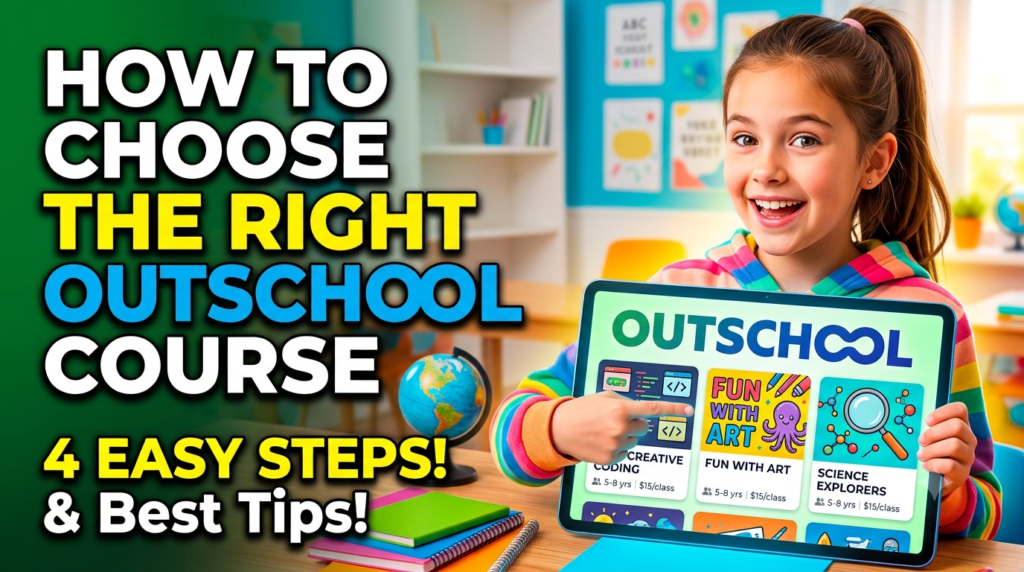
With such a large catalog, choosing the right course requires more than typing a subject into the search bar and clicking the first result. Outschool’s parent guidance specifically recommends using search filters, fully reading class descriptions, contacting teachers with questions, checking supply lists, and preparing appropriately for live sessions. These simple steps can prevent many mismatches. A class may have an appealing title but require prerequisite knowledge your child does not yet have. Another may cover exactly the right material but meet at a time that creates unnecessary stress for the family.
Start by defining the purpose of enrollment in one sentence. For example: “My child needs help with fractions,” “My teenager wants to learn coding,” or “We need a social weekly class for our homeschool schedule.” That sentence becomes your filter. Then compare age range, difficulty, format, schedule, educator background, class size where available, participation expectations, materials, and reviews. Do not automatically equate a large number of reviews with the perfect fit for your learner. Popularity tells you something, but compatibility tells you more. A lesser-known class taught in exactly the style your child needs may deliver a better experience than the most popular option in the category.
Check the Teacher, Format, and Class Description
The educator can influence the experience as much as the subject itself. Outschool’s own educator-facing research says parents consider teaching style and educator personality alongside factors such as topic, class size, and content level. Read the teacher profile and course description carefully. Look for evidence that the educator understands the subject and can explain what learners will actually do. Clear objectives, transparent prerequisites, realistic expectations, and detailed session descriptions are positive signals.
Format matters just as much. A learner who thrives on conversation may prefer a live class, while a busy teenager balancing school and activities might appreciate self-paced study. A student struggling significantly with a subject may benefit from individual tutoring rather than a group course. Consider participation expectations as well. Outschool’s family safety guidance explains that learners in live classes must complete visual check-in procedures, while ongoing camera use can depend on class requirements and circumstances. Families should review current policies before the first session so learners know what to expect. The more closely the class environment matches the child’s comfort level and learning needs, the greater the chance that enrollment becomes a useful experience rather than another unfinished online course.
Match the Course to Your Child’s Learning Style
Two children can sit in the same class and walk away with completely different experiences. One loves rapid discussion; another needs time to think. One learns by watching demonstrations; another needs to build something with their hands. Some learners thrive with deadlines, while others perform better when given scheduling flexibility. This is why choosing among the best Outschool US courses should begin with the learner rather than the course ranking.
Observe how your child approaches learning outside formal lessons. Do they constantly ask questions? Do they prefer videos, books, experiments, conversations, or projects? Are they comfortable speaking in groups? Can they manage independent assignments? A social learner may benefit from interactive live sessions, whereas an independent learner could enjoy self-paced study. Outschool has acknowledged that asynchronous learning may suit some schedules, learning styles, and personality types better than live instruction. There is no prize for selecting the most demanding format. The goal is sustainable engagement. Think of course selection like choosing shoes: the most expensive or popular pair is useless if it does not fit the person wearing it.
Is Outschool Worth It for US Families?
Outschool can be worth considering for US families that value flexibility, subject variety, interest-driven learning, and access to independent online educators. Its biggest strength is choice. Families can explore traditional academics alongside specialized interests and select between live, self-paced, and tutoring-style experiences. Current Outschool information describes a marketplace reaching hundreds of thousands of learners internationally and offering a very large selection of classes. That scale can be a major advantage for families searching for niche subjects or unusual scheduling options.
At the same time, a marketplace requires active decision-making. Course quality, teaching style, schedule, pricing, prerequisites, and learner fit can vary, so families should evaluate individual listings rather than treating every class as interchangeable. Prices can also change by educator, format, duration, and enrollment option, making it wiser to check current listings directly instead of relying on static pricing estimates. Parents should also remember that Outschool is not simply a standardized school curriculum delivered online; it is a platform where independent educators offer learning experiences. For families willing to research courses carefully, it can serve as a flexible supplement for academic support, homeschooling, enrichment, hobbies, and social learning. Its value ultimately depends on whether you find the right teacher and format for your particular learner.




Conclusion
Finding the best Outschool (US) courses for kids, teens, and homeschoolers becomes much easier once you stop searching for one universal “best” class. Younger children may thrive in interactive reading, math, science, or creative courses. Teenagers may gravitate toward coding, technology, writing, languages, or discussion-based learning. Homeschoolers can use the platform to supplement core academics, introduce electives, access specialized educators, or add interactive experiences to an otherwise independent routine.
The most effective approach is to begin with your child’s needs and interests, then compare available courses based on age range, learning objectives, educator experience, teaching style, schedule, format, prerequisites, and current family reviews. Outschool’s large catalog creates opportunities, but thoughtful selection is what turns those opportunities into meaningful learning.
When the match is right, an online class can become more than another hour in front of a screen. It can be the moment a child finally understands fractions, writes their first program, speaks confidently in a group, discovers a love for another language, or realizes that learning can extend far beyond a traditional classroom. That is where platforms like Outschool can be most useful: not by replacing every part of education, but by giving families more ways to build a learning experience around the individual child.
FAQs
Q. What are the best Outschool courses for kids?
A. The best courses depend on the child’s age, ability, interests, and learning style. Popular areas to explore include reading, mathematics, drawing, science, coding, languages, and other interest-based subjects. Parents should compare current listings and teacher profiles before enrolling.
Q. Is Outschool good for homeschoolers?
A. Outschool can be useful as a supplemental resource for homeschooling families. It may help families access specialized instruction, interactive group learning, electives, tutoring, or subjects that parents prefer not to teach independently. Families should still make sure their overall homeschool program meets any applicable state requirements.
Q. What are good Outschool subjects for teenagers?
A. Teens may be interested in coding, programming, app development, creative writing, communication, languages, science, mathematics, and discussion-based classes. The strongest choice usually connects the teenager’s interests with a useful skill or meaningful learning goal.
Q. Does Outschool offer live and self-paced courses?
A. Yes. Outschool offers live and self-paced learning, and its current marketplace also features 1:1 tutoring options. The right format depends on whether a learner prefers real-time interaction, independent scheduling, or individualized instruction.
Q. How should parents choose an Outschool class?
A. Parents should read the complete class description, check the listed age and skill level, examine the educator’s profile, understand the format and schedule, review required materials, and look at current feedback where available. Outschool also recommends contacting the teacher before enrollment when families have questions or concerns about suitability.