
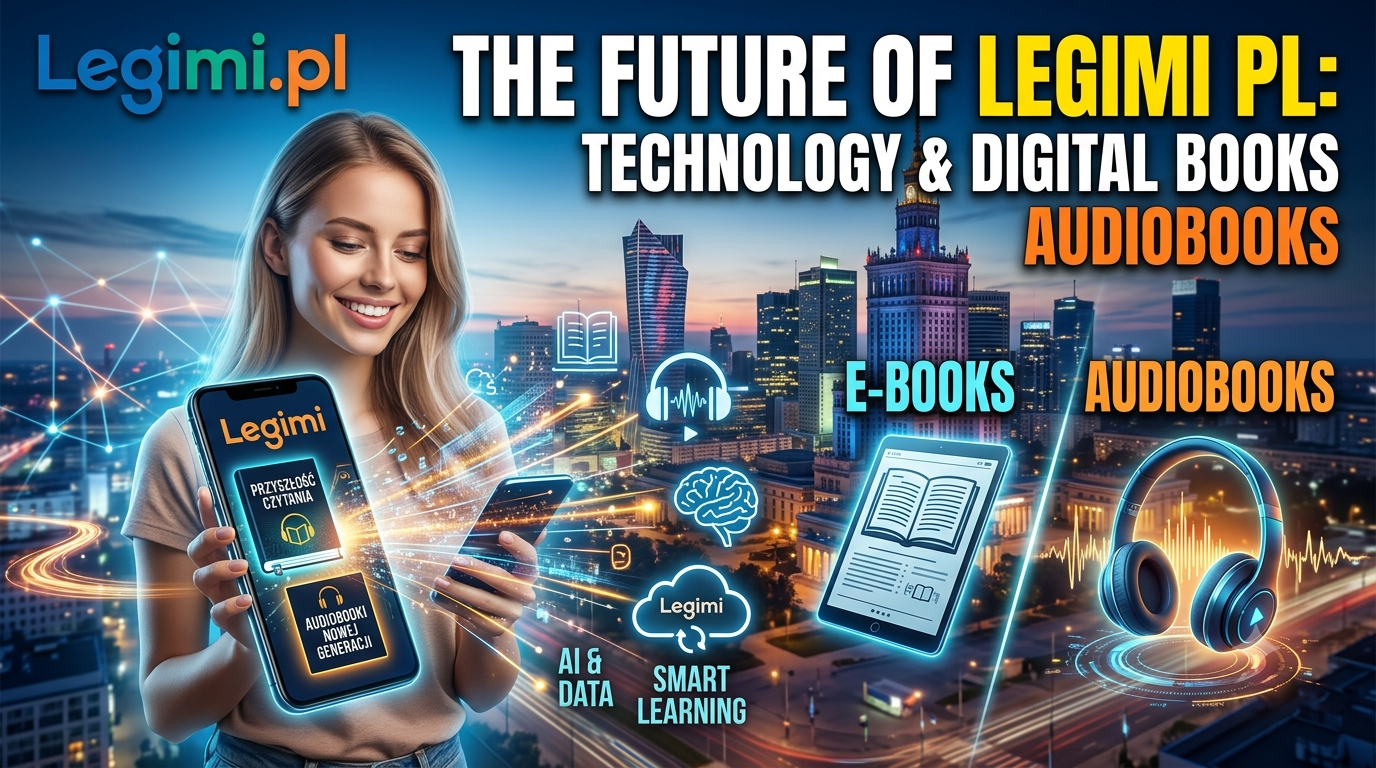
Legimi PL is transforming the way readers discover and enjoy digital books and audiobooks in Poland. With a growing library of ebooks and audiobooks, convenient subscription options, and support for multiple devices, Legimi PL makes reading and listening more accessible for modern users. As technologies such as artificial intelligence, personalized recommendations, cloud synchronization, and advanced e-readers continue to evolve, Legimi PL could play an important role in shaping the future of digital reading. Whether you prefer reading ebooks at home or listening to audiobooks while traveling, Legimi PL offers a flexible digital experience designed to fit today’s connected lifestyle.
Table of Contents
- Introduction: A New Chapter for Digital Reading in Poland
- What Is Legimi PL and Why Does It Matter?
- How Technology Is Transforming Legimi PL
- The Rise of Audiobooks and Hybrid Book Consumption
- Artificial Intelligence and the Future of Book Discovery
- How Data Can Create a More Personal Reading Experience
- Cloud Technology and the Digital Bookshelf
- Accessibility and the Democratisation of Reading
- How Legimi PL Could Support Authors and Publishers
- Challenges Facing the Future of Digital Publishing
- What the Next Generation of Legimi PL Could Look Like
- Conclusion
- FAQs About the Future of Legimi PL
Introduction: A New Chapter for Digital Reading in Poland

Reading has always evolved alongside technology. We moved from handwritten manuscripts to printing presses, from heavy encyclopedias to searchable websites, and now from crowded physical bookshelves to entire digital libraries that fit inside a smartphone. In Poland, Legimi PL represents this ongoing transformation by offering readers access to a broad ecosystem of ebooks and audiobooks through digital devices. As of July 2026, Legimi’s official Polish website advertises access to more than 240,000 ebooks and audiobooks, with subscription options starting from PLN 14.99 per month. That scale demonstrates just how dramatically the idea of owning and accessing books has changed. Instead of purchasing every title individually and finding physical space for it, readers can increasingly approach books in a way that resembles streaming entertainment: choose something interesting, open an app, and begin reading or listening.
The more interesting question, however, is what happens next. The future of Legimi PL will likely be influenced by developments that extend far beyond ebooks themselves. Artificial intelligence, smarter recommendation systems, improved e-readers, cloud synchronisation, advanced audiobook technology and personalised interfaces are reshaping expectations across digital media. Readers increasingly want services to understand context: what they enjoy, when they consume content and how they prefer to discover something new. At the same time, platforms must balance personalisation with privacy, maintain productive relationships with publishers and authors, and make their services simple enough for people who are not technology experts. The digital book of the future, therefore, may not simply be a PDF or EPUB displayed on a screen. It could become part of an intelligent, connected reading environment built around the individual reader.
What Is Legimi PL and Why Does It Matter?
Legimi PL is part of the broader shift toward subscription-based digital reading in Poland. The service combines ebooks and audiobooks with apps and device support, giving users different ways to consume literature depending on where they are and what they are doing. According to Legimi’s current website, its catalogue includes more than 240,000 ebooks and audiobooks, while its dedicated Kindle offering advertises access to approximately 177,000 ebooks. The Kindle subscription page also shows that access conditions can differ by plan and device, highlighting an important reality of modern digital publishing: content availability is shaped not only by technology but also by licensing arrangements and platform ecosystems.
Why does this matter? Because convenience has become one of the strongest forces shaping entertainment and media consumption. A physical bookstore offers atmosphere and discovery, but a digital platform offers something entirely different: immediate access. Imagine hearing about a novel during your morning commute and starting it before you reach the office. That reduction in friction is one of digital publishing’s biggest advantages. Legimi’s relevance lies in connecting books with the everyday devices readers already use. As consumer expectations continue to evolve, the companies that make discovery and consumption effortless are likely to play an increasingly important role in how people develop and maintain reading habits.
From Traditional Bookshelves to Digital Libraries
For generations, a personal library was something physical. You could walk past a shelf and immediately see your collection. Digital libraries changed that relationship by separating ownership or access from physical space. A reader can now carry hundreds or potentially thousands of titles without carrying any additional weight. Services such as Legimi PL take this concept further by making a large catalogue available through subscription access. The bookshelf is no longer necessarily a piece of furniture; it is an interface.
This transformation creates both convenience and new design challenges. A physical bookshelf naturally reminds you what you own because the books remain visible. Digital collections can easily become invisible once you close the application. That means future reading platforms must become better at helping readers rediscover forgotten titles, organise collections and understand their own reading interests. Smart digital shelves could automatically group books by themes, authors, moods or reading status. Instead of manually creating dozens of folders, users might simply ask, “Show me the mysteries I saved last year but never started.” Technology could turn the digital bookshelf from passive storage into an active reading assistant.
The Subscription Model Behind Modern Reading
Subscription services have changed consumer expectations across music, video, software and gaming, and books are increasingly part of that broader behavioural shift. Legimi’s current offers illustrate how subscription access can coexist with different device ecosystems and content models. Its official Kindle page, for example, lists plans that combine unlimited access on supported devices with monthly limits for ebooks downloaded to Kindle. This demonstrates how digital book subscriptions must navigate technical restrictions, publisher agreements and device-specific rules while still trying to offer users a simple experience.
The strength of the subscription model is exploration. When the perceived cost of trying an unfamiliar title is reduced, readers may be more willing to experiment with a debut author or a genre they normally ignore. The challenge is ensuring that this abundance does not become overwhelming. A catalogue containing hundreds of thousands of options can feel like standing in a supermarket with endless aisles and no shopping list. The future of services like Legimi PL will therefore depend not only on having a large catalogue but also on helping users navigate it intelligently. Discovery technology may become just as important as catalogue size.
How Technology Is Transforming Legimi PL
Technology is changing digital reading on several levels simultaneously. Devices are becoming more capable, software interfaces are becoming more personalised, and cloud infrastructure makes content accessible across multiple screens. In June 2025, Legimi announced a new application designed for e-ink devices, describing support for popular document formats and adding audio-file functionality on compatible readers. This development is particularly significant because it begins to blur the traditional boundary between dedicated ebook readers and audiobook devices. A reader designed primarily for text can increasingly become a broader digital-book companion.
That direction hints at what the future could bring. Instead of thinking about ebooks and audiobooks as separate products, platforms can think about the “book” as a piece of content that users experience in different modes. You might read a chapter on an e-ink screen before bed, listen during a morning walk and later search for a specific passage on your laptop. The underlying content remains connected even though the interface changes. For Legimi PL, the technological opportunity is to make those transitions increasingly invisible. The less users have to think about devices, file formats and synchronisation, the more attention they can give to the actual story.
Cross-Device Reading and Listening
Modern readers rarely depend on a single device. A smartphone is convenient on public transport, a tablet works well at home, an e-reader is comfortable for long sessions, and a computer can be useful for reference material. The challenge is continuity. Nobody wants to spend several minutes searching for the page they reached yesterday. Cloud-based synchronisation can solve this by keeping progress, bookmarks, notes and personal libraries connected across devices.
Future improvements could make this continuity more sophisticated. Imagine reading an ebook until page 130 and then pressing one button to continue from the corresponding sentence in the audiobook. Later, you could return to the ebook at exactly the point where you stopped listening. Such functionality depends on accurate alignment between text and audio, licensing rights and reliable synchronisation, but it represents a natural direction for hybrid reading services. The ideal experience would feel less like switching between two products and more like changing the format of the same book.
The Growing Role of E-Ink Technology
E-ink remains valuable because it solves a very specific problem: comfortable long-form reading. Smartphones are multifunctional devices filled with notifications, videos and social media. Dedicated e-readers create a quieter environment where text is the primary focus. Legimi’s 2025 announcement about its updated e-ink application suggests continued investment in this part of the reading ecosystem, including the ability to handle audio on supported devices.
As e-reader hardware develops, these devices could become even more versatile without losing their distraction-free identity. Better processors, longer battery life, improved colour e-ink and more responsive interfaces may expand what readers can comfortably do. Audiobook integration is particularly interesting because it allows one device to serve two consumption modes. For Legimi PL, strong integration with e-ink devices could remain a meaningful competitive advantage among readers who want subscription convenience but still prefer a dedicated reading experience over a smartphone screen.
The Rise of Audiobooks and Hybrid Book Consumption

Audiobooks have transformed reading into an activity that can happen while your eyes and hands are occupied. You can listen while driving, exercising, cleaning or travelling. That flexibility expands the number of moments during a day when someone can engage with a book. Research is also beginning to examine audiobook consumption at a more technical level. A July 2026 study analysing narration characteristics found that acoustic qualities such as tone, pace and loudness can have meaningful associations with audiobook appeal, suggesting that personalisation may eventually extend beyond genres and authors to the qualities of the narration itself.
This creates intriguing possibilities for Legimi PL and similar platforms. Today, recommendations typically focus on what a book is about or what other users enjoyed. Tomorrow, an audiobook service could potentially learn that you prefer calm narration for history, energetic performances for thrillers and slower pacing for bedtime listening. That kind of recommendation system would treat the narrator’s performance as part of the product rather than a secondary attribute. It also highlights why audiobooks should not simply be viewed as audio versions of printed books. They are performances with their own characteristics, audiences and discovery patterns.
Why Audiobooks Fit Modern Lifestyles
Time is one of the biggest obstacles to reading. Many people genuinely want to read more but struggle to find uninterrupted periods when they can sit with a book. Audiobooks change the equation by converting previously unavailable moments into potential listening time. A 30-minute commute becomes half an hour with a novel. A long walk becomes an opportunity to explore a biography. This flexibility makes audiobooks particularly well suited to a culture where people frequently move between work, travel, exercise and household responsibilities.
For digital-book platforms, the opportunity is to make listening as frictionless as possible. Features such as adjustable playback speed, sleep timers, bookmarks, offline downloads and reliable progress synchronisation can significantly improve everyday usability. Future platforms may go further by automatically adapting playback settings to context. A user might prefer a faster speed during a commute and normal speed before sleep. Technology can gradually remove the small inconveniences that interrupt listening, making audiobooks feel like a natural extension of daily routines.
Moving Seamlessly Between Reading and Listening
The distinction between an ebook reader and an audiobook listener is becoming less useful. Many people are both. They choose the format based on the moment rather than maintaining a permanent preference. This hybrid behaviour creates an important opportunity for services offering both formats under one ecosystem.
The future could revolve around true read-listen synchronisation. Imagine reading during lunch, putting your phone in your pocket and instantly continuing with audio while walking back to work. Later, your e-reader could reopen at the precise sentence where you stopped listening. Implementing this consistently across a large catalogue would involve technical and licensing complexities, so it should be viewed as a potential direction rather than a guaranteed Legimi feature. Yet the concept demonstrates where digital reading technology is heading: toward continuity. Readers increasingly expect content to follow them rather than requiring them to adapt their lives around a particular format.
Artificial Intelligence and the Future of Book Discovery
Artificial intelligence may have its biggest impact on digital books before users even open one. Discovery is a major problem for any large content catalogue. When a platform contains hundreds of thousands of titles, traditional categories such as “crime,” “romance” and “history” can only take readers so far. AI systems can potentially understand richer descriptions of what people want, connecting themes, emotional tone, writing style and narrative structure.
Recent research from the audiobook sector offers a glimpse of this direction. A 2025 paper describing Spotify’s AudioBoost system reported using large language models to generate synthetic search queries from audiobook metadata. In online A/B testing, the researchers reported increases of 0.7% in audiobook impressions, 1.22% in clicks and 1.82% in exploratory query completions. Separate 2025 research explored using LLM-enriched metadata to create descriptive recommendation “shelves” around user interests, reporting improved engagement and discovery metrics in testing. These studies do not describe Legimi’s own technology, but they demonstrate how AI-driven discovery could influence the wider audiobook industry and, potentially, services such as Legimi PL.
Smarter Personalised Recommendations
Traditional recommendation engines often rely heavily on past behaviour: you read one crime novel, so the platform recommends another crime novel. Useful? Yes. Truly intelligent? Not necessarily. Human taste is more complicated. You might love one thriller because of its psychological depth while disliking another despite both belonging to the same genre.
Future AI-powered systems could analyse richer signals, including themes, pacing, setting, narrative style and perhaps even preferred narration qualities for audiobooks. A recommendation could therefore become highly contextual: “You enjoyed slow-burn mysteries with unreliable narrators, so here are five similar books.” This approach can also improve diversity. Instead of endlessly recommending the same bestselling authors, an intelligent system could identify lesser-known titles that share meaningful characteristics with books the reader already loves. For platforms like Legimi PL, better recommendations could make a large catalogue feel smaller, friendlier and more personal.
AI-Powered Search and Content Discovery
Search may also become conversational. Instead of typing an exact title, users could describe the experience they want: “Find me a short Polish crime audiobook for a five-hour train journey,” or “I want an optimistic science-fiction novel without complicated world-building.” An AI-assisted search system could interpret these natural-language requests and map them to relevant metadata.
This would fundamentally change digital book discovery. Today’s search boxes often work best when you already know what you want. Tomorrow’s search tools could become useful precisely when you do not. Research into synthetic query generation for audiobook retrieval already shows how LLMs can help systems respond to exploratory searches that go beyond exact titles and authors. For Legimi PL, such technology could eventually turn the search bar into something closer to a knowledgeable digital librarian—provided recommendations remain transparent, relevant and respectful of user privacy.
How Data Can Create a More Personal Reading Experience
Data can help a digital reading platform understand behaviour in ways a traditional bookstore cannot. With appropriate consent and privacy protections, a service can identify which genres a user frequently chooses, when they tend to read, whether they finish long books and how often they switch between text and audio. Used responsibly, those patterns can improve the experience. The goal should not be surveillance; it should be reducing friction.
Future Legimi experiences could potentially offer more meaningful personal insights. Instead of simply telling users how many books they finished, the platform might show how their reading interests evolved over time or suggest achievable reading goals based on their actual habits. Personalisation could also adapt the interface. An audiobook-heavy user might see audio recommendations prominently, while an e-ink reader could receive suggestions optimised for long reading sessions. The critical issue will be trust. Readers should understand what information is collected and have meaningful control over it. Smart personalisation works best when users feel that technology is serving them rather than quietly observing them.
Cloud Technology and the Digital Bookshelf
Cloud technology is the invisible engine behind many modern digital experiences. When a book appears on multiple devices, reading progress synchronises or a saved title remains available after changing phones, cloud infrastructure is doing much of the work behind the scenes. For a service like Legimi PL, reliable cloud functionality can make the difference between a fragmented collection of apps and a coherent reading ecosystem.
The future digital bookshelf could become far more intelligent. Notes and highlights might be searchable across an entire personal library. Readers could ask, “Which books did I highlight passages about productivity in?” and instantly retrieve relevant sections. Students and researchers could potentially organise annotations by subject rather than by individual title. At the same time, offline access will remain essential because connectivity is never guaranteed. The best digital reading ecosystems will likely combine the convenience of the cloud with the reliability of locally downloaded content, allowing books to remain accessible on trains, flights and in areas with weak internet connections.
Accessibility and the Democratisation of Reading
Digital publishing has enormous potential to make books more accessible. Text size can be adjusted, screen-reader compatibility can support visually impaired users, and audiobooks can provide alternatives for people who find long-form text difficult to consume. Translation and text-to-speech technologies may eventually extend access even further, although quality, copyright and licensing considerations will remain important.
Legimi also participates in library-based access models. One of its current library pages advertises free access to more than 225,000 titles through a library code system, demonstrating how subscription technology can intersect with public-library services. Because a user does not always need to visit a physical branch in order to access a new digital title, digital lending can aid in the removal of geographical obstacles.
Technology, however, does not automatically guarantee accessibility. Applications must be deliberately designed for different needs and abilities. Clear navigation, adjustable typography, compatibility with assistive technologies and simple account management all matter. The future of digital reading should therefore be measured not only by how advanced the technology becomes, but by how many people can comfortably use it.
How Legimi PL Could Support Authors and Publishers
A healthy digital reading ecosystem requires more than satisfied subscribers. Authors, narrators and publishers also need sustainable ways to reach audiences and generate revenue. Subscription platforms can offer powerful discovery opportunities, especially for titles that might struggle for visibility in physical retail environments. An intelligent recommendation system could help niche books find the exact readers most likely to appreciate them.
Technology could also provide publishers with aggregated, privacy-conscious insights about reading trends. Understanding which genres are gaining interest or where readers discover particular categories can support better publishing decisions. Yet platforms must carefully balance data-driven decision-making with creativity. Publishing cannot become a factory where algorithms determine which stories deserve to exist. Some of the most important books succeed precisely because they are unusual. The strongest future for Legimi PL would therefore combine technological efficiency with space for editorial judgement, experimentation and independent voices.
Read More:-
How Does Strikingly Simplify the Website Building Process?
Building Your Dream Website with Site123
Boost Your E-commerce Strategy with YITH Plugins
Maximize Your Customer Engagement with LiveAgent’s Features
Why STRIPO is Essential for Digital Product Marketersa
Challenges Facing the Future of Digital Publishing
The future is promising, but it is not frictionless. Digital book platforms must manage licensing agreements, publisher relationships, device compatibility, cybersecurity, privacy and changing consumer expectations. Content availability can differ between plans and devices, as Legimi’s current Kindle offering demonstrates. These differences can create confusion if users expect every title to work everywhere. Clear communication will therefore remain essential.
AI introduces another layer of complexity. Personalised recommendations can be useful, but algorithms can also create repetitive bubbles where readers repeatedly encounter similar content. AI-generated narration may lower production barriers in some contexts, yet many listeners value the artistry and emotional interpretation of human narrators. Recent research connecting acoustic narration characteristics with audience appeal reinforces the idea that narration itself is an important creative element.
| Opportunity | Potential Benefit | Key Challenge |
| AI recommendations | Better book discovery | Algorithmic bias and repetitive suggestions |
| Audiobook technology | More flexible consumption | Production quality and narrator rights |
| Cloud synchronisation | Seamless cross-device access | Privacy and security |
| Subscription access | Lower barrier to exploring books | Sustainable compensation models |
| E-ink innovation | Comfortable long-form reading | Device compatibility |
| Conversational search | Easier discovery | Search accuracy and transparency |
The winners in digital publishing will probably not be the companies with the most technology for technology’s sake. They will be the ones that use technology to solve genuine reader problems while maintaining trust with creators and publishers.
What the Next Generation of Legimi PL Could Look Like
Imagine opening Legimi PL a few years from now. Instead of a generic homepage, you see a personalised shelf based on your current interests. The system knows that you recently finished several historical novels but also saved two technology books. It offers a balanced selection rather than pushing endless variations of your last read. You describe the kind of story you want in ordinary language, and conversational search finds several relevant options.
You begin reading on an e-ink device. The next morning, you continue in audiobook mode during your commute, with your position synchronised automatically. Later, you search your personal highlights to find an idea you remember but cannot place. Your digital library becomes less like a warehouse and more like an organised extension of your memory.
Not every element of this scenario is currently available from Legimi, and technological possibilities should not be confused with announced product plans. Yet current developments already point toward greater convergence. Legimi’s newer e-ink application brings reading and audio functionality closer together, while wider industry research is exploring AI-driven audiobook search, contextual recommendations and data-informed understanding of narration. Taken together, these trends suggest that the next generation of digital-book platforms will compete on personalisation, continuity and discovery, not merely catalogue size.




Conclusion
The future of Legimi PL sits at the intersection of books, audio and intelligent technology. The service already operates at significant digital scale, with its website currently advertising more than 240,000 ebooks and audiobooks, dedicated Kindle access and library partnerships. Its 2025 e-ink application update also demonstrates how the boundaries between reading and listening devices are beginning to soften.
The next stage could be even more transformative. Artificial intelligence may improve recommendations and natural-language search. Cloud technology can create smoother continuity across devices. Audiobook research could lead to more sophisticated personalisation based not only on subject matter but also on narration preferences. Accessibility improvements can help digital books reach wider audiences.
Yet the heart of the experience should remain remarkably simple: helping people find books they love and making those books easy to enjoy.When technology fades into the background, it is at its most potent. If Legimi PL and the wider digital publishing industry can combine innovation with privacy, accessibility, fair creator relationships and genuine reader value, the future of books will not be a battle between print and digital. It will be a world where stories move naturally between pages, screens and headphones—following readers wherever life takes them.
FAQs About the Future of Legimi PL
Q. What is Legimi PL?
A. Legimi PL is a Polish digital reading service offering access to ebooks and audiobooks through subscription plans and supported devices. As of July 2026, its main website advertises a catalogue of more than 240,000 ebooks and audiobooks. Availability can vary depending on subscription type and device.
Q. How could AI influence the future of Legimi PL?
A. AI could potentially improve personalised recommendations, natural-language search and content discovery. Industry research has already explored LLM-generated search queries and contextual recommendation shelves for audiobooks, suggesting practical ways AI may help users navigate large catalogues. These examples represent broader industry developments rather than confirmed future Legimi features.
Q. Can Legimi users access ebooks on Kindle?
A. Yes, Legimi currently offers dedicated Kindle subscription options. Its official Kindle page advertises access to around 177,000 ebooks and explains monthly Kindle download allowances that vary by subscription plan.
Q. Why are audiobooks important to the future of digital reading?
A. Audiobooks allow people to consume books during activities when traditional reading is difficult, such as commuting or exercising. Emerging research also suggests that narration qualities can influence audiobook appeal, opening the door to more sophisticated recommendation and personalisation systems in the future.
Q. What technology could have the biggest impact on Legimi PL in the future?
A. The most influential technologies are likely to include AI-powered discovery, cloud synchronisation, improved e-ink devices, smarter audiobook technology and cross-format reading experiences. Legimi’s updated e-ink application already reflects movement toward bringing ebooks and audio closer together on compatible devices, while wider industry research suggests that AI could make finding the right book significantly easier.