
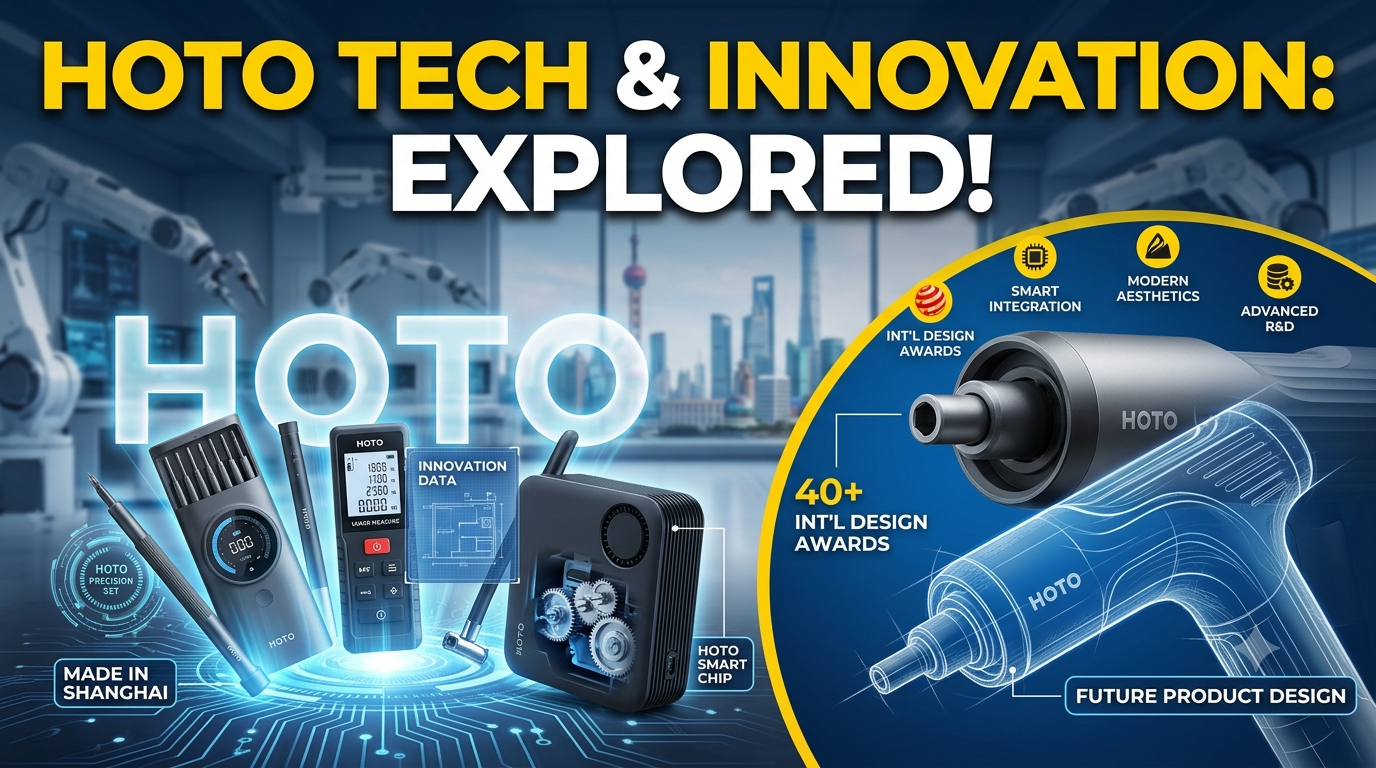
Shanghai HOTO Technology is redefining everyday tools through innovative technology, modern industrial design, and user-focused product development. From precision screwdrivers and smart laser measuring devices to portable air pumps, cleaning tools, and multifunctional lifestyle products, Shanghai HOTO Technology combines practical performance with compact, stylish, and easy-to-use designs. This article explores the company’s technology, product innovation, smart features, global growth, and vision for transforming traditional hardware into modern lifestyle technology.
Table of Contents
- The Story and Vision Behind HOTO Technology
- HOTO’s Design-First Approach to Product Development
- The Technology Powering HOTO’s Smart Tools
- HOTO Electric Screwdrivers and Precision Repair Tools
- HOTO Laser Measuring Technology
- The Evolution of HOTO’s DIY Ecosystem
- HOTO’s Approach to Portable Power and Cleaning
- Smart Kitchen and Lifestyle Technology
- Materials, Manufacturing, and Product Durability
- HOTO and the Influence of Xiaomi’s Design Ecosystem
- Global Expansion and International Product Strategy
- Recent HOTO Product Innovation in 2026
- What Makes HOTO Different From Traditional Tool Brands
- HOTO’s Balance Between Technology and Usability
- The Role of Sustainability and Long-Term Product Use
- Who Can Benefit From HOTO Products?
- The Future of HOTO Technology and Product Innovation
- Conclusion
- Frequently Asked Questions
The Story and Vision Behind HOTO Technology
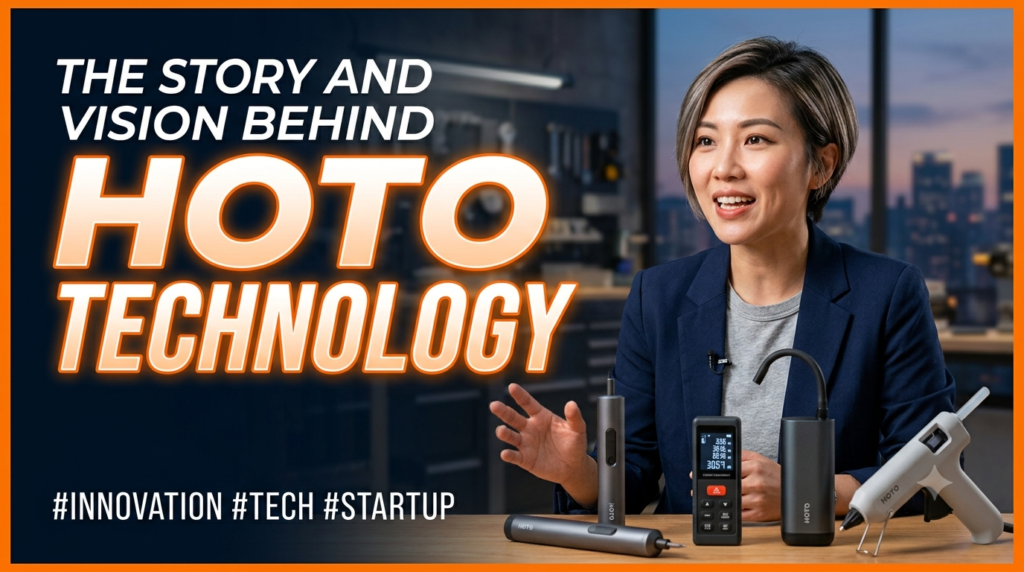
Shanghai HOTO Technology has built its identity around a deceptively simple idea: everyday tools do not have to feel old-fashioned. Founded in 2016, HOTO says its ambition was to reinvent essential tools used in daily life, combining practical functionality with contemporary design. The company launched its first product, a precision screwdriver set, in 2018 and reports that the product went on to sell 2.1 million units. HOTO also states that it has expanded internationally, with offices in Shanghai, the United States, Japan, and Hong Kong, and a user base of more than 10 million people across 56 countries. These figures help explain why Shanghai HOTO Technology has become an interesting name in the modern consumer-tool market, but the more important story is the philosophy behind those numbers. HOTO is not simply trying to manufacture another screwdriver, measuring device, drill, or cleaning gadget; it is attempting to rethink the relationship between people and the tools they use. That distinction matters because conventional tools have traditionally been designed around durability and utility first, while appearance, portability, user experience, and digital integration often came later. HOTO approaches the problem from another direction. It asks what happens when an everyday tool is designed with the same attention to form, interaction, convenience, and visual identity that consumers expect from modern electronics. The result is a product portfolio that sits somewhere between hardware, lifestyle technology, and traditional DIY equipment. That hybrid position is one of the most interesting aspects of HOTO’s innovation strategy.
From Essential Tools to Modern Lifestyle Products
The company’s development illustrates how the boundaries between traditional hardware and consumer technology are becoming less rigid. A screwdriver is still a screwdriver, but the experience around it can be redesigned through electric motors, rechargeable batteries, LED illumination, magnetic accessories, digital displays, compact storage systems, and connected applications. HOTO’s current product range reflects this broader interpretation of tools, covering screwdrivers, measuring equipment, laser levels, drills, rotary tools, air pumps, cleaning devices, kitchen scales, and other accessories. Its international product catalog describes the company as focused on tools intended to help people bring projects to life while making them suitable for both beginners and experienced users. This is significant because DIY has changed dramatically in the age of online tutorials, maker communities, home improvement content, and accessible consumer electronics. Someone buying a tool today may not identify as a professional tradesperson at all. They may be assembling furniture, repairing a laptop, maintaining a bicycle, decorating a room, building a small project, or simply trying to solve a problem around the house. HOTO’s product philosophy appears to recognize that broader audience. Instead of making products look intimidating or highly industrial, the company emphasizes compact proportions, organized storage, straightforward controls, and visual simplicity. It effectively treats the tool as part of a person’s living environment rather than as something that must remain hidden in a workshop. That approach creates a bridge between professional-grade functionality and everyday accessibility, which is an increasingly valuable space in consumer hardware.
HOTO’s Design-First Approach to Product Development
One of the defining characteristics of HOTO Technology is its strong emphasis on industrial design. The company’s current materials repeatedly position design as more than decoration, presenting it as part of the actual functionality of the product. That distinction is important. A tool can have excellent specifications and still be unpleasant to hold, difficult to store, confusing to operate, or visually incompatible with the environment where it will be used. HOTO’s approach attempts to solve these problems simultaneously. Product shapes tend to be compact and deliberately organized, while controls are simplified so users do not need extensive technical knowledge before getting started. The company also publishes designer-focused material explaining the thinking behind product development, including recent design discussions covering screwdrivers, air pumps, flashlights, and cleaning products. This suggests that design is not merely a marketing layer added after engineering is complete. Instead, engineering and design appear to be developed together, with the physical form helping determine how the user interacts with the technology. That is a subtle but powerful strategy. Consider a traditional toolbox: it prioritizes storage and durability, but it may not encourage someone who rarely performs repairs to use it. A compact, visually coherent HOTO kit can make the same activity feel much more approachable. In that sense, HOTO is selling not only mechanical capability but also confidence. It reduces the psychological barrier between seeing a problem and deciding, “I can fix that.”
Why Ergonomics and Simplicity Matter
Ergonomics becomes especially important when a company tries to serve both experienced users and beginners. A professional may already understand torque, bits, measurement references, and tool limitations, whereas a first-time DIY user needs intuitive feedback. HOTO’s products frequently address this gap through one-button controls, integrated lighting, magnetic bit systems, organized cases, digital displays, or app-connected functions. For example, HOTO’s Electric Precision Screwdriver Kit Pro is presented with a clamshell workstation, dual torque levels, one-touch activation, LED illumination, magnetic bit changes, and 48 accessories. The company also describes the kit as only 2.6 cm thick when stored, showing how portability is treated as part of the product experience rather than as an afterthought. The design principle here is remarkably practical: the easier a tool is to understand and store, the more likely people are to actually use it. That may sound obvious, but it represents a meaningful shift in consumer-tool design. Instead of asking users to adapt to complicated equipment, the equipment is adapted to the user’s habits. Good ergonomics also reduces unnecessary friction. If a screwdriver automatically provides illumination where the bit meets the screw, the user does not need a separate lamp. If accessories are stored in a purpose-built case, the user does not have to search through a drawer. If a measuring tool can send measurements to a phone, the user does not need to manually record every number. None of these individual features is revolutionary by itself, yet together they create a significantly more modern workflow.
The Technology Powering HOTO’s Smart Tools
The technological foundation of HOTO products is based on integrating relatively familiar technologies into everyday hardware in ways that feel natural. Rechargeable lithium-ion power systems, brushless motors, LED illumination, digital displays, Bluetooth connectivity, sensors, magnetic components, precision-machined parts, and compact electronics can all be found across different areas of the company’s portfolio. The interesting part is not necessarily the existence of these technologies, but how HOTO combines them into consumer-friendly products. The HOTO Smart Laser Measure, for example, can measure distances up to 30 meters with claimed accuracy within 2 mm, features an OLED display, supports multiple measurement units, and can synchronize data with the Mi Home app through Bluetooth. A traditional tape measure and a digital laser meter perform fundamentally different operations, but HOTO’s concept is to package advanced measurement capability into something compact and intuitive enough for ordinary users. This philosophy extends beyond measurement. Electric screwdrivers transform manual rotational force into controlled motorized motion. Air pumps automate inflation. Cleaning devices combine suction or airflow with compact battery-powered motors. Kitchen scales add digital measurement and, in some models, connected functionality. The common thread is automation without unnecessary complexity. Instead of asking consumers to become technology experts, HOTO attempts to hide much of the technical complexity behind simple physical interactions. The technology works in the background while the user concentrates on the task.
Precision Engineering and Connected Features
Connectivity is another important part of HOTO’s product philosophy. The company has incorporated Bluetooth and app synchronization into selected products, particularly measuring devices. This creates a pathway between physical measurements and digital workflows. A measurement is no longer just a number visible on a screen; it can become data that is stored, reviewed, or used in planning. HOTO’s Smart Laser Measure is an example of this concept, with the company describing smartphone synchronization through the Mi Home ecosystem for storing and sharing measurement information. The value of such connectivity depends on the use case, of course. A homeowner measuring a wall once may never need app integration, while someone working on repeated room measurements or floor planning could benefit considerably from digital records. This highlights an important principle in HOTO’s technology strategy: smart functionality should ideally remain optional rather than becoming an obstacle. A user should be able to pick up a device and complete a basic task quickly, while more advanced users can take advantage of additional capabilities. This layered experience is similar to how successful consumer electronics are designed. A smartphone can be used simply to make a call, but it also provides access to sophisticated computing capabilities. HOTO applies a similar concept to tools. The basic action remains familiar, but digital technology expands what the device can do when needed.
HOTO Electric Screwdrivers and Precision Repair Tools
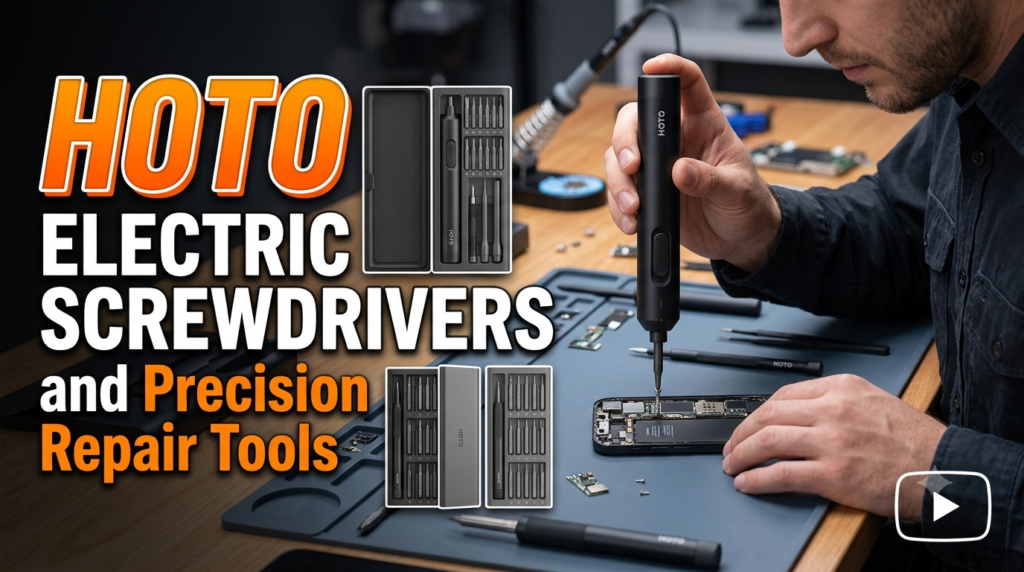
Electric screwdrivers represent one of the clearest examples of how HOTO modernizes a traditional category. The fundamental job has not changed: transfer rotational force into a fastener. What changes is everything surrounding that action. HOTO’s 3.6V Electric Screwdriver Kit, for instance, is listed with 4 Nm of torque, two speed settings, 10 bits, LED lighting, and rechargeable operation. These features demonstrate how a basic manual tool can evolve into a compact electromechanical system. Instead of repeatedly turning a handle, the user can control powered rotation while selecting an appropriate speed and bit. Integrated illumination helps with visibility, while rechargeable power eliminates the need for disposable batteries. The product therefore combines mechanical engineering, battery technology, electronics, lighting, and industrial design into one object. Precision repair tools take the concept even further. HOTO’s Electric Precision Screwdriver Kit Pro is designed around smaller repair tasks, including electronics, where excessive torque can damage components. Its dual-torque approach is intended to give users more control across delicate and demanding jobs, while accessories such as spudgers, suction cups, and a magnetizer/demagnetizer broaden the kit beyond simple screw removal. This is an example of ecosystem thinking: rather than selling a single tool, HOTO can build a coordinated collection around a particular activity. For users, that can reduce the need to purchase unrelated accessories from multiple brands.
Turning Traditional Screwdrivers Into Smart Devices
The most compelling innovation here is not that HOTO makes screwdrivers electric; electric screwdrivers have existed for years. The differentiation comes from how the company packages the experience. Modern consumers are increasingly accustomed to products that combine functionality, portability, battery power, and visual simplicity. HOTO applies those expectations to tools. The resulting products are designed to live comfortably in a desk drawer, apartment, workshop, vehicle, or travel bag rather than requiring a dedicated garage or tool cabinet. That is particularly relevant for people living in cities where space is limited. A compact kit that performs several repair functions can be more attractive than a larger professional toolbox, even when the latter offers greater raw capability. This does not mean HOTO tools replace every professional tool; rather, they occupy a different space between basic household equipment and specialist hardware. That middle ground can be surprisingly valuable. It allows users to perform common repairs without investing in an extensive collection of equipment. It also makes DIY feel less like an industrial activity and more like an everyday skill. When a tool is quiet, compact, rechargeable, illuminated, and easy to store, people may be more willing to use it regularly. In that sense, HOTO’s screwdriver innovation is as much about changing behavior as improving mechanical performance.
HOTO Laser Measuring Technology
Measurement is another category where HOTO demonstrates its philosophy particularly well. The company offers both conventional retractable measuring tape and digital laser measuring devices, giving consumers a choice between familiar mechanical measurement and more advanced electronic measurement. Its Smart Laser Measure provides a 30-meter range with claimed 2 mm accuracy, an OLED display, USB-C charging, unit conversion, and Bluetooth connectivity. HOTO also sells a Laser Measure Pro with a stated range of up to 50 meters and five measurement modes, according to its India product catalog. These products demonstrate how a traditional measurement task can become faster and more data-oriented. Laser measurement is particularly useful when measuring distances that are awkward to reach with a physical tape, such as room dimensions, ceiling heights, long walls, furniture placement, or construction spaces. By putting the technology into a small handheld device, HOTO makes a tool that might once have been associated primarily with professionals accessible to ordinary consumers. The product design again plays a role. A digital measuring device is only useful if people trust it and understand how to operate it. HOTO therefore emphasizes simple controls, readable displays, and multiple reference modes. The goal is to turn an advanced measurement technology into a familiar everyday action: point, measure, read, and move on.
Making Accurate Measurement More Accessible
The larger significance of HOTO’s laser-measure products lies in accessibility. Technology becomes more valuable when it removes friction from a task that people already understand. Most people know what it means to measure a wall, but they may not want to wrestle with a long tape measure while working alone. A laser device changes that interaction. It can make the measurement process faster and easier while reducing the physical inconvenience of stretching a tape across a space. When Bluetooth synchronization is added, the workflow becomes even more digital. Measurements can potentially be stored rather than written down manually. HOTO’s official description specifically positions its connected laser measuring tools as useful for architects, builders, and DIY enthusiasts, showing that the intended audience spans professional and consumer applications. This broad positioning is characteristic of HOTO. Rather than treating advanced measurement as an exclusive professional category, the company packages it as a lifestyle technology product. The underlying technology remains sophisticated, but the interface is simplified. That combination is one of the strongest patterns visible throughout HOTO’s portfolio. Whether the product is a screwdriver, laser measure, air pump, or cleaning device, the company repeatedly tries to answer the same question: How can advanced capability become simple enough for anyone to use?
The Evolution of HOTO’s DIY Ecosystem
HOTO’s current product assortment suggests that the company increasingly views tools as an ecosystem rather than as isolated products. Its catalog includes electric screwdrivers, mini drills, rotary tools, laser levels, measuring devices, air pumps, cleaning equipment, kitchen scales, accessories, and other lifestyle-oriented hardware. This breadth is important because consumers rarely have only one practical problem. Someone interested in repairing electronics may also work on furniture. Someone who owns an air pump may also need a screwdriver. Someone measuring a room may eventually install shelves or assemble furniture. An ecosystem encourages users to remain within a consistent design language while expanding their collection according to their needs. HOTO’s approach also makes accessories important. Replacement filters, blades, glue sticks, bits, and other components appear alongside complete products in its international catalog. That indicates an attempt to support products beyond the initial purchase. In a healthy hardware ecosystem, the original device is only the starting point. Accessories, consumables, replacement components, and complementary tools extend the product’s usefulness over time. For a consumer brand, this creates a relationship that is more durable than a single transaction. For users, it creates consistency. Once someone understands how one HOTO product works, another product with similar visual language and interaction patterns can feel familiar.
Compact Tools for Everyday Makers
The growth of the maker movement has also created an opportunity for companies such as HOTO. DIY culture today extends far beyond woodworking or home construction. It includes electronics repair, crafts, 3D printing, photography equipment, gaming setups, cycling, automotive maintenance, home organization, and countless other activities. HOTO’s recent content has even discussed 3D-printed additions and user-generated projects, reflecting how modern tools can become part of broader creative workflows. Compact tools are particularly valuable in this environment because many makers work from desks, apartments, bedrooms, balconies, or small studios rather than traditional workshops. A full-size industrial tool may be unnecessary for these environments. A portable precision screwdriver, mini rotary tool, compact drill, or laser measure can provide enough capability without consuming significant storage space. HOTO’s product strategy seems to recognize this shift toward distributed, small-scale making. The workshop is no longer necessarily a room filled with machines; sometimes it is a desk with a laptop, a project, a compact toolkit, and a few specialized devices. By designing for that reality, HOTO positions itself closer to consumer electronics than conventional hardware companies traditionally have.
HOTO’s Approach to Portable Power and Cleaning
HOTO’s innovation strategy is not limited to screwdrivers and measuring equipment. Its current catalog also includes portable air pumps, air dusters, vacuums, and multifunctional cleaning products. One example listed by HOTO India is a 4-in-1 AutoCare Air Duster & Vacuum with 20,000 Pa suction, designed to combine blowing, vacuuming, inflating, and related functions in a handheld format. Another product is a portable mini cordless air duster and vacuum intended for applications ranging from keyboards and cameras to cars and household cleaning. These products show how HOTO takes a familiar engineering component—a motor that moves air—and explores multiple consumer applications around it. Instead of building separate devices for every task, multifunctional designs attempt to consolidate several jobs into one portable system. This can be especially useful for consumers who value minimalism. Fewer devices mean less storage, fewer chargers, and potentially less clutter. The engineering challenge, however, becomes more complex because one device must perform several functions without becoming unnecessarily large or difficult to operate. HOTO’s product development therefore involves balancing motor performance, battery capacity, airflow, thermal management, attachments, noise, weight, and ergonomics. The success of such a product depends not only on peak specifications but on whether the user can quickly switch from one function to another. This again demonstrates the company’s broader philosophy: technology is valuable when it simplifies life rather than making it more complicated.
Multi-Functional Devices for Modern Homes
Multifunctionality is becoming increasingly important in urban consumer products. Homes are often smaller, and consumers have more devices competing for limited storage space. A multifunctional tool can therefore deliver practical value beyond its individual technical specification. HOTO’s approach is to make these combinations feel intentional rather than improvised. The company has also used design to create a consistent appearance across categories, allowing a vacuum, screwdriver, air pump, or measuring device to feel like part of the same product family. That consistency can make technology less visually intrusive. Instead of filling a home with unrelated industrial objects, consumers can build a collection that looks coherent. HOTO’s 2026 product developments show this approach continuing, with new and upgraded products spanning cleaning, air management, precision repair, and other categories. Its own reporting on a HOTO Day event described upgrades across products such as air pumps, vacuum devices, rotary tool kits, laser measuring tools, and precision screwdrivers, demonstrating an emphasis on iterative refinement rather than one-time launches. That model is familiar in consumer electronics, where each generation improves the previous one. Applying it to tools encourages consumers to think of hardware as evolving technology rather than static equipment.
Smart Kitchen and Lifestyle Technology
An especially interesting aspect of HOTO’s product strategy is its movement beyond conventional tools into lifestyle technology. The company’s product listings include a Smart Kitchen Scale with Bluetooth connectivity, a high-precision sensor, a 3 kg capacity, LED display, and USB-C rechargeable design. At first glance, a kitchen scale may seem disconnected from screwdrivers and laser levels, but the underlying product philosophy is remarkably similar. Both products transform a simple physical action into a more controlled and measurable digital experience. A traditional kitchen scale tells you weight. A connected digital scale can potentially turn that measurement into data for recipes, food tracking, or repeatable cooking processes. The same philosophy applies to HOTO’s measuring tools. This reveals that the company may be better understood not simply as a “tool manufacturer” but as a consumer hardware company focused on measuring, making, maintaining, and improving everyday activities. That broader category gives HOTO more room to innovate. The technology used in one product category can inform another. Battery systems, displays, sensors, Bluetooth connectivity, charging architecture, motor control, and industrial-design principles can potentially be shared across multiple product families. The result is a portfolio where seemingly unrelated products can still belong to the same technological philosophy. This cross-category approach may become increasingly important as consumer expectations continue to converge across hardware sectors.
Materials, Manufacturing, and Product Durability
Technology and design cannot compensate for poor physical construction, which is why materials and manufacturing remain central to HOTO’s proposition. Tools are inherently demanding products. Screwdrivers encounter torque, bits experience wear, motors generate heat, measuring devices can be dropped, and cleaning products operate around dust and debris. HOTO therefore has to balance aesthetic minimalism with the practical requirements of hardware. Its precision screwdriver materials, for example, include S2 steel bits in the Pro kit, while its tool cases and housings are designed around portability and protection. Product durability also becomes increasingly important when a company promotes rechargeable hardware. A rechargeable tool should ideally provide enough useful life to justify its electronic components, battery, and charging infrastructure. HOTO’s continued release of replacement accessories and upgraded products suggests that the company is building an ecosystem in which individual components can remain useful even as product generations evolve. From an engineering perspective, this creates a difficult balancing act. A product must be light enough to carry but strong enough to survive everyday use. It must be compact without becoming uncomfortable. It must look clean while still protecting sensitive internal electronics. This is where industrial design becomes engineering rather than decoration. Every curve, button, joint, bit holder, charging port, and case compartment can influence the practical experience. The best consumer hardware makes these decisions almost invisible to the user.
HOTO and the Influence of Xiaomi’s Design Ecosystem
HOTO’s products have historically been associated with the broader Xiaomi ecosystem, and some current HOTO products continue to reference compatibility with the Mi Home app. The Smart Laser Measure, for example, is described as connecting to the Mi Home app through Bluetooth for storing and sharing measurement information. This connection helps explain part of the company’s design language and its emphasis on smart functionality. Xiaomi helped popularize a consumer-electronics model in which products across very different categories can share a recognizable minimalist aesthetic and connected ecosystem. HOTO’s approach fits comfortably within that broader philosophy while developing its own identity around tools and making. The relationship is particularly interesting because tools have traditionally been fragmented across specialized manufacturers, whereas smart-home ecosystems encourage interoperability and consistent user experiences. When a measuring tool becomes connected hardware, it can participate in the same digital environment as other consumer devices. That does not mean every user needs connectivity; many people simply want the tool to work. But the option creates a bridge between physical and digital workflows. HOTO’s independent international positioning has also expanded over time, with the company now describing itself as an international organization with operations in multiple markets. The company’s challenge is therefore to maintain the advantages of ecosystem thinking while building a distinctive global brand that can stand on its own.
Global Expansion and International Product Strategy
HOTO’s international strategy is visible in both its stated customer base and its regional product presence. The company says it has users in 56 countries and more than 10 million customers, while maintaining offices in Shanghai, the United States, Japan, and Hong Kong. Its product catalog is also localized across markets, with HOTO India, for example, listing products and prices for Indian consumers. Global expansion creates a different challenge from simply exporting products. Tools are influenced by regional standards, measurement units, charging expectations, consumer preferences, professional practices, and price sensitivity. A laser measure may need to support metric and imperial units. A rechargeable device may need regionally appropriate charging and certification. A product designed for American garages may need to be positioned differently for compact urban apartments in Asia. HOTO’s emphasis on portability gives it a potentially useful advantage because compact tools can cross geographical boundaries relatively easily. The core problem remains universal: people need to measure, repair, assemble, clean, inflate, and maintain things. What changes is how those tasks are performed. A global product strategy therefore requires a combination of standardized engineering and localized execution. HOTO’s growing international footprint suggests that the company is trying to build exactly that kind of model.
Recent HOTO Product Innovation in 2026
HOTO’s 2026 activities provide a useful snapshot of where the company is heading. Its News Center lists multiple recent developments, including two Red Dot: Best of the Best awards in 2026, recognition in Fast Company’s 2026 Most Innovative Companies list in consumer and household goods, and several product and design stories published throughout the year. The company has also highlighted new product concepts such as the PixelDrive Cordless Screwdriver, which it describes as featuring an LED display and a shadowless lighting system intended for detailed assembly work. These developments suggest that HOTO continues to focus on the intersection of tool functionality and consumer-electronics-style interaction. The PixelDrive concept is particularly revealing because lighting is treated as an integrated part of the tool rather than a separate accessory. When working on small components, shadows can make it harder to see the fastener and bit. A carefully designed lighting system can therefore improve both convenience and precision. HOTO’s recent design coverage also includes topics ranging from cleaning devices to air pumps and screwdriver bits, showing that innovation is happening at the component, product, and ecosystem levels simultaneously. This is an important distinction. Product innovation does not always mean inventing a completely new category. Sometimes the more meaningful innovation is finding a better way to combine existing technologies, materials, controls, and workflows.
What Makes HOTO Different From Traditional Tool Brands
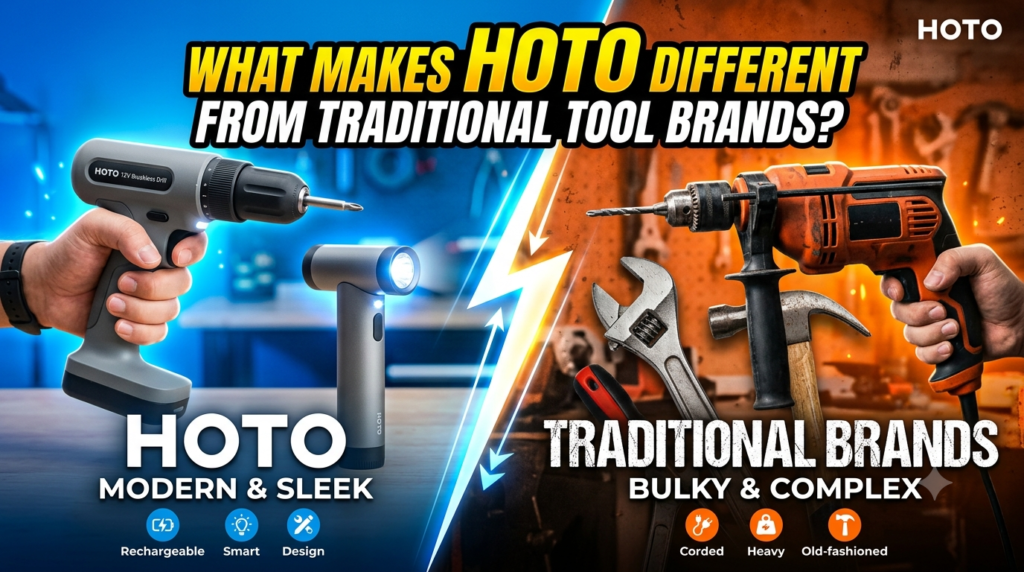
The clearest difference between HOTO and many traditional tool brands is its treatment of the user experience as a core engineering problem. Traditional tools often emphasize strength, specifications, compatibility, and professional reliability. HOTO also considers those elements, but places additional emphasis on appearance, portability, intuitive interaction, digital features, and storage. Its product descriptions repeatedly combine technical specifications with lifestyle-oriented language, positioning tools for DIY users, creators, homeowners, and professionals. This gives the brand a different emotional appeal. A conventional tool may communicate “I am built for work,” while HOTO often tries to communicate “I am built for work, but I also belong in your everyday environment.” That distinction matters in a market where consumers increasingly expect everything they purchase to have a pleasant interface. People care about how a product feels in their hands, where they store it, how they charge it, and whether they understand it immediately. HOTO’s success therefore cannot be explained solely by individual specifications. Its broader innovation is the creation of a coherent identity around modern tools. The company has effectively turned mundane objects into lifestyle hardware. Whether that strategy succeeds over the long term will depend on product reliability, service, ecosystem support, pricing, and continued innovation, but the underlying proposition is compelling: there is room to make traditionally utilitarian products more human-centered.
HOTO’s Balance Between Technology and Usability
Technology can easily become a liability when it is added simply because it is available. A Bluetooth connection does not automatically make a tool better, and a digital display does not necessarily improve a basic task. HOTO’s more successful products appear to follow a different principle: technology should remove friction. A laser measure becomes more useful when digital storage helps organize measurements. A screwdriver becomes more useful when integrated lighting improves visibility. A multifunctional air device becomes more useful when one motor can handle several household tasks without requiring multiple bulky machines. This relationship between technology and convenience is central to understanding HOTO’s innovation model. The company is not trying to transform every tool into a complicated smart device. Instead, it selectively introduces electronics, sensors, motors, displays, connectivity, and rechargeable power where those technologies can produce a noticeable improvement in the user’s workflow. That restraint is important. The best hardware innovation often feels obvious after the fact because it solves a real problem without demanding attention. A user should not have to think about the engineering behind an LED light or motor controller while repairing a cabinet. They simply notice that the job is easier. HOTO’s strongest design opportunity lies precisely there: hiding sophisticated engineering behind approachable interactions. If the company can continue to maintain that balance as its portfolio expands, it can occupy a distinctive position between traditional tools and modern consumer electronics.
The Role of Sustainability and Long-Term Product Use
Sustainability in consumer hardware is more complicated than simply using rechargeable batteries. A genuinely durable product should reduce unnecessary replacement, provide reliable performance, and ideally support maintenance through accessories or replacement components. HOTO’s current catalog includes replacement filters, blades, accessories, glue sticks, and other components for several product families. That ecosystem can contribute to longer product usefulness because users do not necessarily need to replace an entire device when a consumable or accessory reaches the end of its life. Rechargeable operation can also reduce reliance on disposable batteries for products designed around frequent use. At the same time, electronic tools contain batteries, circuit boards, motors, and other components that create their own environmental considerations. The long-term sustainability of such products therefore depends heavily on durability, repairability, responsible manufacturing, packaging, battery life, and end-of-life handling. HOTO’s evolution toward an ecosystem model creates an opportunity to make products more serviceable and useful over longer periods, although the actual environmental impact depends on implementation. The broader consumer trend is clear: people increasingly want products that combine convenience with longevity. A tool that looks attractive but fails quickly is not innovative in a meaningful sense. The real test of product innovation is whether the device remains useful after the novelty has disappeared. For HOTO, continued support, replacement parts, and iterative improvements will be important components of that long-term value proposition.
Read More:-
How Does Strikingly Simplify the Website Building Process?
Building Your Dream Website with Site123
Boost Your E-commerce Strategy with YITH Plugins
Maximize Your Customer Engagement with LiveAgent’s Features
Why STRIPO is Essential for Digital Product Marketersa
Who Can Benefit From HOTO Products?
HOTO’s product range is broad enough to appeal to several different audiences. DIY beginners can benefit from compact tools that reduce the intimidation associated with traditional equipment. Homeowners can use electric screwdrivers, laser measures, drills, cleaning devices, and air pumps for routine maintenance. Makers and creators can use precision screwdrivers and rotary tools for electronics, crafts, and small projects. Professionals may find certain measuring and precision tools useful as portable secondary equipment, particularly when size and convenience matter. HOTO’s own product positioning explicitly spans beginners through seasoned professionals, reinforcing this wide target market. The strongest audience may ultimately be the growing group of consumers who want professional-style functionality without maintaining a professional workshop. These users value performance but also care about aesthetics, portability, storage, charging, and simplicity. They may live in apartments, work from desks, travel frequently, or use tools only occasionally. For them, a compact and well-designed tool can make more sense than an oversized specialist device. HOTO’s product ecosystem is particularly suited to this audience because it lets users expand gradually. Someone might start with a screwdriver, later purchase a laser measure, then add an air pump or rotary tool when a new project requires it. That progression creates a natural path from casual DIY toward more capable home making. In a sense, HOTO is not just selling tools; it is encouraging people to become more comfortable with fixing and creating things themselves.
The Future of HOTO Technology and Product Innovation
The future direction of Shanghai HOTO Technology will likely depend on how effectively it can continue combining physical tools with digital intelligence without sacrificing simplicity. The company’s 2026 activity indicates an ongoing focus on product refinement, industrial design, awards, new categories, and connected functionality. Several technological directions appear particularly promising. Smarter measurement tools could integrate more advanced digital planning capabilities. Precision tools could gain better torque control, usage feedback, and task-specific lighting. Battery-powered devices could become smaller and more efficient as motor and battery technology improves. Multifunctional cleaning products could become more capable while retaining compact form factors. There is also room for deeper software integration, although this must be handled carefully because tools should remain useful even when an app is unnecessary. The most exciting possibility is the continued convergence of categories. A future toolkit might not consist of dozens of independent objects but a smaller number of intelligently designed devices supported by modular accessories and digital workflows. HOTO already shows elements of this direction through connected laser measurement, modular tool accessories, multifunctional air devices, and coordinated product families. If the company can preserve reliability while pushing these ideas forward, it has the potential to influence how consumers think about everyday hardware. The workshop of the future may not look like a traditional workshop at all. It may be compact, rechargeable, connected, beautifully designed, and accessible enough to fit into almost any home.




Conclusion
The story of Shanghai HOTO Technology is ultimately a story about redefining what an everyday tool can be. Since its founding in 2016, the company has pursued a strategy built around modern design, practical technology, portability, and user-friendly experiences. Its reported growth from a precision screwdriver launch to a global portfolio spanning measuring tools, electric screwdrivers, rotary tools, air pumps, cleaning products, kitchen devices, and accessories demonstrates how broadly that philosophy can be applied. What makes HOTO particularly interesting is not any single feature or product. The real innovation lies in the combination of engineering and design: motors become compact and approachable, measurement becomes digital and connected, repair kits become organized workstations, and multifunctional devices replace several individual household tools. Recent 2026 developments, including new product launches and design recognition, indicate that HOTO continues to invest in this direction. The company’s long-term challenge will be maintaining the balance between innovation, reliability, affordability, sustainability, and simplicity as its portfolio becomes more sophisticated. If it succeeds, HOTO could continue playing an important role in the transformation of traditional hardware into modern lifestyle technology. The larger lesson is equally interesting: innovation does not always require inventing something that has never existed before. Sometimes it means looking at an object everyone takes for granted—a screwdriver, tape measure, pump, vacuum, or kitchen scale—and asking a better question: What if this were designed from scratch for the way people live today?
Frequently Asked Questions
Q. What is Shanghai HOTO Technology known for?
A. Shanghai HOTO Technology is known for combining traditional tool functionality with modern industrial design, rechargeable technology, compact form factors, and selected smart features. The company began in 2016 and launched its first precision screwdriver set in 2018, later expanding into categories including screwdrivers, laser measuring tools, drills, rotary tools, air pumps, cleaning devices, and lifestyle products. HOTO states that its products are designed for everyone from beginners to experienced professionals.
Q. Are HOTO tools suitable for professionals?
A. HOTO offers products that can be useful to professionals, particularly where portability, precision, organization, and convenience are valuable. Its product range includes precision screwdrivers, laser measuring devices, laser levels, rotary tools, and other equipment with specifications intended for demanding applications. However, whether a particular HOTO product is appropriate for professional work depends on the exact task, required durability, power, accuracy, and industry standards involved.
Q. Does HOTO use smart technology in its tools?
A. Yes. Selected HOTO products use technologies such as Bluetooth connectivity, smartphone synchronization, OLED displays, digital measurement, rechargeable batteries, and electronically controlled motors. Its Smart Laser Measure, for example, supports Bluetooth connection with the Mi Home app and provides digital measurement information on an OLED display. The company’s broader approach is to use technology where it can make a tool more convenient rather than simply adding features for their own sake.
Q. What are some popular HOTO product categories?
A. HOTO’s current portfolio includes electric and precision screwdrivers, laser measuring devices, laser levels, measuring tapes, rotary tools, drills, air pumps, air dusters, vacuums, cleaning devices, kitchen scales, and related accessories. Its product catalog demonstrates a deliberate expansion from traditional hand tools into broader household and lifestyle hardware.
Q. Why is HOTO considered an innovative tool brand?
A. HOTO stands out because it approaches tools as consumer products rather than purely industrial equipment. It combines mechanical engineering with industrial design, rechargeable power, digital displays, connectivity, integrated lighting, modular accessories, and compact storage. Its recent product and design activity in 2026—including new product development and recognition from major design and business publications—shows that the company continues to emphasize innovation across its portfolio.