
PromoRepublic is a powerful marketing platform designed to help businesses manage social media, local marketing, customer reviews, listings, digital assets, and analytics from one centralized dashboard. Built with multi-location and franchise businesses in mind, PromoRepublic helps marketing teams maintain brand consistency while giving local teams the flexibility to create and publish relevant content. With AI-powered tools, automated workflows, campaign management, and detailed performance insights, PromoRepublic can simplify everyday marketing tasks and help businesses improve their online presence, engagement, and local visibility.
Table of Contents
- The Changing Reality of Modern Marketing
- What Is PromoRepublic?
- Why Multi-Location Marketing Is So Challenging
- How PromoRepublic Brings Marketing Activities Together
- The Role of AI in PromoRepublic
- Analytics and Campaign Visibility
- Benefits for Marketing Teams
- PromoRepublic Pricing and Plans
- What Users Say About PromoRepublic
- Who Can Benefit From PromoRepublic?
- What to Consider Before Choosing PromoRepublic
- The Future of Multi-Location Marketing
- Conclusion
- FAQs
The Changing Reality of Modern Marketing
Marketing teams today operate in an environment that feels dramatically different from even a few years ago. A brand may need to publish social content, respond to customer reviews, maintain local business listings, coordinate campaigns, manage creative assets, monitor performance, and communicate with dozens or even hundreds of locations at the same time. The challenge is no longer simply creating good content; it is making sure that the right content reaches the right audience through the right channel without creating an administrative nightmare for the marketing team. This is especially true for franchises, retail chains, healthcare networks, hospitality groups, professional services businesses, and other organizations where one brand operates across many locations. PromoRepublic is increasingly positioned around this exact challenge, describing itself as an AI-powered marketing platform designed for multi-location and franchise brands. Its current platform brings social publishing, listings, reviews, analytics, AI assistance, asset management, and other workflows into one environment rather than requiring teams to jump between disconnected systems.
Why Traditional Marketing Workflows Are Becoming Harder
Imagine a marketing manager responsible for 100 local business pages. Every week, that person might need to prepare content, send it for approval, answer questions from local operators, check whether posts went live, review engagement numbers, update listings, monitor reviews, and prepare a report for leadership. Now multiply that workflow across several social networks and multiple campaigns. Suddenly, what looked like a simple social media task becomes a large operational process involving spreadsheets, email threads, shared folders, scheduling platforms, reporting tools, and constant follow-ups. This fragmentation is one reason centralized marketing platforms have become increasingly attractive to growing organizations. PromoRepublic’s current positioning reflects this shift by emphasizing a single platform for social, listings, reviews, and analytics, with AI designed to reduce repetitive work and help teams execute local marketing at scale.
The Growing Need for Centralized Marketing Operations
The phrase “one platform” can sound like ordinary software marketing, but the underlying operational problem is very real. When different teams use different systems, information gets scattered, responsibilities become unclear, and small mistakes can multiply across locations. A centralized platform gives headquarters a common operating environment while still allowing individual locations to participate in local marketing. PromoRepublic supports brand hierarchies, territories, permissions, and multi-location structures, which are particularly relevant when an organization needs corporate oversight without eliminating local participation. Its platform also connects with services such as Google, Meta, Yelp, CRMs, POS systems, and data warehouses, depending on the setup and plan.
What Is PromoRepublic?
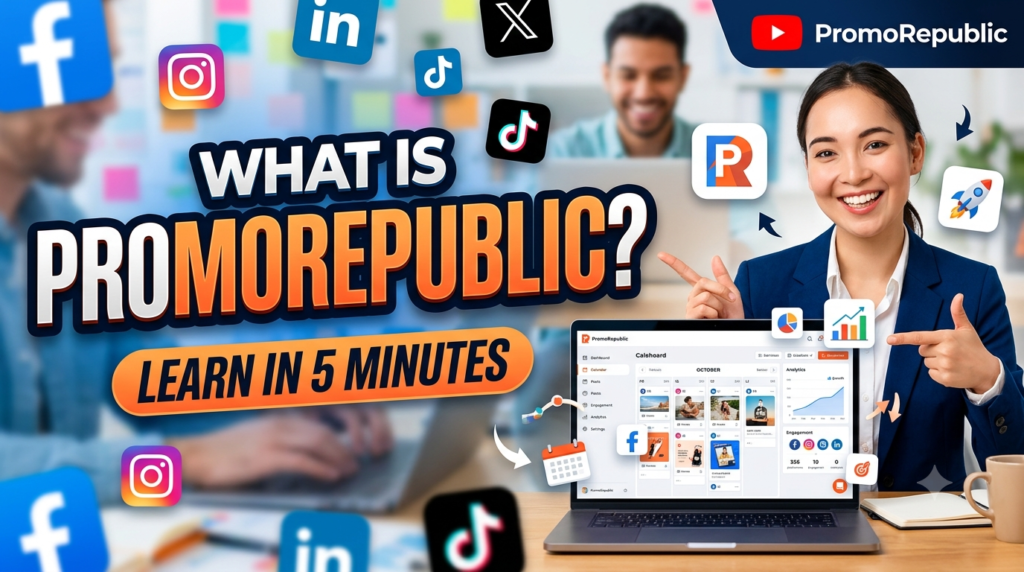
PromoRepublic is a marketing technology platform focused on helping organizations manage local and multi-location marketing. While its earlier reputation was closely associated with social media management and content creation, the company’s current product positioning is much broader. Today, PromoRepublic presents its platform as a centralized environment for social media, reviews, listings, analytics, digital assets, and AI-powered marketing workflows. That evolution matters because modern marketing teams are increasingly responsible for the entire local customer journey rather than social posting alone. A potential customer might discover a business through Google, look at its reviews, visit a social page, check opening information, and then decide whether to contact or visit the location. Managing those touchpoints separately can create unnecessary friction, whereas bringing them into a connected workflow can give marketing teams a more complete view of local performance.
How PromoRepublic Has Evolved Into a Local Marketing Platform
The evolution of PromoRepublic is particularly interesting because it mirrors the changing priorities of marketing departments. Social scheduling remains part of the platform, but the product now extends into listings management, review management, analytics, digital asset management, campaign workflows, and AI. Its current product pages describe specialized areas such as Social AI, Listings AI, Reviews AI, and Analytics AI, reflecting an attempt to connect multiple pieces of local marketing rather than treating social media as an isolated activity. The platform also supports mobile workflows so local operators can participate without needing to become experts in a complicated corporate marketing system. For a modern marketing department, that combination can turn local marketing from a collection of disconnected tasks into a more structured operating process.
Why Multi-Location Marketing Is So Challenging
Running marketing for one business location is already demanding. Running it for 50, 500, or thousands of locations introduces a completely different level of complexity. Each location needs accurate information, relevant content, customer responses, and regular activity, but the organization also needs to protect the larger brand identity. A restaurant chain, for example, may want every location to communicate the same national promotion while allowing each store to highlight its local community. A healthcare organization may need standardized messaging while individual clinics still require location-specific information. This tension between consistency and flexibility is one of the central problems that multi-location marketing software attempts to solve.
Maintaining Brand Consistency Across Locations
Brand consistency becomes difficult when local teams create and publish content independently. Even a small deviation in tone, logo usage, promotional language, or campaign details can create an inconsistent customer experience. PromoRepublic addresses this challenge through tools such as brand kits, digital asset management, content approval workflows, permissions, and centralized campaign distribution. Its social media management product describes a model in which headquarters can set campaigns and brand rules while local locations receive content that they can publish or customize according to the organization’s operating model.
Balancing Central Control With Local Creativity
The strongest local marketing strategies usually need both structure and authenticity. If headquarters controls every word, a local page can feel generic and disconnected from its community. If every local operator has complete freedom, the brand can lose consistency. PromoRepublic currently supports several operating approaches, including centralized publishing, local publishing, and a hybrid model. The hybrid approach is designed around a particularly practical idea: headquarters can maintain baseline activity while local operators contribute additional content that reflects their market. That gives marketing leaders a way to protect brand standards without turning local teams into passive recipients of corporate campaigns.
How PromoRepublic Brings Marketing Activities Together
One of the biggest reasons marketing teams may consider PromoRepublic is the breadth of activities covered by its platform. Instead of treating social media, reviews, business listings, assets, and analytics as completely separate responsibilities, PromoRepublic connects them under a broader local marketing workflow. Its current product lineup includes social media management, digital asset management, review management and generation, listing management, local SEO, analytics, location insights, brand consistency tools, and AI capabilities.
Social Media, Reviews, Listings, and Analytics in One Platform
For marketing teams, the advantage of combining these functions is context. A social post is not simply a piece of content; it contributes to a broader customer experience. Likewise, a review is not merely a reputation metric, and a business listing is not merely a directory entry. When these activities are viewed together, teams can investigate how local visibility, engagement, customer feedback, and campaign execution interact. PromoRepublic’s platform is designed around this connected approach, with analytics covering areas such as social performance, reviews, local search, and location-level insights depending on the plan.
Digital Asset Management and Approval Workflows
Creative teams often lose time searching for the latest logo, campaign image, approved promotion, or correct brand template. Digital asset management can reduce this problem by creating a centralized source for approved marketing materials. PromoRepublic includes digital asset management and content approval workflows in its platform, helping organizations distribute approved content while maintaining greater control over what local teams can access and publish. This becomes particularly useful during national campaigns when dozens or hundreds of locations need access to the same creative materials. Instead of sending files through endless email chains, the marketing organization can create a structured workflow around approved assets and publishing.
The Role of AI in PromoRepublic
AI is now one of the biggest factors shaping marketing technology, but the useful question is not simply whether a platform has AI. The more important question is what the AI actually does inside the workflow. PromoRepublic currently uses AI for content generation, review responses, performance insights, recommendations, and broader marketing automation. Its AI Assistant can work with platform data, including published posts, performance metrics, reviews, account structures, permissions, and brand configuration, to provide contextual assistance. That means the AI is positioned as part of the marketing workflow rather than merely as a generic text generator.
AI Composer and AI Assistant
The AI Composer is designed to help teams create on-brand content, while the AI Assistant can help with tasks such as writing captions, generating review responses, summarizing performance changes, and recommending actions. For busy marketers, this can remove some of the repetitive work involved in producing and reviewing content. Instead of starting every post from a blank page, marketers can use AI to create a first draft and then apply human judgment before publication. PromoRepublic’s own documentation emphasizes that the AI Assistant can use actual platform data when producing suggestions, which makes its role different from simply asking a generic chatbot to write marketing copy.
Moving From AI Assistance Toward AI-Powered Execution
PromoRepublic’s current positioning goes beyond basic AI assistance toward what it calls an agentic marketing platform. The company describes AI agents that can execute local marketing tasks within defined brand rules, while its platform overview says AI can generate content, coach teams, and execute tasks across locations. At the same time, the company’s campaign documentation makes clear that human review and approval remain important, particularly for larger campaigns. This distinction is important for businesses: automation can reduce repetitive work, but marketing teams still need governance, judgment, and accountability.
Analytics and Campaign Visibility
Marketing leaders increasingly need more than a report showing likes and impressions. They need to understand whether campaigns were actually executed, which locations participated, where activity stopped, and which content produced meaningful engagement. PromoRepublic’s Campaign Analytics, introduced in its current documentation, is designed to answer those operational questions. Teams can see campaign participation, task completion, publishing activity, content performance, location performance, and channel-level results. This gives marketing managers a way to investigate not just what happened, but also where execution broke down.
Turning Marketing Data Into Actionable Insights
Consider a campaign distributed to 200 locations. If only 120 locations publish the content, looking only at the overall engagement number does not explain the problem. Campaign Analytics can help teams identify the difference between tasks proposed, approved, and actually published, allowing managers to see where locations are dropping out of the workflow. PromoRepublic’s documentation also describes the ability to use the AI Assistant to ask questions about underperforming locations, campaign participation, and comparative performance. This type of conversational analytics can be particularly useful when marketing managers need a quick operational answer rather than another spreadsheet to interpret.
Benefits for Marketing Teams

The attraction of a platform like PromoRepublic is ultimately connected to productivity. Marketing teams are often asked to produce more content, manage more channels, support more locations, and demonstrate more measurable results without a proportional increase in headcount. Automation and centralization can therefore have practical value if they reduce repetitive coordination. PromoRepublic’s current plans include social publishing and automation, AI tools, mobile workflows, analytics, content approval, digital asset management, and dedicated customer success support, with more advanced capabilities available at higher tiers.
Saving Time and Reducing Manual Coordination
A major source of wasted marketing time is not necessarily creative work; it is follow-up. Who approved the post? Which location has not published? Where is the latest campaign image? Did someone respond to that review? Is the Google listing correct? A centralized platform can bring many of these questions into the same workflow. User reviews also reflect this productivity angle: G2’s current review summary says users frequently praise PromoRepublic’s ease of use, template library, scheduling capabilities, and customer support, although some reviews also mention limitations such as content updates or missing features.
Improving Brand Consistency and Local Activation
Consistency and activation are closely connected. A brand can provide perfect marketing materials, but if local operators never use them, the campaign still fails operationally. PromoRepublic’s platform is designed to help headquarters distribute content and encourage local participation through approval workflows, mobile tools, campaign management, and analytics. The company reports that 67% of franchisees use its platform in one highlighted result, while its pricing page cites an 81% surge in social engagement for a referenced outcome; these are company-reported figures rather than independent benchmarks, so they should be interpreted accordingly.
PromoRepublic Pricing and Plans
Pricing is an important consideration for any marketing technology purchase, particularly for organizations managing many locations. PromoRepublic’s current official pricing page presents three main plan categories: Build, Grow, and Enterprise. Pricing is based on factors such as the number of locations or pages being managed and the modules selected, rather than presenting one universal public price for every organization. Build focuses on core marketing execution, while Grow adds capabilities such as listings management, centralized automation, advanced analytics, benchmarks, and adoption features. Enterprise adds capabilities such as AI agents, executive dashboards, data warehouse integrations, custom workflows, white-label mobile applications, and broader enterprise support.
| Plan | General Focus | Notable Capabilities |
| Build | Core local marketing | Social publishing, reviews, DAM, AI Composer, AI Assistant, mobile app, approvals |
| Grow | Scaled multi-location marketing | Listings, centralized automation, advanced analytics, benchmarks, adoption tools |
| Enterprise | Large and complex networks | AI Agents, executive dashboards, data integrations, custom permissions, white-label options |
Organizations should therefore evaluate pricing based on their actual number of locations, users, channels, modules, integrations, and reporting requirements. PromoRepublic also states that paid pilot programs can be used to validate a business case before a wider rollout.
What Users Say About PromoRepublic
Independent review platforms provide a more balanced picture than vendor materials alone. G2 currently lists PromoRepublic at 4.5 out of 5 based on 163 reviews, with its review summary highlighting ease of use, templates, content creation, and customer support as recurring positives. Capterra’s August 2026 information lists a 4.6 rating from 152 reviews and an ease-of-use score of 4.6, while also showing that reviewers have raised criticisms around particular missing or evolving capabilities.
Trustpilot also shows a mixture of experiences, with a 4.4 score displayed from 42 reviews at the time of the search. Recent reviews include positive comments about scheduling, organization, customer service, templates, and content management, but there are also negative experiences, including criticism related to sales interactions. These reviews should be treated as individual customer experiences rather than definitive evidence of how the platform performs for every organization.
Who Can Benefit From PromoRepublic?
PromoRepublic is particularly relevant to organizations where one marketing team needs to coordinate activity across many locations. Franchise networks are an obvious example because headquarters needs to establish brand rules while franchisees need practical tools to execute locally. Retail chains, restaurant groups, healthcare networks, real estate organizations, financial services, hospitality brands, and other distributed businesses can face similar challenges. The platform’s multi-location infrastructure, location permissions, local marketing tools, campaign analytics, and mobile workflows are specifically designed around this operating model.
Smaller businesses can also find value in social publishing, content creation, review management, and analytics, but the platform’s strongest strategic proposition is arguably its ability to coordinate distributed marketing operations. If a company only needs to schedule posts for a handful of accounts, a simpler social media scheduler may be sufficient. When the problem becomes “How do we keep hundreds of locations active, accurate, on-brand, measurable, and locally relevant?”, the broader platform approach becomes much more relevant.
Read More:-
How Does Strikingly Simplify the Website Building Process?
Building Your Dream Website with Site123
Boost Your E-commerce Strategy with YITH Plugins
Maximize Your Customer Engagement with LiveAgent’s Features
Why STRIPO is Essential for Digital Product Marketersa
What to Consider Before Choosing PromoRepublic
No marketing platform should be selected solely because it has a long feature list. Teams should first map their current workflow and identify the problems they actually need to solve. If the main issue is social scheduling, the evaluation should focus on publishing flexibility, supported networks, approval processes, content creation, and usability. If the organization has hundreds of locations, it should also examine permissions, location structures, local listings, reviews, analytics, integrations, onboarding, and adoption.
User feedback also suggests that there can be trade-offs. Some reviewers appreciate PromoRepublic’s templates and ease of use, while others have pointed to areas where they would like newer content, additional capabilities, or stronger AI functionality. Marketing teams should therefore test the platform against real workflows before committing, particularly when the purchase involves a large number of locations or a significant change to the existing technology stack.
The Future of Multi-Location Marketing
The future of local marketing is moving toward connected systems rather than isolated tools. AI is becoming capable of helping with content, recommendations, analysis, and execution, while marketing teams increasingly expect software to understand context rather than simply automate individual actions. PromoRepublic’s current roadmap and positioning reflect that direction, with AI agents, conversational analytics, integrations, mobile workflows, and centralized governance forming a larger part of the platform. Its Campaign Analytics documentation even describes MCP connectivity that can allow approved external AI tools such as ChatGPT, Claude, or Copilot to access PromoRepublic campaign data, depending on account configuration.
That does not mean humans disappear from the marketing process. Quite the opposite: as routine execution becomes more automated, human marketers can spend more time on strategy, creative direction, customer understanding, campaign planning, and brand development. The software becomes the engine room, while people remain responsible for deciding where the organization is going. That is perhaps the most interesting reason modern marketing teams are looking at platforms like PromoRepublic: not because another scheduling tool is exciting, but because the underlying marketing workflow itself is changing.




Conclusion
Modern marketing teams are dealing with a difficult combination of scale, speed, customer expectations, and operational complexity. For organizations with multiple locations, the challenge becomes even greater because every local page, listing, review, campaign, and customer interaction can affect the overall brand experience. PromoRepublic has expanded from a social media management solution into a broader local marketing platform covering social media, listings, reviews, digital assets, analytics, campaign execution, and AI-powered workflows.
The platform’s appeal comes from bringing these activities into a more connected environment. AI can help teams create content and interpret data, centralized workflows can support brand governance, mobile tools can make local participation easier, and campaign analytics can show where execution is succeeding or falling behind. Independent reviews show strong overall user satisfaction while also identifying areas where some customers would like additional capabilities, making hands-on evaluation important before adoption.
For a marketing organization managing a distributed network, the question is increasingly less about how to publish another social post and more about how to build a repeatable system that keeps every location visible, consistent, responsive, and measurable. That is the space PromoRepublic is targeting—and it helps explain why the platform is attracting attention from modern marketing teams.
FAQs
Q. What is PromoRepublic used for?
A. PromoRepublic is a marketing platform designed particularly for multi-location and franchise businesses. It combines social media management, reviews, listings, digital asset management, analytics, campaign workflows, and AI-powered tools within one platform.
Q. Is PromoRepublic only a social media scheduling tool?
A. No. While social publishing remains an important part of the platform, its current product offering extends into listings, reviews, local SEO, analytics, digital asset management, campaign management, and AI-powered workflows.
Q. Does PromoRepublic use AI?
A. Yes. PromoRepublic currently offers AI Composer, AI Assistant, and AI Agents. The AI Assistant can help generate captions, draft review responses, summarize performance information, and provide recommendations based on available platform data.
Q. How much does PromoRepublic cost?
A. PromoRepublic’s official pricing is based on factors such as locations or pages and the modules required. Its current plans are Build, Grow, and Enterprise, with pricing dependent on the organization’s requirements rather than one universal public price.
Q. Is PromoRepublic suitable for small businesses?
A. It can be useful for smaller businesses that need social publishing, content creation, reviews, and analytics, but its platform is particularly focused on multi-location and franchise organizations. Businesses should compare their actual workflow requirements with the platform’s capabilities before choosing a plan.