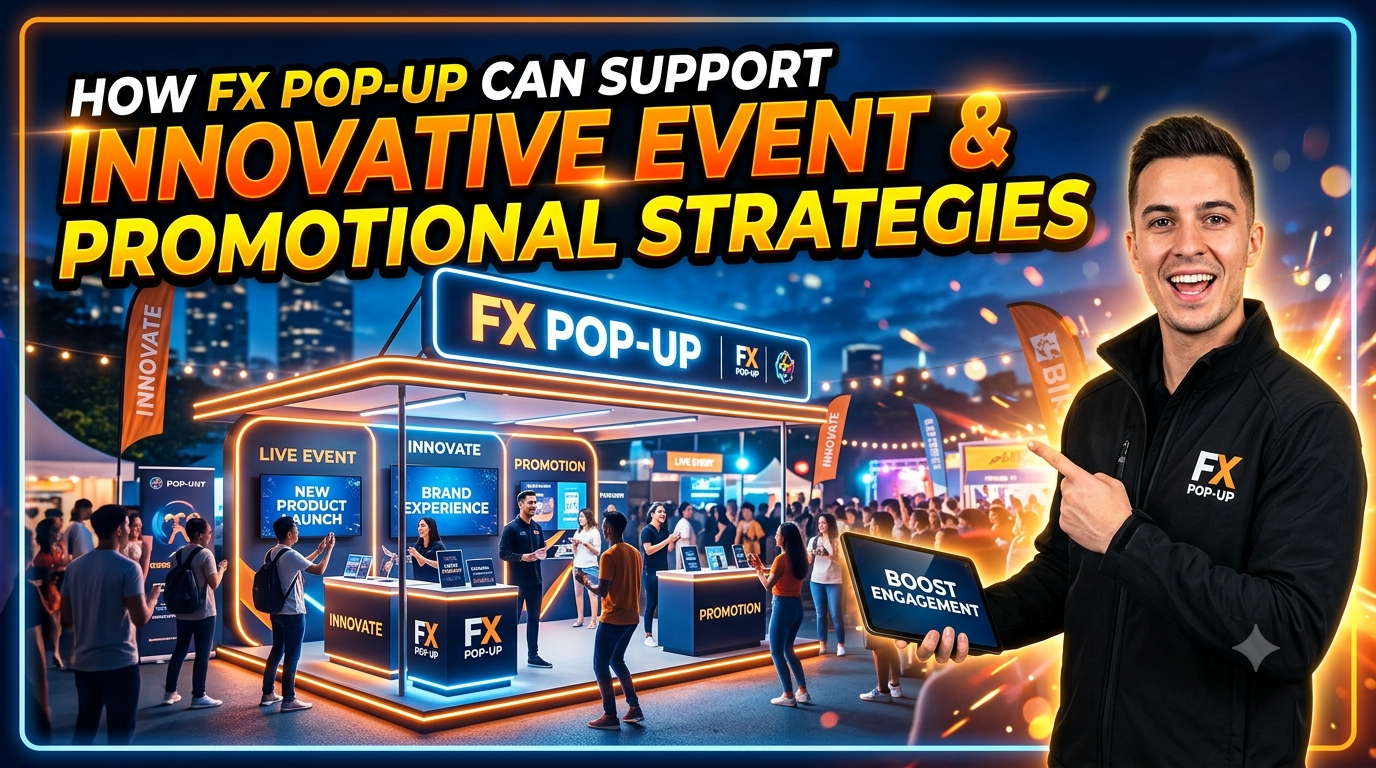
FX Pop-Up can help brands explore innovative event and promotional strategies by creating engaging, memorable, and interactive experiences for their target audiences. From product launches and brand activations to limited-time promotions and customer engagement campaigns, FX Pop-Up offers an experience-driven approach that can connect physical events with digital marketing opportunities. By combining creativity, visual appeal, audience participation, and promotional flexibility, FX Pop-Up can help businesses attract attention, encourage social sharing, strengthen brand awareness, and create meaningful customer interactions in competitive markets.
Table of Contents
- Understanding the Role of FX Pop-Up in Modern Promotion
- Creating Memorable Brand Experiences
- Building Buzz Before an Event
- Designing Interactive Promotional Activations
- Using Visual Storytelling to Capture Attention
- Supporting Product Launches and Brand Reveals
- Integrating Social Media Into Pop-Up Campaigns
- Creating Limited-Time Exclusivity
- Connecting Online and Offline Campaigns
- Using Pop-Ups for Market Testing
- Partnerships and Collaborative Promotions
- Making Promotional Events More Flexible
- Measuring Event and Promotional Performance
- Common Mistakes to Avoid
- Building a Practical FX Pop-Up Strategy
- Future Opportunities for Pop-Up Promotion
- Conclusion
- FAQs
Understanding the Role of FX Pop-Up in Modern Promotion
Marketing has changed dramatically. People are no longer satisfied with simply seeing an advertisement, scrolling past a sponsored post, or reading a promotional message on a website. They want something they can experience, photograph, discuss, and remember. That shift has made pop-up experiences increasingly useful for brands looking to create stronger connections with their audiences. FX Pop-Up can be considered within this broader movement toward temporary, visually engaging promotional experiences, particularly when brands want to make an event feel fresh rather than routine. Current pop-up marketing guidance emphasizes treating a pop-up as an event rather than simply another retail space, with planning across the pre-event, event, and post-event stages. The idea is simple: instead of asking consumers to come to a brand through a conventional advertisement, a temporary experience gives them a reason to step into the brand’s world. This approach can make promotional campaigns feel less like sales pitches and more like cultural moments. When executed properly, a pop-up can become a physical stage where branding, entertainment, product discovery, social interaction, and storytelling happen simultaneously. That flexibility is especially valuable for companies trying to differentiate themselves in crowded markets where conventional promotional tactics can quickly become background noise.
Why Experiential Marketing Matters
Experiential marketing works because it transforms passive audiences into active participants. Think about the difference between watching a video about a product and actually entering a branded environment where you can touch it, test it, photograph it, talk about it, and share your reaction with friends. The second experience creates multiple memory points, which is precisely why temporary activations have become important in modern promotional planning. Recent industry guidance describes pop-up experiences as temporary, immersive activations designed to create excitement, generate foot traffic, and encourage stronger connections between audiences and brands. FX Pop-Up can support this philosophy by giving marketers a framework for thinking beyond ordinary promotional displays and toward experiences that have a beginning, middle, and end. A successful activation might introduce a product through a themed installation, create a special demonstration area, offer an exclusive experience, or turn an ordinary gathering into something worth sharing. The physical environment becomes part of the marketing message. Instead of merely telling customers that a brand is innovative, the event allows the audience to experience innovation directly. That distinction can make a campaign more emotionally engaging and potentially more memorable.
Creating Memorable Brand Experiences
A memorable event does not necessarily require an enormous budget or an extravagant venue. What it needs is a clear idea that connects the audience, the brand, and the experience. FX Pop-Up can contribute to this approach by helping marketers think about promotional events as temporary environments with a specific purpose rather than generic spaces filled with logos. Imagine a skincare company creating a discovery lounge where visitors can explore ingredients, receive personalized recommendations, and photograph themselves inside an aesthetically designed setting. A technology company could create an interactive demonstration zone where visitors solve challenges using a new product. A fashion label could develop a limited-time styling studio where guests customize selected pieces. Each concept gives people a reason to participate rather than simply observe. Research and practical guidance around experiential pop-ups repeatedly highlight the importance of combining a clear audience action, a branded physical environment, and an execution plan that supports the creative concept. When those elements work together, the event becomes more than decoration. It becomes a story that visitors physically enter and help complete.
Turning Products Into Experiences
One of the strongest promotional opportunities comes from transforming a product demonstration into an experience. A product sitting on a table may attract limited attention, but a product integrated into a challenge, workshop, game, consultation, performance, or creative installation can invite much deeper engagement. FX Pop-Up can therefore be positioned as part of an experience-first strategy where the product is not merely displayed but becomes one component of the visitor journey. This is particularly useful for products that are difficult to communicate through static advertising. A new gadget can be tested, a beauty product can be demonstrated, a beverage can become part of a themed tasting experience, and a lifestyle product can be integrated into a realistic environment. The key is to ask a simple question before designing the event: What should visitors do, feel, and remember? That question changes the creative process completely. Instead of starting with banners and promotional materials, marketers begin with audience behavior. Once the desired behavior is clear, signage, product placement, staff interaction, digital content, giveaways, and social media prompts can all support the same objective.
Building Buzz Before an Event
A pop-up should not begin when the doors open. The strongest campaigns start building curiosity days or weeks beforehand. Pre-event promotion can include social media teasers, countdown content, creator partnerships, email announcements, location-based advertising, behind-the-scenes videos, invitations, and carefully controlled reveals. Shopify’s current pop-up marketing guidance recommends planning promotion across three phases: before the event, during the event, and after it, while also emphasizing local influencers, digital promotion, and visible signage. FX Pop-Up can fit naturally into this three-stage approach because the temporary nature of an activation provides an inherent promotional hook. People naturally wonder what is happening, why it is happening, and how long it will last. Marketers can use that curiosity without misleading their audiences by revealing enough information to create interest while keeping certain details for the event itself. A teaser might show part of an installation without revealing the complete design, for example. Another campaign could announce a date and neighborhood while revealing the exact experience gradually through social posts. The objective is not simply to advertise the event but to make people feel that missing it would mean missing something special.
Designing Interactive Promotional Activations
Interactivity is one of the easiest ways to turn foot traffic into meaningful engagement. A person who walks past a promotional display may remember the logo, but someone who spends five minutes participating in an activity has created a personal connection with the campaign. FX Pop-Up can support interactive strategies through concepts such as product challenges, demonstrations, customization stations, quizzes, photo installations, games, workshops, or discovery zones. The best activity does not feel like an obstacle between the visitor and the product. Instead, participation should feel natural and rewarding. For example, a sportswear brand might create a quick performance challenge where visitors can test their skills, while a technology brand could build an interactive problem-solving station around a product feature. The activity should be simple enough to understand quickly, because complicated instructions can cause people to walk away. Current display strategy guidance similarly recommends placing activations where people naturally slow down, keeping headlines visible from a distance, and maintaining an open layout that makes the space easy to approach. This combination of accessibility and interaction can help promotional environments feel welcoming rather than intimidating.
Encouraging Audience Participation
Participation becomes even more powerful when visitors feel that their contribution matters. Instead of simply asking someone to watch a demonstration, brands can invite them to make a choice, customize an item, contribute to a display, complete a challenge, vote on an option, or share a personal response. FX Pop-Up can be incorporated into campaigns where audience participation becomes part of the content itself. Consider an event where visitors choose between several product concepts and immediately see the results displayed on a digital screen. Suddenly, the customer is not just consuming a campaign; they are contributing to it. This approach can also generate useful qualitative insights because employees can observe reactions, listen to questions, and identify objections that may never appear in online analytics. The most effective interactive campaigns balance entertainment with relevance. If the activity is fun but has nothing to do with the brand, visitors may remember the game and forget the company. If the activity is too sales-focused, it may feel like an extended advertisement. The sweet spot is an experience where the entertainment naturally reinforces the brand proposition.
Using Visual Storytelling to Capture Attention
Visual design is crucial because audiences often decide within seconds whether a temporary activation deserves their attention. Strong signage, recognizable branding, clear messaging, lighting, spatial design, props, product displays, and photo opportunities can work together to create a visual narrative. FX Pop-Up can support promotional strategies that use the physical environment as part of the storytelling rather than treating it as a simple backdrop. One useful principle is to design the experience in layers. The first layer should attract someone from a distance. The second should communicate the central idea as they approach. The third should reward visitors once they enter. This approach reflects current recommendations for pop-up displays, which emphasize headlines that can be seen from afar while allowing benefits and details to become clearer at closer distances. Visual storytelling is particularly powerful when a campaign needs organic social sharing. A distinctive installation, unexpected environment, or clever product presentation can become a natural photography point. When visitors choose to capture and share the environment themselves, the physical event begins extending into digital channels.
Supporting Product Launches and Brand Reveals
Product launches can benefit enormously from the temporary and exclusive nature of pop-up campaigns. Instead of introducing a new product through a conventional announcement alone, a brand can create an environment where customers experience the launch as an event. FX Pop-Up can support this type of strategy by providing a conceptual structure around demonstrations, early access, product education, influencer previews, customer testing, and limited-edition releases. The launch environment might include a central reveal moment, interactive product stations, expert demonstrations, and a social-media-friendly installation. Such a campaign can also create useful feedback before a broader rollout. Visitors can explain what attracts them, what confuses them, and which features generate the most excitement. Recent guidance on pop-up brand activations specifically highlights product launches, awareness, lead generation, and direct sales as different objectives that should influence the design of the activation. That is an important lesson: a launch pop-up should not attempt to accomplish everything simultaneously. If the main goal is product education, the experience should prioritize demonstrations and conversations. If the goal is awareness, visual impact and shareability may deserve greater emphasis.
Integrating Social Media Into Pop-Up Campaigns
A modern promotional event should be designed for both physical and digital audiences. Visitors may experience an activation in person, but their photographs, videos, reviews, comments, and posts can carry the campaign much further. FX Pop-Up can support an integrated strategy where social media is not added after the event but considered during the original concept stage. A photo wall, branded installation, short-form video station, creator preview, interactive challenge, or limited-edition product can create natural opportunities for social content. The important word is natural. Audiences are increasingly sophisticated, so an obvious request to “post this and tag us” may feel forced. A better strategy is to create something people genuinely want to show their friends. Current pop-up marketing guidance recommends involving relevant local influencers and creators before an activation and using visible physical cues to create anticipation around the event. When digital and physical promotion reinforce each other, the campaign can develop momentum before the first visitor arrives and continue after the final day.
Generating User-Generated Content
User-generated content can become one of the most valuable outcomes of a well-designed pop-up. A visitor who voluntarily posts a video of an experience is effectively creating an endorsement that may feel more authentic than conventional advertising. FX Pop-Up can support UGC-friendly campaigns by encouraging moments that are visually distinctive, emotionally engaging, or personally relevant. A customization station is a good example because visitors naturally want to document what they created. A surprise performance, unusual installation, interactive product demonstration, or limited-edition giveaway can create another reason to record and share. The event should also make it easy to identify the brand without overwhelming the content with promotional messages. A subtle logo, memorable design element, branded hashtag, or recognizable installation can be enough. The goal is to let the audience tell the story in their own voice. This matters because a pop-up can otherwise disappear as soon as the temporary space closes. UGC gives the experience a digital afterlife, allowing moments created during the event to continue generating awareness.
Creating Limited-Time Exclusivity
Scarcity is a powerful psychological and promotional tool when used honestly. A pop-up naturally creates scarcity because the experience exists for a limited period, in a particular location, and sometimes with limited quantities. FX Pop-Up can therefore support campaigns built around exclusivity without manufacturing artificial urgency. A brand might offer an item available only during the activation, provide early access to registered visitors, invite a limited number of customers to a private preview, or create an event-specific customization option. The temporary nature itself becomes part of the message. Current pop-up event guidance describes these experiences as appearing temporarily and then disappearing, with that impermanence being a central part of their appeal. When customers know that an experience will not be available forever, they have a stronger reason to act now. However, scarcity works best when the promise is genuine. If a brand repeatedly claims that something is available “only today” and then keeps extending the offer, customers can lose trust. Real limitations are more persuasive than artificial ones.
Connecting Online and Offline Campaigns
The most innovative promotional strategies do not treat digital and physical marketing as separate departments. Instead, they create a continuous customer journey. FX Pop-Up can act as the physical centerpiece of a campaign that begins online and continues after the event. A brand might use social media to announce a mysterious activation, direct visitors to a registration page, collect preferences during the event, and then send personalized follow-up content afterward. QR codes can connect physical displays to product pages, educational videos, digital catalogs, competitions, or loyalty programs. Staff can also encourage visitors to follow the brand or sign up for future announcements, provided the process is transparent and worthwhile. This creates a bridge between temporary physical engagement and long-term digital relationships. The result is more valuable than a single day’s foot traffic because the brand can continue communicating with people who demonstrated genuine interest. A pop-up becomes the meeting point between online discovery and real-world experience.
Using Pop-Ups for Market Testing
One of the less obvious benefits of pop-up events is experimentation. A temporary environment allows brands to test products, messaging, pricing, locations, visual concepts, and customer reactions without making the commitment associated with a permanent physical space. FX Pop-Up can support this experimental mindset by encouraging marketers to view an activation as both a promotional opportunity and a learning laboratory. A brand considering expansion into a new market, for example, could organize a temporary activation and study attendance, engagement, questions, product preferences, and purchase behavior. The campaign could test two different messages or display arrangements and compare audience responses. Because the experience happens face-to-face, employees can gather information that digital dashboards cannot always provide. Current brand-activation guidance similarly emphasizes that pop-ups can help brands test ideas, gather insights, generate buzz, and engage audiences without committing to a permanent location. This makes experimentation particularly valuable for emerging brands and companies entering unfamiliar markets.
Gathering Direct Customer Insights
Customer conversations are often one of the richest sources of marketing intelligence. At a physical activation, customers can explain why they like something, why they hesitate, what they expected, and what they would change. FX Pop-Up can be incorporated into a structured feedback process where staff record recurring questions and observations while visitors interact with the experience. Short surveys can complement those conversations, but the process should not become intrusive. Sometimes the most useful insight comes from watching behavior. Do people understand the signage immediately? Which display attracts them first? Where do they stop? What makes them leave? Which product do they touch most often? These observations can help marketers refine future campaigns. A successful pop-up therefore does not end when sales numbers are counted. It can also produce a collection of behavioral and qualitative insights that informs product development, merchandising, communication, and future event design.
Partnerships and Collaborative Promotions
Partnerships can give a pop-up campaign access to new audiences, stronger credibility, and additional creative resources. FX Pop-Up can be incorporated into collaborative promotions involving complementary brands, creators, retailers, venues, communities, or event organizers. For example, a fitness brand might partner with a wellness company, while a technology company could collaborate with a creative studio. The important factor is audience alignment. A partner should bring something meaningful to the experience rather than simply adding another logo. FX Pop-Up itself provides an indication that partnership and affiliate relationships can form part of its commercial ecosystem, including bulk selling partnerships and an affiliate program with promotional assets. For event marketers, this broader partnership mindset can open additional promotional channels. One partner might provide the venue, another the audience, another the product experience, and another the content distribution. When responsibilities are clearly defined, the result can feel larger than what any individual organization could create alone.
Making Promotional Events More Flexible
Traditional campaigns often require long planning cycles and substantial commitments. Pop-ups offer a different model. Their temporary nature allows marketers to experiment with locations, themes, audiences, and formats. FX Pop-Up can support this flexibility by fitting into campaigns that need a modular or adaptable promotional structure. A brand might begin with a small activation, learn from the response, and then repeat the concept in another location with improvements. Another company might use a pop-up only during a product launch, seasonal campaign, trade event, cultural festival, or community gathering. Flexibility does not mean a lack of planning. In fact, temporary campaigns can require extremely careful coordination because there is little time to correct operational mistakes once the event begins. Location, visitor flow, staffing, signage, inventory, technology, safety, permissions, and contingency plans all matter. The strongest flexible campaigns are therefore strategically disciplined behind the scenes while appearing spontaneous and exciting to the audience.
Measuring Event and Promotional Performance
A creative activation still needs measurable objectives. Before launching an FX Pop-Up campaign, marketers should determine what success means. Is the primary goal awareness, sales, leads, product testing, social engagement, customer education, or partnership development? Different objectives require different metrics. A sales-oriented activation might track transactions, average order value, conversion rate, and revenue. An awareness campaign might focus on attendance, social reach, mentions, earned media, brand-search activity, and audience growth. A lead-generation event could measure qualified contacts and follow-up conversions. Current pop-up marketing guidance recommends defining a primary goal and KPI before launching the activation rather than trying to judge success afterward. This prevents a common mistake: declaring an event unsuccessful simply because it did not generate immediate sales when the actual objective was awareness or market research. Good measurement connects creative decisions to business outcomes.
Common Mistakes to Avoid
Even an attractive pop-up can fail if the experience lacks a clear purpose. One common mistake is prioritizing decoration over customer interaction. A beautiful environment may generate photographs, but if visitors do not understand what the brand represents or what they should do next, the promotional value can be limited. Another problem is poor location selection. A brilliant concept placed where the target audience rarely passes will struggle regardless of execution. Current B2B pop-up guidance describes location as one of the highest-leverage decisions and warns that a weak location can make an activation effectively invisible. Other mistakes include overcrowding the space with messages, creating complicated activities, failing to train staff, ignoring accessibility, collecting customer information without a clear value exchange, and forgetting post-event follow-up. FX Pop-Up should therefore be viewed as part of a complete strategy rather than a shortcut around strategic planning. Creativity attracts attention, but clarity, relevance, execution, and measurement turn attention into value.
Read More:-
How Does Strikingly Simplify the Website Building Process?
Building Your Dream Website with Site123
Boost Your E-commerce Strategy with YITH Plugins
Maximize Your Customer Engagement with LiveAgent’s Features
Why STRIPO is Essential for Digital Product Marketersa
Building a Practical FX Pop-Up Strategy
A practical strategy begins with one clear question: What business result should this experience create? Once the answer is established, the audience and location can be selected accordingly. The creative concept should then translate the brand message into something people can see, touch, experience, discuss, or share. FX Pop-Up can become part of that process by supporting the temporary, flexible, promotional nature of the campaign. The planning process should cover pre-event awareness, event-day experience, and post-event engagement. Before launch, marketers can build anticipation through creators, social media, email, local promotion, and teasers. During the event, they can focus on visitor experience, product discovery, participation, and content creation. Afterward, they can follow up with attendees, analyze performance, repurpose content, and document lessons for the next activation. Instead of a one-time occurrence, this establishes a cycle. Every campaign becomes a source of information that can make the following campaign sharper, more efficient, and more relevant.
Future Opportunities for Pop-Up Promotion
The future of pop-up promotion is likely to be increasingly connected, personalized, and experience-driven. Brands are already using temporary environments for product launches, community building, education, entertainment, and perception-changing campaigns. Zoho’s current guide notes that pop-ups have expanded beyond traditional retail categories and are increasingly used by technology companies and other brands seeking stronger human connections. This creates significant opportunities for FX Pop-Up and similar promotional approaches. Future campaigns may combine physical installations with digital personalization, augmented experiences, interactive screens, creator-led storytelling, live commerce, QR-enabled journeys, and real-time audience feedback. Yet technology should remain a tool rather than the central idea. A technologically impressive activation that nobody understands will not outperform a simple experience that makes people genuinely excited. The strongest future campaigns will likely be those that combine smart technology with human interaction, clear storytelling, memorable environments, and measurable objectives. In that sense, the future of pop-up marketing is not simply about making events bigger. It is about making them more meaningful.



Conclusion
FX Pop-Up can support innovative event and promotional strategies by helping marketers think beyond conventional advertising and toward temporary experiences that people can actively participate in. A well-designed pop-up can create anticipation before an event, encourage interaction during the experience, and generate valuable content and customer relationships afterward. Its greatest strength is flexibility: the format can support product launches, brand awareness campaigns, market testing, collaborations, seasonal promotions, customer engagement, and social media initiatives. The most successful strategy, however, begins with a clear objective rather than a desire to create something merely flashy. When location, storytelling, interactivity, visual design, social content, partnerships, measurement, and follow-up all work together, the pop-up becomes much more than a temporary space. It becomes a marketing platform where a brand can demonstrate what it stands for in a way customers can actually experience. As audiences continue to seek authentic and memorable interactions, innovative pop-up strategies can give businesses an opportunity to turn ordinary promotion into something people remember, talk about, and share.
FAQs
Q. What is FX Pop-Up?
A. FX Pop-Up refers to the FX POP UP brand and its online commercial platform. Its website provides shopping-related information along with partnership and affiliate opportunities, making it relevant to promotional and commercial discussions.
Q. How can a pop-up support event marketing?
A. A pop-up can provide a temporary environment where brands combine product demonstrations, entertainment, interactive activities, storytelling, customer engagement, and social content. This makes the event more experiential than a conventional promotional display.
Q. Can FX Pop-Up be used for product promotion?
A. The broader pop-up model can be used for product discovery, demonstrations, launches, limited-time promotions, customer feedback, and audience engagement. The exact approach should depend on the product, target audience, event location, and campaign objective.
Q. Why are interactive pop-up experiences effective?
A. Interactive experiences encourage visitors to participate instead of simply observing. Participation can create stronger memories, generate social content, provide customer insights, and give brands more opportunities to communicate product benefits naturally.
Q. How should brands measure a pop-up campaign?
A. Brands should select KPIs according to their main objective. Useful measures can include attendance, engagement, conversions, revenue, qualified leads, social mentions, user-generated content, earned media, customer feedback, and post-event sales. Defining these metrics before the event makes performance evaluation much more meaningful.