
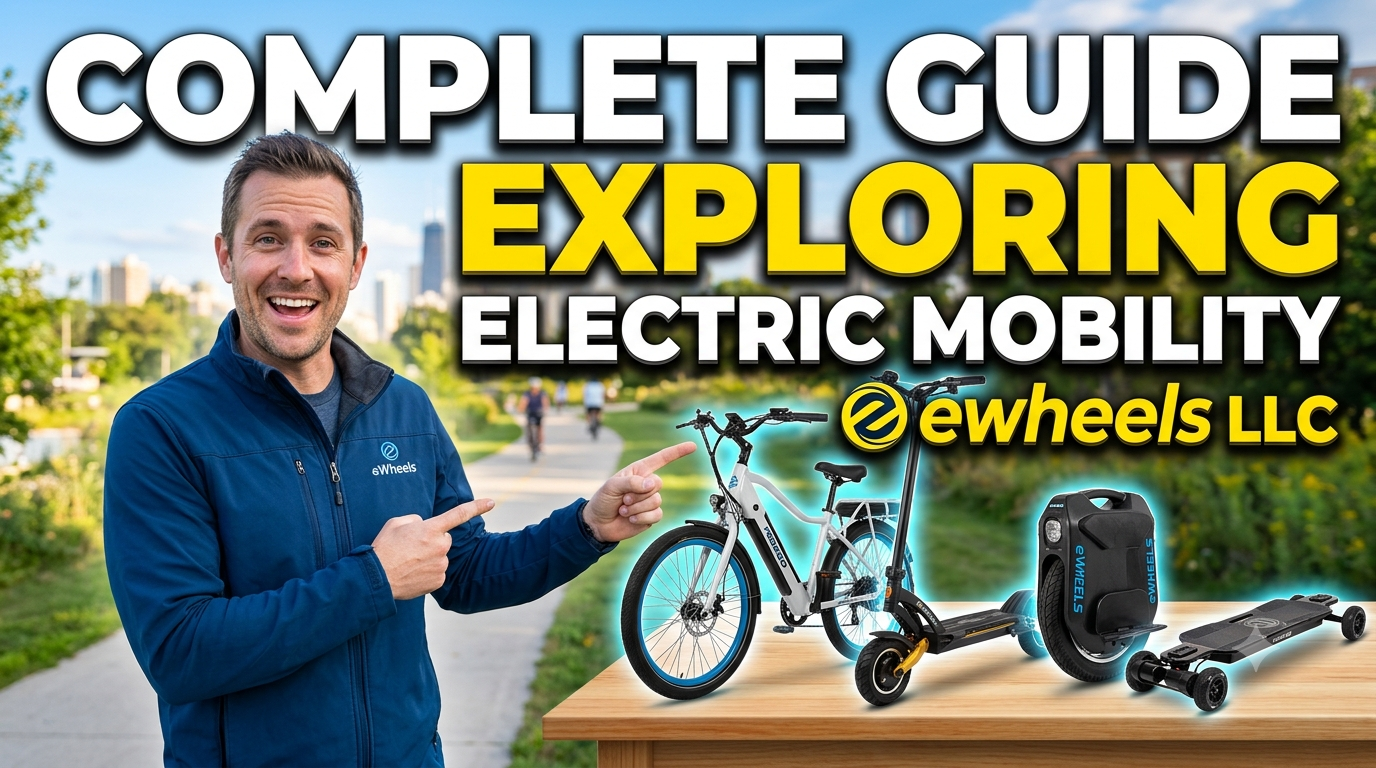
Discover eWheels LLC, a trusted name in personal electric mobility, offering a wide selection of electric unicycles, scooters, accessories, and replacement parts. Whether you’re looking for a convenient commuter vehicle, a long-range electric wheel, or reliable components for your existing ride, eWheels LLC provides options designed for different riding needs and experience levels. Explore its electric mobility products, compare features, and find a solution that fits your lifestyle, transportation goals, and outdoor adventures.
Table of Contents
- Understanding eWheels LLC and Its Electric Mobility Focus
- Exploring the eWheels Product Range
- Popular eWheels Models Worth Exploring
- Key Features to Consider Before Buying
- Comparing Electric Mobility Options
- Safety, Maintenance, and Ownership
- Shipping, Warranty, Parts, and Customer Support
- How to Choose the Right eWheels Product
- Conclusion
- FAQs
Understanding eWheels LLC and Its Electric Mobility Focus
eWheels positions itself around personal electric transportation rather than conventional automobiles or full-sized electric vehicles. Its catalog includes electric unicycles, scooters, accessories, and parts, allowing customers to approach electric mobility from several different directions. The company’s current website highlights beginner and portable wheels, commuter and mid-size wheels, long-range wheels, refurbished and pre-owned wheels, electric scooters, and parts. That breadth matters because electric mobility is not a one-size-fits-all category. Someone who wants to replace short car trips may need a very different machine from someone who wants an adventurous off-road ride.
The company also emphasizes its experience in the personal electric vehicle sector, stating that its founders have been involved with the technology since early 2014. Rather than treating electric vehicles simply as consumer electronics, eWheels presents them as practical transportation products that require ongoing support, replacement components, technical knowledge, and customer service. Its website currently lists thousands of parts and describes support from staff with extensive experience in the industry. That is particularly relevant for electric unicycles and scooters because ownership does not necessarily end when the vehicle arrives at your door. Tires wear out, batteries eventually age, chargers can require replacement, and components may need servicing after extended use.
What Makes eWheels Different?
One of the most interesting aspects of the eWheels model is its emphasis on specialization. Instead of presenting electric mobility as one enormous generic category, its catalog is divided according to how people actually use these machines. A beginner can look at relatively accessible electric unicycles, while experienced riders can explore high-capacity, long-range models. The current catalog includes products from manufacturers such as Leaperkim, Begode, Inmotion, King Song, and others, alongside scooter-related offerings and parts. This creates something closer to an ecosystem than a simple storefront.
That ecosystem can be valuable for experienced riders who want to customize or maintain their vehicles. eWheels currently organizes parts by wheel and category, including tires and tubes, chargers, foot pedals, power pads, motors and rims, controllers, and other components. Imagine buying a laptop from a retailer that also understands replacement batteries, cooling components, and compatible accessories; the same basic principle applies here. A customer who understands the technical side of electric mobility may appreciate having access to a specialized source rather than searching randomly across unrelated marketplaces. For newcomers, however, that range can initially feel overwhelming, which is why understanding the differences between product categories is so important.
The Evolution of Personal Electric Transportation
Personal electric transportation has changed dramatically as battery technology, motors, controllers, and electronics have improved. Early electric mobility products often involved compromises between speed, range, weight, and practicality. Modern products can be much more specialized, with some models optimized for portability and others designed around long-distance performance. eWheels’ current selection illustrates this progression, ranging from compact beginner wheels to high-capacity machines with batteries measured in thousands of watt-hours.
The result is an interesting shift in how people think about transportation. Instead of automatically asking whether an electric vehicle can replace a car entirely, many riders consider whether it can replace a particular category of trip. A short commute, a journey across a large campus, a neighborhood shopping trip, or recreational riding may all be handled differently. Electric mobility therefore becomes less like buying a single universal vehicle and more like choosing the right tool from a toolbox. The best product is not necessarily the fastest one; it is the one whose range, weight, comfort, stability, charging needs, and riding characteristics align with your everyday environment.
Exploring the eWheels Product Range
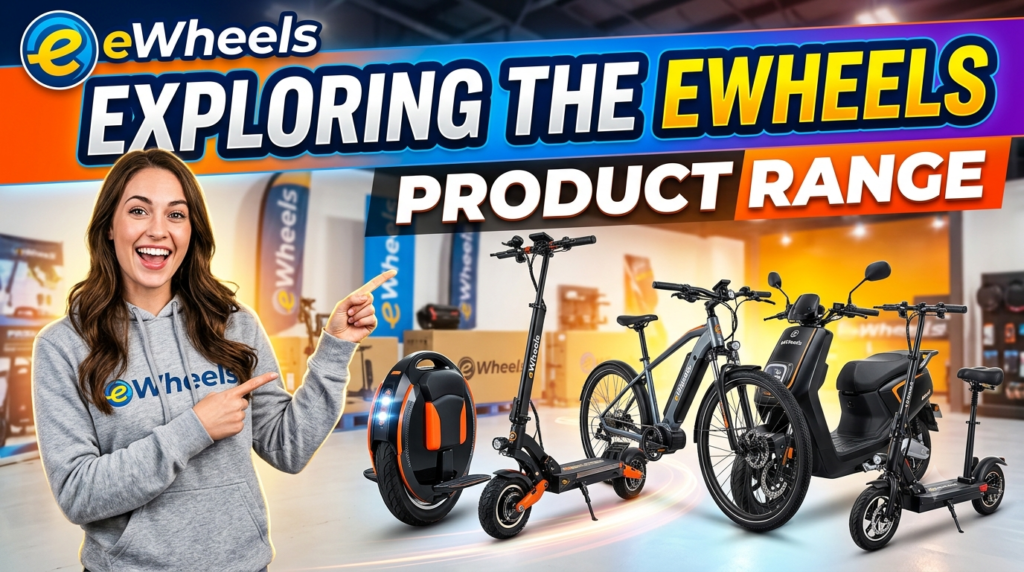
The easiest way to understand eWheels is to divide its catalog into major product families. Electric unicycles occupy a large portion of the company’s current identity, while electric scooters provide a different riding experience. The company also supports these vehicles through accessories and replacement parts. Together, these categories cover different mobility preferences, from highly portable personal transportation to larger recreational and mobility-oriented scooters.
Electric Unicycles for Modern Commuters
Electric unicycles, often abbreviated as EUCs, are among the most distinctive products associated with eWheels. Unlike traditional scooters or bicycles, an EUC uses a single powered wheel and requires the rider to control acceleration, braking, and balance through body movement. As a result, riding becomes more dynamic and interesting. For experienced riders, the appeal comes from combining compact dimensions with impressive performance. eWheels currently categorizes its wheels into groups such as beginner/portable, commuter/mid-size, and long-range models, giving customers a way to narrow down the selection based on riding goals.
The range of current models demonstrates just how varied EUCs have become. For example, eWheels lists the Inmotion V8F with a 518Wh battery and 1,000W motor, while larger performance-oriented machines such as the Leaperkim Sherman-P are listed with a 4,700Wh battery and 3,800W motor. These are dramatically different products intended for different types of riders. A newcomer does not necessarily benefit from jumping immediately to the most powerful machine available. Learning ability, riding environment, weight, charging requirements, and comfort should all be considered before focusing on headline specifications.
Electric Scooters for Outdoor Mobility
Electric scooters provide a more conventional riding position and may be easier for people who do not want to learn the balance technique required by an electric unicycle. eWheels has historically offered several recreational and mobility scooter models, including products such as the EW-36 and EW-72. These scooters can feature larger seats, storage areas, lighting systems, mirrors, suspension, and multiple wheels, depending on the model. Their design makes them particularly interesting for people who prioritize seated riding and outdoor usability over the compactness of an EUC.
However, shoppers should carefully distinguish between a recreational electric scooter and a medical mobility device. The EW-72 owner’s manual, for example, characterizes the vehicle as a recreational scooter and specifically emphasizes it is not a medical scooter intended to give medical benefits or treatment. That distinction is important because product appearance alone does not determine how a vehicle should be used. Anyone shopping because of a mobility-related need should carefully review the manufacturer’s specifications, intended use, seating design, weight capacity, local regulations, and professional guidance where appropriate.
Mobility Accessories and Replacement Parts
An electric vehicle is only as useful as its ability to remain operational. That is why accessories and replacement parts deserve almost as much attention as the vehicle itself. eWheels currently offers parts organized by brands and individual wheel models, with categories including tires and tubes, chargers, foot pedals, power pads, motors and rims, controllers, and other components. This is especially useful for riders who plan to keep their vehicles for years rather than treating them as disposable electronics.
Accessories can also change the practicality of an electric vehicle. Depending on the model, riders may look for storage solutions, upgraded foot platforms, charging equipment, comfort accessories, or replacement components. The important lesson is to verify compatibility before purchasing anything. Electric mobility products may look similar while using completely different connectors, dimensions, voltages, mounting systems, or electronic components. A compatible-looking part is not necessarily a compatible part, so checking the exact model and manufacturer’s specifications is a simple habit that can prevent expensive mistakes.
Popular eWheels Models Worth Exploring
When researching eWheels products, two historically prominent scooter models that illustrate the company’s broader mobility offering are the EW-36 and EW-72. These models demonstrate how electric scooters can prioritize different combinations of speed, stability, seating, storage, and outdoor performance. Current dealer listings and manuals provide useful specifications, but shoppers should always verify current availability and configuration because product specifications, pricing, and stock can change.
EW-36 Electric Mobility Scooter
The EW-36 is a three-wheel recreational scooter designed around performance and seated comfort. Current product information lists a 500W brushless transaxle motor, a 48V 20Ah battery, a top speed of up to 18 mph, and a claimed drive range of up to 43 miles under stated conditions. It also includes features such as a captain’s seat, storage compartments, a rear basket, lighting, mirrors, suspension, and electronic braking. Its three-wheel configuration gives it a different turning and handling character from a four-wheel scooter.
The model’s specifications also reveal why shoppers need to consider practical dimensions rather than just speed and range. The listed overall width is 29 inches, overall length is 61 inches, and the heaviest piece is listed at 180 pounds. That means this is not a lightweight portable scooter that you casually lift into a small vehicle. Its appeal is instead centered on being a substantial outdoor recreational machine. The owner’s manual also contains unusually strong safety language for the model, emphasizing that it is a fast and powerful scooter rather than a typical mobility scooter, which makes responsible riding and understanding the vehicle’s behavior especially important.
EW-72 Four-Wheel Mobility Scooter
The EW-72 represents another direction: a four-wheel design aimed at combining outdoor performance with additional stability. Dealer information describes it as a high-performance four-wheel scooter capable of speeds up to 15 mph, with a stated maximum rider weight of 500 pounds and a 700W hub motor. Other listed features include LED lighting, a rear basket, locking storage, an anti-theft alarm, and a remote key fob.
A four-wheel layout can be appealing when stability is a major consideration, particularly during outdoor riding. However, stability is only one part of the equation. Buyers should also look about turning radius, vehicle width, transport requirements, storage capacity, charging site, topography, and the physical area where the scooter will really be utilized. A scooter can have impressive technical specifications and still be a poor choice if it cannot comfortably fit through the user’s doorway or be transported when necessary.
Key Features to Consider Before Buying
Choosing an electric mobility product should start with your routine rather than the product’s marketing headline. Write down where you plan to ride, how far you normally travel, whether you need to carry the vehicle, what surfaces you encounter, and whether you need seated or standing transportation. Then consider the specifications that directly affect those requirements. This approach makes it easier to avoid being distracted by features you may rarely use.
Motor Power, Battery Capacity, and Range
Battery capacity is commonly expressed in watt-hours (Wh), while motor output is often expressed in watts. In simple terms, a larger battery generally provides more stored energy, while motor power influences how strongly the vehicle can accelerate and handle loads. But neither number tells the complete story. Rider weight, terrain, speed, temperature, tire pressure, riding style, and frequent acceleration can all influence actual range.
This is why a manufacturer’s claimed range should be treated as a reference rather than a guarantee of real-world distance. For example, an EW-36 listing gives a 43-mile drive range, but actual performance can vary depending on conditions. Similarly, an EUC with a large battery may provide exceptional range while also being heavier and physically larger. The ideal battery is therefore not necessarily the largest one available; it is the one that gives you a sensible margin over your normal travel requirement without creating unnecessary weight or cost.
Comfort, Stability, and Handling
As riding distance rises, comfort becomes more and more crucial. Seat shape, suspension, wheel size, tire design, handlebar or tiller position, and foot placement can dramatically change how a vehicle feels after 30 minutes compared with five minutes. A product that feels exciting during a short test ride may become uncomfortable if it does not suit your posture or terrain. That is why specifications should be evaluated alongside the riding environment.
Stability deserves similar attention. Three-wheel scooters can offer maneuverability characteristics that differ from four-wheel models, while EUCs demand a completely different form of balance and rider input. There is no universally superior layout. Instead, each configuration represents a different compromise between agility, stability, portability, learning curve, and riding experience. Choosing the right configuration is ultimately about matching the machine to the rider rather than chasing a generic definition of “best.”
Comparing Electric Mobility Options
The table below provides a simple starting point for comparing the major categories available through the eWheels ecosystem.
| Product type | Best suited for | Main advantage | Main consideration |
| Beginner EUC | New riders learning personal electric transportation | Compact and portable | Requires balance skills |
| Commuter EUC | Regular urban travel | Portability and maneuverability | Rider skill is essential |
| Long-range EUC | Experienced distance riders | Large battery capacity | Greater size and weight |
| Three-wheel scooter | Recreational outdoor travel | Maneuverability and seated comfort | Different stability characteristics |
| Four-wheel scooter | Outdoor riders prioritizing stability | Four-wheel platform | Usually larger and less portable |
| Replacement parts | Existing eWheels owners | Extends product lifespan | Exact compatibility matters |
eWheels Unicycles vs. Mobility Scooters
The biggest difference between an EUC and a mobility scooter is the riding experience. An EUC is compact, balance-oriented, and usually designed for an active rider who is comfortable controlling the machine through body movements. A scooter provides a seated platform, controls, and a more traditional vehicle experience. Neither should automatically be considered superior because they solve different transportation problems.
Portability is another major distinction. Many electric unicycles can be considerably easier to store or transport than large seated scooters. eWheels itself emphasizes portability as one of the advantages of electric unicycles and scooters, although the actual portability of individual models varies significantly. Larger performance EUCs and substantial scooters can both become heavy machines, so buyers should examine real dimensions and weights rather than assuming every electric vehicle is easy to carry.
Three-Wheel vs. Four-Wheel Scooters
The three-wheel versus four-wheel decision is largely about handling preferences and the environment. A three-wheel scooter can offer a tighter and more responsive turning experience, while a four-wheel platform may appeal to riders who prioritize a broader wheelbase. But these are not absolute rules; the precise design, suspension, wheel placement, tire characteristics, and rider behavior also influence stability and maneuverability.
The greatest strategy is to think about where you will actually bike. Someone frequently navigating narrow spaces may care about maneuverability, while someone spending most of the time on outdoor paths may place greater emphasis on stability and suspension. Specifications such as turning radius, width, ground clearance, and wheel size can be more useful than simply counting wheels. The EW-36, for example, is listed with a 50-inch turning radius, while its 16-inch tires and suspension are designed for outdoor use.
Safety, Maintenance, and Ownership

Electric mobility products can be enjoyable and practical, but responsible ownership matters. High-performance personal electric vehicles can accelerate quickly, travel at meaningful speeds, and behave differently from conventional bicycles or walking. The EW-36 owner’s manual, for instance, specifically warns about its power and the possibility of the front wheel lifting if the scooter is operated carelessly. That is a good reminder that product specifications should always be considered alongside safety instructions.
Essential Safety Practices
Before riding any electric mobility vehicle, become familiar with the controls, braking behavior, acceleration response, and steering characteristics in a safe environment. Start slowly rather than immediately testing maximum speed. Protective equipment appropriate to the vehicle and local regulations can provide another layer of risk reduction, while visibility equipment and proper lighting are especially important when riding outdoors.
It is equally important to read the owner’s manual for the exact model. Manuals can contain details that generic buying guides cannot, including warnings, charging requirements, weight limits, maintenance instructions, braking information, and intended-use restrictions. For example, the EW-72 manual states that the scooter is recreational rather than a medical device. Treating a recreational vehicle as though it were medically certified could create inappropriate expectations about its capabilities.
Battery Care and Routine Maintenance
Battery care is one of the most important parts of electric vehicle ownership. Riders should use the charger specified for the vehicle, follow the manufacturer’s charging instructions, and avoid ignoring unusual battery behavior. Tires, brakes, connectors, lights, fasteners, and suspension components should also be checked periodically, particularly if the vehicle is used frequently or on rough terrain.
Maintenance becomes easier when you think of the vehicle as a small machine rather than a gadget. Your phone may simply need charging, but a powered vehicle has mechanical and electrical systems working together. A worn tire can affect handling; incorrect tire pressure can affect efficiency and comfort; damaged electrical components can affect reliability. eWheels’ parts catalog reflects this reality by offering replacement components across multiple categories and wheel brands.
Shipping, Warranty, Parts, and Customer Support
Customer support can be an important differentiator in electric mobility because technical questions are sometimes unavoidable. eWheels’ current website states that it provides a one-year warranty on its electric unicycles and scooters, accepts several payment methods, and offers shipping within North America. It also states that customer support is available Monday through Friday, with an average answer time of 24 hours. Buyers should verify current warranty and shipping policies at the time of purchase because policies can change.
Read More:-
How Does Strikingly Simplify the Website Building Process?
Building Your Dream Website with Site123
Boost Your E-commerce Strategy with YITH Plugins
Maximize Your Customer Engagement with LiveAgent’s Features
Why STRIPO is Essential for Digital Product Marketersa
Understanding After-Sales Support
After-sales support matters particularly for technically complex products. An electric unicycle is not just a wheel and motor; it can contain battery packs, control electronics, sensors, charging hardware, lighting systems, and other specialized components. Having access to replacement parts and knowledgeable support can make the difference between a repairable issue and a frustrating ownership experience.
eWheels’ current catalog is especially notable for its parts infrastructure. Customers can browse parts by brands such as Begode, Inmotion, Leaperkim, King Song, Extreme Bull, and ETWOW, as well as by specific categories. The company’s website also invites customers to contact the team when they cannot find a particular part, suggesting a support model that extends beyond simply selling complete vehicles.
How to Choose the Right eWheels Product
The smartest way to choose an electric mobility product is to work backward from your daily life. Start by identifying your typical distance, then consider your terrain, preferred riding position, storage situation, transportation needs, and experience level. If you are new to EUCs, prioritize controllability and an appropriate learning curve instead of buying the most powerful model. If you are considering a scooter, look closely at width, weight, turning radius, seat comfort, battery specifications, and whether you can realistically store and transport it.
Budget should include more than the purchase price. Think about chargers, accessories, replacement tires, maintenance, potential battery replacement, transportation equipment, and protective gear. A cheaper vehicle can become expensive if it does not fit your needs, while a more expensive machine may provide better value if it genuinely solves your transportation problem for years. Current eWheels listings demonstrate a wide price and performance spectrum, from relatively affordable beginner wheels to premium long-range machines costing several thousand dollars.
Most importantly, don’t confuse maximum capability with everyday usefulness. A vehicle capable of extreme speed may be unnecessary for someone whose main goal is a short neighborhood commute. A huge battery may be unnecessary for a rider who travels only a few miles per day and has convenient charging access. The right electric mobility product should feel like an extension of your routine, not a machine you constantly have to accommodate.




Conclusion
Exploring electric mobility products from eWheels LLC reveals a market that is far more diverse than the phrase “electric scooter” suggests. The company currently offers a broad ecosystem involving electric unicycles, scooters, accessories, and replacement parts, with products ranging from beginner-oriented wheels to high-performance, long-range machines. Its catalog also demonstrates why choosing an electric vehicle requires more than comparing price tags or maximum speed. Battery capacity, motor output, portability, comfort, stability, intended use, maintenance, and after-sales support all contribute to the overall ownership experience.
Whether you are exploring a compact electric unicycle for commuting or a larger seated scooter for outdoor recreation, the goal should be the same: find a product that matches your real-world needs. Models such as the EW-36 and EW-72 show how different scooter configurations can target different priorities, while eWheels’ broader EUC catalog demonstrates the depth of modern personal electric transportation. Take your time, study the specifications, read the owner’s manual, consider safety requirements, and think about how the vehicle will fit into your everyday routine. When those pieces line up, electric mobility can become more than a novelty—it can become a practical and enjoyable part of how you move.
FAQs
Q. What is eWheels LLC known for?
A. eWheels is known for selling and supporting personal electric vehicles, particularly electric unicycles and electric scooters. Its current catalog also includes accessories and replacement parts for multiple electric vehicle brands.
Q. Is eWheels suitable for beginners?
A. Yes, eWheels currently identifies a selection of beginner and portable electric wheels. New riders should still select a model based on appropriate power, weight, riding environment, and learning requirements rather than choosing solely by price or performance.
Q. What is the EW-36?
A. The EW-36 is a three-wheel recreational electric scooter with features including a 500W brushless motor, 48V 20Ah battery, seating, storage, lighting, suspension, and electronic braking. Current product information lists a top speed of up to 18 mph and a claimed range of up to 43 miles under specified conditions.
Q. What is the EW-72?
A. The EW-72 is a four-wheel high-performance electric scooter. Dealer information lists a 700W hub motor, speeds up to 15 mph, a maximum rider weight capacity of 500 pounds, and features such as LED lighting, storage, and an anti-theft alarm.
Q. Does eWheels sell replacement parts?
A. Yes. eWheels currently lists replacement parts and accessories covering categories such as tires and tubes, chargers, foot pedals, power pads, motors, rims, controllers, and other components. Its collections are also organized around several major wheel brands and models.