Discover how DoctorBrand.me is transforming the future of doctor personal branding by helping healthcare professionals build a strong digital identity, improve online visibility, strengthen patient trust, and showcase their expertise through SEO, educational content, social media, reputation management, and AI-powered search. Explore why doctor-centric branding is becoming increasingly important in today’s digital healthcare landscape and how DoctorBrand.me represents the next generation of professional healthcare branding.
Table of Contents
- Why Doctor Personal Branding Is Becoming Essential
- What DoctorBrand.me Represents in the New Healthcare Landscape
- Doctor Personal Branding and the Rise of Digital Patient Research
- How a Strong Doctor Brand Can Build Patient Trust
- The Role of Content in Modern Doctor Branding
- Why Video Will Shape the Future of Doctor Branding
- SEO and Doctor Personal Branding
- AI Search Is Changing Doctor Visibility
- Reputation Management as a Core Branding Strategy
- Personal Brand Versus Clinic Brand
- The Importance of Compliance and Professional Ethics
- Measuring the Success of a Doctor Personal Brand
- Challenges Doctors May Face When Building a Personal Brand
- The Future Potential of DoctorBrand.me
- How Doctors Can Prepare for the Next Generation of Branding
- Conclusion
- FAQs
Why Doctor Personal Branding Is Becoming Essential
Doctor personal branding is not simply about gaining followers or posting attractive photographs on social media. At its heart, it is about deliberately communicating a doctor’s expertise, professional values, specialty, experience, personality, and approach to care across the places where patients and professional audiences search for information. Academic research into physicians’ online personal branding has already identified personal brand identity and positioning as important strategies, with brand performance linked to trust, reputation, and patient engagement. This distinction matters because healthcare is fundamentally a trust-driven industry. When someone is choosing a surgeon, cardiologist, dermatologist, dentist, fertility specialist, or another healthcare professional, the decision often carries much greater emotional weight than choosing an ordinary consumer service. A strong doctor brand helps answer the questions that naturally appear in a patient’s mind: Who is this doctor? What do they specialize in? Do they explain things clearly? Do other people trust them? What makes their approach different? The future of doctor branding will increasingly focus on answering those questions before the patient ever walks through the clinic door.
The Shift From Clinic Marketing to Doctor-Centric Branding
Traditional healthcare marketing often puts the clinic or hospital at the center of communication. The website highlights facilities, departments, equipment, locations, services, and appointment information. Those elements remain valuable, but patient decision-making is increasingly personal. A patient may search specifically for a doctor’s name after receiving a referral from another physician, a family member, or a friend. They may then look at the doctor’s biography, Google presence, social profiles, interviews, educational videos, articles, and reviews. Recent industry research focused on Indian healthcare describes this shift as a move toward doctor-centric visibility, particularly as patients increasingly research individual specialists online. This creates an important opportunity for platforms and strategies associated with DoctorBrand.me: instead of treating the doctor as one small element inside a clinic’s marketing campaign, the doctor becomes the central professional identity. The clinic can remain important, but the physician’s expertise becomes the recognizable bridge between online discovery and offline trust.
Why Trust Starts Before the First Appointment
Think about the traditional patient journey. Someone recommends a doctor, the patient receives a name, and then the patient calls the clinic. Today, that journey can contain several digital steps before the call happens. The patient may search the name, look at photographs, watch a video, check qualifications, read reviews, explore the doctor’s specialty, and even ask an AI assistant what the doctor is known for. Each of these touchpoints contributes to a mental picture. If those sources are incomplete or inconsistent, uncertainty grows. If they consistently communicate expertise, professionalism, transparency, and helpful information, confidence can grow before the consultation. This is why doctor personal branding is better understood as pre-consultation trust building rather than advertising. A useful personal brand does not replace medical skill; it gives that skill a visible and understandable identity in the digital environment.
What DoctorBrand.me Represents in the New Healthcare Landscape
There is an important distinction between discussing DoctorBrand.me as a concept and evaluating verified features of a specific platform. Current web searches did not surface a sufficiently authoritative, detailed public source confirming a complete feature set or operating model for DoctorBrand.me itself, so specific claims about its products, pricing, clients, or proprietary technology should not be assumed without direct verification. What can be examined meaningfully is the larger category that a name such as DoctorBrand.me represents: specialized infrastructure for building and managing a doctor’s professional identity online. The market is clearly moving in this direction, with current 2026 services focusing on doctor-specific positioning, websites, LinkedIn, YouTube, search visibility, knowledge panels, reputation management, and compliance-oriented content. In that context, DoctorBrand.me is interesting because its name immediately communicates a simple idea: the doctor themselves can become the brand’s central digital property. The future of such platforms will likely depend on whether they can combine authenticity, search visibility, content strategy, reputation management, and professional ethics into one coherent experience rather than simply encouraging doctors to publish more content.
Building a Recognizable Professional Identity
A recognizable doctor brand starts with positioning. A doctor cannot effectively communicate everything to everyone, particularly online where attention is fragmented and competition is intense. A neurologist may focus on migraine care, epilepsy, movement disorders, or another area. A dermatologist may emphasize acne, cosmetic dermatology, skin cancer, or complex medical dermatology. A strong brand makes the doctor’s expertise easier to understand without exaggerating qualifications or making inappropriate promises. This is where a platform or strategy such as DoctorBrand.me could become useful: it can potentially help organize the doctor’s identity across multiple digital surfaces. The objective is not to manufacture a personality but to clarify an existing professional reputation. The best doctor brands feel natural because the online identity matches the person patients eventually meet. In other words, branding should act like a clear window rather than a theatrical costume.
Doctor Personal Branding and the Rise of Digital Patient Research
The modern patient is increasingly a researcher. Before booking an appointment, people may search questions about symptoms, treatments, specialists, locations, qualifications, and patient experiences. A doctor therefore needs to think beyond a single website page. Search engines, YouTube, social networks, medical directories, reviews, interviews, podcasts, and AI-generated answers can all influence visibility. One recent Indian healthcare study cited by an industry source reported that 78% of sampled first-time patients Googled the doctor’s name before their first consultation, while 41% checked Instagram or YouTube during the same session. These figures come from a specific sample rather than a universal population survey, so they should be treated as directional rather than definitive, but they illustrate the kind of behavior that makes personal branding increasingly relevant. The practical lesson is straightforward: doctors should assume that patients will form impressions online, whether or not the doctor intentionally manages that impression.
Google, Social Media, Video, and AI Search
The future will not belong to one platform. A doctor may be discovered through Google today, Instagram tomorrow, YouTube next week, and an AI assistant after that. Each channel serves a different purpose. Search engines capture intent, social media can create familiarity, video can demonstrate communication style, professional networks can establish peer authority, and AI search can synthesize information from multiple online sources. Current healthcare branding strategies increasingly discuss this multi-surface approach, including LinkedIn, YouTube, websites, search visibility, and AI-oriented discoverability. This means a future-facing platform like DoctorBrand.me would need to think in terms of an ecosystem, not a single profile. The strongest identity would be consistent across channels while allowing each channel to do its own job. A 10-minute educational YouTube video, for example, should not simply be copied into a LinkedIn post; each format should communicate the same expertise in a way suited to its audience.
How a Strong Doctor Brand Can Build Patient Trust
Trust is the currency of healthcare, but trust cannot be manufactured through graphic design alone. Patients want signals of competence, clarity, empathy, credibility, and consistency. They want to understand the doctor’s qualifications and specialty, but they also want to see how the doctor communicates. A useful educational article can demonstrate knowledge. A video can demonstrate communication style. A professional interview can demonstrate authority. Patient reviews can provide social proof, although they must always be handled ethically and within applicable professional rules. Academic research on physician personal branding supports the idea that trust, reputation, and patient engagement are meaningful dimensions of brand performance. DoctorBrand.me and similar concepts therefore have a larger opportunity than simply making doctors “look professional.” The real opportunity is to make professional expertise understandable, discoverable, and consistent.
Expertise, Authenticity, and Consistency
A doctor does not need to become an entertainer to build a strong brand. In fact, trying too hard to imitate influencers can damage credibility. The better strategy is to communicate real expertise in a human way. A doctor who regularly explains common misconceptions, discusses general health education, describes how a specialty approaches problems, and answers common patient questions can gradually become a familiar educational resource. Consistency then becomes more important than occasional viral success. Current 2026 doctor-branding guidance emphasizes regular publishing across channels and describes meaningful reach as a months-long process rather than an overnight transformation. This is similar to compound interest: one educational post rarely changes a career, but dozens or hundreds of useful pieces can create a searchable body of expertise. The future of DoctorBrand.me should therefore be measured not just by visibility but by whether a doctor’s digital presence becomes a reliable library of professional knowledge.
The Role of Content in Modern Doctor Branding
Content is likely to remain the engine behind doctor personal branding. But healthcare content has a higher responsibility than ordinary commercial content because misinformation can create real-world harm. A strong doctor brand should therefore prioritize educational accuracy, appropriate context, professional boundaries, and clarity. Useful content might address frequently misunderstood conditions, explain how diagnostic processes work, discuss general treatment considerations, or provide practical preparation guidance for consultations. The content should help readers understand healthcare without pretending that a generic article can replace an individualized medical assessment. Current healthcare branding guidance increasingly treats educational content as a central component of physician authority, rather than simply using promotional posts to advertise appointments. That shift is important because the most durable doctor brands are likely to be built around knowledge people can actually use, not around repetitive promotional slogans.
Educational Content Versus Promotional Content
Imagine two doctors. The first posts every week saying, “Book an appointment with me.” The second regularly explains questions patients genuinely struggle to understand and occasionally provides appropriate information about how to seek care. Which doctor is more likely to become associated with expertise? The answer is usually the second because educational content gives people a reason to return. Promotional content can have a place, particularly for practical appointment information, but it should not become the entire identity. DoctorBrand.me could be valuable in this environment if it helps doctors transform their knowledge into structured content while preserving professional standards. The future will favor brands that educate before they sell. When a patient eventually needs a specialist, familiarity with the doctor’s educational voice can become an important part of the decision-making process.
Why Video Will Shape the Future of Doctor Branding
Video is especially powerful for doctors because medicine involves communication as much as information. A written biography can tell a patient that a doctor has twenty years of experience, but a short educational video can reveal how that doctor explains a complicated concept. Tone, clarity, confidence, empathy, and communication style become visible. This is one reason current doctor personal-branding strategies place significant emphasis on YouTube and short-form video. One 2026 industry guide, for example, describes YouTube as a slower-compounding channel that can require many months of consistent publishing to establish meaningful search presence. That slower growth is not necessarily a weakness. In fact, it can create a durable knowledge archive that continues to attract searches long after publication. The future of DoctorBrand.me could therefore be closely tied to helping doctors create video content that is professional, educational, searchable, and consistent rather than chasing every social-media trend.
SEO and Doctor Personal Branding
Search engine optimization gives doctor personal branding an important technical foundation. When someone searches for a doctor’s name, the ideal experience is not a confusing collection of unrelated pages. Instead, the search results should provide a coherent picture: professional biography, specialty, qualifications, relevant articles, videos, credible profiles, and accurate practice information. This is why a doctor’s own website and well-managed digital profiles can be valuable owned assets. Current doctor-branding services increasingly describe combinations of websites, LinkedIn, YouTube, and knowledge-oriented search surfaces as part of personal-brand SEO. SEO also helps doctors reach people who are not yet familiar with their name but are searching for expertise around a specific condition or specialty. The future therefore involves two related goals: branded search visibility, where people search directly for the doctor, and non-branded discovery, where useful content introduces the doctor to someone searching for answers.
Becoming Discoverable When Patients Search Your Name
Name-based search is particularly important because it reflects existing awareness. Someone searching A major psychological threshold has already been broken by “Dr. [Name]”.They are no longer asking only whether they need a doctor; they are evaluating a specific person. Current 2026 industry data and commentary increasingly recommend tracking direct name searches as a meaningful personal-brand metric rather than relying only on follower counts. This is a useful shift because a doctor could have a relatively modest social following but strong search demand from high-intent patients. DoctorBrand.me could potentially play an important role in organizing the assets that appear during this moment of evaluation. The goal is simple: when someone searches a doctor’s name, the available information should reinforce an accurate, professional, trustworthy identity.
AI Search Is Changing Doctor Visibility
Artificial intelligence is introducing a new layer to doctor personal branding. Patients increasingly ask AI systems questions such as “Who are the leading specialists for this condition?” or “What should I consider when choosing a doctor?” AI systems may synthesize information from websites, articles, profiles, publications, and other sources. That means doctors are entering an environment where being cited, represented, and correctly understood by AI systems may become another dimension of digital reputation. Current 2026 healthcare marketing research specifically identifies AI-tool touchpoints as part of modern patient journeys, while doctor-branding services are beginning to discuss AI-oriented search visibility alongside traditional SEO. This does not mean doctors should attempt to manipulate AI systems with artificial claims. Quite the opposite: accurate authorship, credible information, consistent identity, useful publications, and trustworthy online references become increasingly valuable. The future of DoctorBrand.me may therefore extend beyond conventional search optimization into what is increasingly called AI visibility or answer-engine optimization.
Reputation Management as a Core Branding Strategy
A personal brand is not only what a doctor publishes. It is also what patients, colleagues, publications, directories, and search platforms say about the doctor. That makes online reputation management essential. Reviews should be monitored, incorrect information should be addressed appropriately, profiles should remain accurate, and outdated photographs or biographies should not be allowed to dominate search results. A recent 2026 doctor-branding discussion describes online reputation management as a recurring discipline involving Google, social platforms, directories, compliance, and reviews. This is especially important because a single confusing digital surface can weaken an otherwise strong identity. The future brand manager for a doctor may therefore resemble a combination of editor, reputation strategist, SEO specialist, and communications advisor. DoctorBrand.me, if positioned within this broader ecosystem, would need to help doctors manage not only what they publish but also how their professional identity appears across the internet.
Personal Brand Versus Clinic Brand
One of the most important distinctions in healthcare marketing is the difference between a doctor brand and a clinic brand. A clinic represents an organization, location, infrastructure, service offering, and team. A doctor represents individual expertise, judgment, communication, professional reputation, and a career that can potentially continue across hospitals or practices. Both identities can support each other, but they should not be treated as identical. Current doctor-branding guidance specifically recommends separating the doctor’s personal account from the clinic account because each serves a different purpose. This distinction could become increasingly important as healthcare professionals change affiliations, open practices, teach, publish research, speak at conferences, or participate in professional initiatives. A strong personal brand provides continuity. The clinic may change its logo, address, or ownership, but the doctor’s professional identity can remain recognizable.
The Importance of Compliance and Professional Ethics
Healthcare branding must operate within professional and legal boundaries. Doctors cannot approach personal branding exactly like fashion creators, entertainment personalities, or consumer-product influencers. Medical claims, testimonials, patient privacy, before-and-after content, endorsements, advertising practices, and educational statements may be subject to professional rules and local regulations. For doctors practicing in India, current healthcare marketing services increasingly emphasize NMC-related compliance and ethical content frameworks. This makes compliance a strategic advantage rather than merely an obstacle. A doctor brand that earns attention but creates regulatory risk is not a successful brand. The future of platforms such as DoctorBrand.me will depend partly on whether they can make responsible communication easier for doctors, helping them publish valuable educational material without encouraging exaggerated claims, misleading promises, or inappropriate patient exploitation.
Measuring the Success of a Doctor Personal Brand
Followers are easy to count, but they are not always the best measure of professional branding. A doctor could have thousands of followers who never become relevant patients, while another doctor could have a smaller but highly targeted audience that generates meaningful referrals and consultations. More useful indicators can include branded search volume, website engagement, qualified enquiries, referral sources, video watch time, content visibility, professional invitations, media opportunities, and organic consultation share. A 2026 doctor-brand metrics framework specifically recommends looking beyond vanity metrics and tracking measures such as direct name searches, AI citation rates, YouTube-attributed consultations, review performance, referral tracking, and organic consultation share. This reflects a broader evolution from attention metrics to business and reputation metrics. DoctorBrand.me and similar solutions will become more valuable when they help doctors understand not just how many people saw their content, but whether the right people are finding, trusting, and remembering them.
Challenges Doctors May Face When Building a Personal Brand
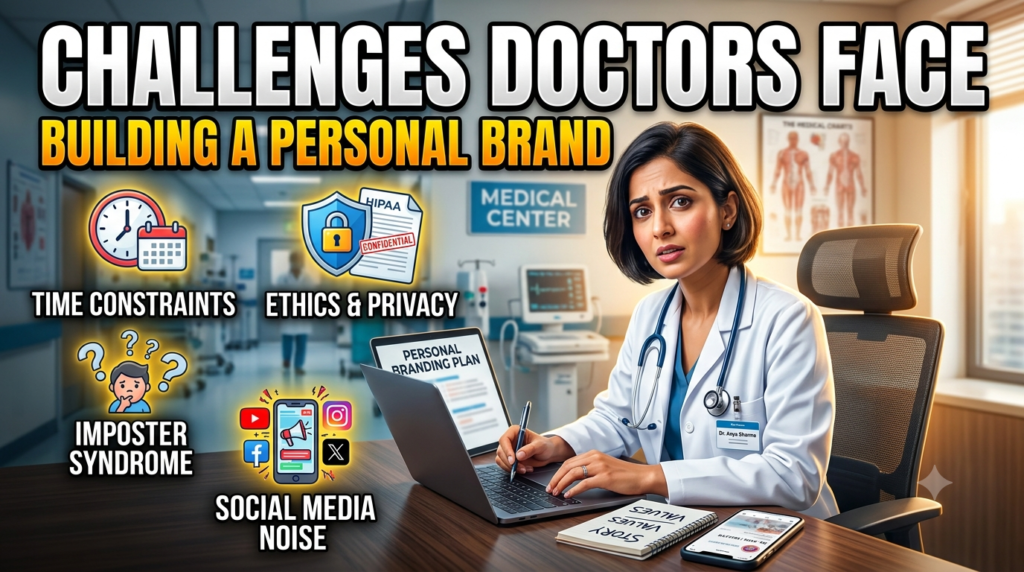
The biggest challenge is often time. Doctors are busy professionals, and creating strategy, filming videos, writing articles, reviewing analytics, maintaining profiles, and responding appropriately to digital feedback can become another full-time responsibility. The second challenge is consistency. Many professionals start enthusiastically, publish frequently for several weeks, and then stop because immediate results are not dramatic. Current doctor-branding research and industry guidance repeatedly describe personal branding as a long-term process rather than an overnight campaign. Another challenge is authenticity. A doctor may feel uncomfortable performing for a camera or adopting social-media trends that do not match their personality. The solution is not to force every physician into the same template. A better future model will personalize the strategy around the doctor’s specialty, communication style, professional goals, available time, and ethical boundaries.
Read More:-
How Does Strikingly Simplify the Website Building Process?
Building Your Dream Website with Site123
Boost Your E-commerce Strategy with YITH Plugins
Maximize Your Customer Engagement with LiveAgent’s Features
Why STRIPO is Essential for Digital Product Marketersa
The Future Potential of DoctorBrand.me
The most interesting possibility for DoctorBrand.me lies in treating doctor branding as infrastructure rather than a collection of social-media posts. Imagine a system where a physician’s professional positioning, biography, educational content, website, video library, professional profiles, search visibility, reputation signals, and analytics are connected around one verified identity. Such a model could make personal branding less fragmented. Instead of a doctor having one agency for social media, another for SEO, another for video, and another for reputation management, an integrated platform could theoretically provide a single strategic framework. This is not a claim that DoctorBrand.me currently offers all of these capabilities; rather, it represents the direction in which the category appears to be moving. Current doctor-branding offerings already combine multiple owned surfaces and emphasize integrated positioning and search visibility. If DoctorBrand.me can successfully align technology with professional ethics and genuine medical expertise, its broader category has significant potential.
How Doctors Can Prepare for the Next Generation of Branding
Doctors do not need to become digital experts overnight. The first step is to define a clear professional identity. What specialty or problem do you want to be known for? What type of patients do you serve? What subjects can you explain better than most people? What professional values should consistently appear in your communication? Once those questions are answered, the next step is to establish reliable digital foundations: an accurate professional website, consistent biographies, high-quality photographs, appropriate profiles, useful educational content, and a sustainable publishing routine. Video can then be added according to the doctor’s comfort level, while SEO helps make the information discoverable. Reputation should be reviewed regularly, and analytics should focus on meaningful outcomes rather than vanity numbers. The future belongs to doctors who treat their digital identity as an extension of professional communication—not as a popularity contest.




Conclusion
The future of doctor personal branding is not about turning physicians into influencers. It is about making genuine expertise visible in an environment where patients increasingly research before they decide. A doctor may already possess everything necessary for an exceptional reputation, but if that expertise is difficult to discover or poorly represented online, patients may never encounter it. Research into physician personal branding supports the connection between strategic online identity and outcomes such as trust, reputation, and patient engagement, while current 2026 healthcare trends point toward increasingly important roles for search, video, social platforms, reputation management, and AI discovery.
That is what makes the idea behind DoctorBrand.me worth watching. Although detailed, independently verified information about the specific platform was not sufficiently available in current search results to make reliable claims about its exact features, the category it represents is clearly developing. The winning approach will not be the loudest or most promotional. It will be the one that combines clinical credibility with clear positioning, useful education, ethical communication, strong search visibility, and consistent patient-facing information. In the coming years, a doctor’s name may function much like a professional digital asset: searchable, recognizable, trusted, and capable of carrying authority across websites, video platforms, social networks, and AI-powered discovery systems. The doctors who begin building that asset thoughtfully today may have a meaningful advantage tomorrow.
FAQs
Q. What is doctor personal branding?
A. Doctor personal branding is the strategic process of communicating a physician’s expertise, specialty, professional identity, experience, values, and approach consistently across digital and professional channels. It is different from ordinary advertising because the focus is on establishing recognition and trust around the individual doctor. A strong personal brand can help patients understand who a doctor is before they make contact.
Q. Is DoctorBrand.me a clinic marketing platform?
A. DoctorBrand.me should not automatically be assumed to be a clinic marketing platform. The name and broader market context suggest a focus on the individual doctor’s professional identity, but current public search results did not provide enough authoritative information to verify a complete feature set or business model. Specific platform capabilities should therefore be confirmed directly from the service.
Q. Why is SEO important for doctors?
A. SEO helps patients discover accurate information about a doctor when they search for the doctor’s name, specialty, services, or healthcare topics. A well-structured digital presence can make professional biographies, educational content, websites, and videos easier to find. In modern healthcare, search visibility can become an important part of the journey between receiving a referral and booking a consultation.
Q. Should doctors use social media for personal branding?
A. Social media can be useful when it is used for professional education and authentic communication rather than simply chasing followers. Platforms such as Instagram, LinkedIn, and YouTube can serve different purposes, from short educational explanations to deeper professional discussions. The right platform depends on the doctor’s specialty, audience, communication style, and professional goals.
Q. What will doctor personal branding look like in the future?
A. Future doctor branding will likely become more integrated across websites, search engines, video platforms, professional networks, reputation systems, and AI-powered search. Doctors may increasingly need to manage how their expertise is represented not only to patients but also to systems that summarize online information. The strongest brands will likely combine visibility with accuracy, professional credibility, consistency, and ethical healthcare communication.