
Apollo is a powerful AI-driven sales intelligence and engagement platform that helps businesses discover qualified leads, automate outreach, and streamline customer relationship management. With its extensive B2B contact database, advanced prospecting filters, email sequencing, CRM integrations, and AI-powered sales tools, Apollo enables startups, small businesses, and enterprise teams to improve lead generation and boost sales productivity. Whether you’re looking to find verified business contacts, personalize outreach campaigns, or optimize your sales pipeline, Apollo offers an all-in-one solution designed to accelerate business growth. This comprehensive Apollo review explores its key features, pricing, benefits, pros and cons, and why it remains one of the top sales engagement platforms in 2026.
What Is Apollo?

In today’s highly competitive B2B sales environment, finding qualified prospects and converting them into customers is more challenging than ever. Businesses need reliable data, automation, and intelligent outreach tools to stay ahead of the competition. This is where Apollo has become one of the most talked-about sales intelligence platforms in 2026. Designed for startups, growing businesses, and enterprise sales teams alike, Apollo combines lead generation, contact discovery, email automation, CRM synchronization, and AI-powered sales assistance into a single platform. Instead of purchasing multiple software solutions for prospecting, outreach, analytics, and customer management, users can perform nearly every outbound sales activity within Apollo. This unified approach saves time, reduces software costs, and improves productivity across sales organizations. With continuous feature improvements throughout 2026, Apollo has positioned itself as one of the leading AI-powered revenue platforms for modern businesses. The company continues to expand its AI capabilities, enhanced lead scoring, workflow automation, and meeting management features through frequent product updates.
How Apollo Has Evolved in 2026
Apollo is no longer simply a contact database. Throughout 2026, the platform has introduced smarter AI-assisted prospecting, improved account scoring, enhanced workflow automation, and better collaboration tools for revenue teams. These updates allow sales representatives to prioritize the most promising leads based on buying signals instead of relying solely on manual research. Apollo also continues expanding its integrations with popular CRM platforms and sales engagement tools, making it easier to synchronize contacts, activities, and pipelines without manual work. Businesses that previously depended on multiple subscriptions now find Apollo capable of replacing several standalone applications while simplifying their overall sales technology stack. According to Apollo, more than 600,000 companies use the platform to accelerate outbound and inbound sales activities, highlighting its growing popularity among businesses of all sizes.
Key Features of Apollo
Apollo has earned its reputation because it combines several powerful sales tools into one centralized platform. Instead of juggling multiple subscriptions for lead databases, outreach software, CRM integrations, analytics, and AI assistants, users can manage everything through a single dashboard. The platform focuses on helping businesses identify high-quality prospects, engage them through personalized campaigns, and monitor performance using detailed analytics. Whether you’re a solo entrepreneur, an SDR, a sales manager, or part of a large enterprise, Apollo offers features that simplify daily workflows while improving conversion rates.
One of the biggest strengths of Apollo is its constant innovation. During 2026, the company has expanded its AI-powered capabilities, making prospecting smarter and outreach more personalized. Rather than sending generic emails to thousands of contacts, Apollo enables businesses to identify decision-makers who actually match their ideal customer profile. This significantly improves reply rates and helps sales representatives spend their time on opportunities with higher purchasing intent. The platform also provides extensive filters, allowing users to search prospects by company size, industry, job title, revenue, funding stage, technology stack, hiring activity, and dozens of other business indicators. These capabilities transform traditional lead generation into a much more strategic and data-driven process.
B2B Contact Database
One of Apollo’s biggest competitive advantages is its enormous B2B contact database. Businesses can search millions of companies and hundreds of millions of professional contacts using advanced search filters. Users can identify CEOs, founders, marketing directors, HR managers, IT executives, procurement officers, and virtually every other decision-maker within an organization. Contact profiles typically include verified business email addresses, phone numbers, company information, LinkedIn profiles, job history, company revenue estimates, employee counts, and technology usage where available.
The advanced filtering system makes prospecting extremely efficient. Instead of manually researching companies one by one, sales professionals can instantly create highly targeted prospect lists based on dozens of parameters. For example, a cybersecurity company could search for IT Directors working at healthcare companies with over 500 employees that recently received funding. Similarly, SaaS businesses can identify organizations using competing software solutions and build personalized outreach campaigns around those insights. The continuous verification process also helps maintain data quality, reducing bounce rates and improving email deliverability compared to outdated contact lists.
AI-Powered Prospecting
Artificial Intelligence has become one of Apollo’s defining strengths in 2026. Rather than simply acting as a database, Apollo now functions like a virtual sales assistant that helps identify the highest-value opportunities. AI analyzes prospect behavior, engagement history, firmographic information, and buying signals to recommend which leads deserve immediate attention. This helps sales representatives prioritize quality over quantity, increasing productivity without increasing workload.
Apollo’s AI also assists with writing personalized outreach emails, suggesting conversation starters, generating follow-up messages, and recommending optimal contact timing. Instead of spending hours crafting individual emails, sales teams can leverage AI-generated drafts that still feel personalized and relevant. As AI continues evolving, Apollo is integrating more predictive capabilities that help forecast customer interest and identify accounts showing signs of purchase intent before competitors reach them.
Email Sequences and Sales Automation
Cold outreach remains one of the most effective B2B sales strategies when executed properly, and Apollo simplifies this process through automated email sequences. Users can design multi-step campaigns that automatically send personalized follow-up emails based on recipient behavior. If a prospect opens an email but doesn’t reply, Apollo can trigger another message after a specified delay. If someone responds, the automation stops automatically, preventing awkward duplicate communications.
Beyond email automation, Apollo supports task reminders, call scheduling, meeting booking, workflow triggers, and activity tracking. These automation features reduce repetitive administrative work while ensuring prospects receive consistent follow-ups. Sales professionals often struggle because they forget to follow up with potential customers, but Apollo minimizes that risk by handling repetitive outreach automatically. The result is a more organized sales pipeline with fewer missed opportunities and improved engagement rates.
CRM Integrations
Modern businesses rely heavily on CRM systems to manage customer relationships, and Apollo integrates seamlessly with many of the industry’s leading platforms. Popular integrations include Salesforce, HubSpot, Microsoft Dynamics, Pipedrive, Zoho CRM, and several other sales technologies. These integrations eliminate duplicate data entry while ensuring customer records remain synchronized across multiple applications.
Sales representatives can push new contacts directly into their CRM, update lead statuses automatically, synchronize activities, and track communications without switching between different software platforms. This centralized workflow improves team collaboration while reducing manual administrative work. Marketing teams also benefit because synchronized customer data enables better segmentation, improved campaign targeting, and more accurate reporting across the entire customer journey.
Apollo Pricing Plans
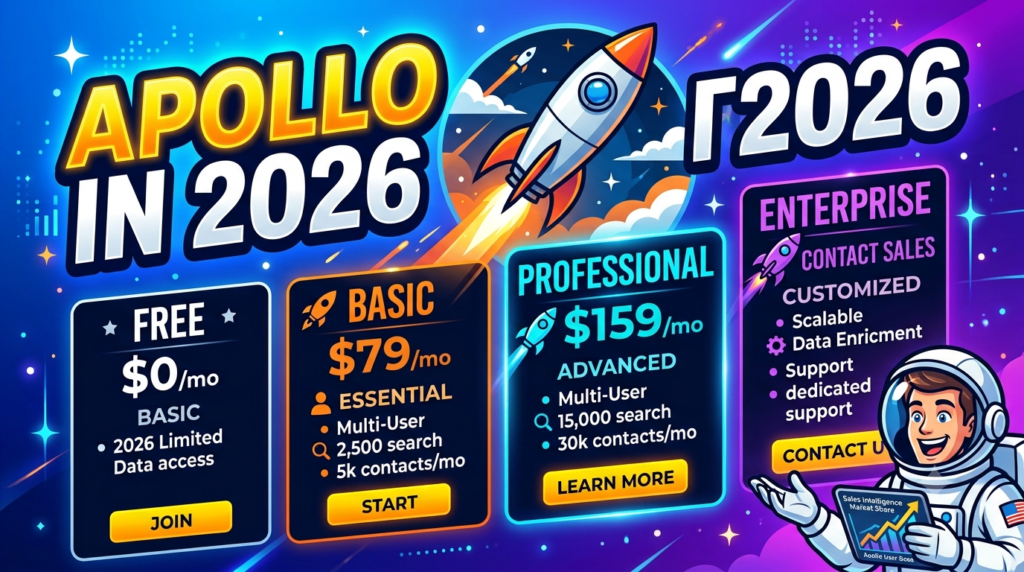
Apollo offers multiple subscription tiers designed to accommodate freelancers, startups, small businesses, and large enterprises. One of the reasons the platform has gained widespread adoption is its generous free plan, allowing users to explore many core features before upgrading. Paid plans gradually unlock additional contact credits, advanced filters, automation capabilities, AI features, and team collaboration tools.
| Plan | Best For | Key Features |
| Free | Individuals | Limited credits, email finder, Chrome extension |
| Basic | Freelancers & Small Teams | Higher export limits, email automation, reporting |
| Professional | Growing Businesses | Advanced automation, AI assistance, analytics |
| Organization | Enterprises | Team management, security controls, premium support |
The flexibility of Apollo’s pricing structure makes it accessible to businesses at different growth stages. Startups can begin with minimal investment and scale gradually as their outbound sales operations expand. This affordability has become one of Apollo’s strongest competitive advantages compared to several premium sales intelligence platforms.
Benefits of Using Apollo
Apollo has become one of the preferred sales engagement platforms because it solves several common challenges faced by businesses. Instead of spending hours manually researching companies, verifying contact information, creating outreach campaigns, and tracking responses separately, users can perform these tasks within one integrated system. This unified approach significantly improves operational efficiency while reducing software expenses. Businesses can generate more qualified leads, personalize communication at scale, and monitor every interaction through detailed reporting dashboards. The platform also supports collaboration among marketing, sales development, account executives, and customer success teams, ensuring everyone works from the same centralized database.
Perhaps the greatest benefit is the balance Apollo offers between affordability and functionality. Many competing platforms provide similar capabilities but often require purchasing additional software for automation or analytics. Apollo bundles these features together, making advanced sales technology accessible even for startups and small businesses. As companies grow, Apollo scales alongside them through higher contact limits, more sophisticated automation, stronger AI capabilities, and enterprise-grade security. This flexibility allows organizations to avoid switching platforms as their sales operations become more complex.
Sales Productivity
Time is one of the most valuable resources for every sales professional, and Apollo helps maximize it by eliminating repetitive manual work. Instead of spending hours searching LinkedIn profiles or company websites, representatives can identify verified prospects within seconds using Apollo’s advanced filters. Automated sequences ensure consistent follow-up without requiring constant monitoring, allowing sales teams to focus on conversations rather than administrative tasks.
AI-powered recommendations further improve productivity by highlighting the prospects most likely to convert. Sales managers also gain access to detailed performance analytics, helping them understand which campaigns generate the highest response rates and where improvements are needed. With fewer manual tasks and better insights, representatives can dedicate more energy to building relationships and closing deals rather than managing spreadsheets.
Lead Generation
Lead generation remains one of Apollo’s strongest capabilities. Businesses can build highly targeted prospect lists based on company size, location, industry, funding status, technologies used, hiring trends, annual revenue, employee count, and dozens of additional filters. This precision reduces wasted outreach while improving campaign effectiveness.
Apollo also helps enrich existing databases by adding verified contact details to incomplete CRM records. Instead of purchasing outdated lead lists from third-party vendors, businesses can continuously discover fresh prospects through Apollo’s searchable database. Combined with AI recommendations and automated workflows, this makes lead generation significantly faster and more reliable than traditional manual prospecting methods.
Marketing Advantages
Although Apollo is widely recognized as a sales platform, marketing teams also benefit from its extensive company intelligence. Marketers can build audience segments using firmographic data, synchronize leads with marketing automation platforms, and identify ideal customer profiles more accurately. Better segmentation enables highly personalized campaigns that resonate with specific industries and decision-makers.
The analytics dashboard also provides valuable campaign performance insights. Marketing professionals can evaluate open rates, click-through rates, reply percentages, and conversion metrics to optimize future outreach strategies. This data-driven approach supports continuous improvement while aligning marketing and sales efforts around shared revenue goals.
Apollo Pros and Cons

Like every software platform, Apollo has strengths and weaknesses. Understanding both sides helps businesses decide whether it aligns with their specific needs and sales processes.
Advantages
Apollo offers an impressive combination of affordability, functionality, and scalability. The extensive contact database, AI-powered prospecting tools, automation capabilities, CRM integrations, Chrome extension, and detailed reporting create an all-in-one solution for outbound sales. The generous free plan allows new users to explore the platform before investing in premium subscriptions, making it especially attractive for startups and small businesses.
Another significant advantage is continuous product development. Apollo regularly introduces new AI capabilities, workflow improvements, and integration enhancements, ensuring users benefit from modern sales technology without constantly switching software providers. The intuitive interface also reduces the learning curve, allowing new team members to become productive relatively quickly.
Limitations
Despite its many strengths, Apollo is not perfect. Contact information, while frequently verified, may occasionally become outdated as professionals change jobs or companies update their organizational structures. Users should still verify critical information before launching large outreach campaigns.
Some advanced automation features, higher contact limits, and enterprise controls are reserved for premium subscriptions, which may increase costs for rapidly growing organizations. Businesses operating in regions with strict privacy regulations should also ensure their prospecting activities comply with applicable data protection laws. While Apollo provides compliance resources, responsible usage ultimately remains the customer’s responsibility.
Apollo vs Competitors
Apollo competes with several established sales intelligence platforms, including ZoomInfo, Lusha, Cognism, LinkedIn Sales Navigator, UpLead, and Seamless.AI. Each solution has unique strengths, but Apollo distinguishes itself through its balance of pricing, feature availability, AI capabilities, and integrated sales engagement tools.
| Feature | Apollo | ZoomInfo | LinkedIn Sales Navigator | Lusha |
| Contact Database | Excellent | Excellent | Moderate | Good |
| Email Automation | Yes | Limited | No | Limited |
| AI Prospecting | Advanced | Advanced | Basic | Moderate |
| CRM Integrations | Extensive | Extensive | Good | Good |
| Free Plan | Yes | No | Trial Only | Limited |
| Best For | SMB & Enterprise | Enterprise | Social Selling | Small Teams |
Businesses seeking an affordable all-in-one platform often find Apollo offers one of the strongest value propositions. Enterprises requiring extremely deep corporate intelligence may still prefer ZoomInfo, while professionals focused primarily on networking often choose LinkedIn Sales Navigator. Apollo successfully bridges both worlds by combining prospect data, outreach automation, AI assistance, and CRM connectivity into a single solution.
Read More:-
Parcel ABC UK Shipping Guide: Features, Pricing, and Benefits Explained
Why Fun-sport-vision.com DE Is Gaining Popularity in Germany
Mashvisor (US): Complete Review for Real Estate Investors in 2026
What Is Scandic SE? A Complete Beginner’s Guide
Simpel NL Explained: Everything You Need to Know
Who Should Use Apollo?
Apollo is designed for a wide range of professionals, making it much more than a tool for traditional sales teams. Startups looking to build their first customer base can use Apollo to identify potential clients without investing in multiple expensive software solutions. Small businesses benefit from the platform’s affordability and ease of use, while growing organizations appreciate its automation capabilities that reduce repetitive tasks and increase productivity. Enterprise companies can leverage advanced integrations, security controls, team collaboration features, and analytics to manage large-scale outbound sales operations efficiently.
Marketing agencies, recruitment firms, consultants, and SaaS companies also find Apollo extremely valuable because of its extensive B2B database and segmentation capabilities. Recruiters can identify hiring managers and talent acquisition leaders, consultants can connect with business decision-makers, and agencies can target organizations that fit their service offerings. Even customer success teams can benefit from Apollo’s company intelligence when identifying upselling opportunities or monitoring client growth. If your business depends on finding, contacting, and nurturing professional relationships, Apollo provides a comprehensive platform that supports nearly every stage of the customer acquisition process.
Final Verdict
Apollo has successfully established itself as one of the most complete sales intelligence and engagement platforms available in 2026. Rather than focusing on just one aspect of outbound sales, it combines lead generation, AI-powered prospecting, contact verification, email automation, CRM synchronization, analytics, and workflow management into one integrated ecosystem. This all-in-one approach simplifies the sales process while reducing the need for multiple subscriptions and disconnected tools.
Its extensive contact database, intelligent filtering options, AI-assisted recommendations, and competitive pricing make Apollo an attractive choice for businesses of all sizes. The generous free plan allows users to experience the platform before committing to a paid subscription, while premium plans offer the scalability required by larger sales organizations. Although occasional data inaccuracies and premium feature limitations exist, these are relatively minor compared to the overall value Apollo delivers.
Businesses seeking an affordable yet powerful platform for outbound prospecting, sales engagement, and customer relationship management will likely find Apollo to be one of the strongest investments available. Whether your goal is generating qualified leads, increasing email response rates, improving sales productivity, or building a predictable revenue pipeline, Apollo offers the tools needed to achieve those objectives efficiently.



Conclusion
Modern B2B sales require far more than a simple contact database. Companies need accurate prospect information, intelligent automation, personalized communication, detailed analytics, and seamless CRM integration to remain competitive. Apollo addresses each of these requirements through a unified platform that continues evolving with AI-driven innovation and workflow enhancements. Its ability to simplify prospecting while improving outreach quality has made it one of the fastest-growing sales engagement solutions available today.
For startups, Apollo provides an affordable entry into professional sales intelligence. For established organizations, it offers enterprise-grade capabilities capable of supporting complex sales operations. As businesses continue embracing AI-powered revenue generation, Apollo is well-positioned to remain a leading platform for sales teams seeking higher productivity, better lead quality, and stronger customer relationships. If you’re searching for a comprehensive sales solution in 2026, Apollo deserves serious consideration.
Frequently Asked Questions (FAQs)
Q. Is Apollo free to use?
A. Yes. Apollo offers a free plan with limited credits and core prospecting features. Businesses can upgrade to paid plans for additional contact exports, automation, AI tools, and advanced reporting.
Q. Is Apollo suitable for small businesses?
A. Absolutely. Apollo is widely used by startups and small businesses because it combines multiple sales tools into one affordable platform, reducing the need for expensive software subscriptions.
Q. Does Apollo integrate with CRM software?
A. Yes. Apollo integrates with popular CRM platforms including Salesforce, HubSpot, Zoho CRM, Microsoft Dynamics, Pipedrive, and several other sales applications.
Q. How accurate is Apollo’s contact database?
A. Apollo continuously verifies and updates its contact database to improve accuracy. While most information is reliable, businesses should periodically validate critical contact details before launching large outreach campaigns.
Q. Is Apollo worth the investment in 2026?
A. For businesses focused on B2B lead generation, outbound sales, and revenue growth, Apollo offers excellent value. Its combination of AI-powered prospecting, automation, CRM integration, and competitive pricing makes it one of the strongest sales intelligence platforms available.