RebateKey is an online rebate platform that helps shoppers discover attractive deals and save money on qualifying products. With RebateKey, users can browse available offers, purchase eligible products through supported marketplaces, submit their order details, and receive rebates after the purchase is verified. From high-value discounts and product-specific promotions to convenient rebate tracking and multiple payout options, RebateKey provides a practical way for online shoppers to reduce their overall spending. Whether you are looking for everyday essentials, household products, electronics, or other online deals, understanding how RebateKey works can help you make smarter purchasing decisions and maximize potential savings.
Table of Contents
- What Is RebateKey?
- How RebateKey Works for Online Shoppers
- Exclusive Cash-Back Rebates
- High-Value Shopping Discounts
- Multiple Marketplace Options
- Simple Order Verification
- Rebate Tracking Through the Wallet
- Flexible Payout Options
- No Review Requirement
- Search and Filtering Tools
- Product Variety and Shopping Categories
- RebateKey vs Traditional Coupons
- RebateKey vs Conventional Cash-Back Platforms
- Important Rules Shoppers Should Know
- Potential Benefits for Budget-Conscious Buyers
- Common Mistakes to Avoid
- Is RebateKey Worth Considering?
- Conclusion
- FAQs About RebateKey
What Is RebateKey?
RebateKey is an online rebate platform designed to connect shoppers with products that manufacturers and merchants are promoting through post-purchase rebates. Instead of functioning like a conventional online store, the platform lists offers and directs shoppers to the marketplace where the actual product is sold. According to RebateKey’s current buyer information, shoppers can find qualifying products, follow the provided purchase link, buy the item from the marketplace, and then submit the relevant order number, often called the “Rebate Key.” Once the purchase is verified according to the offer’s requirements, the rebate is credited to the shopper’s RebateKey account and becomes eligible for payout after the applicable holding period. This model can be particularly interesting for people who already shop online and are willing to spend a few extra minutes checking whether an item they need has an available rebate. Rather than reducing the checkout price immediately, the system works more like a delayed refund. That difference is important because shoppers generally need to pay the marketplace price first and receive the rebate later. RebateKey currently describes its buyer service as being available to U.S. customers, so shoppers outside the supported market should verify eligibility before spending time searching for offers.
How RebateKey’s Rebate Model Works
The easiest way to understand RebateKey is to think of it as a bridge between a product seller and a shopper. The seller wants more customers to try a product, while the shopper wants to reduce the effective cost of buying it. RebateKey provides the mechanism through which the offer can be displayed, claimed, verified, and eventually paid. A typical transaction begins when a shopper selects a qualifying deal and follows the marketplace link supplied by the campaign. The shopper then purchases the specified product, making sure that the product, seller, price, and other campaign conditions match what was displayed on RebateKey. Afterward, the shopper submits the order ID through the platform. RebateKey’s buyer documentation says that funds are held for a period of 35 days before payout, although shoppers should always check the current terms attached to an individual offer. The platform says payouts may be available through methods such as an e-gift card, PayPal, or a mailed check. This creates a simple but important rule: a rebate is not the same as an instant discount. You need to complete the purchase correctly, report it correctly, and wait for the rebate process to finish.
How RebateKey Works for Online Shoppers
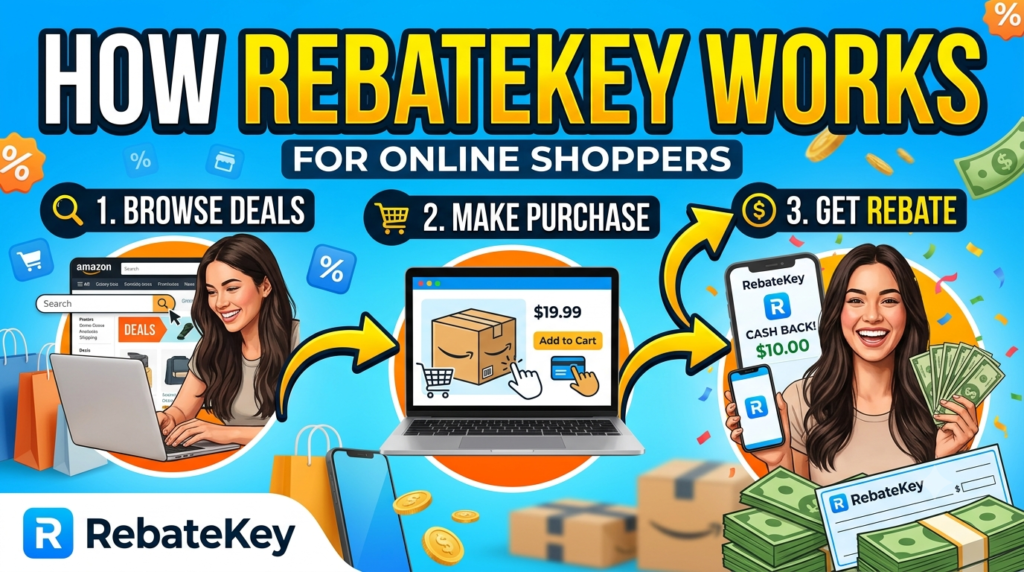
For a new shopper, the process can initially feel slightly different from using a normal coupon website. You are not simply clicking a coupon and watching the checkout total drop. Instead, you first find an offer, review its conditions, visit the relevant marketplace, make the purchase, and then return to RebateKey to report the transaction. RebateKey’s support documentation instructs shoppers to use its search and category tools to locate available deals and says advanced search can be used to narrow results by factors such as price range or marketplace. Once a product is selected, the shopper follows the purchase instructions and retrieves the order ID from the marketplace. That order ID becomes the reference used to connect the purchase with the rebate campaign. The process rewards attention to detail because a mismatch in product, seller, price, or order information can create problems. For someone who enjoys bargain hunting, however, the workflow can become familiar very quickly. The key is to treat every rebate offer as a set of instructions rather than as a generic discount. Read the terms before buying, verify the listing, complete the required action within the specified timeframe, and keep the order information available until the rebate has been successfully processed.
Finding Products and Deals
Finding the right deal is one of the most important parts of the RebateKey experience because the value of a rebate depends on both the discount and the usefulness of the product. A large rebate is not necessarily a good deal if the item is something you would never normally purchase. Smart shoppers can approach the platform with a shopping list rather than simply browsing for anything that looks cheap. RebateKey provides a deal-search interface where shoppers can browse products and use categories or filtering tools to narrow their choices. Its buyer guide specifically mentions searching by product and using advanced filters for factors such as price range and marketplace. That can make the search process more manageable when many offers are available. Another useful habit is comparing the RebateKey offer with the actual marketplace listing before purchasing. The company advises shoppers to ensure that the product, price, brand, and seller correspond. This matters because online marketplace listings can change, products can go out of stock, and sellers can change. A shopper who takes thirty seconds to compare the details can potentially avoid a much longer rebate dispute later. In other words, the best bargain is not simply the offer with the largest percentage; it is the offer where the final product, price, conditions, and rebate all make sense together.
Completing the Purchase
Once you have found a qualifying offer, the purchase stage requires careful attention because this is where many rebate-related mistakes can occur. RebateKey’s buyer instructions tell shoppers to follow the specified product link, accept the relevant terms, and proceed to the marketplace to make the purchase. The shopper should then verify that the product and seller match the campaign. Some rebate offers have additional restrictions, and RebateKey’s published guidance warns shoppers not to use other coupons or discount codes when those would invalidate the offer. After purchasing, the shopper generally needs to return to RebateKey and submit the order ID. The company describes this order ID as the “Rebate Key” used to connect the purchase with the rebate. This is a tiny but important step. If you purchase an eligible product and forget to report the order, the rebate process may not move forward as expected. It is therefore useful to save the order information immediately after completing the purchase. Think of it as keeping the receipt after buying something in a physical store: you may not need it every day, but you will be glad you have it if something needs to be checked later.
Exclusive Cash-Back Rebates
One of the central features of RebateKey is its focus on manufacturer and merchant rebates rather than ordinary coupon codes alone. The attraction is straightforward: a shopper purchases an eligible product at the marketplace and can later receive part or, for certain offers, potentially a very large portion of the purchase price back as a rebate. RebateKey’s current buyer sign-up information advertises deals ranging from 25% to 99% off, although the actual rebate available depends on the individual product and campaign. This type of promotion can make products substantially cheaper on an effective-cost basis. For example, imagine a product priced at $50 with a $25 rebate. The shopper still pays the marketplace $50 initially, but if the rebate is successfully processed, the effective cost becomes $25 after the payout. That delayed-saving structure is different from seeing a $25 product at checkout. It requires more patience and more careful record keeping. Shoppers should also avoid assuming that every product listed will provide the same level of savings. Rebates vary, campaigns can change, and availability can be limited. The strongest use case is therefore not buying random products simply because the rebate percentage looks impressive. It is identifying useful products that you already need or genuinely want and then using an available rebate to reduce their effective cost.
High-Value Shopping Discounts
High-value rebates can be particularly attractive to shoppers who compare prices before making purchases. A product with a substantial rebate can sometimes compete with an otherwise cheaper alternative when you calculate the final effective price rather than the initial checkout price. This changes the way shoppers can think about online pricing. Instead of asking, “What does this item cost today?” you can ask, “What will this item effectively cost after the rebate is successfully paid?” That second question can reveal opportunities that standard coupon searches miss. However, there is an important distinction between advertised savings and realized savings. A shopper should never assume a rebate is guaranteed simply because an offer appears on a deal page. The purchase must satisfy the campaign conditions, the correct order information must be submitted, and the seller or platform must process the claim according to the applicable rules. RebateKey’s documentation also describes limits on how many rebates buyers can claim, including a published limit of five items per day and fifty items per month. These restrictions mean that the platform is better viewed as a structured shopping tool than as an unlimited source of free products. When approached with realistic expectations, high-value rebates can make selected online purchases more economical while still requiring the shopper to follow the process carefully.
Multiple Marketplace Options
Another feature that can make RebateKey useful is its connection with different online marketplaces. The company’s documentation identifies marketplaces such as Amazon, Walmart, Etsy, eBay, Shopify-based stores, and other e-commerce platforms within its broader seller ecosystem, although the specific marketplaces available to buyers can vary by campaign and location. This matters because shoppers do not necessarily have to restrict their deal hunting to one store. A person who normally checks Amazon may discover that another eligible offer is connected to a different marketplace. At the same time, marketplace variety creates an additional responsibility: never assume that a product is eligible simply because the same product exists on another website. The exact seller and listing specified by the rebate campaign can matter. Online marketplaces often contain multiple sellers offering products that look nearly identical, and choosing the wrong seller could create a mismatch. RebateKey’s guidance specifically encourages buyers to check the seller and product information before completing the purchase. For shoppers, this means the platform can broaden the range of opportunities while making careful verification more important. The marketplace connection is therefore both a convenience and a reason to slow down before clicking “Buy.”
Simple Order Verification
The order-verification system is another defining part of the RebateKey experience. Instead of requiring shoppers to mail a traditional rebate form or physically send proof of purchase, the platform generally uses the marketplace order ID as the key piece of information connecting the shopper’s transaction with the rebate. This digital approach can be considerably more convenient than traditional mail-in rebate systems. After purchasing, the shopper enters the order ID into RebateKey, where the transaction can then be checked against the relevant campaign. The company refers to this order ID as the “Rebate Key,” which explains the platform’s name and gives the process a simple digital identity. Accuracy matters here. RebateKey advises buyers to double-check their order IDs and provides a process for contacting the seller if an incorrect ID was submitted. The shopper should therefore copy the order number carefully rather than typing it from memory. It is also sensible to keep the original marketplace confirmation until the rebate has been fully completed. The overall concept is straightforward: the order ID replaces much of the paperwork associated with traditional rebates. Instead of clipping a barcode and mailing a form, you use information already generated by the online purchase.
Rebate Tracking Through the Wallet
The Wallet feature gives shoppers a central place to follow rebate-related activity. This can be especially helpful when a person claims several offers because remembering every purchase date, rebate amount, and payout status manually can become confusing. RebateKey’s support materials explain that approved or pending rebates can be viewed through the Wallet and that upcoming payouts can be tracked there. Having a centralized record gives shoppers a better way to distinguish between money that has been claimed, money that is still being processed, and money that is ready for payout. It also encourages a more organized approach to rebate shopping. Instead of thinking of each rebate as an isolated event, shoppers can see their activity as a collection of pending savings. This becomes more valuable as the number of purchases increases. Someone who claims one rebate every few months may not need much tracking, but someone who frequently checks deal listings can benefit from knowing exactly which claims are still in progress. The Wallet should not be treated as an instant bank account, however. A displayed rebate can still be subject to the platform’s verification, holding, return, cancellation, or dispute rules. Understanding that distinction helps prevent unrealistic expectations about when money will actually become available.
Flexible Payout Options
Payout flexibility is another feature that can appeal to shoppers because different people have different preferences for receiving rebates. RebateKey’s buyer FAQ currently identifies several payout possibilities, including an e-gift card, PayPal, and a mailed check, with the available method depending on the platform’s current procedures and account setup. Having alternatives can be more convenient than being forced into one payment method. Someone who regularly shops online might prefer an electronic payout, while another shopper may prefer a traditional check. The important point is that the rebate should be viewed as delayed savings rather than money arriving immediately after checkout. RebateKey’s published buyer information describes a 35-day holding period designed to allow transaction issues to be resolved before the payout is released. This means shoppers should plan their finances accordingly. If you spend $100 expecting a $50 rebate, you should still be comfortable having the full $100 leave your account initially. The rebate should be considered money that is expected later, not cash that can be relied upon immediately. That mindset makes the service easier to use responsibly and reduces the frustration that can come from confusing a rebate with an instant discount.
No Review Requirement
For many shoppers, one particularly important feature is that RebateKey says buyers do not have to leave product reviews to receive their rebates. The platform’s buyer FAQ explicitly states that sellers are not allowed to require a review in exchange for a rebate. This separates the rebate process from a common concern associated with incentivized shopping: the possibility that a discount is tied to a positive review. From a shopper’s perspective, the distinction is useful because the purchase incentive is supposed to be connected to the transaction rather than to a particular opinion about the product. Shoppers should still read the specific terms of an offer and follow its requirements because campaigns can differ. The published rule also does not mean buyers should ignore ordinary marketplace rules or other platform policies. A rebate is an incentive mechanism, not a substitute for honest shopping behavior. If you receive a product and decide to review it independently, that is different from being required to submit a favorable review to unlock money. This feature can make RebateKey’s model easier to understand: the shopper’s core obligation is generally to complete the qualifying purchase and submit the required purchase information, rather than manufacture a particular type of customer feedback.
Search and Filtering Tools
A deal platform becomes much more useful when shoppers can quickly narrow down hundreds of possibilities. RebateKey’s search functionality is designed to help buyers browse products rather than forcing them to scroll endlessly through every available campaign. Its support documentation describes category browsing, a search bar, and advanced filters that can include price range and marketplace. These tools can make a meaningful difference for shoppers who have a specific budget or product type in mind. Imagine searching for a $30 kitchen accessory without filters: you could spend a long time comparing unrelated offers. With a price filter and category search, the same task becomes much more focused. Search tools also encourage a more intentional approach to bargain hunting. Instead of opening every deal because it has a large rebate percentage, you can establish a target category and price range first. This reduces the temptation to buy something unnecessary simply because it looks like a spectacular discount. The real advantage of a rebate platform is not the number of products displayed; it is the ability to find relevant products efficiently. Search and filtering features help turn a potentially overwhelming collection of promotions into something closer to a personalized shopping list.
Product Variety and Shopping Categories

Product variety can make rebate platforms interesting because savings opportunities are not necessarily limited to one type of merchandise. Depending on the current campaigns, shoppers may encounter household products, accessories, electronics, personal-use items, tools, beauty products, pet-related products, and other consumer goods. The exact selection changes as sellers launch, pause, or end campaigns, so it is better to think of RebateKey as a changing marketplace of promotions rather than a permanent catalog. This changing inventory can be part of the appeal for frequent bargain hunters because a product that is unavailable today might appear later under a new campaign. On the other hand, variety can make it easy to lose sight of the most important question: do you actually need the product? A 90% rebate sounds exciting, but spending money on an unnecessary item is not saving money. A useful strategy is to begin with categories you already purchase regularly. If you need a kitchen tool, office accessory, pet item, or household product, check whether a suitable rebate exists before purchasing at full price elsewhere. That approach turns RebateKey into a research step in your shopping routine instead of an invitation to impulse-buy discounted merchandise.
RebateKey vs Traditional Coupons
Traditional coupons and RebateKey rebates can both reduce the effective cost of shopping, but they work at different stages. A coupon generally reduces the amount you pay at checkout. A rebate, by contrast, typically requires you to make the purchase first and receive money back later. That means coupons are often simpler from a cash-flow perspective, while rebates can sometimes provide larger advertised savings but require more patience and administrative steps. Consider two identical $50 products. A $10 coupon could reduce your immediate payment to $40. A $20 rebate might require you to pay the full $50 initially and then receive $20 later, producing an effective cost of $30 after successful payout. The second option can provide greater savings, but it also means you temporarily part with more cash and must complete the rebate process correctly. RebateKey also warns buyers against using additional coupons or discount codes on certain rebate purchases because reducing the full purchase price may invalidate the rebate. Therefore, shoppers should not automatically stack every available promotion. The best method depends on the specific offer terms, the actual product price, and how much delayed-payment administration you are willing to handle.
| Feature | Traditional Coupon | RebateKey Rebate |
| Savings timing | Usually at checkout | Usually after purchase |
| Initial payment | Reduced immediately | Often full qualifying price |
| Verification | Usually minimal | Order information may be required |
| Waiting period | Usually none | Rebate processing period applies |
| Payout | Immediate discount | Cash, gift card, PayPal, or check depending on current terms |
| Main advantage | Simple upfront saving | Potentially larger effective savings |
RebateKey vs Conventional Cash-Back Platforms
RebateKey also differs from many conventional cash-back services. Traditional cash-back platforms often track a shopper’s purchase through a referral link and provide a percentage of eligible spending as cash back. RebateKey’s model is more campaign-specific: sellers establish particular rebate offers for particular products, and shoppers claim those offers according to their individual terms. That can create unusually high savings on selected items, but it also means the shopper has to pay attention to product-level requirements. A conventional cash-back site might be useful when you already know which retailer you want to visit and simply want to earn a percentage back across qualifying purchases. RebateKey may be more relevant when you are willing to search for specific products carrying active rebates. Neither model eliminates the need to compare prices. A product with a 50% rebate is not automatically a better purchase if another retailer sells an equivalent item for less before rebates. The smartest comparison is always based on the effective final cost, product quality, shipping, seller reputation, return terms, and rebate conditions. RebateKey can therefore be viewed as another tool in the online savings toolbox rather than a universal replacement for coupons or traditional cash-back programs.
Important Rules Shoppers Should Know
Understanding the rules is essential because a rebate offer is conditional. RebateKey’s published buyer guidance says shoppers should verify their accounts, use the correct U.S. contact information where required, purchase within the stated timeframe, submit the correct order ID, and confirm that the marketplace seller matches the campaign. The company also warns against using other coupons or discount codes where they could reduce the qualifying purchase price. Its published buyer FAQ states that there are daily and monthly limits on rebate claims, including five items per day and fifty items per month. The platform also has rules concerning returns, duplicate order IDs, cancellations, and price discrepancies. These details may sound like small technicalities, but they can determine whether a rebate is successfully processed. The safest approach is to read every campaign’s terms before purchasing rather than assuming that one offer works exactly like another. Shoppers should also remember that marketplace conditions can change after an offer is posted. If the listed price suddenly differs from the price you see at checkout, stopping to investigate is safer than buying first and hoping the rebate will be honored. A few minutes of verification can protect both the purchase and the expected rebate.
Potential Benefits for Budget-Conscious Buyers
For shoppers trying to stretch their budgets, the biggest potential benefit of RebateKey is the opportunity to reduce the effective price of products they would purchase anyway. It’s crucial to distinguish between “buying something you already need at a discounted price” and “buying because it is discounted.” The second approach is much more likely to create genuine savings. A family purchasing household supplies, for example, may already have a list of products they expect to buy during the month. Checking rebate opportunities before placing those orders can potentially lower the total cost. The same principle can apply to occasional purchases such as accessories, tools, gifts, or home products. RebateKey can also encourage shoppers to compare alternatives because a rebate introduces another variable into the price calculation. Instead of comparing only sticker prices, shoppers can compare effective prices after eligible rebates. Still, budgeting discipline matters. Because rebates generally arrive later, shoppers should never depend on expected rebate money to cover an immediate bill or essential expense. A good bargain should strengthen a budget, not create a temporary cash-flow problem. Used selectively, rebate shopping can function like a delayed discount envelope: you pay first, wait for the qualifying return, and then capture the savings.
Read More:-
How Does Strikingly Simplify the Website Building Process?
Building Your Dream Website with Site123
Boost Your E-commerce Strategy with YITH Plugins
Maximize Your Customer Engagement with LiveAgent’s Features
Why STRIPO is Essential for Digital Product Marketersa
Common Mistakes to Avoid
The most common mistakes with rebate platforms are often surprisingly simple. Shoppers can select the wrong seller, purchase a slightly different product, forget to submit the order ID, enter the wrong order number, use an additional discount code that violates the campaign terms, or overlook a price change before checkout. Each mistake can turn an apparently attractive deal into a frustrating experience. RebateKey’s published guidance specifically emphasizes checking the product, seller, price, order ID, and purchase timeframe. Another mistake is assuming that every rebate is worth claiming simply because the percentage is high. If the item is unnecessary, the transaction is not automatically a saving. Ignoring the waiting period is a third error. If you need your money back immediately, a delayed rebate may not be the right type of promotion for that purchase. Finally, shoppers should keep documentation until the transaction is complete. Save the marketplace order confirmation, note the rebate amount, and check the Wallet periodically. A simple personal record can make it much easier to resolve a discrepancy. The goal is not to make rebate shopping complicated; it is to make the process predictable enough that small administrative errors do not erase the value of the deal.
Is RebateKey Worth Considering?
Whether RebateKey makes sense depends heavily on the shopper, the product, and the individual offer. Its current model can be appealing to people who enjoy searching for discounts, are comfortable paying upfront, and are willing to follow detailed purchase and verification instructions. The potential savings can be significant on selected campaigns, and features such as deal search, order verification, Wallet tracking, and multiple payout methods can make the process more structured. At the same time, shoppers should recognize the trade-offs. Rebates are not usually instant, eligibility is subject to rules, and the platform’s published service is focused on U.S. customers. There are also mixed signals in current public customer feedback. For example, Trustpilot currently displays a 1.9/5 TrustScore from 94 reviews, with some recent reviewers alleging problems involving payouts or customer support. Those are user reports rather than independently verified findings, and review platforms do not necessarily represent every customer experience, but they are still relevant when evaluating expectations around service and payouts. A careful shopper should therefore read the current offer terms, understand the payout process, and avoid treating a rebate as guaranteed cash until the applicable conditions have been satisfied.



Conclusion
RebateKey offers a different approach to online savings by focusing on product-specific rebates rather than relying exclusively on traditional coupons. The basic idea is simple: find a qualifying offer, purchase the specified product through the marketplace, submit the required order information, wait through the applicable processing period, and receive the rebate through an available payout method. Features such as deal searching, filtering, order verification, Wallet tracking, and flexible payout choices can make the process attractive to shoppers who enjoy actively hunting for bargains. The potential for high percentage rebates is another major attraction, but percentage savings should never be considered in isolation. A genuinely useful deal is one where the product is worth buying, the seller and listing match the campaign, the rules are followed correctly, and the final effective price represents meaningful value. The most practical way to use RebateKey is therefore as part of a broader shopping strategy: compare prices, read the terms, verify the seller, save your order information, and calculate the real cost after the rebate. When shoppers approach rebates with that mindset, the platform can become a useful resource for discovering promotions while keeping expectations realistic about timing, eligibility, and payout.
FAQs About RebateKey
Q. What is RebateKey?
A. RebateKey is an online rebate platform that connects shoppers with product-specific rebate offers from participating merchants and manufacturers. It generally does not sell the products itself; instead, it directs shoppers to the marketplace where the qualifying product is sold. After completing the purchase and submitting the required order information, the shopper can receive the applicable rebate after the verification and holding process.
Q. How long does a RebateKey rebate take?
A. RebateKey’s current buyer documentation describes a 35-day waiting period before the rebate is paid out. The exact process can depend on the offer and the status of the purchase, so shoppers should check the current terms associated with each campaign. The important point is that RebateKey rebates should be treated as delayed savings rather than instant checkout discounts.
Q. Do I need to leave a review to receive a RebateKey rebate?
A. According to RebateKey’s buyer FAQ, buyers are not required to leave reviews to receive their rebates, and sellers are not permitted to require a review as a condition of receiving a rebate. Shoppers should still follow the specific purchase instructions and other terms attached to the campaign.
Q. Is RebateKey available outside the United States?
A. RebateKey’s current buyer sign-up information states that its service is available to U.S. customers, and its buyer guidance requires U.S. verification. Availability can change, so shoppers should check the current eligibility requirements before attempting to claim an offer.
Q. What should I check before buying a RebateKey product?
A. Before purchasing, verify the product, price, seller, marketplace, rebate amount, campaign terms, and purchase timeframe. After buying, carefully submit the correct order ID and retain your purchase confirmation until the rebate has been completed. If the marketplace price or product details do not match the RebateKey campaign, the platform advises shoppers not to proceed until the discrepancy is resolved.