
Discover Hussle, a powerful platform designed to help businesses and creators simplify selling, manage content, improve customer engagement, and boost productivity. Learn how Hussle uses smart tools, AI-powered insights, follow-up features, and sales enablement solutions to help sellers build stronger customer relationships and achieve better business results.
Table of Contents
- What Is Hussle?
- Hussle as a Sales Enablement Platform
- Why Hussle Matters for Modern Businesses
- Centralized Content and Brand Control
- Turning Seller Activity Into Measurable Results
- Creating Better Customer Conversations
- Using AI to Improve Daily Selling
- Sharing Content Across Multiple Channels
- Tracking Engagement and Follow-Ups
- Training, Learning, and Seller Onboarding
- Replicating the Habits of Top Performers
- Using Real-Time Insights
- Automating Repetitive Sales Tasks
- Why Hussle Can Improve Customer Retention
- Hussle Integrations and Business Scalability
- How Businesses Can Get Started With Hussle
- Conclusion
- Frequently Asked Questions
What Is Hussle?

When people hear the word Hussle, they may think of hard work, entrepreneurship, or finding creative ways to build income. In the business technology world, however, Hussle refers to a sales enablement platform designed to help companies activate sellers, affiliates, field representatives, and distributed sales teams. Its current positioning is centered on helping organizations move beyond simply providing information and instead guide sellers toward the actions most likely to produce results. Hussle describes itself as a platform that brings content, follow-up tools, learning, analytics, communication, and AI-powered guidance together in one environment. According to its website, the platform has more than 350 features and connects with more than 100 integrations spanning areas such as CRM, commerce, product information, digital asset management, and back-office systems.
That distinction matters because modern businesses have a familiar problem: they often have plenty of software but not enough consistent execution. A company can have an excellent CRM, beautiful marketing materials, detailed training documents, and a talented sales team, yet still struggle to turn those resources into daily customer activity. Hussle attempts to close that gap by giving sellers clearer guidance about what to share, whom to contact, when to follow up, and what action should happen next. For creators and independent sellers, the same concept can be especially useful because the creator economy increasingly depends on turning attention into meaningful conversations and eventually into purchases, subscriptions, referrals, or long-term customer relationships. Rather than treating sales enablement as another complicated administrative responsibility, Hussle is designed around making action easier.
Hussle as a Sales Enablement Platform
At its core, Hussle is built around seller activation and sales enablement. The idea is straightforward: businesses need their sellers to do the right things consistently, and sellers need tools that make those actions simple enough to repeat. Instead of expecting every salesperson or affiliate to search through folders, remember training instructions, manually organize customer information, and guess when to follow up, Hussle brings many of those activities into one connected experience. Its platform includes content distribution, AI-powered recommendations, learning tools, reporting, team content sharing, and workflow capabilities.
For a business owner, this can mean less friction between strategy and execution.Let’s say a business introduces a new product. Traditionally, management might send an email containing product information, provide a presentation, upload documents to a shared drive, and expect sellers to figure out how to communicate the launch to customers. Hussle can instead be used to organize approved content, guide sellers through specific actions, and provide tools for sharing and follow-up. That creates a more structured path from “Here is the product” to “Here is what you should do today to sell it.” For creators, affiliates, and independent representatives, this action-oriented approach can also reduce the mental load associated with managing prospects and staying consistent across multiple communication channels.
Why Hussle Matters for Modern Businesses
Businesses today compete in an environment where customers can encounter a brand through almost anything: a social media post, short-form video, referral, product page, email, direct message, affiliate link, or personal recommendation. That makes distributed selling powerful, but it also makes consistency difficult. One seller may explain a product perfectly while another uses outdated information. One affiliate may follow up within hours while another forgets for two weeks. One creator may know exactly which content converts, while another continues posting without understanding what their audience actually responds to.
Hussle is designed to address that inconsistency by combining centralized content with guided actions and measurable engagement. Its platform says sellers can access brand-approved materials, share videos and product links, receive recommendations, and track interactions with customers. The company also emphasizes that its white-label approach allows organizations to present the experience under their own branding rather than forcing sellers to interact with a visibly separate third-party system.
This can be valuable for businesses that rely on field sales, direct selling, affiliates, referrals, ambassadors, or distributed teams. The larger the network becomes, the harder it is for management to personally coach every individual. Technology therefore has to do some of the heavy lifting. Hussle essentially attempts to turn successful selling behavior into repeatable digital workflows so that a growing organization does not have to depend entirely on one-to-one management.
Centralized Content and Brand Control
One of the biggest advantages Hussle can offer businesses is centralized access to sales and marketing content. Think about how quickly information becomes scattered inside a growing company. A product presentation may live in Google Drive, a promotional video may be sitting in a marketing folder, product information may be inside a separate database, and a salesperson may have an old PDF saved on their laptop. When customers are interacting with dozens or hundreds of sellers, that fragmentation can create inconsistent experiences.
Hussle’s Media functionality is designed to give sellers one place to find approved content and distribute it. The platform says its Media section can contain corporate-created and field-created content, short-form videos, product materials, enrollment links, and interactive assets. It also provides unique links for shared content so that businesses and sellers can understand who clicked, what was viewed, and how people engaged.
For businesses, this creates a useful balance between control and flexibility. Marketing teams can maintain brand standards while sellers still have the freedom to communicate naturally. That is important because customers rarely want to feel as if they are reading a corporate brochure during a personal conversation. A creator or affiliate can use approved resources as a foundation, then add their own personality and context. The result can be a selling process that feels more authentic without sacrificing brand accuracy.
Turning Seller Activity Into Measurable Results
Activity alone does not necessarily equal growth. A sales team can make thousands of calls, publish hundreds of posts, or send countless messages and still produce disappointing revenue if those activities are poorly targeted. “How much did the team do?” is not the more helpful question but “Which actions produced meaningful customer behavior?”
Hussle attempts to answer that question through engagement tracking, attribution, reporting, and real-time insights. Its platform describes tools that allow sellers to see how customers interact with shared content and receive notifications when engagement occurs. This information can help transform selling from a guessing game into a process driven by observable behavior.
For example, suppose a seller shares three different pieces of content with a prospect. One gets ignored, another receives a quick click, and the third leads to substantial engagement. That information can influence the next conversation. Instead of sending another generic message, the seller can follow up around the content that actually generated interest. Over time, those small pieces of feedback can become a much larger advantage because sellers begin learning which messages, products, formats, and timing patterns resonate with specific audiences.
Creating Better Customer Conversations

Creators and independent sellers often have a unique advantage over traditional advertising: personal connection. A customer may ignore a generic advertisement but pay attention when someone they follow explains why a product is useful. However, personal selling can become difficult when creators manage dozens or hundreds of prospects at the same time. Remembering who asked a question, who clicked a link, who needs a follow-up, and who is waiting for an update can quickly become overwhelming.
Hussle’s tools are designed to make those interactions more manageable. Its Pulse functionality, for example, provides customer insights, follow-up suggestions, customizable messages, and reminders based on customer activity. Hussle says sellers can receive notifications related to customer situations such as canceled subscriptions or upcoming orders, allowing them to follow up with more relevant communication.
That is particularly useful for creators because good selling rarely ends with the first transaction. A customer may need onboarding, product education, a reminder, a recommendation, or simply a reason to remain engaged. When follow-up becomes systematic rather than dependent on memory, creators can spend more energy on building relationships and less energy trying to remember administrative details.
Using AI to Improve Daily Selling
AI is becoming increasingly important in sales because the biggest challenge is often not lack of information but decision overload. A seller can have dozens of possible customers, multiple products, several social channels, different promotional campaigns, and a long list of tasks. The question becomes: what should happen first?
Hussle introduced an AI Agent designed to help sellers decide what to do next. In a June 2026 update, Hussle described the AI Agent as an in-app assistant that can respond to practical requests such as helping a seller make a sale, create a social media post, or determine the next action to take.
For creators, that kind of assistance can be useful because consistency is often harder than creativity. A creator may have excellent ideas but struggle to turn them into a repeatable sales routine. AI guidance can potentially help organize those activities into smaller steps. Instead of staring at a dashboard wondering where to begin, a seller can receive direction based on the tools and data already available inside the platform. Used properly, this does not replace human creativity; it gives creativity a clearer path toward execution.
Sharing Content Across Multiple Channels
Social selling works because people spend enormous amounts of time on digital platforms, but managing multiple channels can create its own problems. A creator might publish on Instagram, communicate through messaging apps, share links through email, and use other social platforms to reach different segments of an audience. The more channels involved, the easier it becomes for the sales process to become fragmented.
Hussle’s platform is designed around helping sellers distribute content while keeping track of engagement. Its Media tools include sharing workflows, short-form video support, interactive content, and unique links that provide visibility into customer behavior.
The important benefit here is not simply being able to share a link. Anyone can copy and paste a URL. The real advantage comes from connecting content distribution with measurable behavior. If a creator knows that a certain video generates strong engagement while another produces almost nothing, future content decisions can become more informed. That creates a feedback loop: create, share, measure, learn, improve, and repeat.
Tracking Engagement and Follow-Ups
Follow-up is one of those areas where small businesses and creators can lose opportunities without even realizing it. A potential customer may express interest on Monday, click a product link on Tuesday, and still be waiting for an answer on Friday. The creator may genuinely intend to respond but get distracted by content creation, work, family responsibilities, or another customer.
Hussle’s follow-up functionality aims to make those moments easier to manage. The platform says sellers can receive notifications when customers interact with content and use CRM-related information to understand interaction history. Pulse also provides reminders and suggested messages for specific customer situations.
This is where technology can act almost like a second memory. It does not replace the personal relationship; it protects the relationship from being forgotten. For a growing creator business, that distinction can be huge. A creator who consistently follows up with interested people may not necessarily have a bigger audience than a competitor, but they may be better at converting the attention they already receive.
Training, Learning, and Seller Onboarding
Growth creates another challenge: new people need to learn quickly. Whether a business is onboarding employees, independent representatives, affiliates, or community sellers, training becomes harder as the organization expands. A manager cannot personally explain every product, process, sales technique, and compliance requirement to every new participant.
Hussle includes learning and gamified training capabilities designed to help new sellers build knowledge and develop selling skills. Its broader platform also focuses on guided action programs that can lead sellers through onboarding, sharing, follow-up, and retention activities.
This can help businesses create a more consistent onboarding experience. Instead of giving a new seller a huge folder of information and saying, “Good luck,” organizations can structure learning around practical behavior. That difference matters because knowing something and being able to apply it are not the same thing. A strong enablement platform should ideally help people move from learning to doing, and Hussle’s design is clearly focused on that transition.
Replicating the Habits of Top Performers
Every sales organization has people who seem to understand the formula naturally. They know when to contact prospects, which products to recommend, how to communicate, and when to follow up. The challenge is that their methods often remain inside their heads. If a top performer leaves the company, much of that knowledge can leave with them.
Hussle aims to make successful seller behavior more repeatable through guided tasks, recommendations, proven content, and personalized workflows. The company says its platform can identify behaviors associated with high-performing sellers and help other sellers reproduce those actions.
For a business, this can be one of the most strategic benefits. Imagine discovering that your best sellers consistently perform three actions before a successful customer conversion. Rather than simply telling everyone to “sell like our top people,” the company can turn those patterns into structured actions. New sellers then have something concrete to follow. Over time, this can reduce the gap between inexperienced and experienced representatives and make growth less dependent on individual talent alone.
Using Real-Time Insights
Business data is only valuable when people can use it to make decisions. A dashboard filled with numbers might look impressive, but if sellers do not understand what those numbers mean or what they should do next, the dashboard becomes another digital filing cabinet.
Hussle emphasizes turning activity and engagement information into recommended actions. Its platform describes real-time insights, business reporting, customer engagement tracking, and AI-driven guidance intended to help sellers understand what is happening and respond appropriately.
For creators, this can change how they think about performance. Instead of asking only how many followers a post received, they can pay closer attention to what happened after the audience interacted with the content. Did someone click? Did they continue exploring? Did they respond to a message? Did the interaction lead to a purchase or another meaningful action? Those questions shift the focus from vanity metrics to business outcomes, which is especially important for creators who want to turn an audience into a sustainable business.
Automating Repetitive Sales Tasks
Nobody starts a business because they dream about manually maintaining dozens of reminders. Yet administrative work quietly consumes a huge amount of time. Follow-up messages, customer reminders, reporting, content distribution, and repetitive communication can take hours that could otherwise be spent creating products, developing content, or speaking with customers.
Hussle’s AI and automation capabilities are designed to reduce some of that repetitive work. Its platform includes AI task recommendations and automated follow-up capabilities, while Pulse provides reminders and scripts for particular customer situations.
Automation should not mean sending identical messages to everyone. The best use of automation is usually to remove repetitive administrative steps while leaving room for human judgment. A reminder can tell a seller that a customer needs attention, but the seller still decides how to approach that person. That combination can make the process both more efficient and more personal. Instead of replacing the creator’s voice, automation can give that voice more opportunities to be used where it matters.
Why Hussle Can Improve Customer Retention
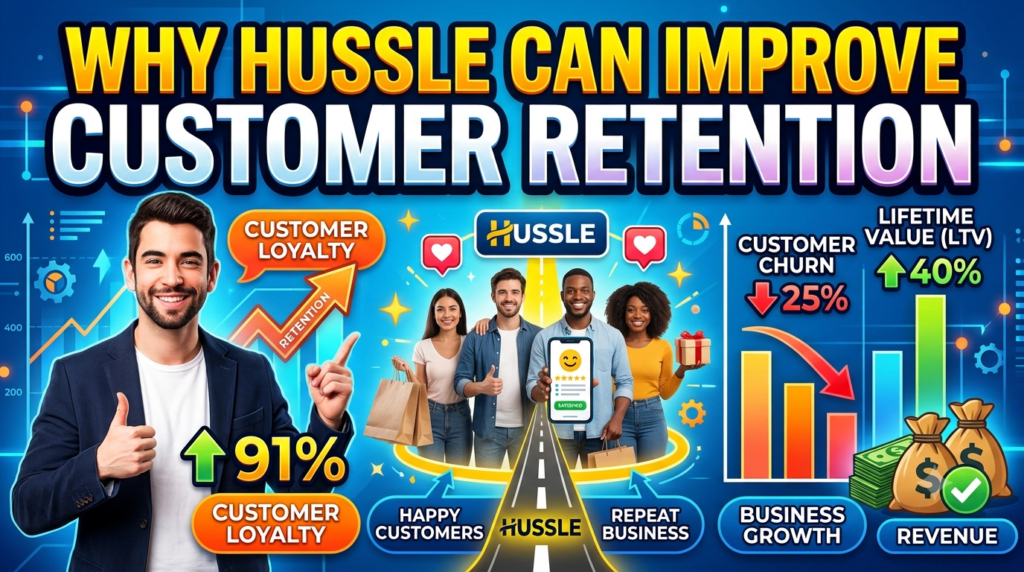
Winning a customer is only one part of building a business. Keeping that customer engaged can be even more important over time. A buyer who receives excellent follow-up, useful information, and personalized communication is more likely to feel that the relationship continues after the transaction.
Hussle’s platform is designed not only around acquisition but also around retention. The company highlights behavior-driven actions, follow-up tools, engagement insights, and customer information that can help sellers respond to important moments in the customer lifecycle.
For creators, this is particularly relevant because personal brands often depend on repeat customers and loyal communities. A creator selling a single product may earn once, but a creator who builds an ongoing customer relationship can create repeat purchases, referrals, subscriptions, and stronger word-of-mouth growth. Hussle can support that process by helping sellers identify when customers need attention rather than waiting until the relationship becomes inactive.
Read More:-
How Does Strikingly Simplify the Website Building Process?
Building Your Dream Website with Site123
Boost Your E-commerce Strategy with YITH Plugins
Maximize Your Customer Engagement with LiveAgent’s Features
Why STRIPO is Essential for Digital Product Marketersa
Hussle Integrations and Business Scalability
Another reason Hussle can appeal to established businesses is its integration approach. The platform states that it supports more than 100 integrations, including systems such as Salesforce, HubSpot, Shopify, BigCommerce, Oracle NetSuite, TikTok, and other business technologies.
Integrations matter because businesses rarely operate from one application. A company may already have its CRM, ecommerce platform, product database, content management system, and operational tools. Asking employees or sellers to abandon all of those systems and start again would be unrealistic. A connected enablement layer can instead help bring relevant information into the selling experience.
For a growing company, scalability is the key consideration. A workflow that works for ten sellers may become chaotic at one hundred sellers. A process that works for one market may become difficult across five markets. Technology becomes valuable when it can support increasing complexity without requiring a proportional increase in administrative work. Hussle’s integration and white-label capabilities are designed with that type of organizational scale in mind.
How Businesses Can Get Started With Hussle
Businesses considering Hussle should begin with a simple question: What selling problem are we actually trying to solve? A company should not adopt another platform simply because it has many features. Finding the largest bottleneck first is a preferable strategy.Is onboarding too slow? Are sellers struggling to find content? Are follow-ups being missed? Is customer engagement difficult to measure? Are high-performing behaviors not being replicated across the organization?
Once the core problem is identified, the business can map it to Hussle’s capabilities. For example, a company struggling with content distribution may focus on Media, while an organization dealing with follow-up challenges may look closely at Pulse. A business focused on onboarding could explore Learning and guided journeys, while a company seeking more actionable intelligence could examine its reporting and AI capabilities. Hussle currently invites organizations to request a demo to understand how the platform fits their sales operation.
The most important thing is to measure the outcome after implementation. Businesses should establish meaningful benchmarks before making major changes. Look at seller activation, content engagement, follow-up completion, customer conversion, retention, and revenue-related indicators. That turns Hussle from a software purchase into a measurable business initiative.



Conclusion
Hussle can benefit businesses and creators by turning sales enablement from a collection of information into a system of action. Its current platform combines content distribution, guided selling, AI assistance, learning, analytics, follow-up tools, integrations, and seller engagement capabilities. The biggest opportunity is not simply having more technology; it is using technology to help people consistently perform the activities that create customer value.
For businesses, Hussle can help create more consistency across distributed sales teams, strengthen onboarding, centralize content, measure engagement, and turn successful seller behavior into repeatable processes. For creators and independent sellers, its tools can help organize customer conversations, improve follow-ups, use content more strategically, and reduce repetitive administrative work. In both cases, the underlying principle is similar: attention becomes valuable when it leads to action.
As selling becomes increasingly social, digital, distributed, and data-driven, organizations need tools that can connect human relationships with intelligent technology. Hussle is positioned around exactly that intersection. Whether the goal is acquiring more customers, helping sellers become productive faster, improving retention, or creating a more organized selling workflow, its value ultimately comes down to one question: can it help people take better actions more consistently? For businesses and creators that answer yes, Hussle can become more than another software platform—it can become part of the operating system behind their growth.
Frequently Asked Questions
Q. What is Hussle used for?
A. Hussle is a sales enablement and seller activation platform designed to help businesses support distributed sellers, affiliates, field representatives, and direct-selling teams. It combines content sharing, learning, analytics, follow-up tools, guided actions, AI capabilities, and integrations in a unified environment.
Q. Can creators benefit from Hussle?
A. Yes. Creators who sell products, promote services, work with affiliates, or manage customer relationships can potentially benefit from Hussle’s content-sharing, engagement tracking, follow-up, and AI-guided selling capabilities. Its tools can help creators spend less time organizing repetitive sales tasks and more time building relationships and creating content.
Q. How does Hussle help with social selling?
A. Hussle provides tools for sharing videos, product links, curated content, and interactive assets while tracking engagement. Its Media functionality uses trackable links and notifications to help sellers understand how customers respond to shared content and determine when follow-up may be appropriate.
Q. Does Hussle use artificial intelligence?
A. Yes. Hussle currently offers AI-powered capabilities, including an AI Agent intended to help sellers determine what action to take next. Hussle described the AI Agent in a June 2026 update as an in-app assistant that can help sellers with activities such as making a sale, creating social content, and deciding what to do next.
Q. Is Hussle suitable for large businesses?
A. Hussle is specifically positioned for organizations with distributed sales teams, direct sellers, affiliates, and field representatives. The platform says it supports more than 100 integrations and offers a white-label experience, which can make it relevant for businesses that need to connect seller enablement with existing CRM, commerce, content, and operational systems.