Spocket Dropshipping makes starting an online store easier by connecting entrepreneurs with reliable suppliers and a wide range of products without requiring them to hold inventory. This guide explains how Spocket Dropshipping works, how to choose profitable products and suppliers, build your store, set competitive prices, manage order fulfillment, and market your business effectively. Whether you are a beginner or looking to improve an existing dropshipping store, learn how to use Spocket to create a professional ecommerce business and build a scalable online brand.
Table of Contents
- What Is Spocket Dropshipping?
- Why Choose Spocket for Your Online Business?
- How Much Does Spocket Cost?
- How to Choose a Profitable Dropshipping Niche
- How to Find Products on Spocket
- How to Build Your Online Store
- How to Price Your Spocket Products
- How Order Fulfillment Works With Spocket
- How to Market Your Dropshipping Store
- Common Spocket Dropshipping Mistakes to Avoid
- Conclusion
- FAQs About Spocket Dropshipping
What Is Spocket Dropshipping?
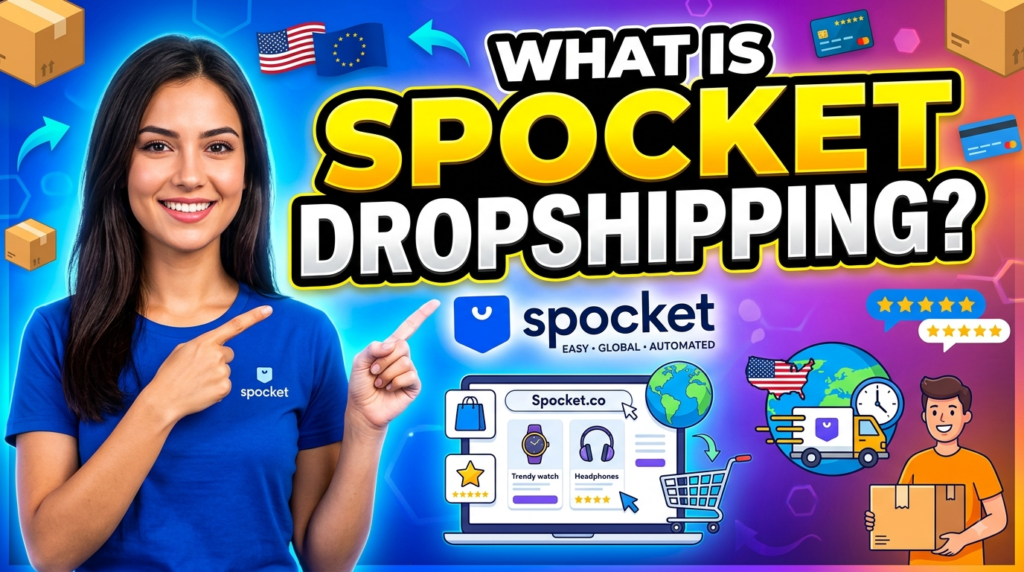
Spocket dropshipping is an online retail model that allows you to sell products without purchasing and storing inventory in advance. Instead of filling your home, office, or warehouse with boxes, you create an online store, select products from suppliers, publish those products in your store, and purchase them from the supplier after receiving a customer order. The supplier then prepares and ships the product directly to your customer. Spocket describes this basic model as a process where the customer pays the retailer, the retailer purchases the product from the supplier, and the supplier ships it directly to the customer, with the retailer keeping the difference between the selling price and supplier cost as gross profit before other expenses. This is what makes dropshipping attractive to beginners: you can test a business idea without committing a large amount of money to inventory before knowing whether customers actually want the products.
How the Spocket Dropshipping Model Works
Think of your online store as the storefront and Spocket as part of the supply chain operating behind the scenes. You focus on choosing products, creating a brand, attracting visitors, answering customer questions, and improving sales, while the supplier handles inventory and physical fulfillment. Once an order arrives, the order information can flow through the connected ecommerce system, allowing you to purchase and fulfill the product through the supplier. Spocket supports integrations with ecommerce platforms including Shopify, BigCommerce, Wix, WooCommerce, Squarespace, Ecwid, eBay, Amazon, and others, although selling-channel rules and integrations can vary.
The important thing to understand is that dropshipping is not the same as effortless income. You eliminate much of the inventory burden, but you do not eliminate the work involved in building a business. You still need to identify a market, select reliable products, create compelling product pages, calculate margins, handle customer service, market your store, monitor advertising costs, and deal with refunds or delivery problems. The technology can make operations smoother, but the business still depends on whether your offer solves a real customer problem.
Why Spocket Is Popular With Online Entrepreneurs
One reason entrepreneurs consider Spocket is its emphasis on a curated supplier marketplace rather than forcing store owners to search randomly across the internet for manufacturers and wholesalers. Spocket says suppliers go through a review and onboarding process, including requirements relating to product quality, inventory ownership, pricing, and shipping performance. The platform also says many suppliers produce and ship products from Europe or North America. That can be useful if your target customers value reasonable delivery times or products sourced closer to their market.
Spocket also offers tools designed to reduce repetitive work. Depending on your plan and integration, you can import products into your store, synchronize information, manage orders, and access supplier details from one ecosystem. The platform currently advertises a catalog of more than 100 million products, although the number of products you can add to your store depends on the subscription tier. For a beginner, that large selection can be both an advantage and a challenge: having thousands of possibilities is useful, but choosing one clear product direction is much more important than uploading hundreds of random items.
Why Choose Spocket for Your Online Business?
Choosing a dropshipping platform is a little like choosing the engine for a car. Your website might look beautiful on the outside, but if the supply chain underneath it is unreliable, the customer experience can quickly fall apart. Spocket aims to simplify several parts of that supply chain by connecting retailers with suppliers and ecommerce platforms while providing tools for product discovery and fulfillment. Its current pricing page also advertises features such as product sourcing, supplier communication, branded invoicing, bulk checkout, order management, and support, depending on the plan selected.
Access to Global and US/EU Suppliers
One of the major selling points of Spocket is access to suppliers from different regions. The platform specifically promotes products from US and EU suppliers, while also offering global sourcing options. This matters because shipping distance can influence customer satisfaction. If your audience is primarily located in the United States, for example, finding a supplier capable of shipping efficiently within that market may be more useful than simply choosing the cheapest product available somewhere else.
However, location should not be your only selection criterion. A nearby supplier with poor product quality can still damage your reputation. When comparing products, look at the supplier’s shipping information, product cost, estimated delivery time, available variants, customer reviews where available, and overall product presentation. You should also consider whether the product is easy to explain and demonstrate through marketing content. A product with a clear benefit is usually easier to advertise than an item that requires several paragraphs just to explain why someone might want it.
Product Quality and Supplier Vetting
Supplier quality is one of the biggest differences between a sustainable dropshipping business and a store that receives complaints after its first few orders. Spocket states that suppliers must meet requirements related to product quality, inventory ownership, pricing discounts, and shipping commitments before being accepted. That vetting can reduce some of the uncertainty involved in finding suppliers independently, but it should not replace your own due diligence.
Before building a major advertising campaign around a product, consider ordering a sample. Spocket specifically promotes sample ordering through its dashboard so retailers can test products and suppliers. A sample lets you examine the packaging, materials, appearance, functionality, and delivery experience yourself. Imagine spending $500 on advertising only to discover that the product looks completely different from the photos. Testing before scaling is far cheaper than learning that lesson from dozens of unhappy customers.
How Much Does Spocket Cost?
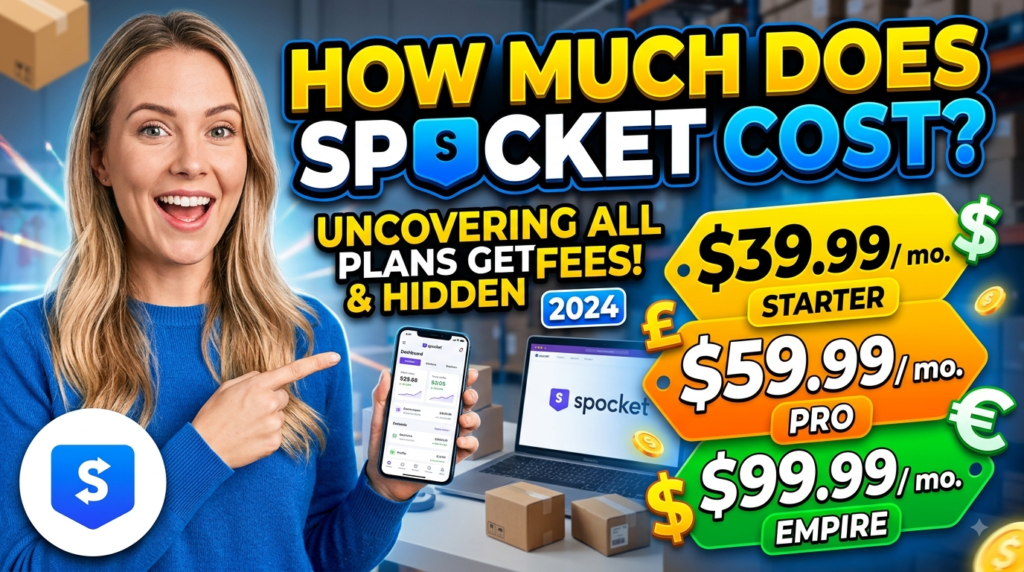
Your initial business budget should include more than the supplier platform. You may need money for an ecommerce platform, domain name, design, advertising, applications, payment processing, samples, customer-service tools, and unexpected expenses. Spocket currently lists a Starter plan at $39.99 per month, Professional at $59.99, Empire at $99.99, and Unicorn at $299.99 when billed monthly. The platform also currently advertises a seven-day trial, while annual billing displays different effective monthly prices. Pricing can change, so check the official pricing page before purchasing.
Understanding Spocket Pricing Plans
| Spocket Plan | Current Monthly Price | Unique Products | Premium Products |
| Starter | $39.99/month | 25 | Not specified in listed allowance |
| Professional | $59.99/month | 250 | 25 |
| Empire | $99.99/month | 10,000 | 10,000 |
| Unicorn | $299.99/month | 25,000 | 25,000 |
The right plan depends on your business rather than your ambition. A beginner does not automatically need the most expensive plan simply because it offers more products. If you are testing one niche and a small catalog, a lower tier may be sufficient. As your store grows, you can evaluate whether additional product limits and features justify upgrading. Spocket also states that its plans include 0% transaction fees, but you should still account for payment processor fees, advertising costs, taxes, refunds, ecommerce software, and other operating expenses when calculating profitability.
How to Choose a Profitable Dropshipping Niche
Your niche is the neighborhood where your business lives. If you try to sell everything to everyone, your store can quickly become a digital supermarket without a recognizable identity. Instead, choose a specific customer group and build a product selection around its interests, needs, or problems. You might focus on home organization, pet accessories, fitness-related products, beauty accessories, travel products, desk accessories, or another category, but the key is not simply picking something that sounds trendy. You need to understand who buys the products, why they buy them, what alternatives exist, and whether enough margin remains after all business expenses.
Finding Products With Real Market Potential
A potentially strong dropshipping product usually has a clear purpose, an identifiable audience, reasonable shipping economics, and enough perceived value to support your desired selling price. Products that demonstrate a problem-and-solution relationship can be especially interesting for marketing because customers can understand their benefit quickly. Spocket’s product discovery tools also include a Winning Products feature that lets users explore products and filter them by countries such as the United States, United Kingdom, Europe, Canada, and Brazil.
Do not interpret a “winning product” label as a guarantee that you will win. Market demand changes quickly, competitors can copy products, advertising costs fluctuate, and customers may have different preferences in different regions. Use platform data as a starting point rather than as a substitute for research. Search Google, TikTok, Instagram, YouTube, marketplaces, and competitor stores to understand how people talk about the product. Then ask the more important question: What can your store do differently?
How to Find Products on Spocket
Once you have chosen a niche, begin exploring Spocket’s catalog with a filter-first mindset. Instead of scrolling endlessly through products, define the characteristics you want before searching. For example, you might look for products with reasonable supplier prices, attractive margins, manageable shipping times, strong product photography, multiple variants, and a clear customer benefit. The goal is not to find the product with the lowest price; the goal is to find a product where the entire customer proposition makes sense.
Spocket’s current platform promotes product importing, supplier information, product discovery, and integrations designed to make adding products easier. Once you find an interesting item, examine the supplier information carefully rather than immediately importing it. Check the estimated shipping cost and time, variations, product specifications, available inventory, and whether the product fits naturally into your store’s overall identity.
Evaluating Product Demand and Competition
Competition is not automatically bad. In fact, competition can be evidence that customers already spend money in a category. The problem appears when dozens of stores sell the same product with identical images, descriptions, and prices. If your store looks exactly like everyone else’s, your customer has little reason to choose you.
Instead, build differentiation around positioning. You could create better educational content, improve product photography, package products into useful collections, create a stronger brand identity, offer clearer buying guides, or target a narrower audience. Suppose 100 stores sell the same desk organizer. One store markets it to everyone, while another creates an entire brand around productivity for remote professionals. The second store has a clearer story, even though the underlying product may be identical.
How to Build Your Online Store
Your store should make customers feel confident within seconds. A professional domain, clean navigation, readable product descriptions, useful images, clear pricing, shipping information, refund policies, contact details, and trustworthy checkout experience all matter. You do not need an extravagant website at the beginning. You need a website that answers the customer’s basic questions without making them hunt for information.
If you choose Shopify, Spocket provides a direct integration process. According to Spocket’s help documentation, you can connect through your Spocket account by selecting Shopify and entering your store URL, or install the Spocket app through the Shopify App Store and authorize the integration. This connection is designed to make product and order management easier.
Connecting Spocket With Shopify
After connecting your accounts, you can browse products, select suitable items, and import them into your store. Spocket’s documentation explains that integrations can synchronize information such as product listings and inventory, while order and tracking information can also flow between connected systems depending on the setup. That automation is valuable because manually copying product information and order details can become tedious as order volume increases.
Still, automation should be treated as an assistant rather than an autopilot. Review every imported product page before publishing it. Rewrite generic supplier descriptions in your own voice, remove unnecessary claims, improve formatting, check variants, verify pricing, and make sure the shipping information is accurate. Customers are not interested in reading a supplier’s internal catalog language; they want to understand what the product does and why it deserves their money.
How to Price Your Spocket Products
Pricing is where many new dropshippers make their first major mistake. They look at a supplier price of $15 and think they can sell the item for $30, making $15. But the actual calculation is more complicated. Your gross revenue may need to cover product cost, shipping, payment processing, advertising, platform subscriptions, discounts, refunds, customer support, taxes, and other expenses.
A simple example makes the point. Suppose your product and shipping cost you $18 and you sell it for $39.99. Your gross difference is $21.99 before other costs. If acquiring the customer through advertising costs $12, your payment processing and other variable costs consume another few dollars, your actual profit may be far lower than the headline margin suggests. That is why profitability should be calculated after customer acquisition costs, not just by subtracting supplier cost from selling price.
Your pricing should also communicate value. A $19.99 product and a $39.99 product may be identical physically, yet the latter can sometimes support a stronger business if the store offers better positioning, presentation, customer support, and perceived value. Do not compete solely on being the cheapest store. Competing on price alone can turn your business into a race where everyone runs faster and earns less.
How Order Fulfillment Works With Spocket
The beauty of dropshipping is that you do not need to personally package every customer order. When your customer purchases through your store, the order can be processed through the connected Spocket workflow, and the supplier handles the physical fulfillment. Spocket explains that its system can bring orders into the platform and supports fulfillment workflows intended to simplify the process.
This does not mean your responsibility ends after clicking a fulfillment button. You still own the customer relationship. If a shipment is delayed, the customer contacts your store, not your supplier. If the product arrives damaged, you need to help resolve the issue. If tracking information is unclear, you may need to communicate with the supplier and then explain the situation to the customer. The supplier operates behind your brand, so supplier reliability becomes part of your reputation.
That is why testing suppliers before scaling is such a smart move. You can discover problems with shipping times, packaging, product quality, or communication before a large number of customers experience them. A dropshipping store is essentially a promise delivered through another company’s logistics network. Your job is to make sure that network can keep the promise.
Read More:-
How Does Strikingly Simplify the Website Building Process?
Building Your Dream Website with Site123
Boost Your E-commerce Strategy with YITH Plugins
Maximize Your Customer Engagement with LiveAgent’s Features
Why STRIPO is Essential for Digital Product Marketersa
How to Market Your Dropshipping Store
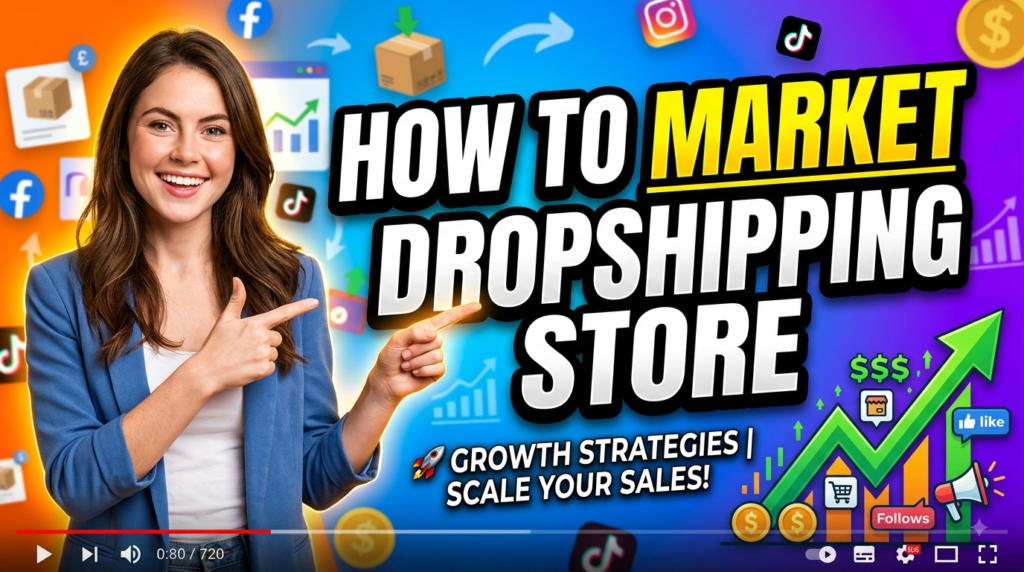
Creating a store is only half the job. The other half is attracting people who might actually buy. You can have a beautiful product page and zero sales if nobody visits it. Marketing should therefore begin while you are developing the store, not after everything is finished.
Organic content can be a useful starting point because it lets you demonstrate products without paying for every impression. Short videos, tutorials, comparison content, problem-solving posts, product demonstrations, customer-focused guides, Pinterest content, YouTube videos, and SEO articles can all help create discovery opportunities. Paid advertising can accelerate testing, but it also introduces risk because you spend money before knowing whether your offer converts.
Using SEO, Social Media, and Paid Advertising
SEO is particularly useful for building long-term visibility. Instead of publishing pages filled with repetitive keywords, create useful content around the questions your target customers actually ask. If you sell home organization products, for example, articles about organizing small bedrooms, choosing storage solutions for apartments, or creating a clutter-free workspace can attract people before they are ready to purchase. The commercial page then becomes the natural next step.
Social media can work differently. Platforms such as Instagram, YouTube, and Facebook can help demonstrate products visually and create a personality around your brand. Spocket itself lists social platforms such as Facebook, Pinterest, Instagram, and YouTube among channels where retailers can advertise products. Your content should not feel like a continuous stream of advertisements. Show the product in use, demonstrate the problem it solves, answer objections, compare alternatives, and give viewers a reason to remember your brand.
Paid advertising should begin with controlled experiments rather than massive budgets. Test different audiences, creatives, hooks, landing pages, and offers. If one advertisement generates clicks but no purchases, the problem might be the product page or price rather than the advertisement itself. If people purchase but the profit disappears after advertising costs, your acquisition economics need work. Think of advertising as a laboratory: every campaign should teach you something.
Common Spocket Dropshipping Mistakes to Avoid
The first mistake is choosing products simply because they look popular. Trends can create excitement, but excitement is not the same thing as sustainable demand. The second mistake is importing dozens or hundreds of products before understanding the target customer. More products can actually make a new store less trustworthy because customers cannot immediately understand what the brand stands for.
Another common mistake is copying supplier descriptions. Search engines and customers both benefit from original, useful content. Rewrite descriptions so they explain the product naturally, focus on benefits, answer common questions, and reflect your brand’s personality. Also avoid making unsupported health, performance, or financial claims. A supplier listing is not automatically permission to promise whatever you want in an advertisement.
Shipping is another area beginners underestimate. A cheap product with expensive or slow shipping can become difficult to sell. Before launching an advertisement, understand the total landed cost and expected delivery time. Spocket’s supplier requirements include commitments around processing and shipping timeframes, but individual products and suppliers still need to be evaluated.
Finally, do not assume that automation replaces customer service. The software can synchronize information, but customers still want a human response when something goes wrong. Build clear policies for returns, refunds, damaged products, delivery delays, and order questions. Your goal should be to make the business feel simple to the customer even when the supply chain behind it is complicated.


Conclusion
Starting an online business with Spocket dropshipping can be a practical way to enter ecommerce without purchasing large quantities of inventory upfront. Spocket provides access to a broad product catalog, supplier marketplace, ecommerce integrations, product discovery tools, and fulfillment features that can simplify several operational tasks. Its current platform also offers multiple subscription levels, allowing businesses to choose a plan based on their product volume and operational requirements.
But the platform itself is not the business. Your niche, product selection, branding, pricing, marketing, customer experience, and financial discipline determine whether the store can become sustainable. The strongest approach is to start small, test products carefully, order samples, understand your true costs, create an original brand experience, and scale only after you have evidence that customers actually want what you are selling. Treat Spocket as infrastructure, not as a magic button for passive income, and you will approach dropshipping with much more realistic expectations.
FAQs About Spocket Dropshipping
Q. Is Spocket good for beginners?
A. Yes. Spocket is designed to simplify supplier discovery, product importing, ecommerce integration, and fulfillment, which can make the technical side of starting a dropshipping store easier for beginners. However, beginners still need to learn product research, marketing, pricing, customer service, and basic business finance.
Q. Do I need inventory to start dropshipping with Spocket?
A. No. The basic dropshipping model allows you to sell products without purchasing and storing inventory yourself. When a customer orders, the supplier fulfills the order and ships it directly to the customer.
Q. Can I use Spocket with Shopify?
A. Yes. Spocket provides a Shopify integration, and its help documentation explains that you can connect an existing Shopify store through Spocket or install the Spocket app through Shopify.
Q. How much money do I need to start a Spocket dropshipping business?
A. There is no single universal startup budget. Besides a Spocket subscription, you may need to budget for your ecommerce platform, domain, samples, advertising, payment processing, applications, and other business expenses. Spocket currently lists paid plans beginning at $39.99 per month on monthly billing, with a seven-day trial advertised on its pricing page.
Q. Can Spocket guarantee that I will make money?
A. No. A dropshipping platform cannot guarantee sales or profits. Success depends on factors such as product demand, competition, pricing, marketing performance, customer experience, supplier reliability, and operating costs. The smartest approach is to test your business model with a controlled budget and scale based on actual results rather than promises of easy income.