

Discover how Planet Hoster can support your growing business website with flexible hosting plans, NVMe storage, advanced security, reliable backups, and scalable HybridCloud solutions. Explore its key features, performance, pricing, and customer support to determine whether Planet Hoster is the right hosting provider for your business growth.
Table of Contents
- Understanding PlanetHoster and Its Hosting Services
- Why Growing Businesses Need Reliable Web Hosting
- The World Hosting Platform Explained
- Scalability and Flexible Hosting Resources
- Website Performance and NVMe Storage
- Security Features for Business Websites
- Backup and Data Recovery Options
- HybridCloud Hosting for Demanding Websites
- The N0C Control Panel and Website Management
- Customer Support and Technical Assistance
- Data Center Locations and Infrastructure
- WordPress and E-Commerce Website Compatibility
- Pricing, Value, and Hosting Costs
- Advantages of Choosing PlanetHoster
- Potential Limitations to Consider
- PlanetHoster vs. Traditional Shared Hosting
- Who Should Consider PlanetHoster?
- Tips for Choosing the Right PlanetHoster Plan
- Is PlanetHoster a Good Long-Term Hosting Solution?
- Conclusion
- Frequently Asked Questions (FAQs)
Understanding PlanetHoster and Its Hosting Services
PlanetHoster is a web hosting provider that focuses on delivering hosting infrastructure, domain services, and managed server solutions for different types of online projects. The company states that it has operated its own infrastructure since 2007 and provides hosting services through facilities in France, Switzerland, and Canada. Its approach is particularly interesting for businesses that want to manage their websites without taking complete responsibility for server administration. Instead of offering only one standard hosting package, PlanetHoster provides different solutions depending on the size and technical requirements of a project. This allows website owners to start with a relatively straightforward hosting environment and consider more powerful services as their needs change.
The provider’s hosting portfolio includes The World, which focuses on individual web projects, and HybridCloud, which targets more demanding workloads requiring dedicated resources. These options serve different purposes, so choosing between them depends on your business model, expected website traffic, and technical requirements. For example, a small consultancy website might not need the same infrastructure as an online store managing thousands of products and customer transactions. PlanetHoster also provides its own hosting management interface, called N0C, which brings several website administration functions together. For business owners who prefer spending time on marketing, sales, and customer service rather than server maintenance, managed hosting can be an attractive option.
Why Growing Businesses Need Reliable Web Hosting

Imagine investing money in advertising, social media campaigns, and search engine optimization, only to discover that your website loads slowly whenever potential customers visit. That situation can affect customer confidence and reduce the chances of generating leads or completing sales. Your hosting provider plays an important role in how your website handles incoming traffic, stores information, processes requests, and remains accessible. As your business grows, you may introduce new landing pages, product categories, customer accounts, booking systems, or payment integrations. Each addition can increase the technical demands placed on your hosting environment. This is why businesses should think beyond the cheapest monthly hosting price and consider the infrastructure supporting their online operations.
A suitable hosting provider should offer enough resources for your current requirements while providing a practical upgrade path for future expansion. Storage capacity, processing power, memory, network infrastructure, security, backups, and technical assistance all deserve attention. You should also consider how easily you can manage your website and whether the provider can help when technical problems occur. PlanetHoster addresses several of these requirements through its tiered World platform and managed HybridCloud services. However, remember that advertised infrastructure specifications do not automatically guarantee a particular website’s loading speed or uptime. Your website’s code, images, plugins, database design, traffic patterns, and configuration also influence performance.
The World Hosting Platform Explained
The World is one of PlanetHoster’s main hosting solutions and is designed for businesses, bloggers, agencies, and website owners who want flexible hosting resources. One interesting aspect of this platform is its project-based structure. Rather than treating every website as an identical workload, PlanetHoster provides separate Web Projects with their own resource allocations and isolation. This approach can be useful for businesses managing several websites because different projects may have different traffic levels and technical requirements. For instance, your company might operate a main corporate website, a separate blog, and a campaign landing page. Having separate hosting projects can make it easier to organize these websites according to their individual needs.
Another benefit is the availability of different resource levels within the same general hosting platform. A business can evaluate its website requirements and choose a plan that provides appropriate storage and resource priority. PlanetHoster advertises unlimited bandwidth and subdomains for its World plans, although businesses should always read the applicable terms and fair-use conditions before purchasing. The platform also advertises replicated storage architecture, which is intended to improve infrastructure resilience. These features make The World worth considering for businesses that want more flexibility than a basic hosting package. Still, the best plan depends on your actual resource consumption rather than simply choosing the most expensive option.
Standard, Plus, and Ultra Hosting Plans
PlanetHoster’s World platform offers three primary configurations: Standard, Plus, and Ultra. Each option provides a different storage allowance and resource configuration, allowing customers to select an environment according to their website requirements. According to the provider’s published specifications, Standard includes 10 GB of NVMe/SSD storage, Plus includes 50 GB, and Ultra includes 100 GB. The company also describes Ultra as offering semi-dedicated priority resources for more demanding projects. This distinction matters because a website with a large product catalogue, multiple plugins, and increasing visitor activity may require more resources than a simple business portfolio.
| Feature | Standard | Plus | Ultra |
| NVMe/SSD storage | 10 GB | 50 GB | 100 GB |
| Project isolation | Yes | Yes | Yes |
| Resource configuration | Standard | Boosted | Semi-dedicated priority |
| Bandwidth | Advertised as unlimited | Advertised as unlimited | Advertised as unlimited |
| Best suited for | Small websites | Growing projects | Demanding websites |
These configurations give businesses a starting point for comparing their requirements. Standard may be sufficient for a small company website or a new blog, while Plus provides additional storage for projects that are expanding. Ultra may be worth investigating when a website requires stronger resource priority or handles more demanding workloads. However, storage alone should never determine your decision. Consider database activity, memory requirements, CPU usage, website software, and expected traffic before selecting a configuration.
Scalability and Flexible Hosting Resources
Scalability is one of the most important considerations when choosing hosting for a growing business. You probably do not want to migrate your entire website every time your visitor numbers increase or your business launches another online service. A scalable hosting environment makes it easier to respond to changing requirements without rebuilding your website from the beginning. PlanetHoster’s World platform offers multiple resource levels, giving customers options as their projects develop. This can be useful for businesses that experience seasonal traffic, launch new marketing campaigns, or gradually expand their online product offerings.
Consider an online store that initially receives a few hundred visitors each week. After successful advertising campaigns and improved search engine rankings, the store might begin receiving thousands of visitors. More customers may browse product pages, search inventory, add items to shopping carts, and complete purchases. These activities can increase server workload, particularly when the website uses resource-intensive plugins or database queries. Having access to higher-resource hosting configurations can make expansion easier. PlanetHoster’s broader portfolio also includes HybridCloud, which offers dedicated CPU and memory configurations for demanding websites. Nevertheless, you should confirm the upgrade process, migration requirements, possible downtime, and additional costs before committing to a particular hosting environment.
Website Performance and NVMe Storage
Website performance influences both the user experience and the effectiveness of your digital marketing efforts. Visitors generally expect pages to load quickly, and delays can make potential customers abandon a website before exploring its products or services. PlanetHoster includes NVMe/SSD storage in its World plans, with different capacities depending on the selected configuration. NVMe storage is designed to provide fast data access, which can benefit database-heavy websites, content management systems, and applications that frequently read or write information. The provider also describes its World infrastructure as using replicated storage architecture. These technical features provide a foundation for hosting performance, although actual results depend on the complete hosting configuration and website optimization.
For example, a business website containing hundreds of product images, customer reviews, and regularly updated content needs an efficient environment for retrieving information. Fast storage can help with certain server-side operations, but it is not a magic solution for every performance problem. Oversized images, unnecessary scripts, poorly configured plugins, and inefficient database queries can still slow down your website. You should combine suitable hosting with image compression, caching, content delivery networks where appropriate, and regular website maintenance. It is also sensible to monitor page-loading times and server response times as traffic increases. Before choosing PlanetHoster, consider testing your actual website rather than relying exclusively on general performance claims.
Security Features for Business Websites
Website security becomes increasingly important when your business starts collecting customer information, processing payments, or managing user accounts. Sensitive information may be exposed, business operations may be disrupted, and customer confidence may be impacted by a security event. PlanetHoster describes several security measures across its infrastructure and managed hosting services, including anti-DDoS protection, firewalls, anti-spam systems, web application firewall protection, and anti-brute-force measures. Its company information also highlights cybersecurity services designed to protect its network against distributed denial-of-service attacks. These features can help create a stronger hosting environment for businesses that want protection against common online threats.
Managed hosting can provide additional value because security involves more than installing a single protection tool. Servers require software updates, vulnerability patches, configuration checks, and continuous monitoring. PlanetHoster lists daily audits, security updates, vulnerability patches, and monitoring among its managed hosting services. This may be particularly helpful for small businesses that do not employ dedicated system administrators. However, hosting-level protection does not eliminate every website security risk. Business owners should also use strong passwords, enable multi-factor authentication where available, update their CMS and plugins, limit administrator access, and follow secure payment-processing practices. Security works best when the hosting provider and website owner both take responsibility.
Backup and Data Recovery Options
Imagine spending months developing your business website, publishing valuable content, and building a customer database. Suddenly, a software update fails or an unexpected technical issue damages important website files. Without a reliable backup, recovering your work could become difficult and expensive. Backups are therefore an essential feature for any serious business website. PlanetHoster’s infrastructure information describes daily backups stored in a remote data center, providing an additional layer of protection against certain infrastructure-related incidents. Its documentation also refers to remote backup storage and restoration through the hosting management environment.
For businesses, backup quality matters just as much as backup availability. You should understand how frequently backups are created, how long they are retained, what data is included, and whether restoration involves additional charges. A daily backup may be appropriate for a company website that changes occasionally, but an active online store might need more frequent backups of orders and customer information. It is also sensible to maintain an independent backup copy rather than relying entirely on your hosting provider. Before purchasing a plan, confirm the exact backup and restoration conditions that apply to that service. A clear recovery strategy can help your business respond more confidently to unexpected website problems.
HybridCloud Hosting for Demanding Websites
As a business website grows, traditional shared hosting may eventually become insufficient. Websites with large product catalogues, high visitor numbers, complex applications, and heavy database activity can require more predictable computing resources. PlanetHoster’s HybridCloud is designed for these more demanding workloads. Unlike a basic project-based hosting arrangement, HybridCloud provides dedicated CPU and memory configurations within a managed server environment. The provider offers several configurations, ranging from Starter to Ultra, allowing businesses to select resources according to their technical requirements.
Here is a quick look at some of the published HybridCloud configurations:
| Configuration | CPU cores | RAM | Storage |
| Starter | 2 | 4 GB | 40 GB |
| Standard | 4 | 8 GB | 60 GB |
| Plus | 4 | 12 GB | 100 GB |
| Pro | 8 | 16 GB | 120 GB |
| Max | 12 | 24 GB | 200 GB |
| Ultra | 24 | 48 GB | 500 GB |
Specifications based on PlanetHoster’s published HybridCloud product information.
For example, an established e-commerce company might need additional processing power to handle product searches, customer accounts, inventory updates, and simultaneous orders. A growing software business could also benefit from a more powerful environment for its applications and databases. HybridCloud may be worth considering when your website consistently approaches the resource limits of its existing hosting plan. Another advantage is that PlanetHoster advertises managed server administration, meaning customers can receive technical assistance with various infrastructure-related tasks. However, businesses should check the precise access permissions, management scope, and included services before choosing a configuration.
The N0C Control Panel and Website Management
Managing a website should not feel like solving a complicated technical puzzle every morning. Business owners need an administration interface that makes everyday tasks easier, especially when they manage multiple domains, databases, email accounts, and website applications. PlanetHoster provides its proprietary N0C control panel for managing hosting environments. The company describes N0C as an interface designed to combine visual simplicity with powerful administration features. It brings together several website management functions, helping customers organize their hosting projects from one environment.
A unified control panel can be useful when your company operates multiple websites or manages different online projects. Instead of switching between several disconnected administration tools, you can access important hosting functions through a central interface. Depending on the service and permissions available, hosting administration may include domain configuration, DNS management, database management, FTP accounts, and SSL certificate-related functions. PlanetHoster’s documentation also describes API capabilities for managing hosting and domains. If you are familiar with cPanel, remember that N0C is a different interface, so you may need some time to understand its navigation and workflow.
Customer Support and Technical Assistance
Technical problems rarely happen at convenient times. Your website might experience an error during a marketing campaign, a customer might report an ordering issue, or an update could create compatibility problems. When these situations occur, responsive technical support becomes extremely valuable. PlanetHoster advertises 24/7 assistance across its hosting offerings, with support options that include tickets, telephone, and live chat. Its managed hosting services also describe assistance with server configuration, PHP and database software, SSL certificate installation, and performance-related recommendations. These services can reduce the amount of technical work business owners need to handle independently.
Customer feedback provides another useful perspective when evaluating a hosting provider. At the time of research, PlanetHoster’s Trustpilot profile displayed approximately 5,522 reviews and a TrustScore of 4.8 out of 5. Many recent reviewers praised the support team’s responsiveness and helpfulness, although customer experiences are not universally positive. Some reviews also mention technical interruptions and account-related concerns. These ratings represent customer feedback rather than independently measured support performance, so it is sensible to read both positive and critical experiences before making a decision.
For a growing business, the important question is not simply whether support is available but whether it can help with the specific problems you may encounter. Check the available support languages, response expectations, escalation procedures, and whether your chosen plan includes any priority assistance. You should also understand which tasks are covered by managed hosting and which remain your responsibility. A good support arrangement can save time, but clear service expectations are equally important.
Data Center Locations and Infrastructure
Your hosting provider’s infrastructure location can influence website latency, data management, and regulatory considerations. PlanetHoster identifies France, Switzerland, and Canada among its infrastructure locations. This gives businesses options when deciding where to host their websites, depending on the locations available for their selected services. For example, a company primarily serving European customers might prefer a European hosting location, while a Canadian business may find a Canadian location more appropriate. Selecting a geographically suitable data center can help reduce network distance between your hosting environment and your target audience.
PlanetHoster also describes infrastructure features such as redundant network connectivity, backup power systems, physical access controls, surveillance, and anti-DDoS protection. Its data center information discusses facilities designed around redundancy and operational resilience. These elements matter because a hosting environment depends on more than just powerful servers. Electrical systems, cooling, connectivity, physical security, and infrastructure monitoring all contribute to the overall hosting environment. Nevertheless, a provider’s infrastructure descriptions should not be confused with independently verified performance measurements. If your business has strict availability or data-location requirements, review the contractual terms and confirm the location of both primary hosting and backups.
WordPress and E-Commerce Website Compatibility
WordPress remains a popular choice for businesses that want to publish content, create service pages, maintain blogs, or operate online stores. A suitable hosting environment should support the technical requirements of the CMS and its extensions. PlanetHoster’s hosting infrastructure lists support for technologies and services such as PHP and MySQL, which are important components of many WordPress installations. Its managed hosting information also mentions software optimization and assistance with configuration. This makes PlanetHoster an option worth evaluating if your business uses WordPress or another compatible PHP-based application.
E-commerce websites have additional requirements because they handle product information, customer accounts, shopping carts, and transactions. A growing online store may also use inventory management tools, marketing integrations, payment gateways, and shipping extensions. These features can increase database activity and server resource consumption, particularly during busy sales periods. PlanetHoster’s World Ultra and HybridCloud configurations may be worth comparing for businesses with more demanding online stores. However, selecting a hosting provider does not automatically make an e-commerce website secure or optimized. You should configure SSL, use reputable payment gateways, maintain regular backups, update extensions, and monitor performance during high-traffic periods.
Pricing, Value, and Hosting Costs
Hosting prices can strongly influence a small business’s decision, especially when the company is managing several other expenses. PlanetHoster advertises promotional pricing for its World hosting platform, including a published launch offer of €5.49 per month for eligible configurations on a 24-month billing cycle at the time of research. However, promotional pricing should not be confused with the standard renewal price. The final amount can depend on the selected plan, subscription period, location, currency, taxes, and additional services.
When comparing hosting costs, look beyond the monthly amount displayed on the homepage. A cheaper introductory package might become more expensive when the renewal period begins, while a slightly more expensive package could include useful services that reduce maintenance expenses. Businesses should also consider migration charges, backup arrangements, domain renewal, email requirements, and the cost of additional resources. HybridCloud pricing should be evaluated separately because it serves a different hosting category and offers dedicated resource configurations. Before purchasing, check the complete checkout price and renewal conditions rather than making a decision based on a promotional headline.
Advantages of Choosing PlanetHoster
PlanetHoster offers several features that may appeal to businesses planning to establish or expand their online presence. One of its main strengths is the variety of hosting solutions available. The World platform provides different resource configurations for individual websites, while HybridCloud targets projects that require dedicated computing resources and managed infrastructure. This creates a potential upgrade path for companies whose hosting requirements become more demanding over time. The provider’s proprietary N0C panel, advertised security features, and remote backup infrastructure add further reasons to consider its services.
Another advantage is the availability of multiple data center locations and the company’s focus on managing its infrastructure internally. For businesses that prefer receiving technical assistance instead of managing every server-related task themselves, its managed hosting services may be particularly attractive. Its published support arrangements and positive customer reviews also make it worth including in a hosting shortlist. Still, these benefits should be evaluated against the exact service terms and your own website requirements. No single hosting provider is automatically the best choice for every business, and the final decision should depend on measurable needs rather than marketing claims alone.
Potential Limitations to Consider
Every hosting provider has limitations, and understanding them before purchasing can prevent unnecessary problems later. One consideration with PlanetHoster is its proprietary N0C control panel. Although a dedicated interface can offer useful management features, website owners who have spent years using cPanel may need time to adjust. Businesses should also examine the differences between The World and HybridCloud carefully because they are not interchangeable hosting products. A website that needs complete server-level control, specific software configurations, or unusual deployment requirements should confirm compatibility and access permissions before subscribing.
Pricing is another area that deserves attention. Promotional offers can make hosting appear inexpensive initially, but renewal rates may change the overall value calculation. Businesses should also avoid assuming that unlimited bandwidth means unlimited access to every server resource. CPU usage, memory, storage, and acceptable-use conditions still matter. Finally, positive customer ratings cannot guarantee that your individual website will experience perfect uptime or uninterrupted service. Review the service agreement, backup policies, refund conditions, and support arrangements carefully. Making these checks before purchasing is much easier than discovering unexpected restrictions after moving your business website.
PlanetHoster vs. Traditional Shared Hosting
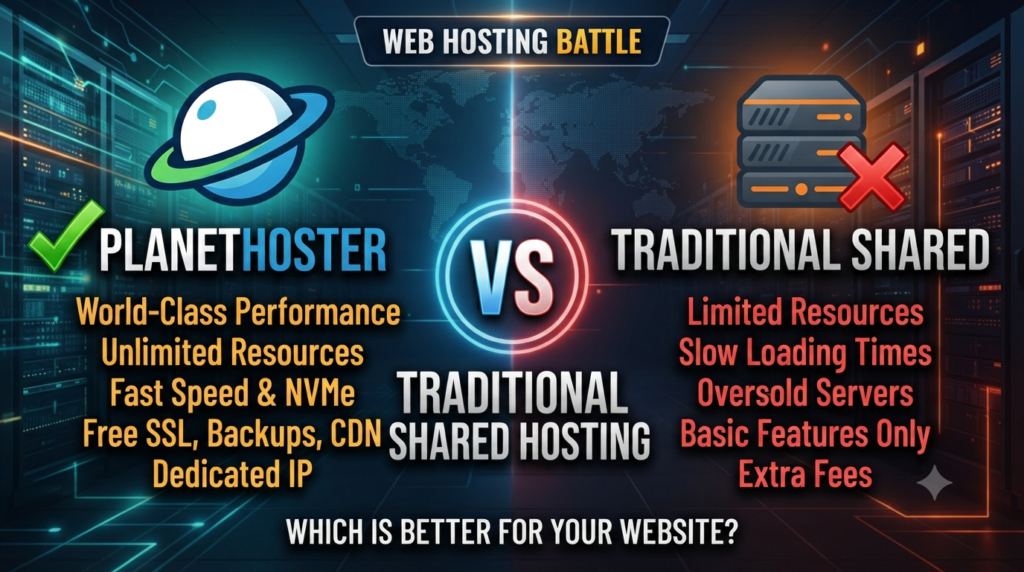
Traditional shared hosting is often a convenient starting point for individuals and small businesses. It generally offers an affordable way to publish a website without managing a dedicated server. However, shared hosting environments can have resource limitations, and website owners may have less flexibility when their projects become more demanding. PlanetHoster’s World platform takes a project-based approach, offering different resource configurations and individual project isolation. This makes it an interesting alternative for businesses that want to understand their resource allocation more clearly.
The following table highlights the general differences:
| Comparison factor | Traditional shared hosting | PlanetHoster World |
| Hosting structure | Shared environment | Individual Web Projects |
| Resource options | Often fixed by plan | Multiple configurations |
| Storage | Depends on provider | 10 GB, 50 GB, or 100 GB |
| Management | Provider-specific panel | N0C control panel |
| Scalability | Depends on available upgrades | Standard, Plus, Ultra options |
| Advanced hosting path | Provider-dependent | HybridCloud available |
This comparison describes general hosting models rather than every shared hosting provider. Some competitors also offer isolated environments, advanced resource management, and dedicated server upgrades. Therefore, businesses should compare actual specifications rather than assuming all traditional shared hosting services work the same way. PlanetHoster’s main attraction is the combination of project-based hosting and a broader managed infrastructure portfolio. Whether that combination offers better value depends on your website’s workload, budget, and technical requirements.
Who Should Consider PlanetHoster?
PlanetHoster may be worth considering for several types of website owners. Small businesses launching their first professional website can investigate The World Standard configuration if their storage and resource requirements are modest. Bloggers, consultants, and service providers may also find project-based hosting useful when they want to organize their online presence without immediately investing in a dedicated server. Businesses operating multiple websites can evaluate the different project configurations according to the demands of each website. Its range of services makes it possible to compare entry-level hosting with more powerful infrastructure as requirements change.
Growing e-commerce businesses, web development agencies, and companies operating resource-intensive applications may want to examine the higher-resource World plans or HybridCloud. HybridCloud’s dedicated CPU and memory configurations are particularly relevant for projects that require more predictable computing resources. Businesses without an internal server administration team may also appreciate the managed services described by PlanetHoster. However, developers who need unrestricted root access or highly specialized infrastructure should confirm the exact permissions and supported configurations before choosing a plan. The right hosting solution should match your team’s technical capabilities as well as your website’s workload.
Read More:-
How Does Strikingly Simplify the Website Building Process?
Building Your Dream Website with Site123
Boost Your E-commerce Strategy with YITH Plugins
Maximize Your Customer Engagement with LiveAgent’s Features
Why STRIPO is Essential for Digital Product Marketersa
Tips for Choosing the Right PlanetHoster Plan
Choosing a hosting plan becomes easier when you understand what your website actually needs. Start by evaluating your current website traffic, storage consumption, database size, and application requirements. A small business website with a few pages does not need the same resources as an online store with hundreds of products and frequent transactions. If you operate several websites, examine whether separate Web Projects would make management easier. This simple assessment can prevent you from paying for resources that you do not need or selecting a plan that becomes insufficient too quickly.
Next, consider your future business plans. Are you expecting to launch a new product line, introduce an online booking system, publish more content, or run larger advertising campaigns? These changes can affect website traffic and server requirements. Compare Standard, Plus, and Ultra according to their published storage and resource configurations. If your website requires dedicated computing resources, investigate HybridCloud separately. Before placing an order, verify the complete price, renewal conditions, backup retention, migration support, data center location, and technical support arrangements. A little research at this stage can help you avoid unnecessary hosting changes later.
Is PlanetHoster a Good Long-Term Hosting Solution?
Choosing a hosting provider should involve more than solving an immediate website requirement. You need to think about where your business might be in two or three years and whether your hosting environment can adapt to those changes. PlanetHoster’s combination of project-based World hosting and managed HybridCloud configurations gives businesses multiple options to evaluate as their websites become more sophisticated. The availability of different storage capacities, resource configurations, and managed infrastructure services makes its portfolio relevant to both smaller projects and more demanding applications.
However, long-term suitability depends on more than the number of hosting plans available. Your business should evaluate actual website performance, technical support quality, renewal pricing, data protection arrangements, and contractual uptime commitments. It is also important to monitor your website regularly and keep independent backups of critical business information. PlanetHoster could be a suitable long-term option if its services meet your requirements and remain competitive as your workload changes. The best approach is to start with a configuration that fits your current needs, monitor its performance, and upgrade when there is a clear technical or business reason.



Conclusion
So, can PlanetHoster support your growing business website? Based on its published hosting features, the provider offers several useful options for businesses at different stages of online development. Its World platform provides Standard, Plus, and Ultra configurations with different storage allowances and resource priorities. For websites with more demanding requirements, HybridCloud offers dedicated CPU and memory configurations alongside managed infrastructure services. Features such as NVMe storage, project isolation, N0C management, security tools, remote backups, and multiple infrastructure locations make PlanetHoster worth considering when comparing business hosting providers.
The most important thing is to choose a hosting package according to your actual business requirements. A small company website may work perfectly well with an entry-level configuration, while a growing e-commerce store or resource-intensive application may require a more powerful solution. Pay attention to renewal prices, service conditions, backup policies, and technical support before making your final decision. Also remember that website performance depends on both hosting infrastructure and proper website optimization. PlanetHoster offers a range of features that can support business growth, but evaluating the exact plan and testing its suitability for your website will help you make a more confident investment.
Frequently Asked Questions (FAQs)
Q. Is PlanetHoster suitable for small business websites?
A. Yes, PlanetHoster can be considered for small business websites through its World hosting platform. Its Standard configuration includes 10 GB of NVMe/SSD storage and individual project isolation. This can be suitable for a relatively lightweight company website, portfolio, or blog, depending on its software and resource requirements. Businesses should compare the available features with their expected traffic and storage needs before purchasing.
Q. Can PlanetHoster handle high website traffic?
A. PlanetHoster offers different hosting configurations for websites with varying resource requirements. Its World Ultra plan provides semi-dedicated priority resources, while HybridCloud offers dedicated CPU and memory configurations. These options may be useful for websites experiencing increasing visitor activity. However, actual traffic capacity depends on website optimization, application requirements, and the resources allocated to the hosting environment.
Q. Does PlanetHoster provide website security and backups?
A. Yes, PlanetHoster describes several security measures, including anti-DDoS protection, firewalls, web application firewall protection, and security monitoring. Its infrastructure information also describes daily remote backups for relevant services. Customers should verify the precise backup frequency, retention period, restoration process, and security features included in their selected hosting plan.
Q. Does PlanetHoster support WordPress websites?
A. PlanetHoster’s hosting environment supports technologies such as PHP and MySQL, which are commonly required by WordPress websites. Its managed hosting information also describes assistance with software configuration and optimization. This makes it an option worth considering for WordPress-based business websites, blogs, and compatible e-commerce applications.
Q. Is PlanetHoster a good choice for a growing e-commerce business?
A. PlanetHoster may be suitable for growing e-commerce businesses that need flexible hosting resources and managed infrastructure options. Its World Ultra and HybridCloud configurations are worth comparing for stores with larger product catalogues, increasing traffic, and more demanding database activity. Before choosing, evaluate the required CPU, memory, storage, backup arrangements, security measures, and total hosting cost.