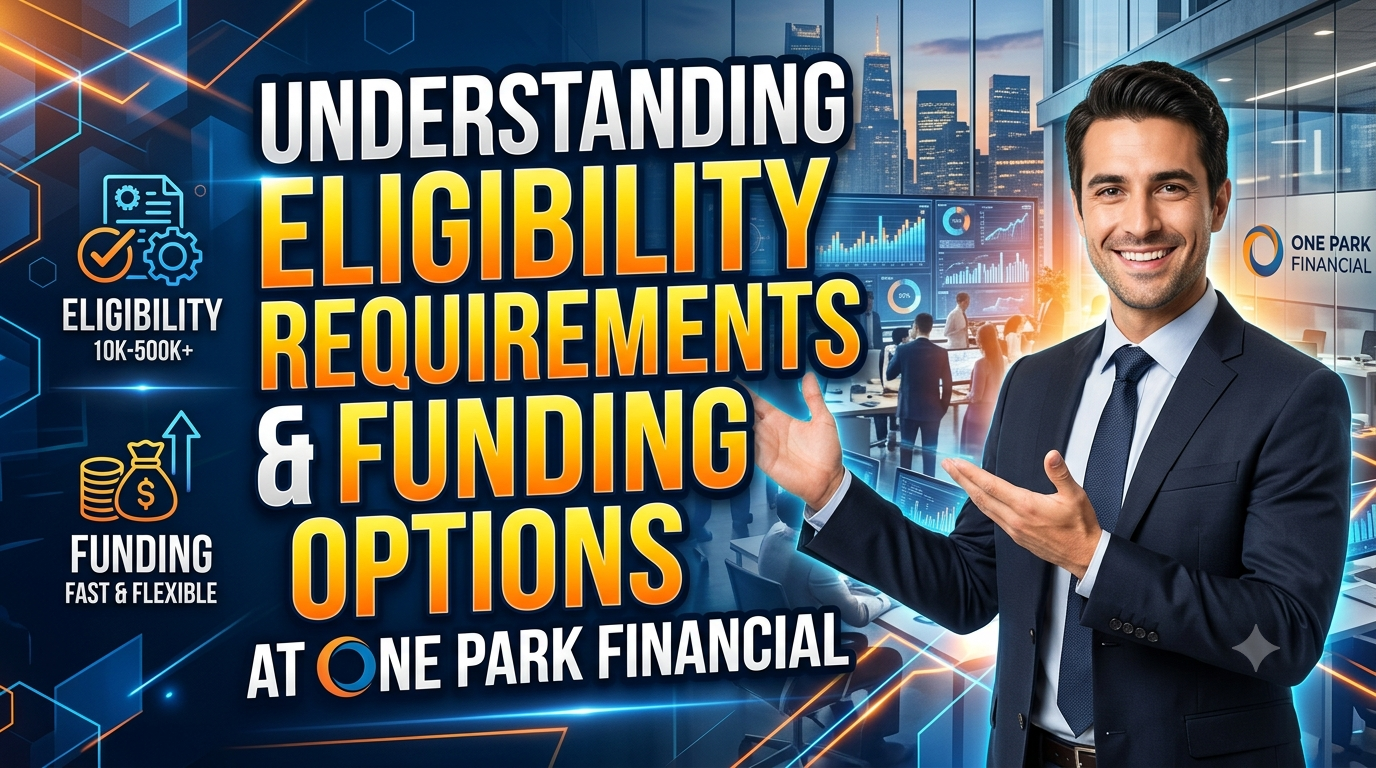
Discover how One Park Financial helps small businesses explore funding options, understand eligibility requirements, and access working capital. Learn about revenue criteria, credit score requirements, application steps, repayment terms, and alternative business financing solutions to make informed financial decisions and support sustainable business growth.
Table of Contents
- Introduction to One Park Financial
- How One Park Financial Works
- Understanding Business Funding Options
- Eligibility Requirements at One Park Financial
- Documents You May Need to Apply
- The Application and Approval Process
- Understanding Funding Costs and Repayment Terms
- Advantages and Potential Risks
- Alternatives to One Park Financial
- Conclusion
- Frequently Asked Questions (FAQs)
Introduction to One Park Financial
Small businesses frequently experience cash flow gaps, even when they have loyal customers and promising sales. A restaurant may need to replace kitchen equipment, a retailer may want to purchase seasonal inventory, or a contractor may need to cover payroll while waiting for customers to pay their invoices. These situations do not necessarily mean a business is failing; they often mean that cash is needed before the next payment arrives. Access to appropriate financing can help bridge that gap, provided the repayment commitment fits the business’s financial position.
One Park Financial focuses on helping small businesses explore funding through a network of financing providers rather than operating as a traditional bank that directly originates every financing product. According to its official FAQ, the company has operated since 2010 and serves businesses across many industries in the United States and Puerto Rico, subject to geographic and industry restrictions. Its model is designed for entrepreneurs who want to explore working capital without relying exclusively on traditional bank lending criteria.
For business owners, the important distinction is that access to a funding opportunity is not the same as guaranteed approval. A quick prequalification result does not necessarily mean that the final funding agreement has been approved or that the offered terms will suit your needs. The financing provider will still assess the business’s financial information and determine the amount, pricing, and repayment conditions. Understanding this distinction helps you approach the process with realistic expectations and compare an offer against other available options.
How One Park Financial Works
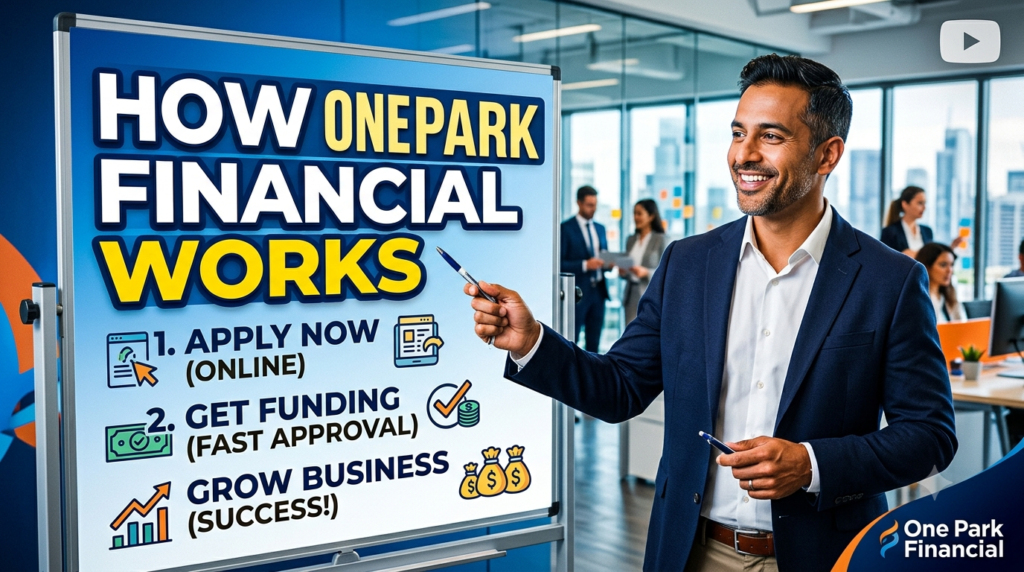
One Park Financial presents itself as a financing intermediary that helps businesses explore suitable capital options. Rather than assuming every applicant should receive the same type of loan, its team reviews the business’s circumstances and works to identify an offer from a funding partner. This approach may be useful when a business owner does not know which financing products are available or has already encountered difficulty obtaining a conventional loan.
The company’s published process begins with an online prequalification form, followed by a conversation with a Business Funding Manager, a review of the proposed offer, and completion of the funding agreement if the applicant decides to proceed. The company says prequalification takes approximately two minutes and that an offer may be ready within two business hours after the application is sufficiently complete. It also advertises funding within 24 hours in qualifying cases, but actual timing depends on documentation, approval, and the funder’s processing.
2.1. The Role of Business Financing Brokers
By assisting an application in understanding possible funding arrangements and communicating with providers, a financing intermediary can streamline the search for business capital. This can save time compared with approaching multiple lenders independently, especially for owners who are unfamiliar with financing terminology or application requirements. A representative may also explain what information is needed and help the business owner understand the offer presented.
However, you should remember that an intermediary is not necessarily the lender that provides the funds. The actual funding provider, the written agreement, and the applicable terms matter. Before signing, ask who is supplying the capital, whether the arrangement is legally a loan or a different financing product, how the provider calculates its charges, and what happens if your sales decline. A professional representative can help explain these details, but you should read the agreement yourself and seek independent advice if anything is unclear.
Understanding Business Funding Options
Business financing is not a single product. Depending on the provider and the applicant’s circumstances, funding may involve a term loan, a revolving line of credit, equipment financing, or a revenue-based arrangement such as a merchant cash advance. Each option serves a different purpose, and each comes with its own costs, eligibility standards, and repayment structure. The best choice depends on what the business needs the money for and how reliably it can generate the cash required to repay it.
One Park Financial’s role is to help applicants explore funding through its partner network. Its website describes access to business capital, but the exact products and terms available to a particular applicant must be confirmed directly with the company. Do not assume that every financing type listed below is available to every One Park Financial customer. Instead, use the comparison as a starting point for questions when reviewing any offer.
3.1. Merchant Cash Advances and Alternative Financing
A merchant cash advance, or MCA, is generally structured as a purchase of a business’s future receivables rather than a conventional installment loan. A provider advances money upfront and receives an agreed amount from the business over time, often through frequent withdrawals or a percentage of card sales. Some alternative financing arrangements use different collection mechanisms, so the written contract determines how repayment actually works.
This type of funding can be appealing to a business that needs capital quickly or does not meet a traditional lender’s requirements. However, fast access to money does not automatically mean affordable financing. Some advances have high effective annual costs, frequent repayments, or contract provisions that create pressure when sales weaken. Before accepting an advance, calculate the total amount you must repay, the expected collection schedule, any fees, and the consequences of a missed payment.
The following table explains common business financing categories. It is a general comparison, not a confirmation that every product is currently offered through One Park Financial.
| Funding option | Typical purpose | Repayment approach | Key consideration |
| Business term loan | Expansion, equipment, major purchases | Scheduled installments | Compare interest, fees, and total repayment |
| Business line of credit | Short-term cash flow gaps | Borrow, repay, and potentially borrow again within the limit | Check draw fees, interest, and renewal conditions |
| Equipment financing | Machinery, vehicles, or specialized equipment | Payments over an agreed term | The equipment may serve as collateral |
| Merchant cash advance | Immediate working capital | Agreed collection of future receivables | Review the total cost and collection frequency |
| Invoice financing | Cash tied up in unpaid invoices | Repayment from invoice proceeds or under the contract | Check advance rates, fees, and customer-payment risks |
A sensible financing decision begins with the business purpose. If you need a machine that will generate revenue for several years, equipment financing may be worth comparing. If you need to bridge a temporary gap between paying suppliers and collecting customer invoices, a line of credit or invoice financing might be more suitable. When you need immediate working capital, alternative financing could be another possibility, but only if the cost and repayment schedule are manageable.
Eligibility Requirements at One Park Financial
Eligibility is one of the first things to examine when exploring business funding. One Park Financial’s current published FAQ identifies three basic starting points: at least three months in business, monthly sales of at least $10,000 before expenses, and a minimum FICO credit score of 500. The company describes these as preliminary requirements rather than a promise of approval.
These criteria help a financing provider assess whether a business has a record of trading, generates sufficient sales to evaluate, and meets its initial credit guidelines. Still, the numbers should not be treated as a complete underwriting formula. Two businesses with identical monthly sales may have very different financial positions because one has high operating costs, substantial existing debt, or irregular deposits while the other maintains healthier cash flow.
The business owner should therefore distinguish between prequalification, final approval, and the actual funding offer. Prequalification indicates that the business may be worth evaluating further. Final approval depends on the provider’s review, and the resulting offer may be smaller or more expensive than expected. Before relying on a particular amount, obtain the written terms and verify that the proposed repayment fits the business’s budget.
4.1. Time in Business and Revenue Requirements
The published minimum of three months in business is relevant for new entrepreneurs who have not yet built several years of financial history. A relatively young business may be considered if it already generates verifiable sales and meets the other preliminary requirements. The company says it uses recent bank statements to assess business activity, which is why applicants should be prepared to provide financial records covering the relevant period.
Monthly sales of at least $10,000 are another stated starting point. Sales refer to money generated by the business before expenses, not the profit the owner keeps. For example, a store might generate $15,000 in monthly sales but spend $11,000 on inventory, rent, wages, utilities, and other costs. Its revenue may look strong at first glance, but the remaining cash must still cover taxes, existing obligations, unexpected expenses, and any new financing payments.
This is why it is important to assess cash flow instead of focusing exclusively on revenue. If your sales vary considerably from month to month, prepare a realistic picture of your strongest and weakest periods. Seasonal businesses should be ready to explain these fluctuations and show how they manage expenses during slower months. Meeting the stated minimum can help you begin the process, but the provider’s assessment of the overall financial picture remains important.
4.2. Credit History and Business Performance
One Park Financial states that applicants should generally have a minimum FICO score of 500 to prequalify. The company also says that it considers business sales and potential rather than relying exclusively on a credit score. This may make the service worth exploring for owners whose credit history makes conventional financing difficult, although a lower score can still affect the probability of approval and the terms available.
A credit score is only one part of the assessment. A funding provider may also examine bank deposits, cash flow consistency, existing financial commitments, the length of the business’s trading history, and other information relevant to its underwriting process. Strong and consistent business activity may support an application, but it cannot guarantee that a provider will approve the requested amount.
It is equally important to be honest about existing debt and any financial difficulties. A previous bankruptcy, for example, may be evaluated differently depending on whether the case is closed or still active; One Park Financial’s FAQ says an active bankruptcy results in automatic rejection under its stated policy. Applicants should verify current requirements with the company because eligibility rules can vary by situation and may change.
Documents You May Need to Apply
Preparing your documents before applying can make the funding process smoother. One Park Financial lists basic business information, three months of business bank statements, and a valid government-issued identification document among its typical requirements. It also describes an option to verify bank information securely instead of manually submitting statements. The precise documents required may depend on your application and the funding provider involved.
You should begin by organizing your business’s legal name, contact information, business address, and owner details. Make sure that your bank statements are complete, readable, and consistent with the information you provide on the application. If your business operates through a separate bank account, use the appropriate business records rather than relying solely on personal account activity.
It is also helpful to keep a current summary of monthly revenue, operating expenses, existing debt payments, and the purpose of the requested funding. Even when a particular document is not mandatory at the initial stage, having accurate financial information ready can help you answer questions and evaluate an offer. Never provide false figures to improve your chances of approval, and use official company channels when sharing sensitive financial records.
A simple preparation checklist includes:
- Business name, address, and contact information.
- Recent business bank statements, generally covering three months.
- Valid government-issued identification.
- Accurate information about monthly sales and existing obligations.
- A clear explanation of how the funding will be used.
Before sharing banking credentials through any verification service, confirm that you understand what information is being accessed, who will receive it, and how it will be used. Review the applicable privacy terms and avoid sending sensitive documents through unverified links.
The Application and Approval Process
One Park Financial describes a four-stage process that starts with prequalification and ends with the deposit of funds after the required agreements and final steps have been completed. Knowing what happens at each stage can help you prepare questions and avoid mistaking an initial indication of eligibility for a confirmed financing commitment.
Step 1: Complete online prequalification
The first stage involves answering basic questions about your business. The company advertises a prequalification process that takes approximately two minutes and says that the initial check does not affect your credit score. This is a preliminary assessment, not a guarantee that financing will be approved. Provide accurate details and check the company’s current privacy and consent terms before submitting your information.
Step 2: Discuss your business with a funding manager
After prequalification, a representative may contact you to understand your business, funding needs, and financial circumstances. This is the time to explain whether you need money for inventory, payroll, equipment, marketing, or another business purpose. You should also mention existing financing and any expected changes in revenue that could affect repayment. A clear discussion helps establish whether the available options are relevant to your situation.
Step 3: Review the proposed offer
If a funding provider is prepared to proceed, you can review the proposed amount, fees, total repayment, payment frequency, and contract conditions. One Park Financial says an offer may be ready within two business hours, but the timeline depends on the completeness of the application and the provider’s review. Do not feel obliged to accept an offer simply because the process has been quick. Take the time to understand the actual financial commitment.
Step 4: Complete the agreement and receive funds
If you decide that the offer suits your business, you will complete the required agreement and any final verification steps. The company advertises funding within 24 hours in qualifying cases, but this is not a universal guarantee. Confirm the expected deposit date, the exact amount that will reach your account after any deductions, and the date the repayment obligations begin. For your records, retain a copy of each signed paper.
Understanding Funding Costs and Repayment Terms
The amount of money deposited into your account is only one part of a financing decision. The total cost, payment schedule, and contract conditions determine whether the funding will help your business or create unnecessary pressure. Before accepting any offer through One Park Financial or another provider, request a written breakdown of every charge and repayment obligation.
For example, imagine that a business receives $20,000 in funding and agrees to repay $26,000 in total. The difference is $6,000, representing the financing cost before considering any other charges that might apply. This does not by itself establish whether the offer is competitive; you must also consider the repayment period, payment frequency, fees, and any relevant legal terms. A shorter repayment period may place greater pressure on day-to-day cash flow even when the headline funding amount appears attractive.
Use a comparison table when reviewing offers from different providers.
| Item to compare | Question to ask |
| Amount received | What is the actual amount that will be deposited into my business bank account? |
| Total repayment | What is the complete amount I must pay back? |
| Fees | Are there origination, service, processing, or other charges? |
| Payment frequency | Will payments be daily, weekly, monthly, or linked to sales? |
| Repayment duration | When is the obligation expected to be completed? |
| Early repayment | Is there a discount, penalty, or other condition? |
| Default terms | What happens if a payment is missed or sales decline? |
| Personal guarantee | Am I personally responsible if the business cannot repay? |
A financing offer should be assessed against the money your business can reasonably afford to repay, not just the amount you want to borrow. Forecast cash flow under both normal and weaker sales conditions. If repayments would leave you unable to pay employees, suppliers, rent, taxes, or other essential expenses, reconsider the amount or explore another option.
Read More:-
How Does Strikingly Simplify the Website Building Process?
Building Your Dream Website with Site123
Boost Your E-commerce Strategy with YITH Plugins
Maximize Your Customer Engagement with LiveAgent’s Features
Why STRIPO is Essential for Digital Product Marketersa
Advantages and Potential Risks
One Park Financial may appeal to businesses that need a relatively quick route to explore working capital. Its published requirements provide a starting point for newer businesses, and its stated minimum credit score may make prequalification worth considering for some owners who do not meet conventional bank standards. The company also advertises a short online application, personalized assistance, and funding that may arrive quickly once all necessary steps are completed.
Another potential advantage is that a financing intermediary can help an owner understand an offer without having to research every financing provider independently. This may be especially helpful for entrepreneurs who are focused on running a business and have limited time to navigate financial products. Still, the value of that assistance depends on the actual offer, the quality of the information provided, and whether the financing terms match the business’s needs.
There are also important risks. Alternative financing may be more expensive than a conventional bank loan, and frequent repayments can make cash flow harder to manage. Some agreements may include personal guarantees or other obligations that remain significant even when sales fall. A business that accepts more funding than it can productively use may end up paying substantial costs without generating enough additional revenue to offset them.
The following habits can help reduce those risks:
- Borrow for a defined business purpose. Identify how the money will contribute to revenue, operating stability, or a measurable business objective.
- Compare multiple offers. Do not assume that the first available option is the most affordable.
- Calculate the full repayment. Focus on the total cost rather than a quick approval or a large funding amount.
- Stress-test your cash flow. Check whether payments remain manageable during a slower sales period.
- Read the complete agreement. Understand default provisions, guarantees, fees, and any restrictions before signing.
The central lesson is straightforward: access to financing is useful only when the business can manage the obligation. A good funding decision supports sustainable operations rather than creating a new financial problem.
Alternatives to One Park Financial
One Park Financial is one possible route to business capital, but it is sensible to compare it with other sources before making a commitment. The most appropriate alternative depends on the business’s age, credit profile, financial records, urgency, and intended use of the funds. A company with stable earnings and a strong credit history may have different options from a new business that needs money immediately.
Traditional banks and credit unions may offer term loans or lines of credit with repayment structures that suit established businesses. However, applicants may need stronger credit, more extensive documentation, collateral, or a longer approval process. Small Business Administration-backed financing in the United States may also be worth investigating through participating lenders, depending on the program and eligibility rules. These options are not automatically cheaper or easier to obtain, so compare actual offers rather than relying on general assumptions.
Online business lenders can provide another comparison point, particularly for businesses that need a streamlined application. Equipment financing may be more appropriate when the funds will purchase a specific asset, while invoice financing may help businesses that regularly wait for customers to pay. A business credit card can sometimes cover smaller short-term purchases, but interest and fees can accumulate if balances are not managed carefully.
| Alternative | May suit businesses that | Main point to consider |
| Bank or credit union | Have established records and can wait for underwriting | Eligibility, documentation, and approval time |
| SBA-backed financing | Meet the relevant US program and lender requirements | Program rules, documentation, and processing |
| Online business lender | Want to compare digital application options | Total cost, payment schedule, and lender terms |
| Equipment financing | Need machinery, vehicles, or other business equipment | Asset requirements and secured obligations |
| Invoice financing | Have unpaid business invoices | Fees and the risk of delayed customer payment |
| Business credit card | Need a flexible way to cover smaller purchases | Interest, fees, and the temptation to carry debt |
A practical way to compare providers is to request written offers for the same funding amount and intended purpose wherever possible. Compare the amount received, total repayment, annualized cost where applicable, repayment frequency, and any personal guarantees. If a provider cannot clearly explain how its financing works or pressures you to sign before you understand the agreement, treat that as a reason to pause.
For more information about the company’s published requirements and process, consult the official One Park Financial website and its FAQ page. These are useful starting points, but the written contract and the terms applicable to your particular offer should guide your final decision.



Conclusion
Understanding eligibility requirements and funding options at One Park Financial can help small business owners decide whether this financing route deserves further consideration. The company’s published starting criteria include at least three months in business, monthly sales of $10,000 or more before expenses, and a FICO credit score of at least 500. Applicants should also be prepared to provide recent business bank statements and valid identification. Meeting these initial requirements may allow you to explore an offer, but it does not guarantee approval or establish the final amount and cost of financing.
Before moving forward, consider what your business genuinely needs, how the money will be used, and whether the expected benefits justify the repayment commitment. Compare offers, examine the complete cost of financing, and make sure your business can continue meeting essential expenses after payments begin. Quick access to capital can create opportunities, but careful financial planning is what helps turn those opportunities into sustainable growth.
Ultimately, the best business financing option is one that meets your immediate needs without putting your future cash flow at risk. Whether you explore One Park Financial, a bank, an online lender, or another funding source, an informed decision will put you in a stronger position to manage your business’s finances and pursue its long-term goals.
Frequently Asked Questions (FAQs)
Q. What are the basic eligibility requirements at One Park Financial?
A. According to its published FAQ, the basic starting requirements are at least three months in business, monthly sales of at least $10,000 before expenses, and a minimum FICO credit score of 500. These criteria are not a guarantee of approval, and the funding provider may consider additional financial information.
Q. Can I qualify for One Park Financial with a low credit score?
A. The company states that applicants with a FICO score of 500 or above may prequalify. It also considers business revenue and performance, rather than relying exclusively on credit scores. However, approval and the terms offered depend on the individual application and the funding provider’s assessment.
Q. How much funding can I receive through One Park Financial?
A. The company’s main website advertises business funding ranging from $10,000 to $1.5 million. The amount available to you may differ based on your business’s financial circumstances, eligibility, and the offer provided by a funding partner. Confirm the available amount and any applicable fees before accepting an agreement.
Q. How quickly can I receive funding from One Park Financial?
A. One Park Financial advertises a prequalification process of approximately two minutes, with an offer potentially available within two business hours and funding possible within 24 hours in qualifying cases. These are advertised timelines rather than guaranteed deadlines. Documentation, underwriting, agreement completion, and funder processing can affect the actual time required.
Q. Is One Park Financial a direct lender?
A. According to the company’s official FAQ, One Park Financial works with funding partners rather than directly providing all the capital itself. Its role is to help businesses explore financing options through those providers. Before signing, identify the actual funding provider and review the complete agreement, including repayment terms, fees, and any personal guarantees.