
Discover how SANSI LED lighting combines powerful brightness, energy efficiency, and innovative Chip-on-Ceramic technology. Learn how SANSI LED lights help reduce electricity consumption, improve light distribution, support long-lasting performance, and provide effective lighting solutions for homes, businesses, outdoor spaces, and indoor gardens.
Table of Contents
- Introduction to SANSI LED Lighting
- Understanding the Technology Behind SANSI LED Lights
- How SANSI LED Lighting Delivers Powerful Brightness
- Energy Efficiency: More Light, Less Electricity
- Comparing SANSI LED Lighting with Traditional Lighting
- Long Lifespan and Consistent Light Output
- Applications of SANSI LED Lighting
- Smart Design and Better Light Distribution
- Environmental Benefits of Energy-Efficient Lighting
- How to Choose the Right SANSI LED Light
- Understanding Lumens, Watts, and Color Temperature
- Cost Savings and Long-Term Value
- Potential Limitations and Buying Considerations
- Conclusion
- Frequently Asked Questions
Introduction to SANSI LED Lighting
Lighting plays an important role in how we experience our homes, workplaces, gardens, and outdoor environments. A well-lit room feels comfortable and welcoming, while a dark workspace can make even simple tasks difficult. However, achieving excellent illumination should not mean accepting unnecessarily high electricity bills. This is where SANSI LED lighting stands out as an option for people looking for a balance between powerful brightness, efficient energy use, and dependable performance. SANSI develops LED lighting products for different applications, including indoor illumination, security lighting, commercial environments, and plant cultivation. Its lighting technology focuses on managing heat, improving light output, and maintaining performance over time. According to its official technology information, the company uses a patented Chip-on-Ceramic, or COC, design that mounts LED chips directly onto a ceramic base to help dissipate heat efficiently.
This engineering approach addresses an important challenge in LED lighting: producing useful light without wasting too much energy as heat. Whether you are upgrading a household bulb, illuminating a workspace, or growing plants indoors, understanding how SANSI combines brightness and energy efficiency can help you make a more informed lighting decision.
Understanding the Technology Behind SANSI LED Lights
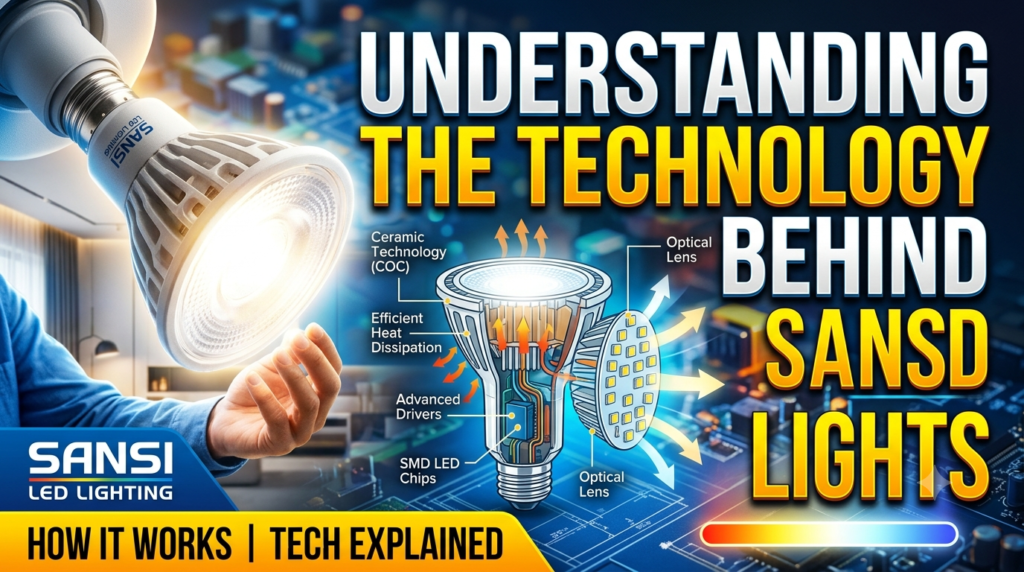
To understand why SANSI LED lights can deliver strong illumination while using electricity efficiently, it helps to look beyond the bulb’s appearance. LED performance depends on several connected factors, including the quality of the semiconductor chips, the electrical driver, thermal management, and the optical design that directs light into the surrounding area. When these components work together, a fixture can provide useful illumination without requiring excessive electrical power. SANSI focuses especially on ceramic-based heat management, which is intended to more efficiently remove heat from the LED chips. Its official COC technology page explains that the chips are mounted directly onto a ceramic base, reducing the number of intervening materials between the chips and the heat-dissipating structure.
This approach can help control operating temperatures and support stable lighting performance. Still, not every LED product delivers the same efficiency, and the technology alone does not determine how much electricity a specific bulb will consume. Buyers should also check the product’s lumen output, wattage, beam angle, and intended application. By considering these elements together, you can better understand how SANSI’s engineering choices translate into practical benefits rather than relying on marketing claims alone.
Chip-on-Ceramic Technology Explained
One of the defining features of SANSI’s lighting approach is its Chip-on-Ceramic technology. In a conventional LED assembly, the light-emitting chips may be mounted on a printed circuit board or another substrate, with heat moving through several material layers before reaching the heat sink. SANSI’s COC design instead places the LED chips directly onto a ceramic base, helping reduce thermal resistance along the heat-transfer path. Ceramic also provides electrical insulation, making it useful for applications where thermal performance and electrical separation are both important. This combination of mechanical stability, insulation, and heat dissipation, according to the business, is essential to their lighting technology.
Why does this matter to everyday users? Efficient heat management can help LED components operate under more controlled conditions, supporting reliability and reducing the likelihood of heat-related performance deterioration. It does not automatically guarantee that every SANSI bulb will be brighter or more efficient than every competing product, but it gives the company a distinct engineering approach. When comparing lighting options, look at the specifications for the exact model rather than assuming all products with ceramic components deliver identical results.
The Role of Heat Dissipation in Lighting Performance
Heat is one of the most important factors affecting the long-term performance of an LED light. Although LEDs generally use electricity more efficiently than traditional incandescent bulbs, they still generate heat inside their electronic components. If that heat cannot escape effectively, the operating temperature may rise, potentially reducing light output, accelerating component aging, and shortening the useful life of the fixture. SANSI addresses this challenge through its ceramic heat-dissipation design and, in some products, structures that encourage natural airflow around the lighting components. Its technical explanations describe how these features help move heat away from the LED chips.
Effective cooling can be especially valuable in lights that operate for long periods, such as security fixtures, industrial installations, or grow lights used for indoor plants. For consumers, the benefit is not simply that the light manages heat differently; it is that good thermal design can help preserve performance over time. However, the final result also depends on ambient temperature, installation conditions, ventilation, driver quality, and how frequently the light is used. Installing fixtures correctly and selecting ones that fit their surroundings are still crucial.
How SANSI LED Lighting Delivers Powerful Brightness
Brightness is one of the first things people notice when they switch on a light, but effective lighting involves more than producing a strong beam. A useful lighting system must provide enough illumination for the intended task while distributing that light across the right area. SANSI approaches this challenge through its LED technology and optical design, which can help direct light where it is needed instead of wasting it outside the target area. For example, a focused security light may be suitable for illuminating an entrance, driveway, or backyard, while a grow light needs to deliver appropriate light intensity to plant leaves. SANSI’s official product information highlights optical lenses designed to improve light distribution in certain products.
This matters because a light source that concentrates illumination effectively may provide better practical results than one with a higher headline brightness but poor coverage. When choosing a SANSI LED bulb, check its lumen rating, beam angle, and intended use. A higher lumen figure generally means more visible light output, but it does not automatically mean the light is comfortable or appropriate for every room. Matching brightness to the environment is the key to getting the most from an energy-efficient lighting system.
Energy Efficiency: More Light, Less Electricity
Energy efficiency describes how effectively a lighting product converts electrical power into useful light. In simple terms, an efficient light produces more lumens for each watt of electricity it consumes. This is particularly important in spaces where lights remain switched on for several hours each day. SANSI combines LED technology with thermal management intended to reduce wasted energy and support stable operation. Its ceramic-based design aims to move heat away from the chips efficiently, while optical elements can improve how effectively light reaches the intended area.
However, the most reliable way to compare energy efficiency is to examine the actual specifications of the products being considered. For example, if one bulb produces 1,600 lumens using 16 watts, its efficacy is 100 lumens per watt. A second bulb producing the same 1,600 lumens at 12 watts achieves approximately 133 lumens per watt. The second bulb would use 25% less power to produce the same rated light output, assuming comparable operating conditions. This simple comparison illustrates why wattage and brightness should be evaluated together. Instead of choosing a light based only on its power rating, look for a product that meets your illumination needs while consuming as little electricity as practical.
Comparing SANSI LED Lighting with Traditional Lighting
Traditional incandescent and halogen bulbs generate light by heating a filament or another element, meaning a substantial portion of their electrical energy becomes heat rather than visible light. LEDs work differently, producing light through semiconductor technology. This difference generally allows LED products to provide comparable illumination with lower electricity consumption. SANSI builds on the advantages of LED lighting through its ceramic thermal-management design, although the precise savings depend on which products are compared. The following table illustrates the general differences between lighting technologies rather than claiming that every SANSI product outperforms every competing bulb.
| Feature | Incandescent lighting | Traditional CFL lighting | SANSI LED lighting |
| Light generation | Heated filament | Gas discharge and fluorescent coating | Semiconductor LED chips |
| Energy use | Generally high | Generally lower than incandescent | Depends on model; designed for efficient operation |
| Heat management | Much energy becomes heat | Produces heat during operation | Ceramic cooling is used in applicable designs |
| Brightness options | Available in different outputs | Available in different outputs | Available in different outputs |
| Maintenance | Often requires frequent replacement | Typically lasts longer than incandescent | Lifespan depends on the specific product and conditions |
| Typical applications | Decorative and general lighting | General indoor lighting | Indoor, outdoor, security, commercial, and plant lighting, depending on model |
The practical lesson is straightforward: compare equivalent light output rather than judging products by appearance or wattage alone. A low-wattage light that does not adequately illuminate a room may force you to install additional fixtures, reducing the expected savings. Conversely, a correctly selected LED can provide sufficient illumination while using considerably less power than an older bulb. If you are replacing several frequently used lights, the combined reduction in electricity consumption can become meaningful over time. You should also consider replacement costs, installation requirements, and the manufacturer’s stated operating life. Looking at all these factors together gives you a more realistic comparison than focusing on the initial purchase price.
Long Lifespan and Consistent Light Output

An energy-efficient light offers greater value when it continues performing reliably over an extended period. Replacing a bulb involves more than buying another product; it may require climbing a ladder, interrupting work, arranging maintenance, or temporarily losing illumination in an important area. SANSI’s ceramic-based thermal-management approach is intended to reduce heat-related stress on LED components, helping support durability and stable light output. Its official technology materials explain that direct chip mounting and ceramic heat dissipation are designed to minimize thermal resistance and help preserve performance.
Nevertheless, actual lifespan varies by model, operating temperature, electrical conditions, and daily usage. A bulb advertised for a particular number of hours should be evaluated using its published specifications and warranty rather than assuming it will last equally long in every environment. For example, a fixture installed in a poorly ventilated enclosure may experience more thermal stress than the same fixture installed according to the manufacturer’s recommendations. Keeping fixtures clean, using suitable electrical supplies, and avoiding incompatible dimmers can also help prevent unnecessary problems. When you compare SANSI products, consider the rated lifespan and warranty alongside brightness and power consumption. Long-term reliability is an important part of energy efficiency because a durable product can reduce both replacement spending and the resources required to manufacture and transport new bulbs.
Applications of SANSI LED Lighting
One advantage of LED technology is its flexibility across different environments. A small household bulb, a powerful outdoor security light, and a specialist plant lamp may all use LEDs, but their designs and performance requirements differ considerably. SANSI offers products across several lighting categories, including residential and security applications, commercial lighting, and horticultural products.
This variety means buyers can consider the brand for different purposes, provided they select the appropriate model for their requirements. Homeowners may prioritize comfortable illumination and lower electricity consumption, while businesses may focus on dependable output and reduced maintenance. Indoor gardeners have another set of needs because plant lighting must provide appropriate intensity and spectral characteristics rather than simply making a space appear bright to human eyes. Outdoor users may need weather resistance, suitable beam coverage, and a fixture designed for exposure to environmental conditions. These differences explain why choosing lighting should begin with the job it needs to perform. Instead of asking only whether a SANSI light is bright, ask whether it provides the right kind of brightness, coverage, durability, and efficiency for your particular environment.
Residential and Indoor Lighting
At home, lighting influences comfort, productivity, and the atmosphere of a room. A bedroom may benefit from softer, warmer illumination, while a kitchen counter or home office often requires brighter, more functional light. SANSI LED products can be considered for suitable indoor applications where users want a combination of useful light output and efficient electricity consumption. When choosing a bulb, consider the size of the room, the height of the ceiling, the color of the walls, and the activities that take place there. A light with an excessively narrow beam may create bright spots and shadows, whereas a suitable beam spread can produce more even illumination. Color temperature is another important consideration: warm white often creates a relaxing atmosphere, while cooler white can feel more task-oriented. The exact options available depend on the product. For an everyday household installation, check the bulb’s base type, voltage compatibility, physical dimensions, and whether the fixture allows sufficient ventilation. If you are replacing several older bulbs, calculate their combined wattage and compare it with the wattage of the proposed LED replacements. These simple checks help ensure that your lighting upgrade improves both everyday usability and electricity efficiency without sacrificing comfort.
Commercial and Industrial Lighting
Commercial and industrial environments often need dependable lighting for longer operating hours and larger spaces. Warehouses, workshops, parking areas, and outdoor facilities may require substantial light output, carefully planned coverage, and equipment that can withstand demanding conditions. SANSI’s professional lighting portfolio includes applications such as street lighting, tunnel lighting, floodlighting, and high-bay lighting.
In these settings, efficiency can have a significant financial impact because many fixtures may operate simultaneously for extended periods. A well-planned LED installation can reduce electricity use compared with less efficient lighting, while durable fixtures may lower the frequency of maintenance work. However, businesses should evaluate the complete installation rather than choosing fixtures solely on their wattage. Important factors include measured light levels, uniformity, glare control, mounting height, ingress protection, ambient temperature, and applicable safety requirements. Industrial facilities may also need lighting designed for dust, moisture, vibration, or corrosive environments. The correct choice depends on the site conditions and the specific fixture’s ratings. Before replacing a large lighting system, a facility manager should compare photometric data, energy consumption, warranty coverage, and maintenance requirements. This approach helps determine whether the initial investment is justified by the expected operating savings.
Indoor Gardening and Plant Growth
Indoor gardening presents a different lighting challenge because plants need light for photosynthesis, not simply illumination that looks bright to people. A grow light must deliver suitable wavelengths and enough light intensity to support the particular plant species and growth stage. SANSI offers dedicated LED grow lights, including models designed for home plants and more specialized growing environments. Its product information describes features such as ceramic heat dissipation, adjustable positioning, and optical lenses intended to improve light delivery.
These features can help growers position light more effectively and manage electricity consumption, but results depend on plant type, distance from the fixture, daily lighting duration, and the product’s spectral output. For example, a leafy herb growing on a kitchen shelf may have different lighting requirements from a fruiting plant that needs stronger illumination. The most useful grow-light specifications include photosynthetic photon flux density (PPFD), light distribution, spectrum, and the manufacturer’s recommended coverage area. A high lumen rating alone is not sufficient to assess a grow light because lumens measure brightness according to human vision rather than the number of photosynthetically useful photons delivered to plants. Choosing a suitable SANSI grow light therefore requires matching its technical specifications to the plants you intend to grow.
Smart Design and Better Light Distribution
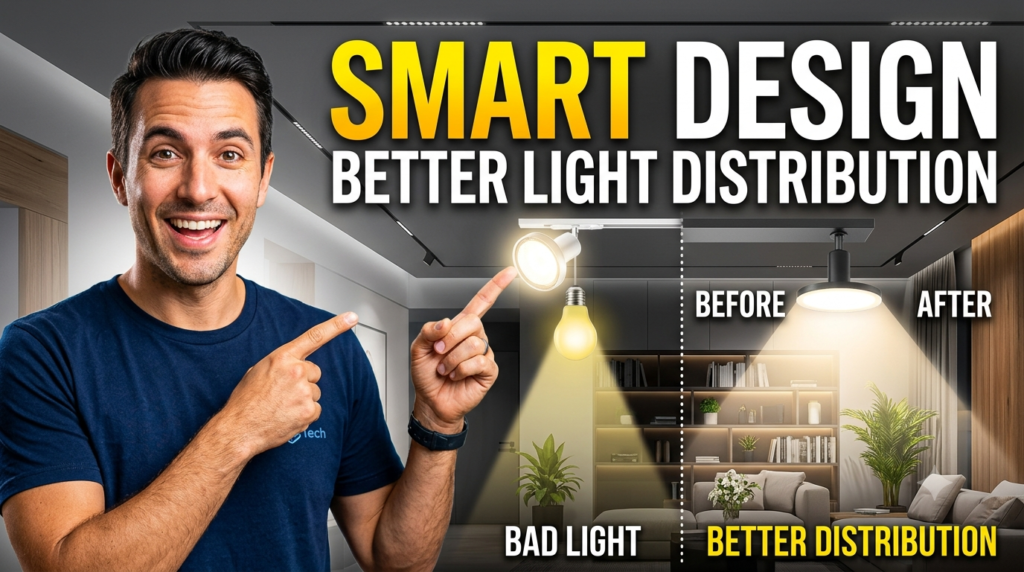
Brightness becomes more useful when a lighting product distributes it effectively. Imagine two lamps producing the same total amount of light: one illuminates a desk evenly, while the other creates a bright spot surrounded by shadows. Although their total light output may be similar, the first lamp may provide a more comfortable working experience. This is why light distribution and optical design deserve attention when choosing an energy-efficient fixture. SANSI’s product range includes lighting designs that use optical lenses to direct and distribute light for particular applications. Its grow-light products, for example, describe lens designs intended to improve light delivery to plants.
Depending on the fixture, a focused beam can be useful for illuminating a specific area, while a wider distribution may be more suitable for general room lighting. Effective distribution can also reduce the need for additional fixtures in some installations, although this depends on the space and its lighting requirements. When shopping, check the beam angle and recommended coverage area alongside the lumen rating. For commercial projects, photometric diagrams can provide a clearer picture of expected illumination. Good lighting design combines sufficient output with appropriate placement, making the available light more useful without automatically increasing electricity consumption.
Environmental Benefits of Energy-Efficient Lighting
Energy-efficient lighting can support environmental goals by reducing the electricity required to illuminate homes and workplaces. When a light uses fewer watts to produce the same amount of useful illumination, the associated electricity demand decreases. Depending on the local electricity supply, lower consumption can also reduce greenhouse gas emissions linked to power generation. SANSI’s focus on LED technology and thermal management aligns with this broader goal of making lighting more efficient. Longer-lasting products may offer an additional benefit by reducing the frequency of bulb replacement and the materials needed for manufacturing, packaging, and transportation. However, the environmental impact of a particular light depends on its complete life cycle, including production, shipping, electricity consumption, and end-of-life disposal. LED products also contain electronic components that should be handled through appropriate recycling or collection programs where available. Consumers can contribute by choosing products that meet their actual lighting needs, switching lights off when they are unnecessary, and selecting fixtures with credible performance specifications. Energy efficiency is most meaningful when it combines lower electricity use with responsible product selection and maintenance. SANSI lighting can be one option within this wider approach, but the actual environmental benefit should be assessed using the product’s efficiency, operating hours, expected lifespan, and local electricity conditions.
How to Choose the Right SANSI LED Light
Choosing the right SANSI LED light starts with identifying what you want to illuminate. A bulb for a bedroom does not necessarily need the same brightness or beam pattern as a security light for an outdoor entrance. Similarly, a plant-growing fixture needs specifications relevant to photosynthesis rather than relying on ordinary household lighting measurements. Once you know the application, compare the product’s light output, wattage, dimensions, color temperature, beam angle, and operating requirements. If you are buying an outdoor light, check its ingress protection rating and confirm that it is suitable for the intended weather exposure. For a grow light, examine its PPFD data, coverage recommendations, spectrum, and suggested distance from the plants. For a household bulb, make sure its base fits the socket and its voltage is compatible with your electrical supply. Warranty terms also matter because they indicate the manufacturer’s stated coverage for qualifying product issues, subject to the conditions provided. SANSI publishes product-specific information through its official website, making it a useful starting point for checking available features.
Rather than choosing the highest-powered option automatically, select a model that meets your needs with an appropriate amount of light and a reasonable level of electricity consumption.
Understanding Lumens, Watts, and Color Temperature
Three measurements can make choosing energy-efficient lighting much easier: lumens, watts, and color temperature. Lumens describe the total visible light output of a source, while watts indicate how much electrical power it consumes. Color temperature, measured in kelvins (K), describes the appearance of the light, ranging from warmer-looking white to cooler-looking white. Understanding the difference prevents a common purchasing mistake: assuming a higher wattage always means a better or brighter bulb. In reality, two lights consuming the same amount of power can produce different quantities of visible light because their efficiencies differ. The table below summarizes how these measurements help you compare products.
| Measurement | What it tells you | Why it matters |
| Lumens (lm) | Total visible light output | Helps determine whether a light provides sufficient brightness |
| Watts (W) | Electrical power consumption | Helps estimate energy use and running costs |
| Lumens per watt (lm/W) | Light output per unit of power | Helps compare energy efficiency |
| Color temperature (K) | Warm or cool appearance of white light | Helps match lighting to a room or task |
| Beam angle | How broadly light is distributed | Helps assess coverage and light placement |
| PPFD | Photosynthetically active photons reaching a surface per second per unit area | Helps evaluate light delivered to plants |
For example, consider two hypothetical bulbs that each produce 1,200 lumens. The first produces 100 lumens per watt, whereas the second produces 80 lumens per watt, if the first consumes 12 watts and the second uses 15. The first bulb therefore produces the same rated light output while using 20% less electricity than the second. These figures are illustrative, not specifications for particular SANSI products. When comparing actual models, use their published ratings and consider light quality, coverage, and suitability as well as efficiency. This gives you a much stronger basis for choosing the right light than relying on wattage alone.
Read More:-
How Does Strikingly Simplify the Website Building Process?
Building Your Dream Website with Site123
Boost Your E-commerce Strategy with YITH Plugins
Maximize Your Customer Engagement with LiveAgent’s Features
Why STRIPO is Essential for Digital Product Marketersa
Cost Savings and Long-Term Value
The financial value of an LED light comes from more than its purchase price. Electricity consumption, daily operating hours, replacement frequency, and maintenance requirements all affect the total cost of ownership. A more expensive light may offer better long-term value if it delivers the required brightness with lower power consumption and remains reliable for an extended period. To understand the potential savings, imagine replacing a 60-watt incandescent bulb with a 10-watt LED that provides comparable illumination. If the light operates for five hours every day, the incandescent uses 0.30 kilowatt-hours daily, while the LED uses 0.05 kilowatt-hours. The difference is 0.25 kilowatt-hours per day, or approximately 91.25 kilowatt-hours over a year. At an illustrative electricity rate of ₹8 per kilowatt-hour, that represents ₹730 in annual electricity savings for one bulb, assuming consistent usage and comparable light output. Actual savings will depend on your electricity tariff and the products being compared. With SANSI, the appropriate calculation should use the actual wattage of the chosen model rather than a general assumption about the brand. If you are upgrading multiple bulbs or lights that run for long periods, the combined savings may be more substantial. Considering electricity costs alongside durability and maintenance helps you decide whether the initial investment makes financial sense.
Potential Limitations and Buying Considerations
Although SANSI LED lighting offers features designed to support brightness and efficiency, it is important to assess each product realistically. Not every LED light is suitable for every application, and a specialist fixture may be unnecessary for someone who only needs basic room illumination. The purchase price can also differ between products depending on their power, features, construction, and intended use. Buyers should compare these costs with the expected electricity savings and operating life instead of assuming that a higher-priced light will always provide better value. Another consideration is installation compatibility. A bulb may not fit a particular fixture, and some dimmable products require compatible dimmers to operate correctly. Outdoor lights must be selected according to the environment, while indoor grow lights need suitable placement and operating schedules to avoid providing too much or too little light to plants. It is also sensible to review the warranty, local availability, replacement options, and electrical certifications relevant to your location. Finally, marketing terms such as high brightness and energy saving should be supported by measurable specifications. Check the lumen output, wattage, and other application-specific data before making a decision. A thoughtful comparison helps you benefit from the right technology without paying for features you do not need.




Conclusion
SANSI LED lighting uses LED technology, ceramic-based thermal management, and application-specific optical designs to combine the potential for strong illumination with economical electricity use. Its Chip-on-Ceramic approach places LED chips directly onto a ceramic base, helping manage heat and supporting reliable performance. When combined with an appropriate optical design, these features can make lighting more effective for residential, commercial, outdoor, and horticultural applications. Energy efficiency also depends on the light output delivered for each watt consumed, so checking real product specifications remains essential. Buyers should compare lumens, wattage, beam angle, color temperature, and lifespan rather than choosing a fixture based solely on its appearance or advertised power. Over time, a well-selected LED light can reduce electricity consumption and may lower replacement and maintenance costs. The best choice is the one that provides the right illumination for your environment while meeting your budget and installation requirements. Whether you are upgrading household bulbs, improving workplace lighting, or supporting indoor plant growth, evaluating these factors will help you determine whether a SANSI product is a suitable investment.
Frequently Asked Questions
Q. What makes SANSI LED lighting different from ordinary LED lights?
A. SANSI emphasizes its Chip-on-Ceramic technology, which mounts LED chips directly onto a ceramic base to support heat dissipation and electrical insulation. The company also incorporates optical and structural designs for specific lighting applications. The practical difference depends on the individual model, so compare published brightness, wattage, efficiency, and lifespan specifications before purchasing.
Q. Do SANSI LED lights help reduce electricity bills?
A. They can help reduce electricity costs when a selected model consumes less power than the lighting it replaces while providing comparable illumination. To estimate your savings, subtract the new light’s wattage from the old light’s wattage, multiply the difference by daily operating hours, and calculate the cost using your electricity tariff. The actual savings depend on the products compared and how often they are used.
Q. Are SANSI LED lights suitable for outdoor use?
A. Some SANSI products are designed for outdoor applications, including security and professional street lighting. However, suitability depends on the exact model and its protection ratings. Before installation, verify the fixture’s weather resistance, ingress protection rating, voltage requirements, and suitability for the intended environment.
Q. Can SANSI LED grow lights support indoor plants?
A. Yes, SANSI offers dedicated grow lights for indoor plants and other horticultural applications. These products are designed to provide light for plant growth, but the correct choice depends on the plant species, growing area, light intensity, spectrum, and distance from the leaves. Check the product’s PPFD information and coverage recommendations rather than relying on ordinary brightness measurements alone.
Q. What should I check before buying a SANSI LED light?
A. Start by identifying the intended application and the amount of illumination required. Then compare lumen output, wattage, lumens per watt, color temperature, beam angle, and expected lifespan. For specialist products, check additional requirements such as outdoor protection ratings or grow-light specifications. Finally, review compatibility, warranty conditions, and total operating costs to make an informed purchase.