Designmodo Startup Framework is a powerful Bootstrap-based website builder designed to help users create responsive, professional-looking websites and landing pages without starting from scratch. With its drag-and-drop editor, ready-made UI blocks, Bootstrap 5 templates, customization options, and code export capabilities, the Designmodo Startup Framework makes web design faster and more convenient for startups, marketers, freelancers, designers, and developers. Whether you want to build a landing page, portfolio, business website, or marketing campaign page, Startup Framework provides flexible tools to turn your ideas into polished web experiences while saving time and reducing repetitive coding work.
Table of Contents
- What Is Designmodo Startup Framework?
- Key Features of Designmodo Startup
- Designmodo Startup Pricing
- Pros of Designmodo Startup Framework
- Cons of Designmodo Startup Framework
- Who Should Use Designmodo Startup?
- Designmodo Startup vs Traditional Web Development
- Tips for Getting the Most From Startup
- Is Designmodo Startup Worth It?
- Conclusion
- FAQs
What Is Designmodo Startup Framework?
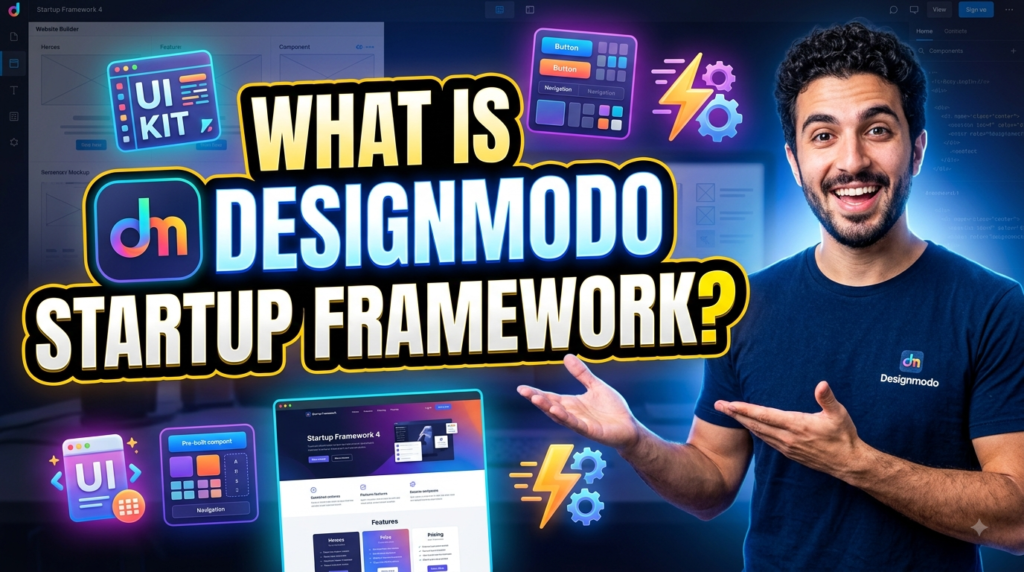
If you have ever tried to build a polished landing page from scratch, you already know the problem: the blank canvas can be surprisingly intimidating. You may have an idea for the page, know roughly what the hero section should say, and even have your colors and logo ready, but turning that idea into responsive HTML, CSS, and a consistent visual system can consume far more time than expected. Designmodo Startup Framework approaches that problem from a different direction. Instead of asking you to build every component manually, it provides a visual, drag-and-drop environment based on Bootstrap, allowing you to assemble pages from professionally designed sections and then customize them for your project. Designmodo currently describes Startup as a Bootstrap template builder that helps developers create responsive landing pages more quickly, while its official product information highlights a WYSIWYG editor, ready-made UI elements, Bootstrap 5 templates, SEO controls, version backups, and export functionality. The important distinction is that Startup is not simply another generic website builder designed to keep everything inside a proprietary hosting ecosystem. It is particularly attractive when you want to visually create a page and eventually work with the resulting code. That makes it especially interesting for designers, marketers, developers, agencies, freelancers, and startup teams that need speed without completely giving up control. The real question, though, is not whether Startup can create attractive pages—it clearly can—but whether its workflow, features, pricing, and limitations make sense for your particular website project.
How the Bootstrap-Based Builder Works
The foundation of Startup is Bootstrap, which matters because Bootstrap is already familiar to a huge number of web developers and provides a responsive grid and component structure. Designmodo’s own tutorial describes Startup as a drag-and-drop Bootstrap page builder and notes that the generated pages are built around responsive design and modern HTML5/CSS3 structure. Think of the framework as a box of high-quality building blocks rather than a pile of raw construction materials. You can choose a header, hero area, content section, testimonial block, pricing section, contact form, footer, or other component, arrange them visually, replace the text and imagery, and adjust the design rather than writing every line of markup from zero. This workflow can be particularly useful when the primary goal is getting a professional marketing page online quickly. A developer can then take the exported project and continue customizing it when the project requires more control. The approach also reduces the amount of repetitive front-end work involved in producing common landing-page structures. Instead of spending hours making sure basic spacing, responsiveness, typography, and section relationships work together, you start with components that have already been designed as part of a coherent visual system. That does not mean every website becomes magically finished in minutes, because content strategy, branding, accessibility, performance, integrations, and custom functionality still require thought. What Startup does exceptionally well is shorten the distance between “I need a polished page” and “I have a usable page structure in front of me.”
Key Features of Designmodo Startup
The strongest reason to consider Designmodo Startup is its collection of features aimed at accelerating visual web development. According to Designmodo’s current product information, Startup includes a drag-and-drop WYSIWYG editor, Bootstrap 5-based templates, a UI kit containing ready-to-use elements, automatic project backups, basic SEO controls, and the ability to edit page elements without coding. The platform has also evolved beyond simply offering static blocks. Its current feature information mentions integration setup, additional UI elements, popups, team functionality, and an SVG library, showing that the product is intended to function as a broader visual page-building environment. For someone who regularly produces landing pages, product pages, campaign pages, or startup websites, these features can remove a lot of repetitive work. You are not starting from an empty HTML file and wondering how to structure every section. You are starting from a library of established patterns and adapting them to your needs. That distinction can have a meaningful impact on productivity. The value is even stronger when multiple people are involved because designers can focus on visual decisions while developers can concentrate on the parts of a project that actually need engineering expertise. Startup is therefore best understood as a productivity tool for Bootstrap-based web design, rather than as a replacement for every possible development workflow.
Drag-and-Drop Visual Editor
The visual editor is probably the feature that most directly affects the day-to-day experience of using Startup. Rather than designing a page entirely through code, you can manipulate sections and components visually, which makes experimentation much faster. This is especially useful for people who understand design and marketing but do not want to spend their entire day writing front-end markup. A good visual editor also changes the feedback loop: instead of editing code, saving a file, refreshing a browser, inspecting the result, and repeating the process, you can make many structural decisions directly within the builder. G2 reviews reinforce this perception, with users describing Startup as easy to use and praising its drag-and-drop interface and customizable blocks. One verified small-business reviewer specifically highlighted the ability to create websites quickly with pre-designed blocks, while another reviewer praised the straightforward interface and visual components. Of course, visual editing does not eliminate the need for web knowledge. If you need unusual interactions, complex backend functionality, highly specialized layouts, or advanced accessibility work, you may still need a developer. But for standard marketing pages, the editor can make the process feel less like programming and more like assembling a design system.When speed is important, that is a significant benefit.
Ready-Made Blocks and Templates
Pre-designed blocks are another major selling point because they give you a starting point that already looks intentional. A modern landing page typically contains familiar sections such as navigation, a hero statement, product benefits, social proof, feature explanations, pricing, calls to action, and a footer. Creating each of those from scratch is possible, but it is rarely the best use of time when the goal is simply to launch a polished marketing page. Startup provides templates and reusable components that let you mix and match these structures. Designmodo’s template library includes complete Bootstrap-based examples, including startup-oriented layouts with pricing tables, contact forms, video sections, and flexible blocks that can be rearranged. The advantage goes beyond aesthetics. Consistent components can help prevent the visual inconsistency that often appears when different sections are independently designed. Instead of having one button style in the hero, another in the pricing section, and a completely different card design lower on the page, you begin from a unified system. You can still customize the content and visual direction, but the underlying design language gives you a strong foundation. For freelancers and agencies producing multiple client pages, this can turn Startup into something resembling a reusable production line: choose a suitable foundation, adapt the brand, replace the content, refine the layout, and export the result.
Bootstrap 5 and Responsive Design
The Bootstrap foundation is particularly relevant for developers who do not want to be locked into an unfamiliar framework. Designmodo states that Startup 5 runs on Bootstrap 5, while its tutorials describe the builder as a Bootstrap-based solution for creating responsive pages. This gives Startup a different character from closed website builders where the visual editor and hosting platform are inseparable. Bootstrap’s established grid and component conventions can make the resulting project easier for a developer already comfortable with the framework to understand and modify. Responsive design is also central to modern websites because a landing page that looks beautiful on a large desktop but breaks on mobile is not really a successful landing page. Starting from responsive components gives you a stronger baseline, although you should still test the finished page across actual screen sizes and browsers. A useful way to think about this is that Startup handles some of the engineering groundwork, but it does not absolve you from quality assurance. You still need to inspect spacing, text wrapping, images, navigation, forms, accessibility, loading performance, and mobile interactions. The framework provides the road; your team still needs to make sure the vehicle reaches its destination safely.
Code Export and Customization
Code export is one of the most important differences between Startup and many purely hosted visual website builders. Startup is designed around Bootstrap-based page creation and allows users to export the resulting work, which can then become part of a broader development workflow. Designmodo’s official tutorial specifically describes exporting a completed Startup page and downloading its HTML, while the product itself emphasizes Bootstrap-based templates and visual editing. This is valuable because you are not necessarily choosing between visual simplicity and developer control. A designer can create the first version visually, while a developer can later modify the exported files for more specialized requirements. For example, a team might build a campaign landing page in Startup, export the code, connect the form to its preferred backend, add analytics, integrate custom scripts, and deploy it using its existing infrastructure. That flexibility can be a genuine advantage for technical teams. At the same time, code export should not be confused with unlimited customization inside the editor. Some users specifically mention limitations when they need more complex websites or detailed styling control, so advanced projects may eventually require direct code editing. In other words, Startup can be an excellent launchpad without necessarily being the final destination for every project.
Designmodo Startup Pricing
Pricing is one area where you should check the official page before purchasing because software plans can change. Designmodo’s current product pages show Startup with a free option and paid plans, while the official Startup page currently lists Business at $50 per quarter and Agency at $62 per quarter in the displayed pricing section. Designmodo’s broader site currently presents different annual pricing figures, so the safest approach is to treat the official pricing page as the source of truth at the time you are ready to subscribe rather than relying on an old review or comparison website. The free tier is useful because it allows prospective users to experience the editor before committing financially, although it has feature limitations. The paid tiers are primarily differentiated by export capacity and additional capabilities: the official Startup page lists 20 exports per month for Business and unlimited exports for Agency, alongside full feature access and priority support. This structure makes the decision fairly straightforward. If you are experimenting, learning, or creating occasional pages, start with the free option and evaluate whether the workflow fits you. If you are producing client websites regularly, the unlimited-export Agency plan may make more sense. The important calculation is not simply the subscription price; it is the amount of development and design time you save compared with building equivalent pages manually.
| Plan | Current official displayed price* | Export allowance | Best suited for |
| Free | $0 | Limited | Testing the editor and learning the workflow |
| Business | $50/quarter | 20 exports/month | Small teams and occasional website production |
| Agency | $62/quarter | Unlimited exports | Freelancers and agencies handling multiple projects |
*Prices can change, and Designmodo’s site displays different billing-period figures in different product sections, so verify the current checkout price before purchasing.
Pros of Designmodo Startup Framework
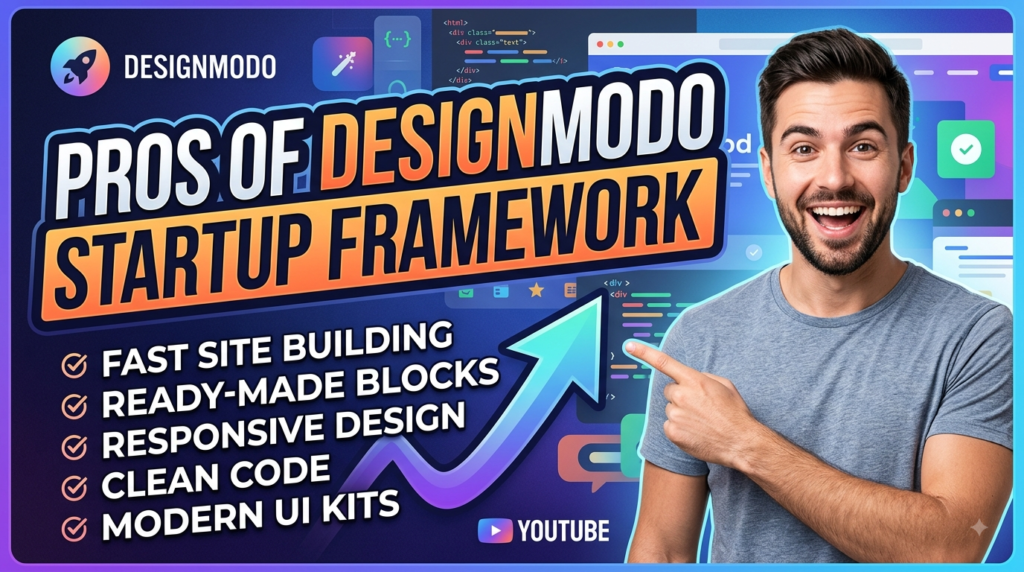
The biggest advantage of Designmodo Startup is speed without completely sacrificing developer access. Finding that combination is more difficult than it seems. Many no-code tools are extremely convenient but can become restrictive when you need to move beyond the platform, while traditional development provides flexibility at the cost of time and technical effort. Startup sits somewhere between those approaches. You can visually assemble professional-looking Bootstrap pages, customize the content, use responsive components, and export the project for additional development. User feedback also suggests that ease of use is one of its strongest qualities. G2 currently lists Startup at 4.5 out of 5 based on 16 reviews, with reviewers repeatedly mentioning the intuitive interface, pre-designed blocks, fast website creation, and customer support. Another G2 comparison shows Startup receiving a 9.3 ease-of-use score in the comparison dataset against Wix’s 9.2, although the sample sizes and methodologies should be considered before treating those numbers as a definitive industry ranking. The framework is particularly compelling when your project has a clear visual structure but does not justify building every common component from scratch. For a startup launching a product page, a freelancer creating a client’s landing page, or a marketing team preparing a campaign site, those saved hours can translate into real business value.
Speed and Ease of Use
Speed is where Startup can deliver its clearest return on investment. Imagine needing to create a landing page for a product announcement tomorrow morning. With traditional development, you might spend time setting up the project, creating components, establishing responsive behavior, selecting typography, writing CSS, testing breakpoints, and then refining the design. With Startup, much of the initial structure already exists, allowing you to focus more heavily on the message and visual direction. A verified G2 reviewer described using Startup to produce a rebranded website for an urgent client request within 24 hours, saying that the pre-designed blocks helped accelerate the process considerably. That does not mean every website can or should be built overnight, but it illustrates the productivity benefit. Speed is particularly valuable when you repeatedly create similar page types. Once you understand how the editor works, the process becomes increasingly familiar: choose a structure, customize the sections, refine the responsive layout, check SEO settings, preview the page, and export. The learning curve therefore pays dividends over time. If you build only one extremely complicated website every few years, Startup may not dramatically change your economics. If you produce landing pages every month, however, shaving hours from repetitive front-end work can become a meaningful competitive advantage.
Professional Design Quality
A second major advantage is the quality of the starting point. A blank editor gives you freedom, but freedom without design direction can sometimes produce a page that feels like five unrelated websites glued together. Designmodo’s templates and blocks are created with modern marketing and interface patterns in mind, giving users a more reliable visual foundation. The official template library demonstrates layouts with structured hero sections, pricing tables, contact areas, video content, and flexible blocks designed to be mixed and matched. This can be especially useful for users who are comfortable with technology but less confident about visual design. You do not have to become a professional UI designer before creating a credible landing page. Instead, you can start from established patterns and then introduce your own brand personality through typography, colors, photography, copy, and spacing. The result is not automatically perfect—good design still depends heavily on content and hierarchy—but the framework makes it harder to fall into some of the most obvious beginner mistakes. For businesses, this matters because the website is often the first impression a visitor gets. A polished structure can make a small company look organized and credible before the visitor has read a single paragraph.
Cons of Designmodo Startup Framework
No tool is perfect, and Startup’s biggest weakness becomes visible when your project moves outside the type of website it was designed to accelerate. If you need an extremely complex web application, a highly customized interaction system, unusual backend behavior, or granular control over every design detail, a visual Bootstrap builder may eventually feel restrictive. G2 reviewers have specifically pointed to limitations for more complex websites and situations requiring detailed styling control. There is also a learning curve—not necessarily a steep one, but enough to require time if you want to use the system efficiently rather than simply clicking around. Another consideration is subscription cost. While a free option lets you test the product, frequent users need to decide whether the paid plan provides enough productivity gains to justify ongoing spending. The tool can also encourage users to think in terms of available blocks, which can sometimes lead to pages that feel too template-driven if customization is superficial. If everyone simply changes the logo and headline, the final websites may start looking similar. The solution is not to avoid templates; it is to use them as foundations rather than finished products. Good users treat the blocks as ingredients, not the meal itself.
Customization Limitations
Customization deserves special attention because it is one of the biggest dividing lines between beginners and experienced developers. A marketing manager may consider a large library of adjustable blocks more than enough, while a front-end engineer may want control over every wrapper, CSS rule, animation, breakpoint, and component behavior. Both perspectives are valid. Startup is strongest when you need structured customization—changing text, imagery, layout, styles, components, and page composition inside an established design framework. It becomes less attractive when your requirements are so unusual that the framework itself starts getting in the way. One G2 reviewer noted that people seeking more complex websites or detailed styling control may encounter limitations. The presence of code export partially solves this problem because developers can continue the work after leaving the visual editor. Still, you should decide early where the boundary lies. If you already know the project will require a custom application architecture, advanced database logic, complex user authentication, or sophisticated application-state behavior, Startup should probably be considered a front-end acceleration tool rather than the entire development platform. Used that way, its limitations become much less problematic.
Who Should Use Designmodo Startup?
Designmodo Startup makes the most sense for freelancers, designers, marketers, startup founders, agencies, and developers who frequently create landing pages or relatively straightforward websites. It is particularly useful when visual polish matters and the deadline is tight. A freelancer can use it to create a client prototype quickly before refining the exported code. A marketing team can use it to build campaign pages without waiting for a developer to create every section. A startup founder can experiment with messaging and page structure before investing in a more extensive custom implementation. Developers can use it as a productivity layer when they do not want to hand-code repetitive Bootstrap structures. The common thread is that these users benefit from starting with a professional design system rather than starting from zero. On the other hand, someone building a large e-commerce platform, social network, SaaS dashboard, or highly interactive web application may need a different primary tool. That does not make Startup a bad product; it simply means the job is different. Choosing software is a little like choosing a vehicle: a sports car is not defective because it cannot carry a refrigerator, and a delivery van is not a poor vehicle because it cannot race around a track. The right question is whether Startup matches the road your project needs to travel.
Designmodo Startup vs Traditional Web Development

The most useful comparison is not necessarily Startup versus another website builder; it is Startup versus doing the same work manually. Traditional development gives you maximum flexibility, but flexibility comes with responsibility. You need to establish the component architecture, responsive system, CSS, typography, page structure, interactions, browser testing, and deployment process yourself. Startup handles a significant portion of the repetitive front-end foundation and allows you to concentrate on customization and content. This can produce a much faster workflow for standard marketing websites. Designmodo’s own tutorial emphasizes that Startup is intended to help users create responsive Bootstrap pages quickly through drag-and-drop editing. The trade-off is that manual development can ultimately provide more precise control. If you have a specialized design system or an engineering team that already has a mature component library, building directly in your own stack may be more efficient than adapting an external builder. Startup is therefore most compelling when the alternative is spending substantial developer time recreating common page patterns. It is less compelling when your team already has an extremely efficient internal system for producing those same pages. Before purchasing, compare the tool against your actual workflow, not against an imaginary beginner who has never written HTML.
| Factor | Designmodo Startup | Traditional Development |
| Initial setup | Fast | Usually more involved |
| Visual design | Built around ready-made components | Fully custom |
| Coding required | Low for basic page creation | High |
| Bootstrap support | Core part of workflow | Optional |
| Custom functionality | Possible after export/custom coding | Maximum flexibility |
| Reusable components | Built into the builder | Developer-defined |
| Speed for landing pages | Usually strong | Depends on team and existing stack |
| Control over architecture | More limited | Very high |
| Best use case | Marketing pages and rapid Bootstrap sites | Complex or highly customized applications |
Read More:-
How Does Strikingly Simplify the Website Building Process?
Building Your Dream Website with Site123
Boost Your E-commerce Strategy with YITH Plugins
Maximize Your Customer Engagement with LiveAgent’s Features
Why STRIPO is Essential for Digital Product Marketersa
Tips for Getting the Most From Startup
The first tip is simple: do not start by dragging random blocks onto the page. Start with the goal of the page. Decide what action you want the visitor to take, what information they need before taking it, and what objections might stop them. Once that structure is clear, choose Startup components that support the story rather than allowing the component library to dictate the story. The second tip is to customize more than the headline. Replace generic imagery, refine typography, adjust spacing, rewrite button labels, and make sure the visual hierarchy reflects the brand. The third is to treat SEO as part of the design process rather than something you remember five minutes before publishing. Startup’s official feature list includes basic SEO controls such as meta tags, favicon, Open Graph information, and body classes, but those tools are only useful if you actually create strong titles, descriptions, headings, URLs, and page content. Finally, always test the exported result. Check mobile layouts, forms, navigation, image loading, links, metadata, and accessibility. A beautiful editor preview is only one checkpoint; the real product is the website your visitor experiences.
Is Designmodo Startup Worth It?
For the right project, yes—Designmodo Startup Framework is worth considering, especially if your priority is creating professional Bootstrap-based landing pages and websites faster without completely abandoning the possibility of code-level customization. Its strongest combination is the visual editor, pre-designed blocks, Bootstrap 5 foundation, responsive approach, and export workflow. Current user feedback also supports the product’s reputation for ease of use, with G2 showing a 4.5/5 rating from 16 reviews and multiple reviewers praising its drag-and-drop experience and speed. The qualification is important: Startup is not automatically the best choice for every website. If your project requires a sophisticated application architecture or highly granular customization, you may outgrow the builder. But if you are repeatedly building marketing pages, startup websites, campaign landing pages, portfolios, or Bootstrap-based client sites, the productivity gains can make the subscription worthwhile. The smartest approach is to use the free option first, build a realistic page rather than a five-minute demo, and see whether the workflow genuinely saves you time. If it does, the paid plan becomes much easier to justify. In short, Startup is worth it when speed, design quality, Bootstrap compatibility, and exportable code matter more to you than unlimited visual freedom inside the editor itself.



Conclusion
Designmodo Startup Framework occupies an interesting middle ground between traditional coding and fully managed no-code website builders. It gives users a visual environment for creating responsive Bootstrap pages while preserving a path toward developer customization through exported code. Its ready-made components can dramatically reduce repetitive design and front-end work, while Bootstrap 5 provides a familiar foundation for developers who want to continue working with standard web technologies. The biggest benefits are speed, ease of use, professional starting designs, and a workflow that can accommodate both designers and developers. The biggest drawbacks appear when a project requires unusually complex functionality or extremely detailed styling control. That makes the buying decision less about whether Startup is “good” and more about whether its strengths line up with your workflow. If you regularly need polished landing pages and want to move from concept to exportable website quickly, it can be a very practical investment. If you are building a highly specialized application, you may be better served by treating Startup as a supplementary design and prototyping tool rather than your complete development environment. Ultimately, the best test is simple: build one realistic project with the free version, measure the time you save, and then decide whether the paid features are worth the cost.
FAQs
Q. Is Designmodo Startup good for beginners?
A. Yes. Startup is designed around a visual drag-and-drop workflow, making it accessible to users who do not want to write every part of a landing page manually. G2 reviewers frequently praise its straightforward interface and pre-designed components. Beginners should still learn basic HTML, CSS, responsive design, and SEO concepts because those skills make it much easier to customize and troubleshoot the final website.
Q. Is Designmodo Startup based on Bootstrap?
A. Yes. Startup is built around Bootstrap, and Designmodo’s current information states that Startup 5 runs on Bootstrap 5. This makes it particularly attractive to developers and designers who already understand Bootstrap’s responsive grid and component approach.
Q. Can I export a website created with Designmodo Startup?
A. Yes. Exporting is an important part of the Startup workflow. Designmodo’s own tutorial demonstrates exporting a completed Startup page and downloading the HTML, allowing developers to continue working with the generated project outside the visual editor.
Q. Does Designmodo Startup have a free plan?
A. Yes. Designmodo currently offers a free Startup option with limited features. Its official product page also lists paid Business and Agency plans, with the displayed pricing showing different export allowances between those tiers. Because pricing can change, check the official Startup pricing page before subscribing.
Q. Is Designmodo Startup better than coding a website from scratch?
A. That depends on the website. Startup can be considerably more efficient for standard landing pages, marketing websites, and Bootstrap-based projects because you begin with ready-made components rather than creating everything from scratch. For highly customized applications or projects with unusual technical requirements, traditional development can provide greater architectural and styling control.