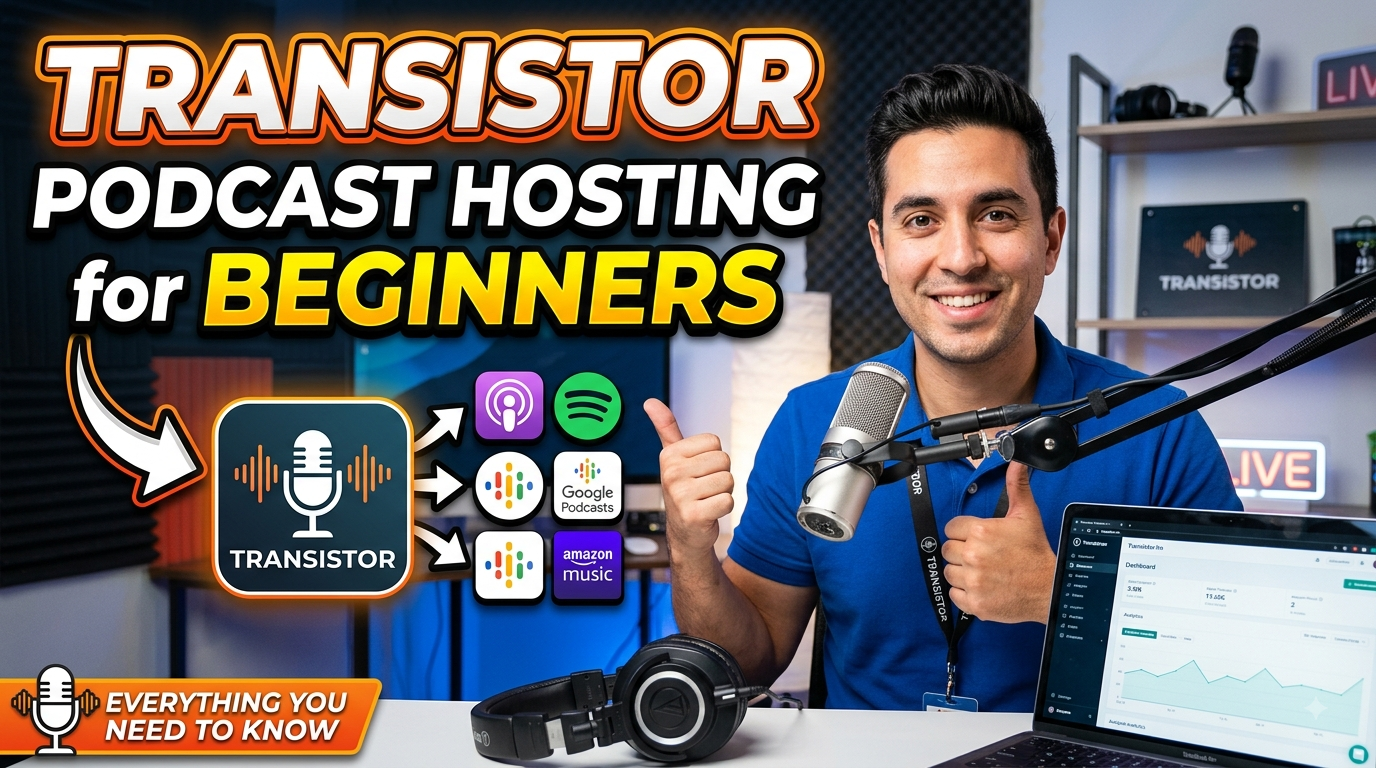
Transistor Podcast Hosting is a powerful podcast hosting platform designed to make publishing, managing, and growing a podcast simple for beginners and experienced creators alike. With features such as unlimited podcast hosting, reliable RSS feed distribution, advanced podcast analytics, customizable podcast websites, team collaboration, private podcasts, and monetization tools, Transistor Podcast Hosting provides everything creators need to build a professional podcast presence. Whether you’re launching your first show, managing multiple podcasts, or looking for detailed audience insights, Transistor offers a scalable solution that helps streamline podcast publishing and reach listeners across major podcast platforms.
Table of Contents
- What Is Transistor Podcast Hosting?
- Why Podcast Hosting Matters
- Key Features of Transistor
- Transistor Podcast Pricing
- How to Start a Podcast With Transistor
- Transistor RSS Feeds and Distribution
- Transistor Podcast Analytics
- Transistor Podcast Website Builder
- Private Podcasts and Team Collaboration
- Transistor Dynamic Ads and Monetization
- Transistor Video Podcast Hosting
- Pros and Cons of Transistor
- Is Transistor Beginner-Friendly?
- Transistor Alternatives
- Tips for Growing Your Podcast With Transistor
- Common Mistakes Beginners Should Avoid
- Is Transistor Worth the Money?
- Conclusion
- FAQs About Transistor Podcast Hosting
What Is Transistor Podcast Hosting?
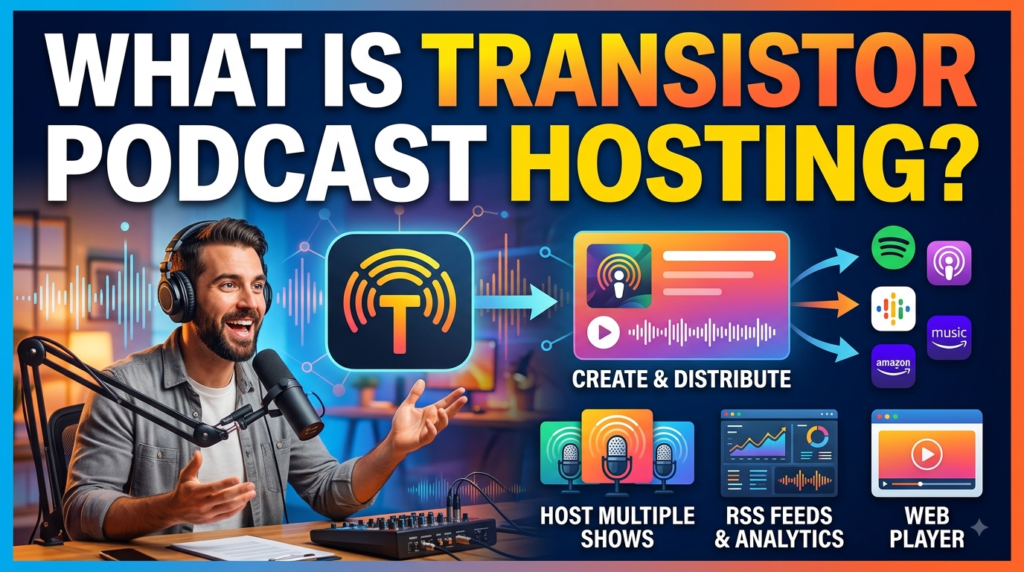
Transistor is a podcast hosting platform that provides the infrastructure needed to publish and distribute podcast episodes online. When you record a podcast, you ultimately have an audio file that needs to live somewhere reliable so podcast applications can retrieve it whenever someone wants to listen. Transistor stores your podcast media and creates the RSS feed that contains important information about your show, including episode details and links to your audio files. That RSS feed then becomes the bridge between your podcast and listening platforms. Transistor explains that services such as Apple Podcasts and Spotify are not the same thing as podcast hosting servers; podcast apps read the RSS feed and retrieve the audio from the host’s servers. This distinction is one of the first things beginners should understand because it removes a lot of confusion. You don’t normally upload the same MP3 file manually to every podcast application every time you publish. Instead, you publish your episode through your host, and the RSS feed communicates the new episode information to supported directories and podcast applications. Transistor therefore handles a behind-the-scenes job that listeners rarely see but that every successful podcast depends on. For a beginner, that means you can focus more of your attention on choosing topics, recording good conversations, editing your audio, writing compelling titles, and building an audience rather than trying to manage podcast infrastructure yourself.
How Transistor Works
The easiest way to understand Transistor is to imagine your podcast as a small publishing business. Your microphone creates the raw material, your editing software turns that material into a finished episode, and Transistor acts as the distribution warehouse that stores the finished product and makes it available to listeners. Once you upload an episode and publish it, Transistor updates the show’s RSS feed. Podcast applications and directories can then detect that update and retrieve the episode from the hosting infrastructure. This process happens mostly in the background, which is exactly what you want from a hosting platform. You don’t need to understand server architecture, content delivery networks, or RSS technology to start publishing, although learning the basics can help you troubleshoot problems later. Transistor also gives each podcast its own RSS feed, website, and analytics area, while allowing multiple shows to exist under the same account. For someone starting with one podcast, this may seem like more functionality than necessary, but it becomes useful if your creative plans expand. Perhaps you start with an interview show and later launch a company podcast, a second niche show, or a private internal podcast. Instead of building a completely separate hosting setup for every project, you can manage those shows through the same Transistor account. That makes the platform feel less like a simple audio file host and more like a centralized operating system for podcast publishing.
Why Podcast Hosting Matters
A podcast host is important because your audience needs a dependable way to access your episodes whenever they press play. Imagine publishing a newspaper without having a printing or distribution system: you may have brilliant articles, but readers have no reliable way to receive them. Podcast hosting solves a similar problem by providing the infrastructure between your finished audio and the applications where people listen. A good host should make publishing straightforward while also providing reliable delivery, RSS feeds, analytics, and tools that help you grow. Transistor’s current offering includes a podcast-ready RSS feed, unlimited audio storage and bandwidth, a global CDN, an embeddable player, a customizable website, analytics, multiple-user support, and integrations with several marketing tools. These features matter because podcasting is not just about recording sound; it is an ongoing publishing workflow. You need to organize episodes, distribute them, understand listener behavior, maintain your show information, and eventually decide how to monetize your audience. A beginner can technically start with a very basic hosting solution, but the right platform can reduce friction as the show grows. That is one reason Transistor positions itself as an all-in-one platform rather than merely a place to store MP3 files. The goal is to give creators the infrastructure needed to publish consistently without requiring them to become technical experts first.
Transistor vs. Podcast Apps
One of the biggest beginner misunderstandings is assuming that Spotify or Apple Podcasts is where the podcast itself is hosted. In reality, podcast applications function primarily as listening and discovery platforms, while the hosting provider stores and serves the podcast’s media files. Transistor’s documentation explains that once an episode is published, the host updates the RSS feed, and podcast apps and aggregators detect the new episode and retrieve it from the host’s servers. This is why you generally don’t need to upload every episode separately to every listening application. Instead, you submit your podcast’s RSS feed to the relevant directories, and those services can read the information contained in that feed. Transistor supports distribution to a wide range of destinations, including Spotify, Apple, YouTube, Amazon, Pocket Casts, Deezer, Podcast Index, Overcast, Castbox, Goodpods, Pandora, iHeartRadio, Anghami, Gaana, and JioSaavn, among others. That doesn’t mean every platform works in exactly the same way, and you should always check the requirements of individual directories, but the basic idea remains simple: Transistor is the home base, while podcast apps are the places where your audience discovers and listens to your show. Once you understand that relationship, podcast publishing becomes much easier to visualize.
Key Features of Transistor
Transistor’s appeal comes from the fact that its feature set extends well beyond basic podcast file hosting. The platform currently offers podcast hosting, distribution, analytics, websites, an embeddable player, private podcasts, collaboration tools, dynamic advertising, AI transcription, integrations, and video podcast functionality. For a beginner, it is tempting to look at a long feature list and assume every feature is equally important, but that isn’t really the case. Your priorities should change depending on the stage of your podcast. At the beginning, you probably care most about uploading episodes, generating an RSS feed, distributing your show, creating a professional presentation, and understanding basic listener numbers. Later, analytics, team collaboration, private feeds, monetization, and automation may become much more important. One useful aspect of Transistor is that many of these capabilities are available as part of the same ecosystem rather than requiring you to stitch together numerous separate services. The platform also supports multiple podcasts from one account, which makes it particularly interesting for creators who know they want to experiment with several shows. Instead of paying for a separate hosting account every time you launch another podcast, Transistor allows unlimited podcasts on its plans. That structure can be especially valuable for businesses and podcast networks, although a solo beginner with one small show should still compare the cost against their expected usage before subscribing.
Unlimited Podcast Hosting
One of Transistor’s most distinctive features is its policy of allowing unlimited podcasts under a single account. The company states that users can create and manage as many podcasts as they want regardless of subscription plan, with each podcast receiving its own RSS feed, website, and analytics page. This is different from a model where each individual show requires its own paid hosting account. Imagine you’re building a small media company and want to launch five different podcasts aimed at five different audiences. With a per-show pricing model, your hosting costs could multiply quickly. Transistor’s account-based approach can make that scenario considerably simpler. For a beginner, the value may not be obvious on day one, but it becomes interesting if you expect your podcast project to grow into multiple shows. It can also benefit agencies or consultants who manage podcasts for clients because multiple shows can be organized within one hosting environment. The important point is that unlimited podcasts does not mean unlimited usage in every possible sense. Transistor’s plans still have monthly download limits, private subscriber limits, and different feature availability depending on the plan. So beginners should not read “unlimited podcasts” as “everything is unlimited.” It means the number of shows you can create is not the primary restriction, while other usage metrics determine which subscription tier makes sense.
Multiple Shows Under One Account
Managing multiple podcasts from one account can save both time and administrative effort. Transistor says every show can have its own RSS feed, podcast website, analytics page, and distribution setup, while team members can be assigned to individual podcasts. This structure is useful if your podcasting journey becomes more ambitious. For example, you might run a personal interview podcast while also producing a branded podcast for your company. Instead of treating those as two unrelated technical projects, you can manage them through a shared platform while keeping their content and feeds separate. The benefit is not only financial; organization matters when you’re publishing regularly. Having different shows in one dashboard can give you a central place to manage episodes, users, statistics, and publishing workflows. Transistor also supports unlimited team members and collaborators according to its current pricing plans, meaning you can bring editors, producers, marketers, or other contributors into your workflow. For a beginner working alone, this might sound unnecessary, but it becomes useful surprisingly quickly once another person starts helping with your podcast. Instead of exchanging passwords or giving everyone access to everything, collaboration features can provide a cleaner way to divide responsibilities. If you plan to turn podcasting into a team project, this is one of Transistor’s strongest practical advantages.
Transistor Podcast Pricing
Pricing is one of the first things beginners should examine before choosing a podcast host because your hosting bill can become a recurring business expense. According to Transistor’s current pricing page, its plans are offered in USD and include a 14-day free trial, with annual billing offering 12 months for the price of 10. The current monthly pricing shown by Transistor is $19 for Starter, $49 for Professional, and $99 for Business, while an Enterprise option begins at $199 per month for larger requirements. The important detail is that the plans are differentiated by usage and features rather than by the number of podcasts you can create. Starter includes unlimited podcasts, unlimited team members or collaborators, 20,000 monthly downloads, advanced analytics, API access, a built-in podcast website, and 50 private podcast subscribers. Professional increases the allowance to 100,000 monthly downloads and 500 private subscribers while adding features such as dynamic ads, dynamic show notes, and automatic YouTube posting. Business increases monthly downloads to 250,000 and private subscribers to 3,000 while also adding branding removal. These numbers make it easier to think about Transistor in terms of audience scale rather than simply asking whether one plan has more features than another. A new creator with a small audience may have little reason to jump straight to Professional or Business. Starting with a lower tier and upgrading when your audience and publishing needs justify it can be a more sensible approach.
Starter Plan
The Starter plan at $19 per month is the entry point on Transistor’s current pricing page and is likely the most relevant plan for many independent beginners who want a professional hosting environment without immediately committing to a higher tier. It includes unlimited podcasts, unlimited collaborators, 20,000 monthly downloads, advanced analytics, API access, a built-in podcast website, a podcast network website, live customer support, and 50 private podcast subscribers. For a new creator, the most useful combination is probably unlimited shows, analytics, website functionality, and RSS distribution. If you only have one podcast and your listener numbers are modest, the 20,000-download monthly allowance may be more than enough initially. The advantage of starting at this level is that you get access to a mature hosting environment without needing to pay based on the number of shows you create. However, you should think about your expected publishing frequency and audience size before signing up. A podcast that publishes once a month to a tiny audience has very different hosting requirements from a daily show with thousands of listeners downloading every episode. Transistor also states that if users consistently exceed their download limit, the company will reach out rather than automatically shutting off the audio service. That gives growing creators some breathing room, although regularly exceeding a plan’s limits is a clear signal that it may be time to move up.
Professional and Business Plans
The Professional plan costs $49 per month, while the Business plan costs $99 per month according to Transistor’s current pricing information. Professional supports 100,000 monthly downloads and 500 private podcast subscribers, while Business supports 250,000 monthly downloads and 3,000 private subscribers. Both include the core hosting, analytics, website, API, and collaboration capabilities, while higher-tier functionality includes dynamic ads, dynamic show notes, and automatic YouTube posting. Business additionally offers branding removal. These plans are more relevant once podcasting becomes a serious business activity or when the audience has grown beyond the comfortable limits of the Starter tier. Imagine you run a weekly business podcast that attracts tens of thousands of downloads every month and you want to insert advertising dynamically rather than manually editing old episodes. A higher plan can then provide tools that directly support the operational side of the show. Similarly, businesses running private podcasts for employees, customers, or communities may benefit from higher private subscriber limits. The key is not to choose a plan simply because it sounds more professional. Choose based on actual publishing volume, download demand, private subscriber requirements, and monetization needs. Paying for features you don’t use is rarely a smart strategy, especially during the experimental stage of a new podcast.
How to Start a Podcast With Transistor
Starting a podcast with Transistor is fundamentally a workflow of creating your audio, preparing your show information, uploading the finished episode, and publishing the resulting RSS feed to podcast directories. Transistor’s own guidance describes a beginner workflow that includes getting a USB microphone, recording audio, exporting it as an MP3, uploading that MP3 to Transistor, publishing the episode, and then submitting the resulting RSS feed to services such as Spotify and Apple Podcasts. The technology may sound complicated when written down, but the actual process becomes much easier when you break it into stages. First, decide what your podcast is about and who should listen. Next, create basic branding such as your podcast title, cover artwork, description, and episode format. Then record and edit your first episode before uploading it. Once your show information is ready, Transistor handles the hosting and RSS side of the equation. This is an important mindset shift for beginners: don’t wait until everything feels perfect. Your first episode is unlikely to sound exactly like episode 100, and that’s normal. What matters is building a repeatable production workflow. The more consistently you can move from idea to recording to editing to publishing, the more comfortable podcasting becomes.
Preparing Your Podcast
Before opening Transistor, prepare the creative elements of your podcast so the setup process doesn’t feel like a series of interruptions. Start with a clear show name that is memorable without being unnecessarily complicated. Then write a concise description explaining what the podcast is about and what listeners can expect. Your artwork should be readable even when displayed as a small thumbnail because many listeners will encounter your show on mobile devices. You should also decide on your episode structure: will you publish interviews, solo commentary, educational episodes, news discussions, storytelling, or a mixture? These decisions affect your recording and editing workflow. Equipment doesn’t have to be expensive either. Transistor’s own FAQ says that beginners can start with a USB microphone, a pop filter, and a computer, phone, or tablet, and it mentions microphones such as the ATR2100 and Samson Q2U as examples. Free recording and editing software can also be enough to get started. The biggest mistake is often spending weeks researching microphones while spending almost no time developing the actual content. A podcast is ultimately a communication product, not an equipment showcase. Clear speech, useful ideas, good storytelling, and consistent publishing will generally matter more to your audience than owning the most expensive microphone in the room. Prepare enough to produce a professional first episode, but don’t let preparation become an excuse for never publishing.
Uploading and Publishing Your First Episode
Once your audio is recorded and edited, the next step is to upload it to Transistor and add the information that helps listeners understand what they’re about to hear. Your episode title should be clear and specific rather than vague. Your description should explain the episode’s value and can naturally incorporate relevant keywords without becoming a block of robotic SEO text. Show notes can provide additional context, links, resources, timestamps, or calls to action depending on your format. After publishing, Transistor updates the podcast’s RSS feed, which allows supported podcast platforms and directories to detect the new episode. A beginner should also listen to the final published episode themselves. Check the title, description, artwork, audio quality, links, and playback experience before aggressively promoting the show. Think of the first publication as a quality-control test for your entire workflow. Once you know that recording, editing, uploading, publishing, and distribution work correctly, repeating the process becomes much easier. Don’t underestimate the importance of consistency here. If publishing one episode takes you an entire weekend because your workflow is chaotic, you may struggle to maintain the show. Build a simple process you can repeat even when you’re busy, because consistency is one of the foundations of podcast growth.
Transistor RSS Feeds and Distribution
The RSS feed is one of the most important technical components of your podcast, even though most listeners will never think about it. Your RSS feed contains the structured information that podcast platforms use to understand your show and retrieve new episodes. Transistor automatically updates the feed when you publish new content, and supported podcast directories can detect those changes and retrieve your media. Transistor currently supports distribution across a broad range of podcast platforms and directories, including major destinations such as Spotify, Apple, YouTube, Amazon, Pocket Casts, Deezer, Overcast, Castbox, Pandora, iHeartRadio, Anghami, Gaana, and JioSaavn. For creators targeting audiences in different countries, the presence of services such as Gaana and JioSaavn can be particularly relevant because distribution is not limited to the most familiar Western podcast applications. Still, beginners should understand that distribution does not magically create an audience. Getting your show listed is the starting line, not the finish line. You still need compelling episodes, discoverable titles, useful descriptions, social promotion, guest appearances, community engagement, and potentially search-engine optimization to attract listeners. The role of Transistor is to make the technical delivery system reliable enough that you can focus on those audience-building activities rather than manually distributing every MP3 file.
Transistor Podcast Analytics
Analytics can turn podcasting from guesswork into a learning process. Transistor’s analytics dashboard provides information such as monthly listens, total listens per episode, average downloads, popular listening applications, listener devices, geographic information, and episode performance over different time periods. This matters because raw download numbers alone don’t tell the whole story. Suppose one episode receives significantly more downloads than your usual episodes. You can investigate what made it different: Was the topic more specific? Did a guest promote it? Was the title more compelling? Did you publish it at a different time? Analytics won’t automatically answer every question, but they can show you patterns that help you make better editorial decisions. Transistor also provides an estimated subscriber count based on recent download behavior, while acknowledging that podcast subscriptions are difficult to measure precisely because RSS is an open system. That’s an important lesson for beginners: don’t obsess over one number. Look for trends. If average episode downloads are gradually increasing, your audience may be growing even if individual episodes fluctuate. If listeners are concentrated in a particular country or city, that could influence your guests or marketing strategy. Analytics should be treated like a compass, not a scoreboard. They help you understand where you’re going and what seems to be working, but they don’t replace creative judgment.
Transistor Podcast Website Builder
A podcast doesn’t have to exist only inside listening applications. Transistor provides a built-in website builder that can give each podcast its own web presence, including customization options for artwork, colors, additional pages, links, and custom domains. This can be valuable for beginners because building a separate website can introduce additional expenses and technical work. A dedicated podcast website gives you a place to explain what your show is about, display episodes, share your biography, publish resources, and direct visitors toward listening platforms. It can also help your podcast establish a stronger presence in search engines because your content isn’t locked entirely inside third-party applications. If someone searches your podcast name on Google, having a website that clearly represents the show can make the overall brand feel more legitimate. For businesses, a website can connect the podcast to products, services, newsletters, lead-generation forms, or other marketing assets. Transistor also says its website builder can be used even by people who host their podcast elsewhere, which makes it useful beyond the hosting service itself. Beginners shouldn’t assume that a website will instantly generate thousands of listeners, but it can become an important home base. Social platforms change, podcast apps change, and algorithms change; your own website gives you a more stable place to build your brand.
Private Podcasts and Team Collaboration
Not every podcast is intended for the general public. Companies may want internal training podcasts, communities may want members-only audio, and businesses may create paid audio content for customers. Transistor supports private podcasts, which operate differently from public feeds. Instead of sharing one public RSS feed with everyone, private podcast subscribers can receive unique RSS feeds tied to their access. This structure makes private podcasting useful when the creator needs more control over who receives the content. Transistor’s current plans include different private subscriber limits, starting at 50 on Starter, 500 on Professional, and 3,000 on Business. The platform also supports team collaboration, allowing creators to invite collaborators to work on podcasts and access relevant statistics. This becomes particularly useful when a podcast stops being a one-person hobby and becomes a production operation. An editor can work on episodes, a producer can manage publishing, and a marketing person can review performance without everyone needing to operate from a single login. For beginners, these features may not be immediately necessary, but understanding that they exist can help you choose a platform with room to grow. You don’t necessarily want to migrate your entire podcast infrastructure six months later simply because your original hosting solution couldn’t support the team or private content model you eventually needed.
Transistor Dynamic Ads and Monetization
Once your podcast develops an audience, monetization becomes an increasingly interesting topic. Transistor’s Professional and Business plans currently include dynamic advertising capabilities that can place ads at the pre-roll, mid-roll, or post-roll positions of episodes. Dynamic advertising can be useful because it allows creators to manage advertising without permanently baking every advertisement into the original audio file. That distinction becomes especially valuable for evergreen episodes that may continue attracting listeners months or years after publication. Instead of having an old sponsor’s message remain permanently embedded in the episode, dynamic ad technology can provide more flexibility. However, beginners shouldn’t treat podcast monetization as an automatic consequence of signing up for a hosting platform. Advertising revenue depends heavily on audience size, niche, engagement, geography, advertiser demand, and the relationship you build with sponsors. Transistor’s FAQ also points to other monetization approaches used by podcasters, including Patreon-style support, membership sites, and sponsorships. A smart strategy is to build the audience and trust first. If listeners consistently find your episodes valuable, they are more likely to support paid products, memberships, or sponsored content later. Think of monetization as the fruit of a healthy podcast tree: first build the roots, trunk, and branches.
Transistor Video Podcast Hosting
Podcasting increasingly includes video, and Transistor’s feature set has expanded in this direction. Its current website highlights video podcast hosting and distribution, while its FAQ explains that Transistor is an approved Apple hosting partner for HLS video and that the rollout is being expanded gradually. Transistor’s current feature information also describes video podcast distribution to destinations that support video, including YouTube, Apple, Spotify, and other compatible podcast applications. This can be useful if you want to record video interviews and treat the audio and video versions as part of one broader content strategy. Instead of thinking of your podcast as only an MP3 file, you can think of each episode as a content package that may include audio, video, show notes, clips, social posts, transcripts, and a website page. That approach gives you more opportunities to reach different audiences. Some people prefer listening while commuting, while others prefer watching interviews on YouTube. Video can therefore expand the potential reach of a podcast, although it also increases production requirements. Lighting, cameras, framing, video editing, storage, and thumbnails become additional considerations. Beginners shouldn’t feel pressured to launch with a complicated video studio. Start with a format you can maintain consistently, then add production layers as your audience and resources grow.
Pros and Cons of Transistor
Transistor has several compelling advantages, particularly for creators who want more than basic audio hosting. Its unlimited-podcast model is one of the strongest benefits because a single account can manage multiple shows without charging separately for each podcast. The platform also combines distribution, analytics, websites, collaboration, private podcasting, advertising tools, and other capabilities in one ecosystem. Its current plans include live customer support, and the company emphasizes human support rather than automated-only assistance. On the other hand, the monthly cost can be higher than some entry-level hosting options, especially if you are running a tiny hobby podcast with minimal audience growth. The Starter plan is currently $19 per month, so someone who only wants the cheapest possible way to publish a few episodes may find less expensive alternatives elsewhere. Another consideration is that while podcasts are unlimited, monthly downloads and private subscriber counts still vary by plan. Advanced features such as dynamic advertising and automatic YouTube posting are also reserved for higher tiers. Therefore, the right question isn’t simply “Is Transistor good?” A better question is “Does Transistor’s combination of features, pricing, and scalability match the way I plan to podcast?” For a serious creator, business, or multi-show operator, the answer may be yes. For a casual hobbyist seeking the lowest possible monthly expense, the answer may be different.
Is Transistor Beginner-Friendly?
Yes, Transistor can be beginner-friendly, particularly because it hides much of the technical infrastructure behind a relatively straightforward publishing workflow. A new podcaster doesn’t need to manually manage an RSS server, configure audio delivery infrastructure, or build a podcast website completely from scratch. The platform provides hosting, RSS distribution, analytics, and website tools in one environment. The main learning curve for a beginner isn’t necessarily Transistor itself; it’s understanding podcasting as a medium. You still need to learn how to record clean audio, edit mistakes, write strong episode descriptions, create attractive artwork, choose good titles, submit your RSS feed, and promote your show. Transistor can simplify the publishing infrastructure, but it can’t choose your niche or create compelling conversations for you. That’s actually a good thing because the creator should remain responsible for the creative direction. If you’re nervous about starting, use the first few episodes as practice. You will learn more by publishing three real episodes than by reading twenty articles about microphones. Transistor’s 14-day free trial also gives prospective users an opportunity to test the platform before committing to a paid subscription. Use that trial to upload a test episode, explore analytics, experiment with the website builder, and understand the publishing workflow rather than simply creating an account and forgetting about it.
Transistor Alternatives
Although Transistor is a strong hosting option, it isn’t automatically the perfect choice for every creator. The podcast hosting market includes several alternatives with different pricing structures, user interfaces, monetization models, audience tools, and target customers. Some platforms focus heavily on beginners and low-cost publishing, while others emphasize monetization, advertising, video, enterprise podcasting, or advanced analytics. The best comparison should therefore start with your needs rather than with a generic ranking. If you have one small hobby show and your biggest priority is minimizing monthly expenses, you may prioritize price. If you manage several podcasts, you may place much more value on unlimited shows. If you’re creating a private corporate podcast, private subscriber management may matter more than public audience growth. If you’re building a monetized media brand, advertising and analytics could become central to your decision. Transistor’s own 2026 comparison of podcast hosts describes the platform as an all-in-one solution aimed at serious podcasters and podcast networks, highlighting unlimited shows and expanded distribution capabilities. That positioning is useful when deciding whether the platform matches your ambitions. Rather than asking which host is universally “best,” compare the services across price, downloads, storage, RSS functionality, analytics, website tools, private podcasting, monetization, video support, collaboration, customer service, and scalability. The best host is the one that removes the biggest obstacle in your own workflow.
Tips for Growing Your Podcast With Transistor
Using a good hosting platform is only one part of growing a podcast. Once Transistor handles the technical distribution, your attention should shift toward content quality and audience discovery. Start by choosing a specific topic and audience rather than trying to appeal to absolutely everyone. A podcast that promises “interesting conversations about everything” can be harder to position than one that clearly serves a particular group with a particular problem or interest. Use episode titles that tell potential listeners exactly what they will gain, and write descriptions that naturally contain phrases your audience might search for. Review Transistor’s analytics regularly, but avoid refreshing the dashboard obsessively after every episode. Look for meaningful patterns over several episodes: which subjects attract more downloads, which episodes continue performing after publication, which listening platforms dominate, and where your listeners are located. Transistor’s analytics can provide these kinds of insights, including episode comparisons, listener trends, applications, devices, and geographic information. You should also turn each episode into multiple pieces of content. A single interview can become an audio episode, video episode, short clips, quote graphics, blog content, newsletter material, and social posts. This approach gives your podcast more chances to reach people without requiring you to create completely new ideas every day. Most importantly, publish consistently enough that listeners know your show is alive. Growth usually comes from dozens of small improvements rather than one magical promotional trick.
Read More:-
How Does Strikingly Simplify the Website Building Process?
Building Your Dream Website with Site123
Boost Your E-commerce Strategy with YITH Plugins
Maximize Your Customer Engagement with LiveAgent’s Features
Why STRIPO is Essential for Digital Product Marketersa
Common Mistakes Beginners Should Avoid
One of the most common beginner mistakes is spending too much money on equipment before proving that they actually enjoy podcasting. You don’t need a professional studio to publish a useful first episode. Another mistake is choosing a podcast name that is clever but impossible to understand, which can make discovery more difficult. Some beginners also publish episodes without listening to the final version, only to discover distracting background noise, incorrect links, awkward edits, or technical problems after the episode is already live. Another major problem is inconsistency. Publishing three episodes in one week and then disappearing for two months makes it difficult to build listener habits. Beginners can also make the opposite mistake by obsessing over statistics too early. If your first episode gets 20 downloads, that doesn’t necessarily mean the podcast failed; it means you have 20 opportunities to learn from the experience. Transistor’s analytics are useful precisely because they allow you to look at trends rather than relying entirely on emotion. Finally, don’t confuse distribution with marketing. Transistor can help get your show into podcast platforms, but being available on Spotify or Apple Podcasts doesn’t guarantee discovery. You still need to promote the show, communicate its value, build relationships with guests and communities, and give people a reason to listen. Hosting is the foundation, not the entire house.
Is Transistor Worth the Money?
Whether Transistor is worth paying for depends on what you expect from your podcast. At the current $19-per-month Starter price, it isn’t the cheapest possible route into podcast hosting, but it provides a broad collection of features, including unlimited podcasts, advanced analytics, website tools, API access, team collaboration, and 20,000 monthly downloads. That combination becomes more compelling if you plan to run multiple shows, collaborate with other people, build a professional podcast brand, or eventually expand into private podcasts and monetization. The value becomes even clearer for creators who would otherwise need several separate tools to accomplish the same tasks. On the other hand, if you’re simply experimenting with podcasting and your biggest goal is spending as little as possible, you should compare Transistor with cheaper alternatives before committing. The platform’s value isn’t really about being the absolute cheapest hosting provider. Its value comes from convenience, scalability, multiple-show support, analytics, and an integrated publishing workflow. The 14-day trial is therefore important because it gives you a practical way to judge whether the interface and workflow fit your needs. Upload a sample episode, explore your RSS feed, look at analytics, test the website, and imagine yourself publishing every week. If the platform makes your podcasting process easier and the price fits your budget, it can be a sensible long-term home.



Conclusion
Transistor is more than a place to upload podcast MP3 files; it is a complete publishing environment designed to help creators manage distribution, analytics, websites, collaboration, private podcasts, monetization, and multiple shows. Its biggest differentiator is arguably the ability to host unlimited podcasts under one account, making it particularly attractive to creators, businesses, agencies, and podcast networks that expect to operate multiple shows. For beginners, the platform can simplify the technical side of podcasting while leaving the creative work where it belongs: with the creator. You still need a strong idea, good audio, useful episodes, consistent publishing, and an audience-growth strategy, but you don’t have to build the underlying podcast infrastructure yourself. The current pricing starts at $19 per month for Starter, with higher tiers adding greater download limits and features such as dynamic ads, automatic YouTube posting, and expanded private podcast capabilities. If you’re considering Transistor, the smartest approach is to start with your actual podcast goals rather than simply choosing the plan with the longest feature list. Decide how many shows you expect to run, estimate your audience, determine whether you need private feeds or monetization, and consider how much analytics and website functionality matter to you. Once those questions are clear, choosing a hosting platform becomes much less intimidating. A podcast begins with a microphone and an idea, but a reliable hosting system can give that idea the infrastructure it needs to travel much farther.
FAQs About Transistor Podcast Hosting
Q. Is Transistor good for podcast beginners?
A. Transistor can be a good choice for beginners who want a professional podcast hosting platform with room to grow. It provides hosting, RSS feeds, distribution, analytics, a podcast website, and other tools within the same platform. The current service also offers a 14-day free trial, giving new users an opportunity to test the workflow before paying. Beginners should remember that Transistor doesn’t replace the need to learn recording, editing, content planning, and podcast marketing. Its main advantage is simplifying the technical publishing infrastructure.
Q. How many podcasts can I host on Transistor?
A. Transistor currently allows users to create and manage unlimited podcasts under one account, regardless of the subscription plan. Each podcast can have its own RSS feed, website, and analytics page. This makes the service especially useful for creators or organizations operating several shows. However, unlimited podcasts does not mean unlimited downloads or unlimited private subscribers because those limits depend on your subscription tier.
Q. How much does Transistor cost?
A. Transistor’s current pricing page lists Starter at $19 per month, Professional at $49 per month, and Business at $99 per month, with an Enterprise option starting at $199 per month for larger requirements. The company also offers a 14-day free trial and says annual billing provides 12 months for the price of 10. The best plan depends on monthly downloads, private subscribers, and the advanced features you need.
Q. Can Transistor distribute podcasts to Spotify and Apple Podcasts?
A. Yes. Transistor provides an RSS feed that can be submitted to major podcast platforms and directories. Its current distribution documentation lists Spotify, Apple, YouTube, Amazon, Pocket Casts, Deezer, Overcast, Castbox, Pandora, iHeartRadio, Gaana, JioSaavn, and many other services. After your show is submitted, new episodes can be detected through the RSS feed rather than requiring you to manually upload the same audio file everywhere.
Q. Does Transistor provide podcast analytics?
A. Yes. Transistor provides analytics covering areas such as episode downloads, average downloads, listening apps, listener devices, listener trends, and geographic information. It also provides an estimated subscriber count based on recent download behavior, while acknowledging that exact podcast subscriber measurement is difficult because podcasting relies on RSS. For beginners, the best approach is to use analytics to identify trends and improve future episodes rather than becoming overly focused on a single number.