Spocket is a powerful dropshipping platform that helps online sellers discover reliable suppliers and high-quality products for their ecommerce stores. With a strong focus on suppliers from the US and Europe, Spocket makes it easier to find products, automate order fulfillment, manage inventory, and provide faster shipping options to customers. Its integrations with popular ecommerce platforms, product sourcing tools, and supplier network make Spocket a convenient solution for both beginners and experienced entrepreneurs looking to build and scale a successful dropshipping business.
Table of Contents
- Understanding the Spocket Dropshipping Model
- Access to US and EU Suppliers
- Curated Product Selection
- Automated Product and Order Management
- Multiple Ecommerce Integrations
- Branding and Customer Experience
- Spocket Pricing and Plan Flexibility
- Supplier Vetting and Business Confidence
- Why Spocket Appeals to New and Experienced Sellers
- Is Spocket Right for Your Dropshipping Business?
- Conclusion
- FAQs
Understanding the Spocket Dropshipping Model
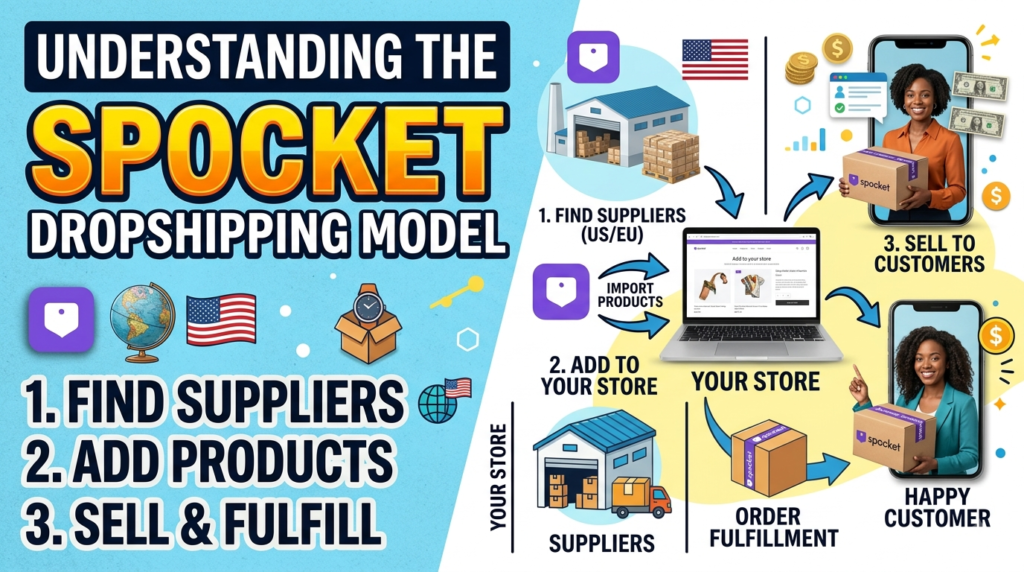
The basic idea behind dropshipping is straightforward: an online seller promotes products without purchasing and storing large quantities of inventory in advance. When a consumer puts an order, the supplier completes it and sends the item straight to the buyer. This means the retailer can concentrate more heavily on storefront design, marketing, customer relationships, content, and sales instead of maintaining a warehouse full of products. Spocket is designed to simplify this model by giving sellers a place to discover products and suppliers and then connect those products to their ecommerce operations.
This model is particularly attractive to entrepreneurs who want to test a niche before committing substantial capital to inventory. Imagine wanting to build a store around home accessories, fitness products, beauty items, fashion accessories, or another specialized category. A traditional retail approach may require purchasing stock before knowing which products customers actually want. With dropshipping, the seller can test products with less inventory exposure. Of course, since advertising costs, returns, competition, client acquisition, and subscription charges still matter, this does not completely eliminate company risk.What it does provide is a more flexible starting structure, and Spocket is built around making that structure easier to operate.
How Spocket Connects Sellers With Suppliers
One of the strongest reasons sellers consider Spocket is the supplier network. Instead of independently searching the internet for manufacturers and distributors, a merchant can browse suppliers and products through the platform. Spocket says its catalog includes suppliers from the US, Europe, and other regions, while its current platform emphasizes US and EU sourcing as a major part of its value proposition.
That centralized approach can save time. A new store owner might otherwise spend hours comparing supplier websites, checking product information, investigating shipping policies, requesting samples, and determining whether a supplier can integrate with the chosen ecommerce platform. A curated marketplace does not mean every product is automatically perfect, but it gives sellers a structured starting point. Instead of beginning with a giant search engine and hoping to find trustworthy partners, merchants can start with suppliers operating inside a platform designed specifically around dropshipping.
Why Supplier Reliability Matters in Dropshipping
Supplier reliability is one of the most important pieces of the dropshipping puzzle because the seller does not physically control fulfillment. If the supplier makes a mistake, the customer generally does not care which company caused it. The customer purchased from the online store, so the retailer carries the responsibility for explaining the problem and finding a solution. That makes supplier selection more than a sourcing decision; it becomes part of the store’s reputation.
Spocket says suppliers undergo an onboarding and review process covering areas such as product quality, inventory ownership, pricing, and shipping performance. Its supplier requirements also state that suppliers should manufacture products or hold their own inventory rather than simply acting as inventory-free resellers. For sellers, this kind of screening can provide an additional layer of confidence before adding a product to a storefront. It does not replace due diligence, product testing, or customer-service monitoring, but it can make the supplier discovery process more structured.
Access to US and EU Suppliers
Geography matters enormously in ecommerce. A product that takes weeks longer to arrive than anticipated may rapidly convert a pleasant purchase into a terrible experience. Customers are increasingly demanding clear shipping information and reasonable delivery schedules.Spocket places particular emphasis on suppliers in the US and Europe, which can be attractive for sellers whose customers are concentrated in those markets. The company currently says that a large share of its US and EU suppliers support fast shipping options.
For an online seller, having regional supplier choices can also make product selection more strategic. Rather than simply asking, “Is this product cheap?” a merchant can ask, “Can I deliver this product efficiently to my target customer?” That second question is often much more useful. A slightly higher supplier cost may be acceptable if the overall customer experience is stronger and the seller can build a sustainable margin around it.
The Advantage of Faster Fulfillment
Shipping speed has become a major part of the online shopping experience. Customers can compare several stores within minutes, and delivery expectations can influence which store receives the order. Spocket highlights fast shipping through US and EU suppliers as one of its primary benefits.
For sellers, faster fulfillment can have several practical advantages. It can reduce the amount of time customers spend waiting for an order, make shipping promises easier to communicate, and potentially reduce support questions such as “Where is my package?” Additionally, quicker fulfillment might make a small online business seem more competitive when compared to larger merchants. The key is to check the actual shipping information for individual products rather than assuming every supplier or item has identical delivery performance.
Reaching Customers With Better Delivery Options
A dropshipping business often succeeds by focusing on a specific audience rather than trying to sell everything to everyone. Once the target audience is understood, shipping becomes part of the positioning. A seller targeting customers in the United States, for example, may prioritize products that can be fulfilled domestically. Another merchant targeting European shoppers may look for suppliers with suitable regional fulfillment options.
This is where Spocket can become useful as a sourcing tool rather than merely a product directory. Sellers can compare products based not only on appearance and wholesale pricing but also on supplier location and fulfillment considerations. The result can be a more deliberate product strategy. Instead of choosing a product simply because it looks popular, the merchant can consider whether its supplier location, price, shipping profile, and expected customer demand make sense together.
Curated Product Selection
Product research can be one of the most exhausting parts of starting a dropshipping store. There are countless products available online, but quantity is not the same thing as opportunity. A huge catalog can actually create decision fatigue: the seller keeps scrolling, comparing, second-guessing, and searching for the mythical “perfect product” without moving forward.
Spocket addresses this problem through a curated supplier and product ecosystem. Its current platform advertises more than 100 million products and emphasizes categories ranging from fashion and accessories to home goods and other ecommerce niches. For an entrepreneur, that breadth creates room to test different product ideas without building relationships with dozens of unrelated sourcing websites.
Finding Products Without Endless Supplier Research
The real benefit of a sourcing platform is not simply the number of products it contains. It is the amount of research work that can be consolidated into one workflow. A merchant can browse available products, review supplier information, examine pricing, and consider how an item might fit into the existing store.
That can be especially valuable for beginners. Someone launching their first ecommerce business may understand marketing and social media but have little experience negotiating with suppliers. A platform such as Spocket provides a bridge between those skills. It allows the seller to spend more time learning how customers behave and less time trying to construct a supplier network from scratch.
Product Quality and Profit Potential
Quality and profit have to be considered together. A cheap product that generates refunds, complaints, and poor reviews can be far more expensive than a higher-quality product with a better customer experience. Spocket says its suppliers are expected to provide quality products and offer discounted pricing that allows merchants to maintain a retail margin. Its supplier requirements specify at least a 25% discount from retail pricing, with a recommended 40% discount for stronger results.
However, sellers still need to perform their own calculations. Product cost is only one part of the equation. Advertising, transaction fees, platform subscriptions, shipping, refunds, taxes, discounts, and customer support can all affect the actual profit. The smartest approach is to treat Spocket’s supplier pricing as an input into a broader business model rather than assuming a listed wholesale price automatically equals a profitable product.
Automated Product and Order Management
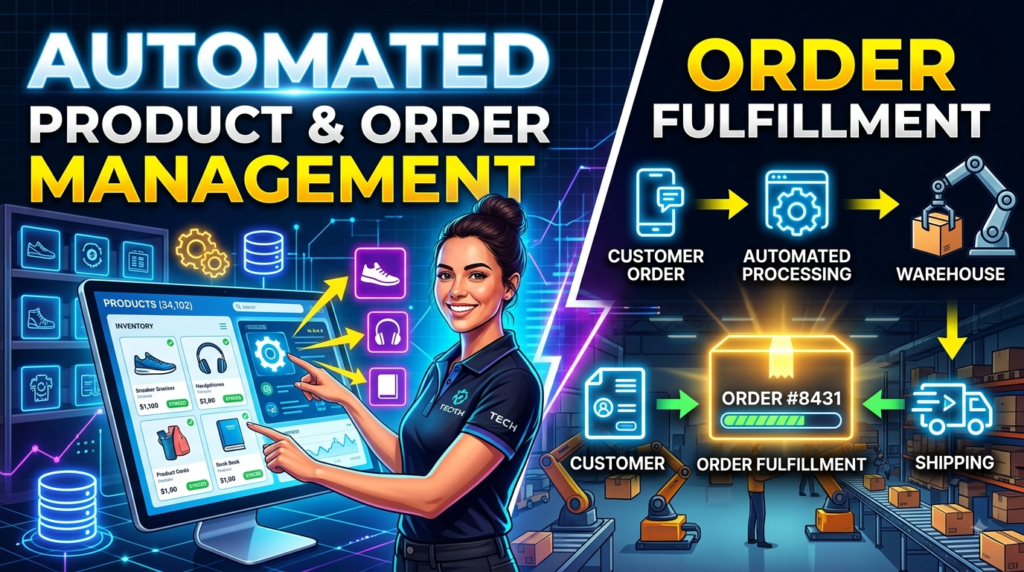
Automation is another reason online sellers are drawn to dropshipping platforms. Manually copying product titles, descriptions, photographs, prices, inventory information, and orders from supplier websites can quickly become a repetitive full-time job. Automation turns many of those repetitive actions into a connected workflow.
Spocket currently promotes automated product importing, inventory management, order synchronization, fulfillment, and tracking features. It also says merchants can import products into connected stores with a single click. These capabilities are particularly useful when a store begins expanding beyond a handful of products.
Product Import and Store Integration
A seller’s ecommerce store is the storefront customers see, while Spocket can function as part of the sourcing and fulfillment infrastructure behind that storefront. The platform says it integrates with ecommerce systems including Shopify, WooCommerce, Wix, and BigCommerce.
That integration can reduce friction during product selection. Instead of manually rebuilding every listing, the merchant can select products through the sourcing platform and transfer relevant product information into the store. This matters because time is a scarce resource for small businesses. Every hour saved on repetitive product administration is an hour that can potentially be redirected toward advertising, SEO, social media, email marketing, customer service, or product research.
Inventory, Pricing, and Order Updates
Inventory accuracy is one of the less glamorous but extremely important parts of ecommerce. Imagine running a successful advertising campaign for a product only to discover that the supplier has run out of stock. Customers may still place orders, leaving the store owner responsible for cancellations, delays, or alternative arrangements.
Spocket says its platform can monitor price and stock information and provide automated order management and tracking. These features can help reduce manual checking, although merchants should still review their stores regularly. Automation works best when treated as an assistant rather than an excuse to stop monitoring the business. Good sellers continue checking supplier performance, product quality, margins, customer feedback, and fulfillment results.
Multiple Ecommerce Integrations
Modern online sellers rarely want to rebuild their entire business around one tool. They may already have a Shopify store, WooCommerce website, marketplace presence, or another ecommerce setup. A dropshipping platform becomes more useful when it can fit into that existing ecosystem rather than forcing merchants to start from zero.
Spocket currently lists integrations with several major ecommerce platforms, including Shopify, WooCommerce, Wix, and BigCommerce. This flexibility makes the platform relevant to different types of sellers, from someone launching a first store to an established merchant experimenting with another sales channel.
Shopify and Other Supported Platforms
Integration matters because ecommerce operations are interconnected. Product sourcing affects product listings; product listings affect marketing; marketing creates orders; orders trigger fulfillment; fulfillment creates tracking information; and tracking influences customer satisfaction. When those pieces communicate effectively, the seller has a smoother operational workflow.
Spocket’s platform is designed around that connected model. Its supplier materials also describe automatic product import, inventory synchronization, and order synchronization for Shopify. For merchants, the biggest benefit is convenience: fewer disconnected systems can mean fewer opportunities for manual errors.
Branding and Customer Experience
Dropshipping does not have to mean an impersonal customer experience. The strongest ecommerce stores build a recognizable identity even when the physical products are fulfilled by third-party suppliers. Branding can influence whether a customer remembers the store, trusts it, and eventually purchases again.
Spocket supports branded invoicing on its paid plans, allowing sellers to add their business identity to invoices. That may sound like a small feature, but small details can contribute to the feeling that a customer is buying from an actual brand rather than a random product page.
Branded Invoices and Store Identity
Think about the difference between buying from a recognizable boutique and buying from an anonymous page with generic information. The physical product might be similar, but the surrounding experience changes how the purchase feels. A branded invoice, consistent product presentation, professional store design, clear policies, and responsive support can work together to create credibility.
For sellers, this means Spocket can be one piece of a larger brand-building strategy. The platform can help with sourcing and fulfillment, but the merchant still controls the elements customers interact with most directly: the website, messaging, advertising, customer service, pricing strategy, and brand voice.
Spocket Pricing and Plan Flexibility
Cost is naturally one of the first questions sellers ask before adopting any ecommerce tool. Spocket currently lists monthly plans including Starter at $39.99 per month, Professional at $59.99, Empire at $99.99, and Unicorn at $299.99, while annual billing is presented at lower effective monthly rates on the pricing page. The plans differ primarily in areas such as the number of unique products, premium products, and related features.
| Plan | Current monthly price | Unique products |
| Starter | $39.99/month | 25 |
| Professional | $59.99/month | 250 |
| Empire | $99.99/month | 10,000 |
| Unicorn | $299.99/month | 25,000 |
The platform currently advertises a 7-day trial on its pricing pages, so sellers should check the current terms before subscribing. Pricing should always be evaluated against expected revenue rather than considered in isolation. If a tool saves substantial operational time, supports better products, and helps a store process more orders, its subscription may be easier to justify; if the store has little traffic or weak margins, the same subscription can become an unnecessary expense.
Supplier Vetting and Business Confidence
Perhaps the biggest reason online sellers choose Spocket is the attempt to reduce supplier uncertainty. According to Spocket’s help documentation, suppliers go through a review and onboarding process and are expected to meet standards involving product quality, inventory ownership, pricing, and shipping performance.
That does not mean merchants should blindly trust every product. Smart ecommerce operators still order samples, inspect packaging, verify shipping estimates, calculate margins, and read customer feedback where available. But supplier vetting can give entrepreneurs a more organized foundation for that research. Instead of treating every unknown supplier as an equal candidate, sellers can begin with suppliers that have already entered a platform’s curated ecosystem.
This matters because trust is difficult to build and easy to lose. A customer may forgive a delayed package once, but repeated fulfillment problems can damage reviews and reduce repeat purchases. Reliable sourcing therefore becomes a long-term business strategy rather than a simple operational detail.
Read More:-
How Does Strikingly Simplify the Website Building Process?
Building Your Dream Website with Site123
Boost Your E-commerce Strategy with YITH Plugins
Maximize Your Customer Engagement with LiveAgent’s Features
Why STRIPO is Essential for Digital Product Marketersa
Why Spocket Appeals to New and Experienced Sellers
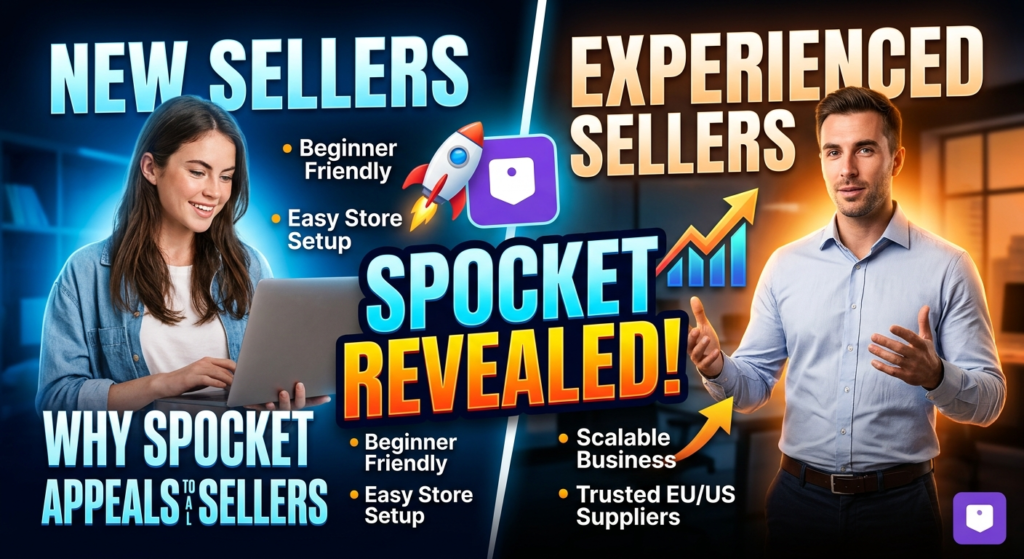
Spocket can appeal to beginners because it reduces the number of moving parts involved in launching a dropshipping store. A new entrepreneur can create an account, connect an ecommerce store, browse products, import selected items, and begin testing a niche without negotiating individually with every supplier. According to Spocket, its workflow is beginner-friendly and prioritizes shop integration, product discovery, automated fulfillment, and order tracking.
Experienced sellers may find a different kind of value. Once a store has traction, the problem often changes from “How do I start?” to “How do I scale without creating chaos?” Managing more products, suppliers, orders, inventory updates, and customer questions can become increasingly difficult. Automation, multiple-store support, supplier discovery, and bulk order functionality can become more valuable as operational complexity increases. The current pricing information also indicates support for multiple stores, although a separate subscription is required for each store to access all features and VIP support.
The platform also has a broad catalog, which can support experimentation. Sellers can test different niches, compare products, identify potential winners, and gradually concentrate their marketing budget on items that demonstrate genuine demand. That is a healthier strategy than assuming a product is a guaranteed winner simply because it appears popular on a sourcing platform.
Is Spocket Right for Your Dropshipping Business?
Spocket can be a strong option for sellers who prioritize supplier discovery, US and EU sourcing, product variety, automation, and streamlined ecommerce operations. It is particularly appealing when shipping reliability and supplier screening are important considerations. The platform’s current offering combines product sourcing with integrations, order management, inventory information, tracking, and branded invoicing, creating a relatively complete dropshipping workflow.
At the same time, no platform can guarantee that a dropshipping store will succeed. Product-market fit still matters. Marketing still matters. Customer service still matters. Profit calculations still matter. A seller should compare product costs against all business expenses and test supplier performance before scaling a product aggressively.
The best way to think about Spocket is as infrastructure rather than a magic button. It can help remove some of the friction between finding a product and delivering it to a customer, but the entrepreneur still has to build the business around that infrastructure. When product selection, supplier reliability, pricing, branding, marketing, and customer service work together, dropshipping becomes much more than simply listing products online.



Conclusion
Online sellers choose Spocket for reliable dropshipping solutions because it addresses several of the operational problems that can make traditional dropshipping frustrating. Its focus on curated suppliers, US and EU sourcing, product discovery, automated fulfillment, inventory synchronization, order tracking, ecommerce integrations, and branded invoices gives merchants a connected way to manage important parts of their businesses. Spocket currently promotes a catalog exceeding 100 million products and a network built around global dropshipping, while its supplier requirements are designed to encourage product quality, appropriate pricing, inventory ownership, and dependable fulfillment.
For a new seller, that structure can make the learning curve less intimidating. For an established merchant, it can reduce repetitive administrative work and provide additional sourcing opportunities. The most important point, however, is that reliability should be evaluated product by product and supplier by supplier. Sellers who combine Spocket’s tools with careful product testing, realistic financial calculations, strong branding, and excellent customer service are better positioned to turn dropshipping from a simple business idea into a sustainable ecommerce operation.
FAQs
Q. What is Spocket used for?
A. Spocket is a dropshipping platform that helps online sellers discover products and suppliers and connect those products with ecommerce stores. It also provides tools for product importing, inventory information, order fulfillment, tracking, and other dropshipping operations.
Q. Why do sellers prefer US and EU suppliers on Spocket?
A. US and EU suppliers can be attractive to sellers whose customers are located in those regions because regional fulfillment may support faster delivery compared with longer international shipping routes. Spocket specifically promotes US and EU suppliers as part of its fast-shipping value proposition.
Q. Does Spocket verify its suppliers?
A. Spocket says suppliers go through a review and onboarding process. Its published requirements cover product quality, inventory ownership, discounted pricing, and compliance with stated processing and shipping timeframes.
Q. How much does Spocket cost?
A. Current monthly pricing listed by Spocket starts at $39.99 for Starter, followed by $59.99 for Professional, $99.99 for Empire, and $299.99 for Unicorn. Annual billing offers lower effective monthly prices, according to the current pricing page.
Q. Is Spocket suitable for beginners?
A. Yes. Spocket provides product sourcing, store integration, product importing, automated fulfillment, and order-management tools that can simplify the technical side of launching a dropshipping store. Beginners should still learn product research, marketing, pricing, customer service, and ecommerce fundamentals to build a sustainable business.